 Religion’s a recurring subject for horror, and for a lot of reasons; there’s a lot in there to be scared about. More, from at least the 18th century onward writers have followed Edmund Burke and Ann Radcliffe in linking horror with the sublime. When horror fiction in the West has grappled with religion, naturally enough it’s tended to use Christian symbols, ideas, and sometimes even theology — whether in something as simple as the crucifix turning away a vampire, or in something more central to the story, as showing the birth of Satan’s child in The Omen or Rosemary’s Baby.
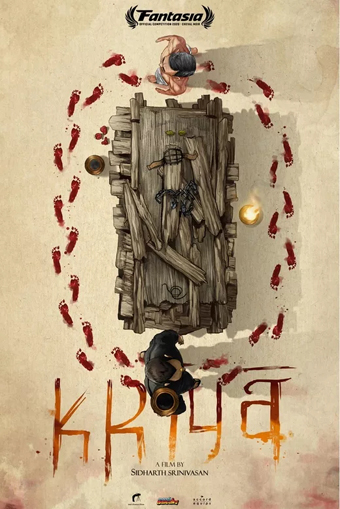
Of course, horror from other traditions may use religions closer to hand. Thus Kriya, an Indian film written and directed by Sidharth Srinivasan. A little like 2015’s Ludo it uses horror movie ideas and images in an Indian context, in this case placing black-magic versions of Hindu rites at its core. It’s Srinavasan’s third theatrical feature, but his first horror film. For me, as an outsider to the tradition he’s examining, it worked quite well.
It opens in a nightclub, where a mysterious, beautiful woman named Sitara (Navjot Randhawa) invites the DJ, Neel (Noble Luke), to take her home. Neel finds her home is a palatial estate, where Sitara’s dying father (M.D. Asif) is lying gagged and bound. With him are Sitara’s mother Tara Devi (Avantika Akerkar) and younger sister Sara (Kanak Bhardwaj), as well as the family servant Magdali (Anuradha Majumder) and an older priest, or pandit (Sudhanva Deshpande). Sitara wants Neel to take part in the funeral — certain rites can be performed only by the son of the family, and as there’s no son, she hopes Neel will fill in. But there’s something deeply strange and sinister in the old house and the weird family. As the night goes on the wrongness of the place becomes clearer, and Neel senses the wrongness even as he’s pulled deeper into it.
This is not exactly a haunted house story, but is certainly a story about a house-bound horror. As such the sense of place and the physical state of the location is important, and Kriya does not disappoint here. The sprawling mansion exudes a palpable sense of decay, the skin-crawling feel of a thing slowly dying, a shell that cannot be lit by the few small lives within it. The story mostly takes place over the course of a single night, and that night is thick and dark, manifesting in deep shadows everywhere inside. According to Srinavasan, in a fascinating extended question-and-answer panel alongside some of the cast, the building’s a 150-year-old building from the time of the Raj; I didn’t notice any overt thematic overtones to colonialism in the narrative, but I suspect there’s an implication there about Sitara’s family, their aristocratic aspect, and their relationship to power.
But if there’s a Western architectural vocabulary underlying the house, the sense of an Indian setting is nevertheless deep, and central to the film. The plot is fundamentally an interrogation of Hindu practice, and religious practice in general. And the horror of the film, not just the supernatural aspect but the motive for the inhuman things done to human beings, has to do with belief and ritual. Again, from the Q&A, Srinavasan observed that “Kriya, loosely, relates to last rites or rituals.” Part of the theme of the movie is to do with what happens when precepts are followed without being understood. (Also in the Q&A, the cast spoke about the Hindi dialogue as being especially elaborate, often quotations from religious texts.)
…
Read More Read More

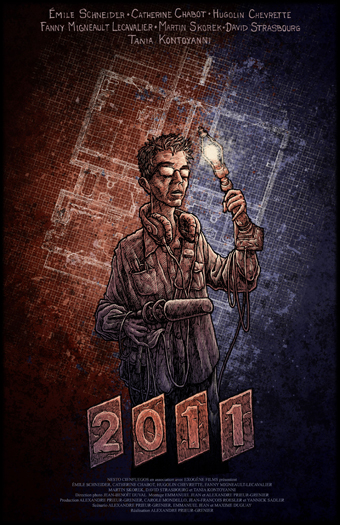 I’ve mentioned that many of the films I saw at this year’s Fantasia were haunted-house stories. Or: horror movies that revolve around a specific architectural location. That’s an intriguing coincidence in the year of COVID-19, but perhaps speaks to filmmakers finding a way to limit budgets and get the most use possible out of their locations. Which brings me to 2011, a film set in a single apartment and a kind of ghost story that begins and ends with the horror-thriller form. But this only becomes clear at the very end, for mainly this is an experimental and ambitious film that wanders through different genres and types of stories.


 The Japanese image of the three wise monkeys is as early as the 16th century: one monkey with hands over eyes, the next with hands over ears, the third with hands over mouth. See no evil, hear no evil, speak no evil; thus the monkeys’ names, Mizaru, Kikazaru, and Iwazaru, ‘not-seeing,’ ‘not-hearing,’ and ‘not-speaking.’ There’s a pun in Japanase on zaru, not, and saru, monkey, so collectively the trio’s simply ‘three monkeys,’ or sanzaru.