Magic: To Eff or Not to Eff?

Magic: To Eff or Not to Eff?

Should magic in fantasy fiction have a freakish perplexing quality that stands outside of reason or should it be a kind of alternate science, a para-physics (or para-chemistry or whatever) for a universe with physical norms that differ from ours?

This has been on my mind lately, for various reasons. And (like most people) when I think of the poetics of fantasy, I think of 18th C. skeptical philosophers.

Read More Read More

The Story Is All: Ten Fiction Editors Talk Shop

The Story Is All: Ten Fiction Editors Talk Shop

cw_33Issue 33 of Clarkesworld Magazine features a round-table interview with “Ten of the top speculative fiction magazine editors,” including Black Gate‘s John O’Neill.

Clarkesworld Magazine, edited by Neil Clarke, Sean Wallace, and Cheryl Morgan, is a 2009 Hugo Award moninee for Best Semiprozine.

It was founded in 2006 and has published fiction by Robert Reed, Jeffrey Ford, Theodora Goss, Stephen Dedman, Rebecca Ore, Jeff VanderMeer, Jay Lake, Mary Robinette Kowal, Catherynne M. Valente, and many others.

The interview also includes Realms of Fantasy‘s Shawna McCarthy, Sheila Williams from Asimov’s Science Fiction, Ann VanderMeer of Weird Tales, Patrick Nielsen Hayden of Tor Books, Cat Rambo from Fantasy Magazine, Mike Resnick from Jim Baen’s Universe, Stanley Schmidt from Analog Science Fiction and Fact, Jason Sizemore of Apex Magazine, and Gordon Van Gelder of The Magazine of Fantasy and Science Fiction.

The interview was ably conducted and assembled by Jeremy L. C. Jones, who states:

Ultimately, fiction editors are the people who mine the slush pile for new voices and who push established writers to grow beyond their previous stories. They read story after story, and more pile up each day. They screen, sort, revise, and reject. They seek the new, the fresh, the familiar, the entertaining, and the weird. They discover and they miss out.

“There is no magic formula,” said Gordon Van Gelder of The Magazine of Fantasy and Science Fiction. And this holds true for writing stories, submitting stories, and editing stories.

Among other things, Jeremy asked his subjects What are some reasons why you’d reject a good story? and What does “fit” mean for your magazine?

This whole interview is a treasure trove of info for writers, whether you write science fiction, fantasy, or anything else.    — Filling Spaces

You can find the complete interview here.

The People That Time Forgot: The Movie

The People That Time Forgot: The Movie

The People That Time Forgot (1977)
Directed by Kevin Connor. Starring Patrick Wayne, Doug McClure, Sarah Douglas, Dana Gillespie, Thorley Walters, Shane Rimmer, David Prowse, Milton Reid.

Amicus Productions waited two years to release a sequel to their hit The Land That Time Forgot, stopping along the way to do another Edgar Rice Burroughs adaptation, At the Earth’s Core. The People That Time Forgot marks the last gasp for its brand of low-budget fantasy/adventure film, since another film that came out that same summer of ‘77, set in a galaxy far, far away, caused a shift in genre-movie expectations when it turned into the highest-grossing film in history.

But The People That Time Forgot still brings handmade thrills and an old-fashioned attitude that adheres to Edgar Rice Burroughs’s style—if not to the letter of his writing. Unlike The Land That Time Forgot, which stays close to the first third of ERB’s novel in its script from Michael Moorcock and James Cawthorn, the script for the sequel from Patrick Tilley charts its own direction rapidly and leaves the original plot of the middle novella of the collective novel behind. Since the third novella, “Out of Time’s Abyss,” was apparently never slated for film adaptation, Amicus had to create a sense of completion with The People That Time Forgot that required dumping much of Burroughs’s material.

Read More Read More

In Praise of Escape

In Praise of Escape

brickI’ve only ever heard the terms ‘escapism’ and ‘escapist’ used as pejoratives and, quite often, used to describe things that I enjoy. We all know what these terms mean, and especially what they are implicitly communicating: the notion that escapist entertainment is a crutch, a way of running away from reality. But also, and I think that this is more important, that it has no redeeming value as art or as educational material.


But the whole thing breaks down when you look at individual cases. I think pop singing contests are the worst drek on TV, pure mind-wasters, absolute escapist fare. But most of the fiction I like, books and films, would no doubt be regarded with revulsion by a professor of modern literature who shops at the same bookstore as me. That professor of modern literature’s passionate devotion and minute study of one particular author would be seen as an indulgence in ivory tower academic fantasy by the man who installed the rain gutters on the professor’s bungalow, a man who looks forward every week to American Idol.

Read More Read More

Tooth without Consequences: Dreams with Sharp Teeth

Tooth without Consequences: Dreams with Sharp Teeth

Dreams with Sharp Teeth was more than a quarter of a century in the making; the first footage was shot in the early 1980s and was used in a PBS special; the film-makers kept coming back for more until they had a feature-length documentary (including lots of older material) which premiered in April 2007. It’s about someone named Harlan Ellison. If you have never heard of him, this movie is not your best possible introduction to one of the great American fantasists. If you are one of the legions of people who hate Harlan J. Ellison’s guts, you will not want to see this movie, unless you enjoy the sensation of hating the guts of someone lots of other people seem to love. Anyone not in these two groups will probably find stuff to like and dislike in this movie.

Harlan Ellison escapes from various perils and lives happily (if somewhat angrily) ever after. That was an unannounced spoiler. More details beyond the jump.

Read More Read More

Risus: Rules-Lite to the Min

Risus: Rules-Lite to the Min

rlogoRisus: The Anything RPG
By S. John Ross

I seem to have gotten into a Rules-Lite RPG series here at Black Gate. Not sure how that happened. I didn’t plan it, I know that for certain…

A few weeks ago, I reviewed one of the classics of “beer-and-pretzels” role-playing games, Kobolds Ate My Baby! Although a great game, KAMB! uses a specific (comically specific) setting with rigid character types. If you want to unleash a beer-and-pretzels RPG night without any limitations, you will want to turn to Risus, a generic system perfect for the slam-bang quick gag game.

Risus takes the term “rules-lite” and goes to the minimum with it: the whole system fits comfortably onto six PDF pages you can download here. I have to take caution with this review, because I might risk writing one that’s longer than the review subject. But those six pages provide only a blueprint for endless parody-RPG weirdness; I’m reviewing the experience you might get from putting Risus into practice.

Read More Read More

Donald im Deutschen, or Unsung German Ph.D. Art Historian Heroines of the Comics Industry

Donald im Deutschen, or Unsung German Ph.D. Art Historian Heroines of the Comics Industry

donaldWho knew? The national weekly Micky Maus, featuring mainly Donald Duck, sells 250,000 copies in German, beating out Superman. Another 40,000 mostly adult readers snap up the monthly all-Donald specials. The fan organization D.O.N.A.L.D. (an acronym for “German Organization for Non-commercial Followers of Pure Donaldism”) holds a yearly convention, philosopher Max Horkheimer admitted to reading Duck comics at bedtime, and many Germans credit the Donald with introducing them to the literary classics. He remains the most popular children’s comic in Germany.

As Susan Bernofsky writes in the May 23 Wall Street Journal, it’s because Disney’s German licensee, Ehapa, retained artistic control over the translations. Donald was introduced during the years following World War II, when school officials were setting fire to American comics and some were proposing laws to ban comic books altogether. Ehapa hired a Dr. Erika Fuchs, who had never laid eyes on a comic before she was handed her first Donald Duck story. Her job was to breathe a little erudition into Disney. In her version, Donald quotes (and misquotes) Schiller and Goethe, he’s prone to philosophical musings, and even ordinary dialogue is cranked up: “I’d do anything to break this monotony!” becomes: “How dull, dismal and deathly sad! I’d do anything to make something happen.” A cat belts Wagner. And through it runs a vein of political critique, mostly, it seems, aimed at Nazism and intolerance.

Dr. Fuchs supplied the German for Donald Duck for a rather amazing 54 years, until her death in 2005.

Robie the “Reboots” we don’t need…

Robie the “Reboots” we don’t need…

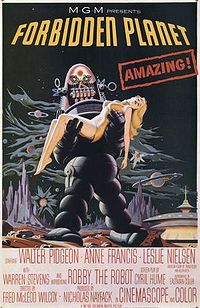
200px-forbiddenplanetposterjpgGiven all the discussion of late about reboots, I wonder why no one has ever thought to revisit this classic.  Forbidden Planet was my Star Wars when I was in fifth grade. In the New York metro area, Channel 9 had a  feature called “Million Dollar Movie” that used to play a particular movie ever day throughout the week in the early evening.  Forbidden Planet was a regular staple, and whenever it was in rotation, I was there in front of the TV (which, to give you an idea of how old I am, displayed only black and white).
One of the things that was particularly cool about this flick  is that it opened up a window to the nomenclature of Freudian repression and Shakespeare, all dressed up in space adventure.  My guess is that a reboot would probably ruin it; for every Star Trek or Batman there’s A War of the Worlds starring Tom Cruise…

I’m not saying I want to see a remake, but given the limited imagination of much commercial filmdom, I wonder why no has considered it.

(Not so Short) Fiction Review #17: Epic Fantasy, Chick Lit Division: Justina Robson’s Quantum Gravity Series

(Not so Short) Fiction Review #17: Epic Fantasy, Chick Lit Division: Justina Robson’s Quantum Gravity Series

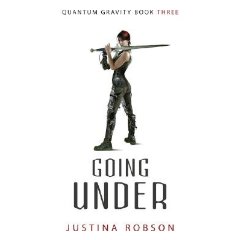
Going Under by Justina RobsonThe notion of the female warrior, while rooted somewhat in factual history (e.g., Joan of Arc), is largely an idealized notion of mythology, science fiction and fantasy. I suppose there is doctoral dissertation potential in figuring out why patriarchal societies that at best otherwise relegate women to supportive roles away from the battlefield (and at worst and more typically brutally victimize women as spoils of war) generate these tales of powerful females who can lop off a head or two as well as the next guy. Speaking as a guy whose adolescent sexual fantasies were heavily influenced by Emma Peel, the black leather-clad consort of John Steed in saving the free world from various madmen bent on world domination by delivering a quick blow to the groin, I’m guessing it’s some kind of inversion of castration anxiety.

During science fiction’s New Wave movement in 1960s, a fecund period of feminist fiction in general, the mythos of the female warrior served as an apt metaphor. Joanna Russ’s renowned series of stories collected as The Adventures of Alyx depict the titular heroine as both sensual and tough, a thief and assassin who, in breaking with the stereotype, isn’t Amazonian beauteous. Also breaking the mold is that Alyx is not depicted consistently throughout the series, though the one constant is that she is a “real” person, as opposed to the cliché of the one dimensional fantasy hero, male or female. Alyx was an inspiration for many genre writers, in particular Mary Gentle, whose “realistic fantasies” typically feature a strong, but flawed (as is of course any human) warrior woman, most notably in Ash: A Secret History.

Read More Read More