Pastiches ‘R’ Us: Conan the Hunter
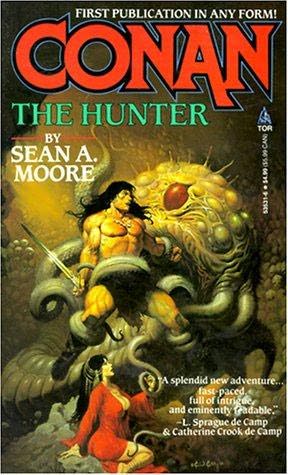 Conan the Hunter
Sean A. Moore (Tor, 1993)
You know I’m getting busy in other parts of my life when I pull out another Conan pastiche review for you here at Black Gate. (I store them up in a locked chest to be used in emergencies.) I’ve so far looked at a book each from John Maddox Roberts, Leonard Carpenter, and Steve Perry. So now it’s time for one from Sean A. Moore.
First, a prologue. (Almost all Conan pastiches have prologues, so why not start a review with one?) There is a moment in Conan the Hunter where a palace gardener beats our hero unconscious. Incredibly, the book is not as completely horrible as that absolutely ridiculous statement would make it sound. But it just has to be one of the most unbelievable moments I’ve read in any Conan story. Go ahead, read that statement again. By Crom, I dare you not to laugh.
Now that I’ve set the tone, it is time to dive into the meat of Conan the Hunter, or at least the gristle.
This is the first Conan novel from Sean A. Moore. Like John C. Hocking, Moore came late to Tor’s pastiche series, and went on to pen a two more before the line went on hiatus. Judging from this outing, Moore’s strengths lie in crafting a clever, dense plot with immense, epic scope, and populating it with an imaginative flood of action and monsters. This novel bursts at the seams with supernatural menaces and crimson battles: A leech beast in the sewers. Hordes of gargoyles. Repugnant, horror-laden traps everywhere. An invincible demon-sorceress trying to revive her race. A cramped duel to the death in the corridors of a palace. A henchman with a magnetic lodestone for a shield. Nifty stuff all around, candy for a heroic fantasy reader.
Yet for all this material, Conan the Hunter can make for miserably slow going. Moore demonstrates two tremendous flaws that impede the novel and make it only sporadically entertaining and otherwise a chore to read.


 with my good friend
 ![[info]](http://l-stat.livejournal.com/img/userinfo.gif)
 As far as I’m concerned, Christmas just came early.
 If there is a watch, then there must be a watchmaker. That’s the crux of the argument for intelligent design, that existence, and specifically you and me, are the result of some conscious creator. My main problem with this is the adjective “intelligent.” If I was designing existence, there’s a lot I’d leave out, like cancer or maggots or flatulence or Glenn Beck. Or that for certain kinds of life to continue and thrive, other life forms must suffer. Besides, this all begs the question of, if there is a designer (intelligent or otherwise), who created the designer?
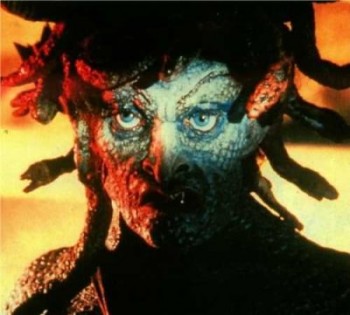 I’m not going to say anything about how Hollywood hasn’t had an original thought since 1997. Or the absurdity of remaking films when they are going to be rewritten or re-imagined anyway. Or how most remakes turn into hyper-kinetic kaleidoscopes of eye-candy and dumb dialogue.
 From Jason Sizemore of Apex Magazine:
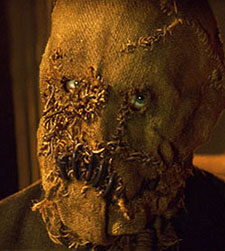 My novel-writing continues apace. Therefore, I shall be brief today. Or as brief as I possibly can.
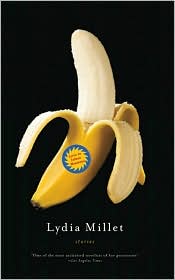 While her work sometimes hints at the fantastic, Lydia Millet isn’t strictly speaking a fantasy writer, certainly not in the sense of questing elves or weird alternate universes, and certainly not as evidenced in her new short story collection, Love in Infant Monkeys. Yet Millet’s work is frequently mentioned in genre venues; indeed, one of the stories collected here, “Thomas Edison and Vasil Golakov,” (in which the famed inventor of light bulbs and power generation attains metaphysical illumination by continually re-running a film of a circus elephant’s seemingly Christ-like electrocution)previously appeared in
 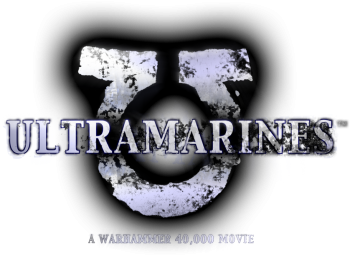 Chances are if you are at all interested in fantasy or science fiction books or games, you’ve at least brushed against Games Workshop’s ubiquitous Warhammer franchise. Warhammer comes in roughly two flavors, the fantasy version which is a Tolkien, D&D, and Moorcock mash-up, and the space opera version, called Warhammer 40,000. Taking place in the bleak world of the 41st millennium, with the tagline “In the grim darkness of the future there is only war,” Warhammer 40k is a violent world of warring factions, lost technology, dark and corrupting forces, fanaticism, and a medieval Gothic aesthetic. It is a universe where power armored soldiers charge into battle with chainsaw swords screaming religious oaths, millennia-old spaceships a mile long look more like Notre Dame Cathedral than the starship Enterprise, and daemonic forces and hostile races in the form of orks, ‘elves,’ and H.R. Geiger aliens erode the power of a moribund human civilization presided over by a nearly-dead God Emperor.