Pastisches ‘R’ Us: Conan the Unconquered
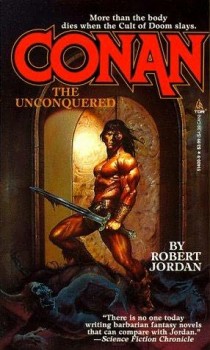 Conan the Unconquered
Robert Jordan (Tor, 1983)
Moving on with my Conan/Robert Jordan double-feature. . . .
With Conan the Unconquered, Robert Jordan’s third book in the series, the author seems settled with his style of writing the Hyborian Age. Some of the flaws in Conan the Defender are subdued, although the story is the average “meat ‘n’ potatoes” Conan pastiche material. The book has a feeling of comfort food: neither challenging nor surprising, but providing decent sword-and-sorcery entertainment.
The plot of Conan the Unconquered follows the Middle Eastern fantasy playbook, set around the Vilayet Sea in the Kingdom of Turan, with an excursion across the waters to Hyrkanian lands. Conan is not yet in his twenties, and has arrived in the Turanian city of Aghrapur. A compatriot from his thieving days, Emilio from Corinth, approaches Conan with the offer to join in stealing a necklace from a compound outside the city. The compound belongs to the Cult of Doom, whose members may be responsible for many assassinations occurring in the city. (The Cult of Doom sounds as if Jordan is swiping from the recent movie Conan the Barbarian.) Emilio’s lover, Davinia, is the one who wants the necklace stolen. Conan no longer wants to dabble in thievery, but after the astrologer Sharak casts a chart for the barbarian, he changes his mind and seeks out Emilio from the stewpots of Aghrapur.
As usual with pastiches, Conan has slender reason to stay in the story; the device of Sharak’s chart is a flimsy one (and Sharak as a plot device hangs around far longer than he’s needed) to keep Conan interested in the Cult of Doom and its necromancer leader Jhandar. Jordan manages to coax Conan into the story faster than in Conan the Defender with some sleight-of-hand that makes both Conan and Jhandar believe the other must die for them to live. Conan allies with a vengeance-minded Turanian sergeant, a group of Hyrkanians chasing after Jhandar for the desolation he brought to their land, and the beautiful Yasbet who keeps her parentage a secret.
 There are a lot of things to commend this book to an experienced gamer. The rules are fairly simple yet cover a lot of ground. I like how the abilities are not really tied into specific stats that are sometimes hard to justify - this system is much more fluid. It also is not conducive to rules lawyering and if there is one thing I hate, it is rules-lawyering, so this is a positive for me. I can see where the OCD crowd who wants a rule for everything could be irritated with it, but I game by the principle that story precedes rules, and this rule set is made for that mindset.
 Anyone familiar with the Mistborn series knows Sanderson is expert at spinning fantasy stories packed with memorable characters, crisply detailed settings, unique magic, and major helpings of intrigue. Lately he’s been feted as the writer continuing Robert Jordan’s Wheel of Time series. While I realize that from a purely professional standpoint, the deal was a no-brainer, I hope cleaning up the WoT‘s loose ends won’t keep this talented author from giving us more of his own marvelous work.
 Talebones, a so-called semi-prozine published twice a year, is calling it quits with issue #39 , some 14 years from its debut in 1995. Details as to why editor/owner Patrick Swenson is ending publication are scant, other than this terse
  Long-time reader and professional writer Brent Knowles recently posted a review of Black Gate 13:
 Creepy experience number one happened in New Orleans in
 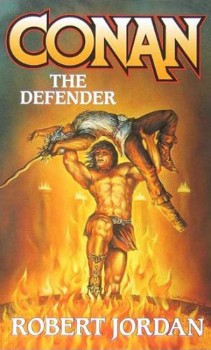 Conan the Defender
 What’s interesting about a collection of “interfictions,” aka “interstitial fictions,” is that this isn’t just another descriptor (e.g., new wave fabulism, new weird, slipstream, paraspheres, fill-in-the-blank) made up by an editor or a marketing department or critic that subsequently becomes blogosphere fodder about how inaccurate and/or stupid it is. Rather, interfictions is the self-proclaimed terminology of an actual
 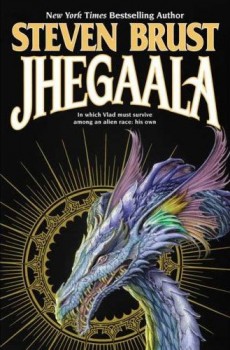 Jhegaala
 Steampunk Tales offers an interesting convergence of the new and old, a pulp magazine for the iPhone (don’t worry, non-Apple heads, there’s also a downloadable PDF version). Volume 4 features ten stories: