I, Cyborg
Living in the Third Place Between Me and You
We’ve all been there: for some reason you lose your web connection. All of a sudden, it’s like you’ve lost a limb. You wander around, listless, anxious, this terrible nagging feeling of being cut off from the world. It happened to me last month: for two whole days (days!) my modem died, and I wrestled frantically with technicians checking phone lines and digging round my house as my cyberself entered intensive care.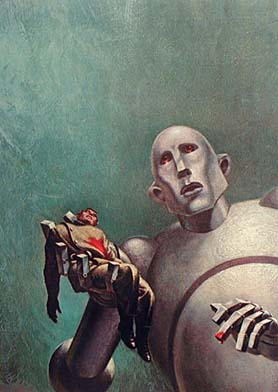
As I mooned around in doomed isolation, it occurred to me that my plight – comprehensible to the vast majority of people reading this – would be a complete mystery to my parents’ generation (with apologies to adventurous silver-surfers out there) – who’d grown and matured before the internet came to stay. I had a vision of a world with two types of people: those who enjoyed the comforting buzz of eternal information streams sliding effortlessly through the backs of their minds, ready to bathe in at any moment; and those for whom information was something static, hard, and external – something to be looked up in a book, or researched with painful diligence. Both staring at one another across an invisible chasm with utter incomprehension.
My dictionary (online, naturally) defines “cyborg” as “a human who has certain physiological processes aided or controlled by mechanical or electronic devices”. Setting aside dependencies on televisions, games consoles, and certain brands of coffee machines, recent studies do seem to be suggesting there’s now a qualitative difference in the thought processes and possibly even brain structures of those of us who’ve spent years happily plugged into the vast ocean of freely available information on the worldwide web. I don’t just mean plugged in 24/7 – this isn’t some secret of the anorak illuminati. Not at all – look around on any bus or train, any bar, café, restaurant, at any time of day or night, at the constant dataflow of texting and twittering and facebooking zipping around the globe. Or ask yourself – how many of us buy encyclopedias any more? Or write letters, rather than a quick email? What’s our reaction when we find a question we can’t answer – do we throw up our arms, go buy a book? Or do we simply surf a while, till the information we need appears?
 The English alphabet contains twenty-six letters. They all have their uses. Some more than others. The letter “E” gets the most use: how could we live without it?
 I was planning to start the series of posts on Romanticism and fantasy this week, but something came up in the last few days that I’d like to write about; particularly since it seems to resonate with
 In a galaxy, far, far away,