Red Sonja 14
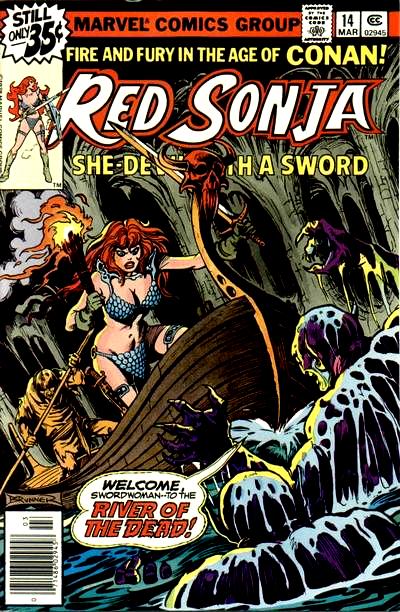 So this issue begins with Red Sonja walking through an unnamed town at night, minding her own business. Not sure how small the town is or how late, but on page one, we see only one other person on the street and he’s sleeping on it. I’ve probably mentioned before in these reviews that I find the preponderance of unnamed towns and unnamed demons to be a bit annoying, especially coming from Roy Thomas, who’s fairly knowledgeable about all things Hyborian. Seriously, just make up a name for the town or use a real city name. No one’s going to check.
Watch. Evanston. Red Sonja’s walking through Evanston, trying to forget her beloved Suumaro (the mommy-fixated boy-king who treated his wives like slaves and wanted Sonja to join his harem – what a catch). Now let’s move along.
So Red Sonja is just minding her own business, which is pretty much all the invitation anyone seems to need to bother her. She’s approached by a glowing nobleman named Gonzallo (see, no one cares that it’s a stupid name), who offers to pay her a diamond if she’ll act as his bodyguard for a few hours. When she asks why he’s glowing, he dismisses the question by saying that he’s eccentric.
The diamond looks real, so Red Sonja lets herself be hired. The first thing Gonzallo does is guide her to his gondola (oh, so they’re in Venice) and his requisite deformed gondolier, Karon. As the three of them make their way through the canals of (Venice? Evanston? Lower Aquilonia?), Sonja notices the surroundings have begun to change and soon they’re moving through an underground canal. The chamber is lit faintly by phosphorus, just enough for Sonja to see an iron gate rising up out of the water to block the way they’d come.