Masks and Talismans: Kurt Busiek’s Astro City
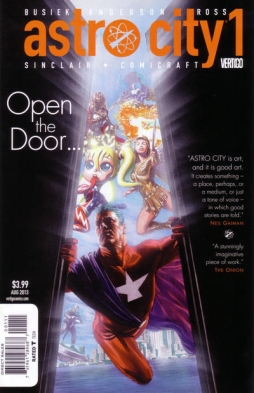 A couple Wednesdays ago, I did something I haven’t done in ages. I went down to my local comic store on new-comic day (which is Wednesdays) and bought a new super-hero comic off the rack. Not a Marvel or DC book, though — not really, though it was published by DC’s Vertigo imprint. This was the return of a series first published in 1995, under the Image Comics banner. The title’s moved around a fair bit since, and frequently been on hiatus from regular publication. But it’s back now, and hopefully for a long time to come. It’s Kurt Busiek’s Astro City, and I want to talk about what it is and why I’m going to be buying it going forward.
In this comic, Astro City’s a metropolis located somewhere in the continental United States; it’s a hub for super-heroic activity, and has been for decades. Mad science, high sorcery, aliens: all of that. Men and women in strange costumes. Wild sprawling battles. Secret societies and crime rings. Everything you expect from super-hero stories — but not told the way you expect it. Because alongside all that imaginative chaos, there’s a city. Filled with millions of human beings. Astro City tells us their stories, as well. It’s an anthology book, alternating single issues and longer arcs, displaying incredible dramatic and emotional range for a genre often considered to have distinct formal limitations.
Writer and creator Kurt Busiek summed it up as “about being human among the superhuman,” which is true and also only part of it; superhumans are often the main characters of the stories, but Astro City as a place gives them a kind of context, a human connection, human meaning to the fantasy of their powers. Astro City uses the super-hero form as a way to talk about human beings, and vice-versa. It is, from one point of view, a struggle with the super-hero traditions of the past, an examination of genre conventions, a turning of those conventions to new ends. First appearing not so long after the ‘deconstruction’ of super-heroes exemplified by Watchmen and The Dark Knight Returns, Astro City was at one time considered as part of a wave of ‘reconstructionist’ titles; but it was always more than that. It was, and is, a comment on super-heroes — working with perhaps the most meta-fictional of all genres, a form that endlessly reinvents its own past, Busiek pastiches and re-imagines the whole history of hero comics, creating a kind of ocean of story out of which he can draw seemingly endless incidents and anecdotes.
 ‘Magic’ is an elastic metaphor. Among its many possible uses is that of a descriptor for something that happens in performance, especially live performance: the magic of an actor possessed by a character, the magic of a given moment invested with wonder and remaining in the memory, though inevitably passing away. The magic of stage magicians isn’t in the sleight-of-hand; it’s in the effect on the audience. The related magic of the carnival — the amusement park, the theme park — is a kind of second-person secondary-world magic. You are there. You are in a conjured fantasyland. A circus, in this reading, isn’t about the stink of animals or the scutwork of putting up tents and preparing performance spaces; it’s about the feeling the show tries to inspire. It is, potentially, for some, a venue for magic — transient, susceptible to thinning, but capable of generating wonder.