Browsed by
Category: Vintage Treasures

New Treasures: The Warlord of the Air by Michael Moorcock

New Treasures: The Warlord of the Air by Michael Moorcock

The Warlord of the AirWe covered several high quality reprints from Titan Books last year, including Kim Newman’s Anno Dracula: The Bloody Red Baron; Sax Rohmer’s The Hand of Fu Manchu; and books by James P. Blaylock, Guy Adams, and others.

But their accomplishments don’t end there. Starting in January of this year, Titan began reprinting Michael Moorcock’s early steampunk trilogy Nomad of the Time Streams, beginning with The Warlord of the Air, originally published way back in 1971:

It is 1973, and the stately airships of the Great Powers hold benign sway over a peaceful world. The balance of power is maintained by the British Empire – a most equitable and just Empire, ruled by the beloved King Edward VIII. A new world order, with peace and prosperity for all under the law. Yet, moved by the politics of envy and perverse utopianism, not all of the Empire’s citizens support the marvelous equilibrium.

Flung from the North East Frontier of 1902 into this world of the future, Captain Oswald Bastable is forced to question his most cherished ideals, discovering to his horror that he has become a nomad of the time streams, eternally doomed to travel the wayward currents of a chaotic multiverse.

The first in the Nomad of the Time Streams trilogy, The Warlord of the Air sees Bastable fall in with the anarchists of this imperial society and set in train a course of events more devastating than he could ever have imagined.

These classic novels have been out of print for some fifteen years. Titan has already released the second, The Land Leviathan, on April 16; that volume finds Bastable in an alternate 1904 devastated by a terrible war waged with futuristic weapons and deadly biological attacks. The third and final volume, The Steel Tsar, follows Bastable’s adventures in an alternate 1941 where both World Wars were averted and Russia is still ruled by Tsars, and Bastable finds himself imprisoned by the rebel ‘Steel Tsar,’ Joseph Stalin. It will be released on August 13.

The Warlord of the Air was published by Titan Books on January 15. It is 215 pages in trade paperback, priced at $9.95 ($9.95 for the digital edition).

Forrest J. Ackerman and the Days of the Do-It-Yourself Anthology

Forrest J. Ackerman and the Days of the Do-It-Yourself Anthology

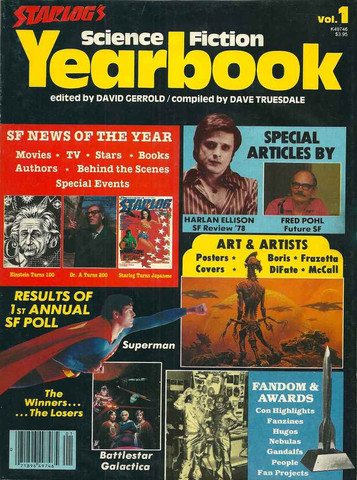
Forrest J Ackerman Starlog 1978-2When I was 14 years old, I stumbled on an article in Starlog magazine titled “The World’s Greatest Science Fiction Fan.”

It was about Forrest J. Ackerman, of course: writer, literary agent, and editor of Famous Monsters of Filmland. But Forry’s greatest claim to fame was his legendary science fiction collection, housed in the Ackermansion in Los Angeles.

The article was accompanied by some mind-blowing photos. Forry standing before one of his greatest prides: his complete collection of Weird Tales. Forry posing with the original model used in George Pal’s War of the Worlds. Forry shaking hands with the Maschinenmensch from Metropolis. [Click on the image at left or below for bigger versions.]

The article appeared in the 1978 issue of Starlog, and it had a pretty profound effect on me. After I read it, I knew what my life’s work would be: to build a science fiction collection that could stand with pride alongside Forrest J. Ackerman’s.

These are the things that only a 14-year-old can dream.

Read More Read More

Vintage Treasures: Valkenburg Castle

Vintage Treasures: Valkenburg Castle

Valkenburg CastleAll this recent talk of Star Fleet Battles and Metagaming’s classic microgames like Ogre and Wizard has me thinking of other great pocket games of my youth.

Now, “great” is a relative term. The elements that make a typical fantasy board game great — things like style, richness of setting, and diversity of play — don’t apply to microgames. The things that make a pocket game great are inventiveness, fast play, and simplicity.

Although a great setting and a little style don’t hurt, either.

Task Force Games was the king of pocket games in the early 1980s. Much of that was by virtue of its one runaway success, Star Fleet Battles; but it had an impressive line of other fantasy and SF titles, including Swordquest (which I discussed last June); Starfire (which eventually inspired a series of science fiction novels from David Weber and Steve White); Intruder, which pits a desperate crew against a lethal alien in deep space (clearly inspired by the movie Alien); Spellbinder; City States of Arklyrell; and over a dozen more (there’s a nice survey here and a complete list here).

But Valkenburg Castle was the first, and it’s still my favorite. It was almost completely unique in 1980 — a board game that captured the essential gestalt of fantasy role playing, although in a slightly abstracted fashion: penetrating a dark and foreboding stronghold, confronting the unwholesome creatures within, and winning glory through cleverness and force of arms.

The premise of Valkenburg Castle was simple. You play as the young Lord Hobart van Valkenburg, rightful heir, returning at last to the place where his grandfather was murdered and his family first driven into exile. The castle is now monster-infested, home to sinister and powerful beasts who lurk somewhere in its depths.

To win back his ancestral home, Lord Hobart must explore the twisting ruins of a castle he has never before seen and drive out the dark forces who have made it their home — including the powerful creatures who lair at the deepest dungeons levels.

Read More Read More

Vintage Treasures: The Amazing Space Race

Vintage Treasures: The Amazing Space Race

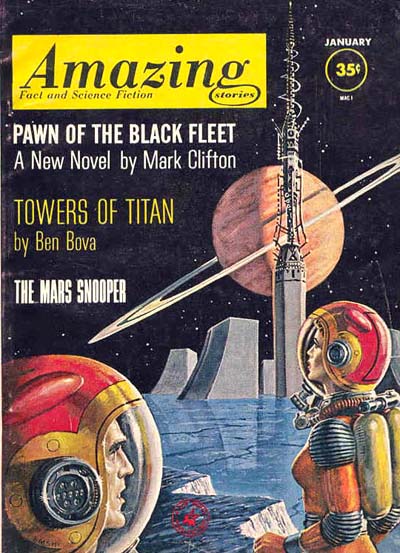
Amazing Stories January 1969A few weeks back, I purchased a lot of 27 Amazing Stories digests from the mid-60s and early 70s in great condition, for $35 (including shipping) — or about a buck an issue.

This was simultaneously delightful and dismaying. Delightful, of course, to get a fine set of SF magazines for not much more than they cost on the newsstand 45 years ago; dismaying to find that pristine vintage copies of one of the most important SF magazines command such little interest in the market.

Seriously, this doesn’t bode well for the thousands of SF magazines I’ve been gradually accumulating in my basement for the last 35 years. I  consider them treasures, but it seems the number of people who share my interest is shrinking every year. I just hope they don’t all end up getting recycled when I shuffle off this mortal coil.

Well, all collectors can really do is delight in those treasures we find, and share our enthusiasm with those around us. To that end, here I am, talking about a handful of issues of Amazing Stories, starting with the January 1969 issue, at left.

The late sixties was a bumpy time for the Granddaddy of Science Fiction magazines. Perhaps its finest editor, the talented Cele Goldsmith, left when the magazine was sold to Sol Cohen’s Ultimate Publishing Company in March 1965. At the time, Ultimate was simultaneously publishing Great Science Fiction, Science Fiction Classics, and other profitable reprint magazines — profitable chiefly because they didn’t pay for any of the reprints. Cohen wanted to pursue a similar strategy with Amazing.

Cohen hired Joseph Wrzos to edit both Amazing and Fantastic magazines, and indeed for several years Amazing offered almost exclusively reprints — although Wrzos reportedly did get Cohen to cough up funds for one new piece of fiction per issue. Wrzos left in 1967, and Harry Harrison was briefly editor from September 1967 to February 1968, when the talented Barry Malzberg stepped into his shoes.

Read More Read More

Vintage Treasures: Robert E. Howard’s Cthulhu: The Mythos and Kindred Horrors

Vintage Treasures: Robert E. Howard’s Cthulhu: The Mythos and Kindred Horrors

Robert E Howard Cthulhu The Mythos and Kindred HorrorsOn April 27, I wrote a Vintage Treasures article about Robert E. Howard’s The People of the Black Circle, one of the first fantasy books I ever owned.

The Comments section quickly became a discussion of REH collecting, with readers swapping photos of their favorite Howard books. Joe H. shared a LibrayThing catalog of his Howard collection, noting the hardest title to find had been Cthluhu: The Mythos and Kindred Horrors. “It took me years to track down a copy,” he said.

Well, that’s exactly the kind of thing that perks up a collector’s ears. Intrigued,  I went on a quest to find my own copy of Cthluhu: The Mythos and Kindred Horrors, a collection of Robert E. Howard’s Cthulhu stories.

I finally succeeded this week, after a two-week search. I settled in with my new copy today. First thing I noticed is that the cover, by Stephen Hickman, depicts a treasured artifact from my own collection: the Hickman-designed Cthulhu statute by Bowen Designs — a prized collectible these days. Now that it’s worth something, maybe my wife will let me bring it up out of the basement.

The other thing I noticed is that this is a sizable collection: 250 pages. While I knew Howard had made some minor contributions to Lovecraft’s famous milieu before his death, I had no idea he’d written so many stories that could be categorized as part of the Cthulhu Mythos.

Perhaps editor David Drake has been fairly liberal with his selections. I note that “Pigeons from Hell” is included, and that’s only peripherally a Cthulhu story — but it’s a damn good tale, so I’m not complaining.

Read More Read More

Get a Random SF or Fantasy Book Cover from The Encyclopedia of Science Fiction

Get a Random SF or Fantasy Book Cover from The Encyclopedia of Science Fiction

Into the Slave NebulaOh, Internet. Will you ever cease to come up with new ways for me to waste time?

So the latest thing I’ve been doing is hitting the Lucky Dip button in the Picture Gallery section of the online Encyclopedia of Science Fiction. It generates a random book cover from their massive archives:

So far, I’ve seen a few hundred vintage hardcovers and paperbacks, from a 1951 Lord Dunsany hardcover I never knew existed (The Last Revolution) to Samuel R. Delaney’s 1977 collection of critical essays on science fiction (The Jewel-Hinged Jaw); from John Brunner’s 1968 Lancer paperback Into the Slave Nebula to the 1954 Gnome Press edition of C. L. Moore’s Northwest of Earth. And many hundreds in between.

It’s a fascinating kaleidoscope (I can’t really call it a tour) of our genre — and a great launching point to ignite your interest. I ended up reading about UK author M. John Harrison after seeing the cover to his 1975 Panther paperback collection The Machine in Shaft Ten and Other Stories. Plus, doing about a dozen Google searches on the words “Slave Nebula.”

Of course, there’s a powerful search function as well, in case you want to leap directly to a specific book or author. The Encyclopedia of Science Fiction, the new online incarnation and third edition of the classic reference book edited by John Clute and Peter Nicholls, indexes some 54,000 individual titles, with 113,500 internal hyperlinks and over 4,000,000 words. It builds massively on the text of the (already massive) 1995 CD-ROM edition, and is produced in collaboration with British SF publisher Gollancz and the SF Gateway. And it is, as the introduction points out, still a work in progress.

The only thing that’s missing? The back button. I tried to scroll back to some of the earlier samples, but no dice. Looks like the Lucky Dip is powered by a Javascript app of some kind that doesn’t allow you to page back through prior selections — so if you see something interesting, be sure to write it down!

Vintage Treasures: The Girl With the Hungry Eyes by Fritz Leiber

Vintage Treasures: The Girl With the Hungry Eyes by Fritz Leiber

The Girl With the Hungry EyesSometimes it seems that every time a new sword & sorcery novel appears, a publicist automatically slaps “comparable to Fritz Leiber!” on the cover.

I’ll tell you why: it works. When Karen Burnham at SF Signal noted that Tim Pratt’s latest Pathfinder novel Liar’s Blade had done “an excellent job of capturing the spirit” of Fafhrd and the Grey Mouser, I bought it immediately. A fantasy novel with the charm and style of Fritz Leiber’s great adventures? Where’s my credit card.

I think publicists must get tired of comparing new sword & sorcery to Fritz Leiber and Robert E. Howard. I know it’s annoying to their fans, and I don’t think it does a genuine service to most new writers — not in the long term, anyway.

And frankly, all the focus on Fritz Leiber as the poster child for exemplary S&S overlooks his success in a broad range of genres: science fiction, mystery, dark fantasy, supernatural horror, plays, and even a 1966 Tarzan novel. Ask anyone who’s read his 1965 Hugo Award-winning novel The Wanderer, about a rogue planet that drifts close to Earth — or his brilliant short story “A Pail of Air,” a post-apocalyptic tale of a family fighting to survive on a world grown so cold that oxygen has condensed out of the air, and the strange things they discover when the world has gone completely still — and you’ll find that Leiber’s Fafhrd and the Grey Mouser tales, as important as they are to the Sword & Sorcery canon, stand as only a small sample of a stellar writing career that spanned over 50 years.

As a paperback collector, it’s hard to pick my favorite Fritz Leiber book. I love Michael Whelan’s cover for Swords and Ice Magic (1977), and of course The Big Time (1961), Gather, Darkness! (1975), and the creepy Our Lady of Darkness (1977). But I think it would have to be a collection, possibly The Mind Spider and Other Stories (1961), Ship of Shadows (1979), or The Ghost Light (1984).

But I might just cheat and make it the 1949 Avon paperback The Girl With the Hungry Eyes.

Read More Read More

Weird of Oz Reminisces: A Friend of the Imagination

Weird of Oz Reminisces: A Friend of the Imagination

cobra_hiss_When I say “a friend of the imagination,” I do not mean an imaginary friend. Shane was, and is, real. The only son of one of my mom’s dear friends, he loomed large in the first decade of my life, though I only saw him about once a year.

I’m sure that when you cast your mind back to that first, formative era — to the halcyon days of youth that began your journey and shaped its course in ways both obvious and subtle — you recall some friend or acquaintance who holds a special place in your own private history’s pantheon of important people. Perhaps he or she first introduced you to something — an idea or hobby or sport — that would prove to be a lifetime love, a lifelong pursuit.

Shane was one such person, a boy who unwittingly (and, perhaps to this day, unbeknownst to him) enriched my creativity and broadened my imagination. I can’t help but think his example had some impact on my career as a creative writer; it was, at least, one branch in the confluence of influences that brought me here to this moment, writing a blog for Black Gate.

Shane’s mom had grown up with mine but moved to California, so about once a year she and her son came to visit us in Arizona. These visits account for some of my earliest and fondest memories. To them I can trace important moments in the unfolding path I have followed. Granted, some of these imaginative leaps might have come in other circumstances had Shane never come from that faraway country sung about by the Beach Boys. There were many other seminal formative events, particular authors and movies (it is a time of life that is littered with such discoveries, naturally), but Shane happened to be the one who nudged my imagination along on almost an annual basis throughout my grade-school years, like a sensei who periodically appears and says, “All right. You’re ready for the next level. And this one is particularly rad and gnarly.” (Okay, I can’t recall if he actually used ‘80s surfer slang, but I think he did use some. We all did. It was in the air.)

Read More Read More

Vintage Treasures: The Awful Green Things From Outer Space

Vintage Treasures: The Awful Green Things From Outer Space

The Awful Green Things From Outer SpaceI keep promising myself I’m going to stop obsessing about games that have been out of print for decades.

Clearly, I’m a man of little character. Let’s not dwell on that. Let’s dwell instead on one of the great mini-games of all time, Tom Wham’s The Awful Green Things From Outer Space.

First, a bit of history to support that claim. The Awful Green Things From Outer Space originally appeared as an insert in Dragon Magazine #28 (published in 1979). That’s pretty great.

Great enough to be reprinted as a full-fledged standalone game by Dungeons and Dragons publisher TSR in 1980, anyway. In 1988, Steve Jackson Games, publishers of GURPS, acquired the rights and revived Awful Green Things as a pocket game, alongside other mini-games like Ogre, GEV, Car Wars, and Illuminati.

Even in august company like that, Awful Green Things stood out for its gonzo humor and original design. I was going to paraphrase the text on the back, but there’s really no way to distill it. Here it is in its entirety:

The crew of the exploration ship Znutar just wanted to cruise around the Galaxy, discovering strange new worlds and playing pool. But then their ship was invaded by the Awful Green Things. And suddenly they were fighting for their lives!

In this wacky two-player game, one person takes the part of the Awful Green Things. Every turn the monsters multiply and grow… especially if they can eat somebody! The other player commands the crew, frantically trying weapon after weapon in hopes of defeating . . . The Awful Green Things from Outer Space!

The pocket edition consisted of a resealable box about the size of a paperback, 137 full-color counters (and a ziplock bag to keep ’em in), 24 pages of rules; and a 12″ x 21″ color map. The game was copiously illustrated by creator Tom Wham and Beverly Hale. My copy doesn’t have a price tag, but I think it was around 8 bucks. You can buy an updated, boxed edition from Steve Jackson Games for $24.99, but the pocket edition is still the one to get if you can find it.

Get Out of the Dungeon with Monsters! Monsters!

Get Out of the Dungeon with Monsters! Monsters!

monsters-monsters-smallSome 35 years ago, I read an article in The Space Gamer on an unusual little game called Monsters! Monsters!

I’m not even sure I’d played D&D when I first read about Monsters! Monsters! I was introduced to fantasy gaming by Metagaming, and specifically their brilliant mini-games Ogre, Melee, and Wizard, all designed by Steve Jackson.

Orge everyone knows about — if you didn’t play the game at the lunch table in high school when it was first released in 1977, then you’re probably aware of last year’s Kickstarter campaign that raised nearly a million dollars for a massive 14-pound Designer’s Edition.

I doubt every copy of Ogre in the world in 1977 totalled 14 pounds. I think Ogre may have the unique distinction of being the simplest and most spare SF game ever created, and now it’s also the largest.

Anyway, it was Melee and Wizard that first taught me all about role playing. I rolled my first attack dice in a school cafeteria in 1978 (I missed). The rules were simple, the miniatures were made of paper, but the magic was exactly as advertised. I carried those games in my back pocket for years, and my friends and I were die-hard Metagaming fans long before we stepped into our first dungeon.

Metagaming’s house organ was the magazine The Space Gamer, where they advertised upcoming releases, chatted about the industry, and generally talked up their games. It was there I first learned of the wider world of role playing, and where I discovered an odd little game called Monsters! Monsters! that they released in 1976.

Read More Read More