Browsed by
Category: Vintage Treasures

Vintage Treasures: An Earth Man on Venus by Ralph Milne Farley

Vintage Treasures: An Earth Man on Venus by Ralph Milne Farley

An Earth Man on VenusRalph Milne Farley was a pen name for Roger Sherman Hoar, a state senator and assistant Attorney General for the state of Massachusetts. Why a state senator wouldn’t proudly lay claim to a novel featuring a man and woman in underwear on the cover is beyond me, but some people just humbly shy away from fame, I guess.

Or maybe it’s the antennae growing out of her head. It’s hard to be sure.

Whatever the case, An Earthman on Venus was originally published (as The Radio Man) in that grand old lady of the pulps, Argosy, in 1924. It was immediately popular, and reprinted many times, starting in Famous Fantastic Mysteries (1939) and then in hardcover from Fantasy Publishing in 1948.

The version of interest to us is the 1950 Avon paperback, pictured at left. Primarily because it’s a prime early example of underwear chic, but also because it was the first true mass market edition.

Legendary editor Donald A. Wollheim — who would later found DAW Books — was at the helm at Avon at the time, and he had an eye for pulp fiction that would play well in paperback. While he was at Avon, he made A. Merritt, H. P. Lovecraft, and C. S. Lewis’s Silent Planet space trilogy available in mass market for the first time, bringing those authors — and many others — a wide audience.

The Radio Man isn’t particularly well-remembered today, but it’s an important part of the history of our genre nonetheless. Not just because of it has giant ants and antenna girls on the cover… well, mostly that. But it was also one of the first sword-and-planet adventures, and it was successful enough to spawn no less than seven sequels over the next three decades, starting with The Radio Beasts (1925) and including The Radio Planet (1926), The Radio Flyers (1929), The Radio Menace (1930), The Radio Gun-Runners (1930), The Radio War (1932) and The Radio Minds of Mars (1955).

Now I don’t know about you, but I thought the sequel was invented with The Godfather, Part II. Evidence that fantasy writers were doing that kind of thing half a century before Francis Ford Coppola thought of it fills me with pride. And a powerful compulsion to buy blue lingerie for Alice, but let’s not get in to that.

Read More Read More

Vintage Treasures: The People of the Black Circle by Robert E. Howard

Vintage Treasures: The People of the Black Circle by Robert E. Howard

people-of-the-black-circleI may have more books by Robert E. Howard in my collection than any other writer.

I’m not certain, as I haven’t counted, and if you allow anthologies then he’ll be beaten out handily by folks like Isaac Asimov and Martin H. Greenberg. But the venerable Mr. Howard occupies more than two shelves in my library, which is astounding for someone who died at the age of thirty.

I came to Howard early. The first story I read by REH was “Pigeons from Hell,” which Charles Saunders mentioned in a speech he gave to the Ottawa Science Fiction Society in 1981, the year his groundbreaking Imaro was released. “Horror doesn’t usually scare me,” he told us. “‘Pigeons From Hell’ scared me.”

I think the second REH tale I read was the Solomon Kane tale “Skulls in the Stars,” which I enjoyed even more. (I wrote about the two Bantam Solomon Kane collections, Skulls in the Stars and The Hills of the Dead, last year.)

But I wasn’t a Conan fan. Most of it was prejudice — in those days, all those novels with barbarians on the cover were considered the lowest form of fantasy, and I generally snubbed them. Oddly, I don’t think I even associated Conan with Robert E. Howard.

I surreptitiously tried a Conan book in my early teens, a collection of tales mostly by L. Sprague de Camp and Lin Carter, if I remember correctly. Didn’t impress me. That was all I needed to confirm that I was better than this stuff and return to reading books of quality, like Perry Rhodan and Alfred Hitchcock and the Three Investigators.

All that began to change with The People of the Black Circle, a Christmas gift from my brother Michael.

Read More Read More

Vintage Bits: Sword of Aragon

Vintage Bits: Sword of Aragon

Sword of AragonI’m a huge fan of computer games, and especially role playing games. Perhaps the thing I enjoy most about them is they’re so clearly descended from the hobby I loved as a teen — desktop role playing and Dungeons and Dragons, itself a direct descendent of Sword & Sorcery as written by Robert E. Howard, Jack Vance, Roger Zelazny, and Fritz Leiber.

The things I cherished as a young man have grown up and conquered Western Civilization. The only thing that could be better would be if the Spider-Man and Avengers comics I zealously collected forty years ago suddenly spawned billion-dollar media properties — but come on, what are the chances of that?

But back to computer games. This isn’t going to be a computer-games-aren’t-as-great-as-they-used-to-be diatribe. The fact is, modern computer games are fabulous. I can sit on my couch for hours and be thoroughly entertained watching my son play games like Arkham City, Heavy Rain, Borderlands and Enslaved. These are truly immersive experiences, with captivating plots, great characters, and outstanding pacing.

Still, you’ll notice that I didn’t say I played these games. No, my enjoyment these days is pretty much limited to watching Drew play.

I don’t game much any more. That’s not because the games suck; it’s because I grew up with a very different kind of gaming experience, and the games I want to play just aren’t made any more.

I’m not asking for the industry to roll back 20 years. What I really want to do is play all those great old games once more — something that is sadly impossible, unless I can find a way to get my old IBM 286 machine to boot up again.

What games are those? Old school dungeon-crawls, like Wizardry, Pool of Radiance, Dungeon Master, and Dragon Wars. Science Fiction RPGs like Starflight and BattleTech: The Crescent Hawk’s Inception. Adventure games like The Lurking Horror and The Secret of Monkey Island. And tactical wargames like MechCommander.

And especially the brilliant blend of wargaming, role playing, and adventure gaming that is the underrated classic Sword of Aragon, one of the finest fantasy games ever made.

Read More Read More

The Magazine of Fantasy & Science Fiction, July 1961: A Retro-Review

The Magazine of Fantasy & Science Fiction, July 1961: A Retro-Review

Magazine of Fantasy & Science Fiction July 1961Now to an early ’60s issue of F&SF. This one has an Ed Emshwiller cover, illustrating Brian Aldiss’s “Undergrowth.” It is billed as an “All-Star Issue,” which I find curious, as several of the writers are what I would call “Little-Known.”  I’ll get into that a bit later.

The features: No interior illustrations, of course. There is of course Isaac Asimov’s Science article, “Recipe for a Planet,” which goes into great detail on the components of the Earth.

There is a Books column by Alfred Bester. He discusses a couple of Dover editions of Jules Verne, as well as a film about him (The Fabulous World of Jules Verne). He treats Kingsley Amis’s New Maps of Hell (with approval, expressed in no detail, and accompanied by a recommendation for Lucky Jim, “the funniest first novel since Pickwick Papers” [(Which later first novel might be added? A Confederacy of Dunces?]). He follows with three reviews of short story collections, by Knight, Nourse, and Pohl.

That tells us something, doesn’t it? How likely would  a review column today be to cover not a single current novel, but three collections?

And I suppose Feghoots can be called a feature, too. This issue features number XLI in “Grendel Briarton’s” series. I have enjoyed my share of Feghoots over time, but this one is awful, and not in a good way, concerning intelligent gnus. Really, one thinks, surely Mills (or whoever was editing F&SF at any particular time) could have rejected the really bad Feghoots. Bretnor had to know better. (“Grendel Briarton” was a pseudonym, and an acronym, for Reginald Bretnor.)

Read More Read More

Vintage Treasures: Chaosium’s Thieves’ World

Vintage Treasures: Chaosium’s Thieves’ World

Thieve's World Chaosium-smallThere was a time when shared-world fantasy was brand new, and taking the genre by storm. That time was 1979, and the man at the helm was Robert Lynn Asprin, a midlist novelist who had never edited anything before in his life.

Robert Lynn Asprin was the guest of honor at one of the first science fiction conventions I ever attended, Maplecon 2 in Ottawa in 1979. He was a spirited and self-deprecating guest, telling stories of Joe Haldeman and Poul Anderson gently correcting his spelling and grammar (“These are the people I’m supposed to be editing?!”) as he midwifed the birth of what would become one of the most successful fantasy franchises of the 20th Century: Thieves’ World, the Ace paperback anthology that triggered an explosion in shared world fantasy over the next two decades. Thieves’ World eventually encompassed thirteen collections and over half a dozen original novels, published between 1979 and 2004.

It wasn’t the only new trend to emerge at the end of the 70s in fantasy fiction — in fact, it wasn’t even the biggest. The influence of Dungeons and Dragons was cresting at the same time, and with the publication of Margaret Weis and Tracy Hickman’s Dragons of Autumn Twilight, the first DragonLance novel, in 1984, the two genres finally collided, and neither would ever be the same again.

As fantasy fiction and gaming gradually blended throughout the 80s, it didn’t just mean that bookstores were flooded with gaming novels. Gaming stores likewise were invaded with a new generation of book-inspired titles, from Iron Crown’s Middle Earth Role Playing to Chaosium’s Call of Cthulhu, and TSR’s Conan and Lankhmar properties, just to name a few.

These two juggernauts of 20th Century fantasy, Thieves World and role playing, came together in 1981 with the release of the Thieves’ World boxed set from Chaosium, a singular accomplishment that has been called the “Rosetta Stone of early roleplaying.”

Read More Read More

Michael Moorcock’s Von Bek: A Review

Michael Moorcock’s Von Bek: A Review

Von BekNo matter what your opinion of Michael Moorcock, you can’t deny that he’s a versatile writer; from the pulpy adventures of Dorian Hawkmoon to the sophisticated high literature of Mother London, this man seems capable of writing anything, and Von Bek, a collection of three stories that focus around the family of the same name and their quest for the Grail, is proof.

This is especially true of the first book: The Warhound and the World’s Pain, which focuses on Ulrich Von-Bek. Here you’ll encounter the same Gothic tones and deep melancholy of the Elric books, the gung-ho adventure of Hawkmoon alongside another healthy dose of Moorcock’s boundless imagination. It is at once questioning and original, daring and clever; unafraid to show the ravages of war, but still enjoyable as simple, leave-your-brain-at-the-door adventure.

A hard to attain but perfect combination. In this tale Lucifer, wanting to redeem himself in the eyes of God, enlists Ulrich Von Bek to retrieve the Holy Grail, or, as he calls it, the ’cure to the worlds pain.’

All throughout this venture, he is hindered by Klosterheim, who has been ordered to prevent him from finding the Grail. Klosterheim’s arrogant nature, intolerable ignorance, and prejudice make him an apt and contemptible rival for our charismatic anti-hero.

I say anti-hero because Von Bek, much like Elric, is a far-cry from Conan or Aragorn in that, rather than having an immovable viewpoint on morals, Von Bek, at least at the beginning, has none. The fact that he only accepts the tangible and takes destruction in his stride makes him a compelling companion, and makes his quest — which surrounds religion and metaphysics — all the more apt, and therefore all the more interesting.

Read More Read More

Sleeps With Monsters on Martha Wells’ The Element of Fire

Sleeps With Monsters on Martha Wells’ The Element of Fire

The Element of FireMartha Wells’s first novel, The Element of Fire, was published twenty years ago this July. It marked the debut of a major new fantasy writer.

The Element of Fire is a standalone novel set in the country of Ile-Rien, the setting for her Nebula-nominated The Death of the Necromancer (1998) and the Fall of Ile-Rien trilogy. Martha’s three contributions to Black Gate featuring her heroes Giliead & Ilias —  “Reflections,” “Holy Places,” and “Houses of the Dead” — helped put the magazine on the map. They are part of her Ile-Rien stories, and fill in some of the gaps between the novels.

Over at Tor.com, Liz Bourke kicks off an extended examination of Martha’s novels with a look at The Element of Fire:

It’s one of the best books I’ve ever read… and as a debut novel it is singularly accomplished.

The court of Ile-Rien, around which the action of The Element of Fire centers itself, is a complicated place. King Roland, recently come to his majority, is a weak ruler, warped by the abuse of his years-dead father. The court’s real power remains the Dowager Queen, Ravenna…

Wells’ deftness of characterization is delicate, precise and astute. An outside attack doesn’t lead to all the court’s factions banding together under capable leadership: rather it intensifies the amount of politicking and the coming-to-fruition of treasonous plots…. Wells has a fantastic touch for conjuring personality in all of her work…

I think it a fantastic book. In its honor, the next few installments of Sleeps With Monsters will focus on a selection of Martha Wells’ other works: the Fall of Ile-Rien trilogy and Wheel of the Infinite, at least, and possibly a surprise or two as well.

The Element of Fire was published in July 1993 by Tor Books. It is 413 pages in hardcover. Read Liz Bourke’s complete review here, and get the scoop on Martha’s  latest novel, Emilie and the Hollow World, here.

Galaxy Science Fiction, January 1951: A Retro-Review

Galaxy Science Fiction, January 1951: A Retro-Review

Galaxy Science Fiction January 1951-smallGalaxy Science Fiction’s fourth issue was published for January, 1951.  Now with 50% more illustrations, Galaxy was rolling along, ready to offer the best fiction on the market.

“Tyrann” by Isaac Asimov – This is the first part of a three-part serial of Asimov’s novel.  It was later reprinted under the title: The Stars, Like Dust.  Biron Farrill is a young nobleman visiting Earth when someone tries to kill him with a radiation bomb.  An acquaintance of Biron’s tells him that there’s a plot underway by the Tyranni.  The Tyranni, who control the galaxy by oppressing the various world leaders, killed Biron’s father and are now coming after him.

Biron flees to Rhodia in hopes of finding refuge under their leader, Hinrik V.  The Tyranni track Biron’s movement, allowing him to reach Rhodia in order to test Hinrik’s loyalty.  Soon after his arrival, however, Hinrik’s daughter and cousin confide in Biron that they are not loyal to the Tyranni and that the three of them must find a way to escape the planet without alerting the Tyranni.

I love this story so far.  The characters are great, especially Hinrik’s cousin who shows two personalities – one is a public façade in order to keep his work secretive.  Plus, their ships jump to hyperspace!

Asimov didn’t coin the term hyperspace, but he was one of its early adopters, and the way the jump is described will resonate well with Star Wars fans.  By the way, if FTL (Faster Than Light-speed) travel was good enough for Asimov and Galaxy, why is it shunned by some editors today?

Read More Read More

New Treasures: Dungeons of Dread

New Treasures: Dungeons of Dread

Dungeons of DreadI continue to be impressed with Wizards of the Coast’s premium reprint program. It started with an inspired effort to get Gary Gygax’s original Advanced Dungeons and Dragons rules back into print in high-quality hardcovers. We’ve discussed it before — Scott Taylor looked at the original announcement back in August; I examined the corrected edition of Unearthed Arcana here, and we invited readers to win copies by sharing stories of their game characters here.

It’s a praise-worthy undertaking indeed. But like a lot of folks I still have copies of Gygax’s bestselling rulebooks, so while I’m glad modern gamers – especially OSR players – can easily get copies of the finest RPG ever written, to me it was chiefly of academic interest.

All that changed with the release of Dungeons of Dread, which collects four classic AD&D adventure modules written by Gary Gygax and Lawrence Schick, originally released between 1978 and 1982. Dungeons of Dread puts some of the genre’s most famous early adventures – which previously existed only in yellowing softcover pamphlets – in hardcover for the first time, complete with maps and all the original black-and-white interior art.

Dungeons of Dread gathers the first four S-series adventures: Tomb of Horrors, White Plume Mountain, Expedition to the Barrier Peaks, and The Lost Caverns of Tsojcanth. I’ve discussed S1: Tomb of Horrors recently, and I admit I’m not much of a fan. A masterpiece of design, the module is a player-killer extraordinaire, and not a lot of fun. I’ve never read White Plume Mountain, but I’m certainly familiar with the gonzo Expedition to the Barrier Peaks, one of Gygax’s most esoteric creations, a module created to merge AD&D and Metamorphosis Alpha by placing adventurers at the crash site of an alien craft high on a desolate mountain peak.

But The Lost Caverns of Tsojcanth is one of the finest adventures ever created. Twice the size of Tomb of Horrors, Tsojcanth is an old-school dungeon crawl which introduced a host a new monsters (later collected in the Monster Manual II) and challenged the players to cross a dangerous wilderness and multiple levels of an ingeniously designed subterranean lair, before coming face-to-face with Drelzna, the vampiric daughter of long-deceased archmage Iggwilv. Gygax built on the plot threads he carefully laid here in its loose sequel, WG4: The Forgotten Temple of Tharizdun.

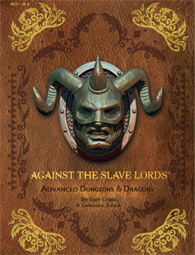
All four adventures were collected in a slightly abridged form, revised to form a connected campaign, in the softcover Realms of Horror in 1987, which is now long out of print. But this is the first true permanent edition. For me, it is also the first must-have release in WotC’s premium reprint line, and I hope it is only the first of many to come. I’d love to see, for example, similar treatment for Gygax’s Against the Giants and Descent in the Depths adventures, and of course The Temple of Elemental Evil — copies of which demand outrageous prices on eBay.

Dungeons of Dread was published by Wizards of the Coast on March 19. It is 192 pages in hardcover, priced at $39.95. There is no digital edition.

Fantastic Science Fiction Stories, December 1959: A Retro-Review

Fantastic Science Fiction Stories, December 1959: A Retro-Review

Fantastic Science Fiction Stories December 1959As promised, a return to Cele Goldsmith’s years at Amazing and Fantastic. This issue comes from quite early in her term.

Last time I looked at Fantastic, I noted the subtitle “Stories of Imagination,” and I commented that much of the magazine remained Science Fiction, despite the Fantasy-leaning title and the ambiguous subtitle. This issue, by contrast, is subtitled “Science Fiction Stories” – an apparently deliberate rejection of the fantastical element. Turns out this subtitle had begun only with the September 1959 issue, and it lasted only through September of 1960, being supplanted by “Stories of Imagination” in October.

Interesting is a letter in this December issue from R. D. Miller, stating that with the September issue: “I took one look at the logo and the worst had happened: Fantastic Science Fiction Stories.” The letter in its whole praises the previous Fantastic for being a home to fiction in the Weird Tales tradition, and laments the apparent plan to discard that in favor of “the Science Fiction monster.”

The response from the editors (don’t know if Goldsmith or Editorial Director Norman M. Lobsenz wrote these) goes: “You want a magazine with 90% bad fantasy? Or one with 50% first-class fantasy and 50% first-class s-f?” (Logically, they should have been able to have a magazine with 50% first-class fantasy and 50% bad fantasy instead, right?)

The cover is by Edward Valigursky, illustrating Poul Anderson’s Flandry story “A Message in Secret.” I must say the man on the cover looks nothing at all like my image of Flandry.

Interior illustrations are by Mel Varga and Leo Summers. Interestingly, the cover of the Ace Double edition of “A Message in Secret,” retitled Mayday Orbit, is also by Valigursky – not as good, Flandry in a cold suit so not recognizable, but noticeably the same depiction of the “Prophet’s Tower” on each cover.

Read More Read More