Browsed by
Category: Vintage Treasures

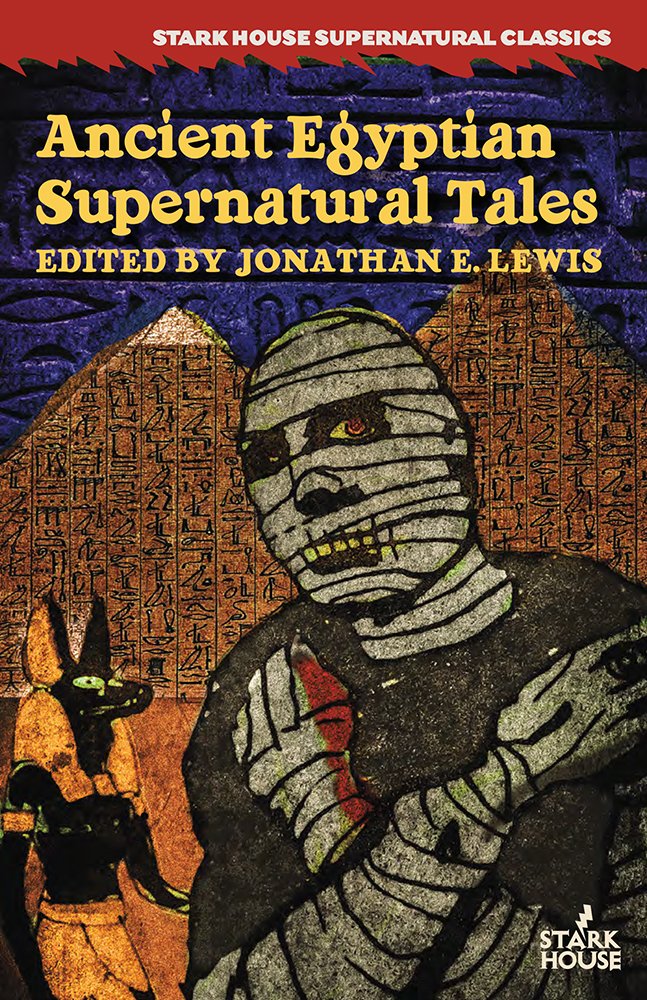
New Treasures: Ancient Egyptian Supernatural Tales edited by Jonathan E. Lewis

New Treasures: Ancient Egyptian Supernatural Tales edited by Jonathan E. Lewis

ancient-egyptian-supernatural-tales-small ancient-egyptian-supernatural-tales-back-small

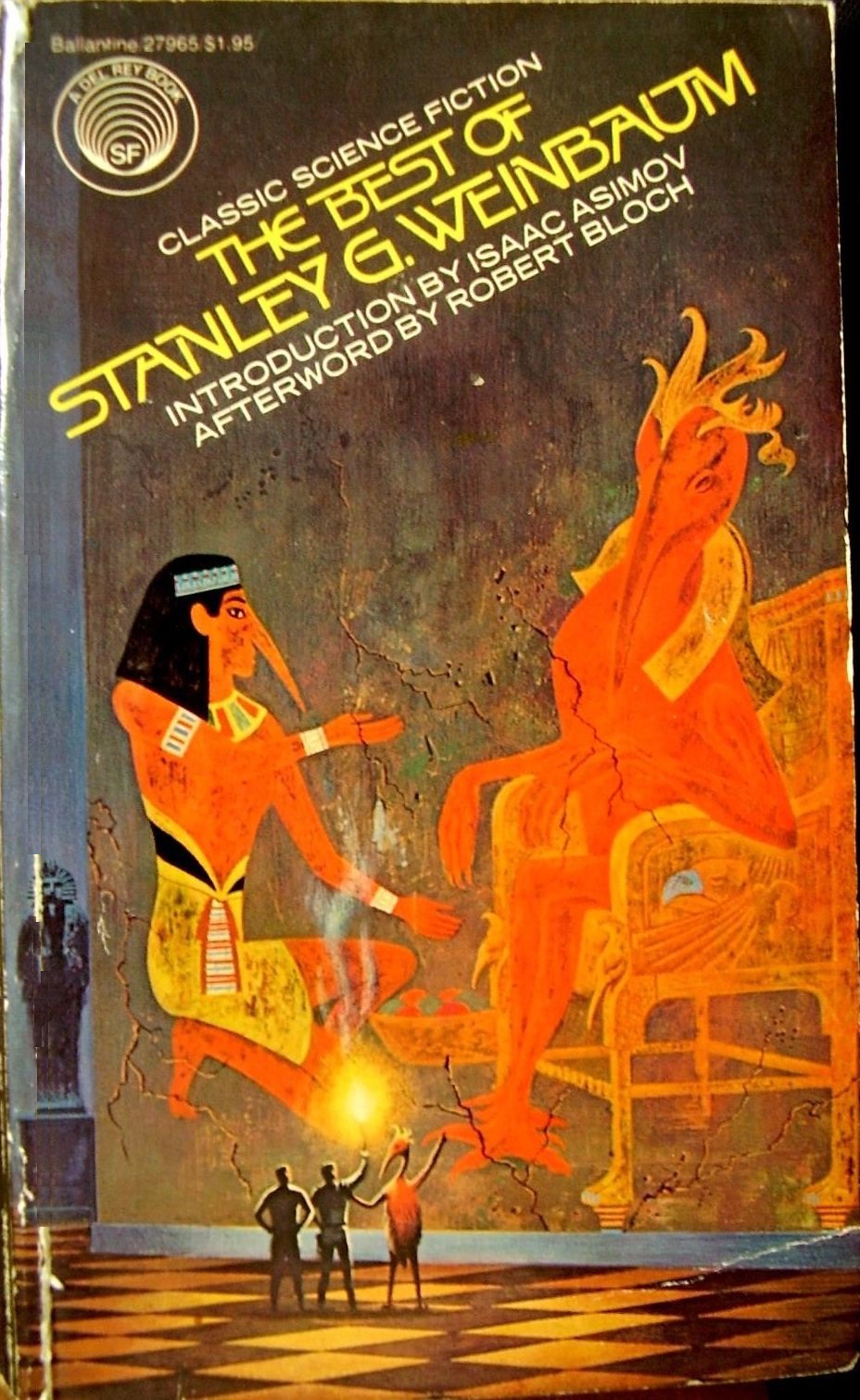
Here’s a fun little artifact, eminently suitable for late summer reading: Jonathan E. Lewis’s anthology of classic (and pulp) Egyptian dark fantasies, Ancient Egyptian Supernatural Tales, published in trade paperback in July as part of the Stark House Supernatural Classics line.

Lewis has done a fine job assembling a stellar line-up of dark fantasy and horror stories featuring mummies, curses, ancient Egyptian vampires, and lots more. In addition to classic tales from Edgar Allan Poe, Louisa May Alcott, Arthur Conan Doyle, H. Rider Haggard, and Sax Rohmer, there’s a quartet of stories from Weird Tales (by Frank Belknap Long, E. Hoffmann Price, John Murray Reynolds — and Tennessee Williams!), Algernon Blackwood’s novella “A Descent Into Egypt,” and two excerpts: one from the first mummy novel ever written in English, Jane Webb Loudon’s The Mummy (1827), and one from Bram Stoker’s classic The Jewel of Seven Stars.

Read More Read More

Vintage Treasures: The Best Science Fiction of the Year #3, edited by Terry Carr

Vintage Treasures: The Best Science Fiction of the Year #3, edited by Terry Carr

The Best Science Fiction of the Year 3 Terry Carr-small The Best Science Fiction of the Year 3 Terry Carr back-small

How did Terry Carr’s Best Science Fiction of the Year paperback anthology series last an incredible sixteen years, from 1972 until his death in 1987?

It’s not that hard to figure out. When early volumes were as amazing as #3, released in July 1974, it didn’t take long for these books to establish a stellar reputation — and a staunchly loyal readership.

How incredible was The Best Science Fiction of the Year #3?

It contains some of the finest science fiction stories of all time, packed into one slender volume. Like “The Women Men Don’t See” by James Tiptree, Jr… perhaps her most famous story, and that’s saying something. And Vonda N. McIntyre’s Nebula Award-winning “Of Mist, and Grass, and Sand,” which became the basis of her 1978 novel Dreamsnake (which swept the Hugo, Nebula, and Locus Awards the following year.) And Harlan Ellison’s classic “The Deathbird,” the Hugo and Locus Award-winning title story of his celebrated 1975 collection Deathbird Stories. Plus Gene Wolfe’s famous “The Death of Dr. Island,” winner of the Locus and Nebula awards for Best Novella.

And an unassuming little story by a young writer named Ursula K. Le Guin, “The Ones Who Walk Away from Omelas,” which won the Hugo Award for Best Short Story, and is considered by many (me included) to be one of the finest short stories ever written. And lots more — including a Jack Vance novella, plus stories by Philip José Farmer, Alfred Bester, R. A. Lafferty, Robert Silverberg, and F. M. Busby. All for $1.50!

Read More Read More

Old Dark House Double Feature III: The Ghost in the Invisible Bikini (1966) and Ghost of Dragstrip Hollow (1959)

Old Dark House Double Feature III: The Ghost in the Invisible Bikini (1966) and Ghost of Dragstrip Hollow (1959)

The Ghost in the Invisible Bikini-small

The Ghost in the Invisible Bikini
American International Pictures (1966)
Directed by Don Weis
Written by Louis M. Heyward and Elwood Ullman
Starring: Basil Rathbone, Boris Karloff, Tommy Kirk, Deborah Walley, Aron Kincaid

I’m not sure how the phrase “everything but the kitchen sink” originated. Perhaps to describe this movie, which pulls out all the stops. As with Ghost of Dragstrip Hollow, I went into it with very low expectations and ended up being surprised.

I’m pretty sure this is the only movie ever made that starred Basil Rathbone, Boris Karloff and Tommy Kirk. Black Gate readers will probably know the first two names and I think it’s safe to say that this movie wasn’t the highlight of their careers, although Rathbone turns in an energetic performance.

Read More Read More

Blogging Marvel’s Master of Kung-Fu, Part Three

Blogging Marvel’s Master of Kung-Fu, Part Three

Master_of_Kung_Fu_Vol_1_22Giant-Size_Master_of_Kung_Fu_Vol_1_2Master of Kung Fu #22 sees the welcome return of artist Paul Gulacy who came and went a bit in these early issues. The first half of the story sees Shang-Chi set upon by Si-Fan assassins at a Chinese restaurant in New York before infiltrating his father’s skyscraper base of operations. Fu Manchu has captured both Sir Denis Nayland Smith and Black Jack Tarr. Shang-Chi stows away aboard Fu Manchu’s private jet unaware of their destination. Once on the ground, he follows as his father’s minions lead their captives to a cave in the side of a mountain which has been filled with dynamite. Shang-Chi rescues the two Englishmen and prevents the detonation which would have seen Fu Manchu kill his archenemy in the same instant he destroyed Mount Rushmore. Doug Moench, like Steve Englehart before him, has an embarrassment of riches that are largely squandered with insufficient page count to fully develop his narrative. This would soon change, however, and make the series one of the finest published in the 1970s.

Most of Marvel’s Giant-Size quarterly titles were throwaways, much like too many of their special Annual editions, but Giant-Size Master of Kung Fu #2 was a 40-page epic designed to showcase both the character of Shang-Chi and the talents of the series’ writer and artist, respectively. Doug Moench had been harboring a desire to address racism and bigotry directly and a series with an Asian protagonist gave him the perfect forum to do so. Paul Gulacy now had the freedom to display martial arts fighting as well as moving displays of romance and longing relying solely on the power of his images in a string of panels that conveyed storytelling free of words. Even more significant is the fact that Gulacy’s depictions of lust and attraction never pandered to titillation as the artist evinced a mature understanding of the art form’s possibility. The fact that he was strongly influenced by cinema and Steranko’s pop art work of the 1960s take nothing away from the fact that Gulacy was coming into his own as an artist with this title.

Read More Read More

Gamma 3, 1964: A Retro-Review

Gamma 3, 1964: A Retro-Review

Gamma 3-smallHere’s a bit of a curiosity — a magazine I had not heard of until quite recently.

Gamma was a short lived digest magazine published out of North Hollywood, CA, between 1963 and 1965. Five issues total were published, the first three edited by William Nolan (best known, probably, for writing Logan’s Run with the recently late George Clayton Johnson, but an active writer since 1956 and still publishing new stuff now, age 88). Because of its location*, perhaps, they attracted some writers associated with the movie business, and in general published a mix of SF and Fantasy, and of writers both from within and without the genre, that reminded me of F&SF, especially in its first few years.

*(Indeed, of the 9 writers in this issue, 7 (as far as I can tell) were based in California, and those who weren’t (Malamud and Highsmith) are the most prominent and the only “non-genre” writers.) The interior art is by Luan Meatheringham, an LA artist active in the ad industry and as a freelancer, who seems to have disappeared from notice.

The cover is called “Expedition to Jupiter,” by Morris Scott Dollens, and it depicts a spaceship and a couple of astronauts on what I take to be Ganymede or Callisto, with Jupiter in the sky.

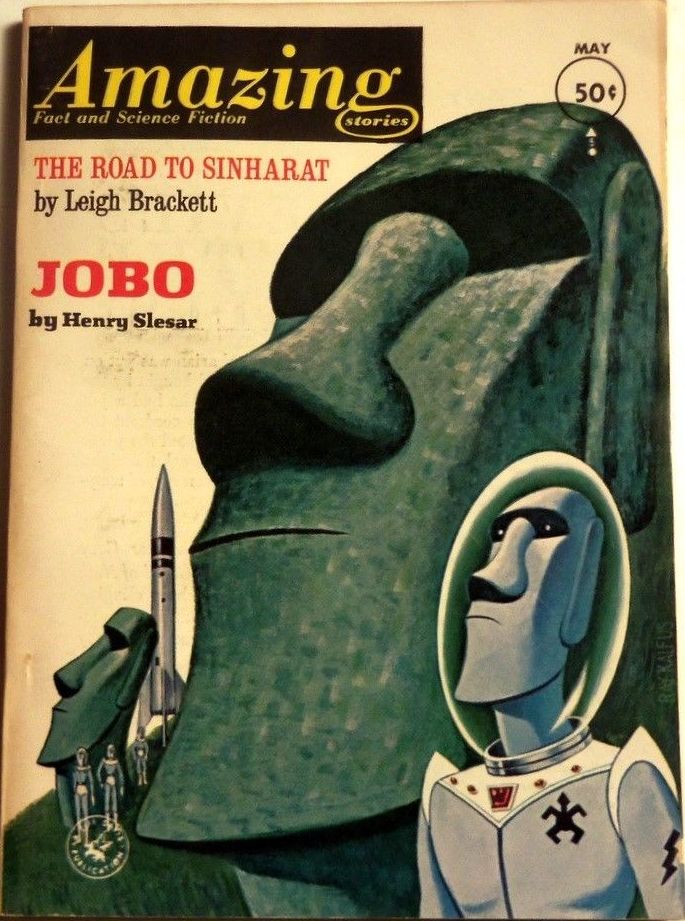
There is one feature, an interview with the editor (using a false name) of a Soviet publishing house, discussing the state of Soviet SF. (By coincidence, I just read a similar piece in Amazing.)

Read More Read More

Andre Norton: Are Her Men Really Women?

Andre Norton: Are Her Men Really Women?

Norton Star RangersIt’s been my experience that Andre Norton is extremely popular among women of my generation, those who grew up reading SF when there were few women writing, and even fewer female protagonists. When I was looking at Norton’s Witch World last time, I found myself wondering whether this popularity was due to how Norton feminized her male protagonists, making them easier for female readers to relate to.

By feminizing, I mean that Norton gives her male protagonists the same kind of “otherness” that is normally associated with the female. Women have long been defined by how they aren’t men, and similarly Norton’s male protagonists are almost always defined by how they’re not the standard socially/politically accepted norm.

Even the positive qualities they may have are somehow the very things that set them apart, and define them as “other.” These are invariably qualities that the standard norm don’t wish to have, even though they’re demonstrably useful.

In Star Rangers Kartr, although a member of the Patrol, is a second class citizen, as are all of the Ranger class of combatants. In fact, he’s excluded from the class of regular Patrol in a number of ways. Even though he’s human, he’s from a frontier world, and is therefore a “barbarian”; he’s a “sensitive” in that he has certain mental abilities which can include telepathy – and it’s significant that this valuable ability is either distrusted by those who believe in its existence, or simply denied by those who don’t. Lastly, he’s a “bemmy lover”* in that he doesn’t join in excluding his nonhuman comrades from social or political status.

Read More Read More

When Men Were Men and Aliens Were Green and Up to No Good: The Pulp Tales of Robert Silverberg

When Men Were Men and Aliens Were Green and Up to No Good: The Pulp Tales of Robert Silverberg

In the Beginning Tales from the Pulp Era Robert Silverberg-small Early Days More Tales from the Pulp Era Robert Silverberg-small

Robert Silverberg’s career as a science fiction writer spans over six decades. His first short story, “Gorgon Planet,” appeared in the February 1954 issue of Nebula Science Fiction, when he was 19 years old, and his first novel, Revolt on Alpha C, was published in 1955. He won a Hugo in 1956 for “Best New Writer,” and for the next few years — until the market for SF magazines collapsed in 1959 — he was extraordinarily prolific, routinely publishing five stories a month, and producing roughly a million words a year.

He published over 80 stories in 1958 alone, in magazines like Imaginative Tales, Fantastic, Amazing Stories, Imagination, and many others. His story “Re-Conditioned Human” appeared in the February 1959 issue of Super-Science Fiction (see the cover below left), and he had two novelettes in the April issue (below right): “Vampires from Outer Space” (under the name Richard F. Watson) and “Mournful Monster” (as Don Malcolm).

Those magazines are almost impossible to find now (unless you’re Rich Horton, of course), but Subterranean Press has done a favor for Silverberg fans — and pulp fans — everywhere by assembling two handsome volumes of his early work. In the Beginning: Tales from the Pulp Era was published in hardcover in February 2006, and Early Days: More Tales from the Pulp Era will arrive on August 31, 2016.

Read More Read More

Fantastic, August and September 1964: A Retro-Review

Fantastic, August and September 1964: A Retro-Review

Fantastic Stories of Imagination August 1964-small Fantastic Stories of Imagination September 1964-small

My most recent forays into Cele Goldsmith Lalli’s editing career have concentrated on Amazing, so here’s a look at a couple of issues of Fantastic. These two issues include a complete John Jakes serial, so I’ll consider them together.

During this period Fantastic was subtitled “Stories of Imagination,” and though it concentrated on fantasy it also published some SF. (The letter column, when one existed, occasionally included complaints about this, to which the response was “sometimes there just isn’t enough good fantasy.”) Fantastic was also thin on features, usually the only one being an editorial from Norman Lobsenz and a brief Coming Next Month blurb. The August editorial is about psychic research, particularly that of the Greek scientist Angelos Tanagras. I thought Lobsenz was a bit too credulous. The September issue’s editorial complains about the quality of SF on TV: instead of adaptations of Isaac Asimov’s robot stories we got Living Doll, and instead of The Martian Chronicles we got My Favorite Martian.

August’s cover is by Ed Emshwiller, with interiors by Emsh, Virgil Finlay, and George Schelling. Robert Adragna does the September cover, and the interiors are by Adragna, Finlay, Emsh, and Schelling.

The stories, then.

Read More Read More

Alaric’s Biggest Secret: “The Desert of Vanished Dreams” by Phyllis Eisenstein

Alaric’s Biggest Secret: “The Desert of Vanished Dreams” by Phyllis Eisenstein

In the Red Lord's Reach and Born to Exile Phyllis Eisenstein-small

Phyllis Eisenstein’s wandering minstrel Alaric, one of the most beloved characters in modern fantasy, appeared in eight short stories in Fantasy & Science Fiction between 1978-1998, and in two novels: Born to Exile (1978) and In the Red Lord’s Reach (1989). He recently made a long-overdue reappearance in George R.R. Martin and Gardner Dozois’ massive 2014 anthology Rogues, in the novelette “The Caravan to Nowhere.”

He’s reappeared again, this time in the new novelette “The Desert of Vanished Dreams” in the latest issue of The Magazine of Fantasy and Science, still on sale at better bookshops. In honor of the occasion, F&SF has interviewed Phyllis on their website, and Phyllis reveals several secrets about the magical world she’s been nurturing for nearly four decades.

Read More Read More

A Southern Tale of Spectral Revenge: Cold Moon Over Babylon by Michael McDowell

A Southern Tale of Spectral Revenge: Cold Moon Over Babylon by Michael McDowell

Cold Moon Over Babylon Michael McDowell-1980-small Cold Moon Over Babylon Michael McDowell-1980-back-small Cold Moon Over Babylon Valancourt-small

Leave it to Valancourt Books to produce the first reprint of Michael McDowell’s spooky southern gothic Cold Moon Over Babylon. It was originally published in paperback by Avon in February 1980 (above left and middle, cover artist unknown).

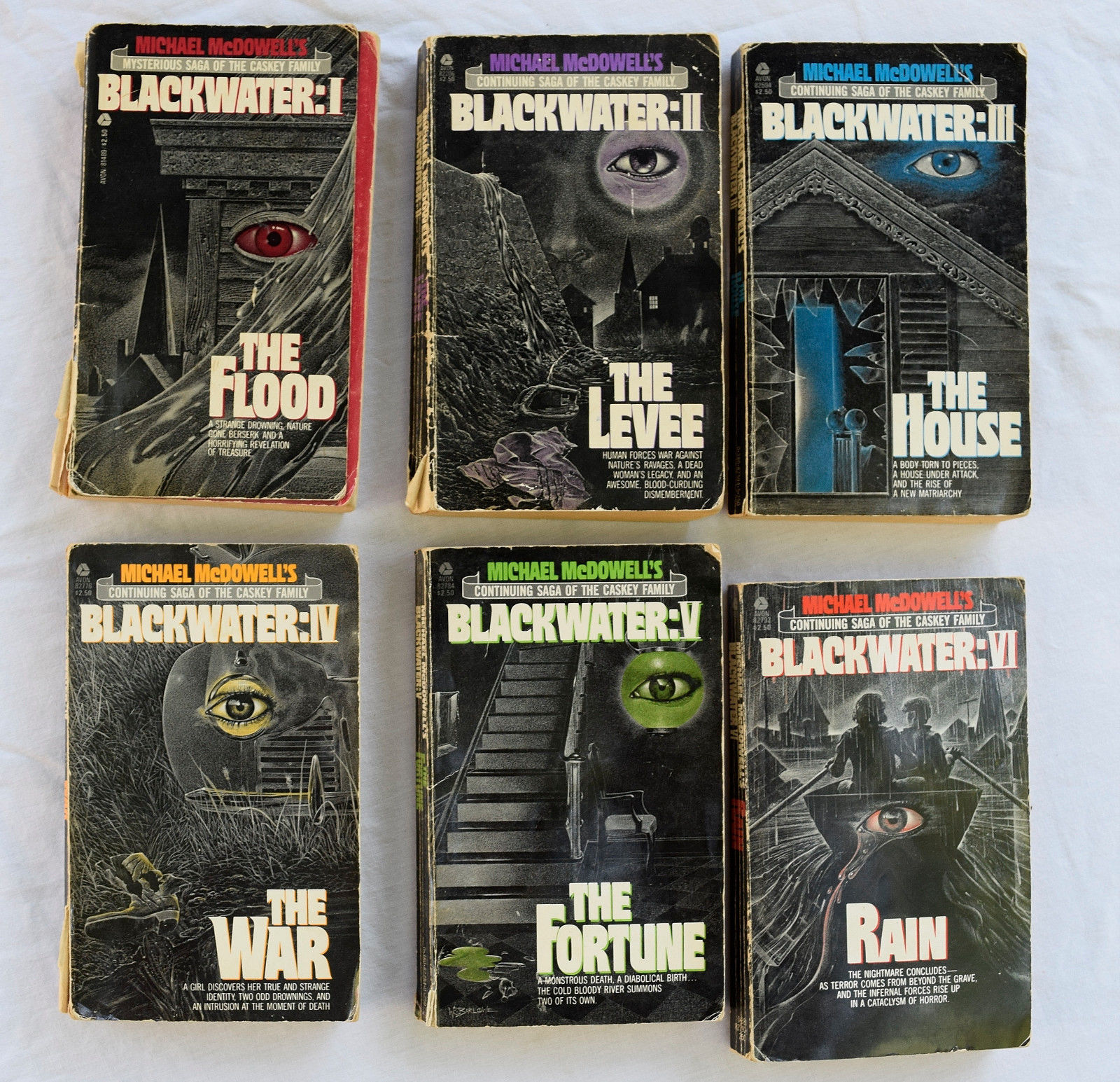
Stephen King called McDowell “The finest writer of paperback originals in America.” McDowell’s other novels include the Blackwater series, The Amulet (1979), and Toplin (1985). I first discovered him with the Valancourt reprint of The Elementals (1981). I was standing in front of the Valancourt booth at the 2014 World Fantasy Convention, gazing in amazement at their incredible back catalog, and that was the book that forced me to open my wallet.

Last year Valancourt brought most of McDowell’s back catalog back into print as part of their 20th Century Classics line, starting with Cold Moon Over Babylon, now available in a handsome new trade paperback with a wonderfully spooky new cover by Mike Mignola.

Read More Read More