Browsed by
Category: Rich Horton

If, July 1961: A Retro-Review
If, July 1961: A Retro-Review

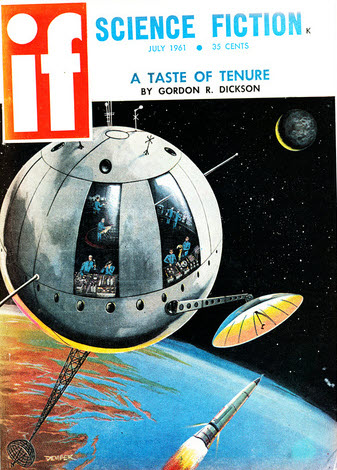
Worlds of If July 1961-smallI’ll get back to Cele Goldsmith’s magazines soon enough, but I happened to grab this issue of If, so it’s up next. This issue comes from very late in H. L. Gold’s official tenure as editor – Frederik Pohl became editor (officially) with the first issue of 1962. (I believe it’s generally regarded that Pohl was editor in all but name for some time prior.) During this period, the cover and spine read only If Science Fiction, though the title page still had “Worlds of” ambiguously placed, so that one could read it either If: Worlds of Science Fiction or Worlds of If Science Fiction.

The cover is by Dember, called “Operation Overlook,” not illustrating any story. (It’s a depiction of a manned satellite orbiting Earth, apparently watching for rocket launches and the like.) Interiors were by Wood, Larry Ivie, and West, and someone unidentified in one case. (Sometimes the illustrator was credited, sometimes I could read the signature, and in one case there was no signature and no credit.) There’s also a page called IFun, with two single panel comics, by Wagner.

Advertisements include the ubiquitous Rosicruans, U. S. Savings Bonds, and some in-house ads. Other features include Science Briefs, a puzzle, and a brief article about the Wendigo, by Theodore Sturgeon (on the masthead as “Feature Editor.”) There is also an attempt to start (restart?) a letter column, to be called Hue and Cry, though this single page only briefly quotes a letter from one Lawrence Crilly, requesting a lettercol.
Read More Read More

Amazing Stories, August 1964: A Retro-Review

Amazing Stories, August 1964: A Retro-Review

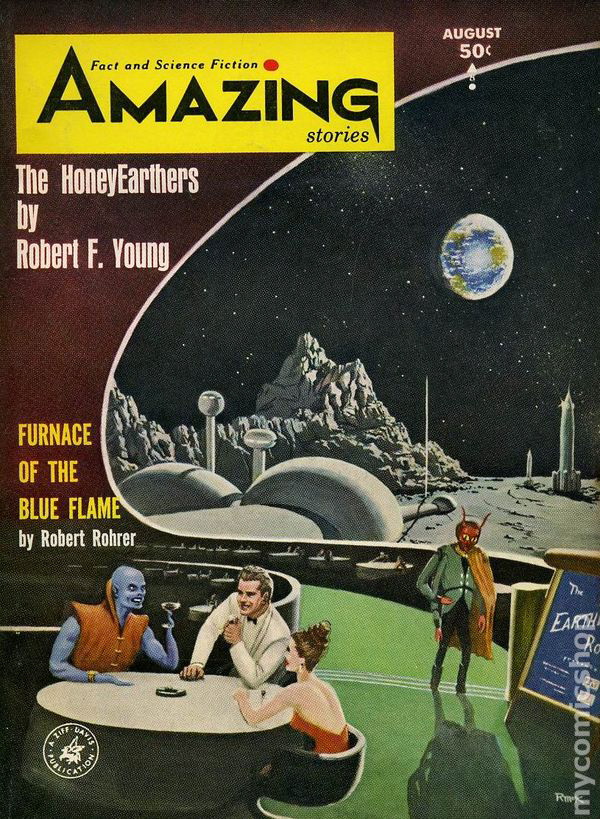
Amazing Stories August 1964Here’s another of Cele Goldsmith’s issues of Amazing, though by this time she had married, and was Cele Lalli. Of particular interest this time around is an obscure Ursula K. LeGuin story.  I notice as well a different font for the title – I liked it. Not sure when it changed.

This time the cover is by Richard McKenna. At first I thought it might be the author of the Nebula winning story “The Secret Place” as well as “Casey Agonistes” and the bestselling non-SF novel The Sand Pebbles (for which last I have seen it suggested he did the original cover). This is credited to him in the ISFDB, actually, and it’s creditable if not brilliant, a scene at a restaurant on the Moon, with aliens – vaguely reminiscent, perhaps, of David Hardy.

However, further investigation (with the help of ace bibliographer Phil Stephenson-Payne) reveals several further covers from mid-60s SF magazines, mostly Galaxy and If, credited to R. McKenna. These covers bear some resemblance in style to this cover, and those that are signed are signed RMcK, much as with this painting. The latest of these other covers dates to 1968, while Richard McKenna of The Sand Pebbles died in 1964. So it seems most likely that another Richard McKenna worked as an illustrator for a while in the mid-60s.

The editorial, unsigned this time (other examples I’ve seen were signed by Norman Lobsenz, the Editorial Director) is about continental drift, which was just beginning to gain traction as a believable theory. There is no science article, but Sam Moskowitz contributes an SF Profile on Mort Weisinger, focusing on his early career as an SF fan, fanzine producer, and occasional writer, before giving him a bit more credit for Superman than seems fair to Siegel and Shuster.

Read More Read More

Amazing Stories, January 1963: A Retro-Review

Amazing Stories, January 1963: A Retro-Review

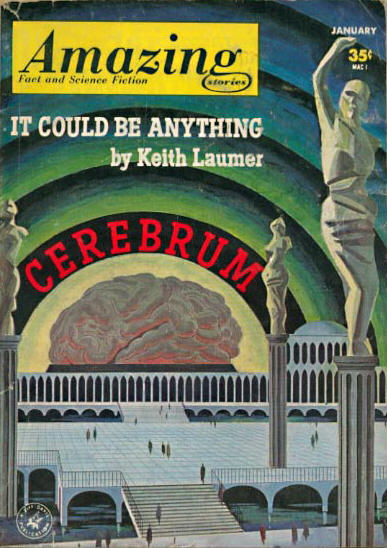
amazing stories January 1963This issue was published almost exactly 50 years ago. This was well into Cele Goldsmith’s tenure. Goldsmith is regarded now as one of the great magazine editors in our field’s history, for what she did with Amazing and Fantastic from December 1958 through June 1965.

I immediately noticed the subtitle: “Fact and Science Fiction.” This appeared with the October 1960 issue and lasted through Goldsmith’s tenure (she was Cele Lalli by the end). 1960 was also the year Astounding Science Fiction became (starting with the February issue) Analog Science Fact and Fiction. Amazing may have been following Analog’s lead, or both may have been reacting to the Space Race, and the increased U.S. emphasis on science education.

Goldsmith/Lalli left the magazine when Ziff-Davis, her employers, sold it – she stayed on with Ziff-Davis and became a very successful editor with Modern Bride.

The cover is by Lloyd Birmingham, an unfamiliar name to me. I didn’t like it very much. As John Boston puts it: “an attempt at pompous pageantry that just looks silly.” It illustrates the lead story, “Cerebrum,” by Albert Teichner.

Interiors are by Birmingham, Leo Morey, George Schelling, and the great Virgil Finlay. There are a couple of inhouse ads, a Classified section, and two full page ads, one for the Rosicruans, and one for the 1963 Stereo/Hi-Fi Directory.

The Fact content is represented by Ben Bova’s article, “Progress Report: Life Forms in Meteorites,” the subject of which seems clear enough, though the article actually discusses the discovery of chemicals possibly related to life in meteorites, as well as where meteorites come from.

Read More Read More

Analog, July 1961: A Retro-Review

Analog, July 1961: A Retro-Review

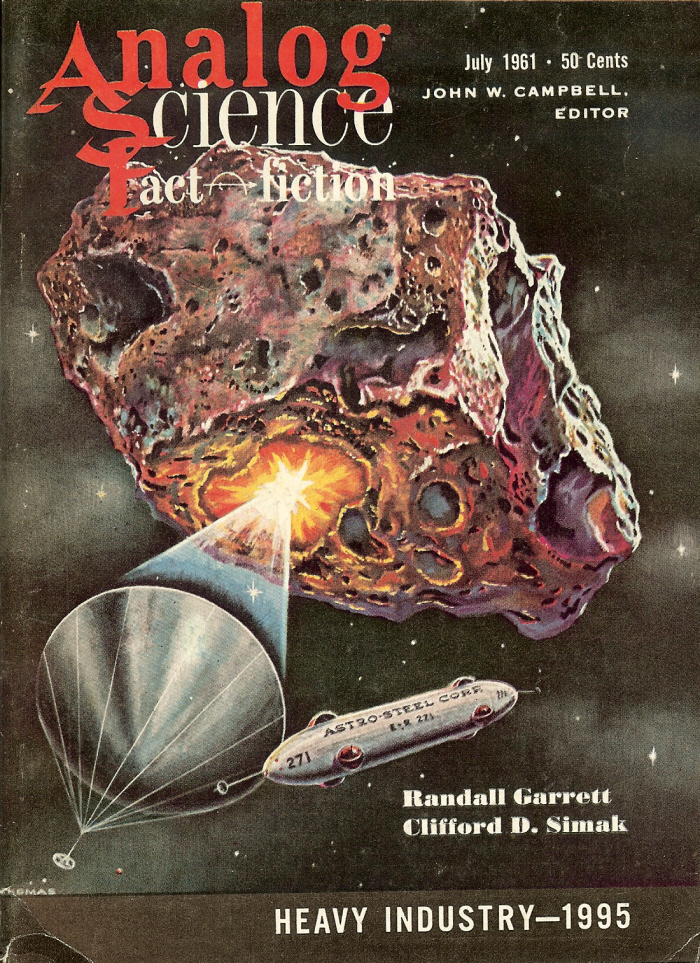
analog-july-1961This is one of the earlier issues after Astounding completed its name-change to Analog. (The issues from February through September 1960 showed both titles on the cover – so October 1960 was the first purely Analog issue.)

Its Table of Contents is familiar to readers of the magazine even to the present day – there’s an editorial, there’s In Times to Come, there’s The Reference Library (book reviews), there’s the letter column (Brass Tacks). There is also a Science Fact article, and a serial, two novelettes, and two short stories.

The only item you won’t find in most present-day issues is The Analytical Laboratory, which ranks the stories from the issue two months earlier based on reader votes. (This was discontinued some time after I became a subscriber in the ’70s – I remember sending in my postcard with my votes a number of times.)

At any rate, for the April issue the number one story was the opening of Clifford Simak’s serial “The Fisherman”, better known these days by the book title, Time is the Simplest Thing.

The cover shows an asteroid mining setup. It’s by Thomas, who did a few covers for Analog in 1961 and 1962, and nothing much else I can find. I don’t even know his first name. Interiors are by Douglas, John Schoenherr, and H. R. Van Dongen.

Read More Read More

Venture, March 1957: A Retro-Review

Venture, March 1957: A Retro-Review

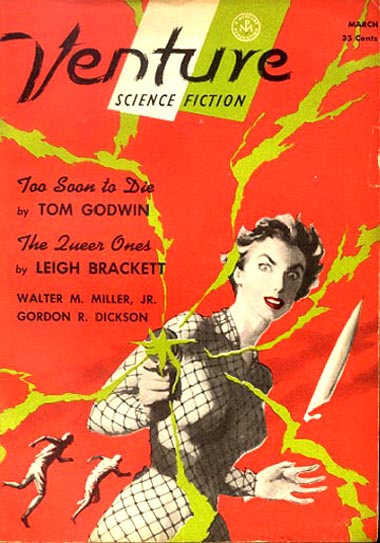
venture-science-fiction-march-1957-smallAnother magazine from 1957, at the cusp of the Space Age, though this one appeared several months before Sputnik. Venture was a companion magazine to F&SF, intended to focus on pure Science Fiction. Ten bi-monthly issues appeared beginning in January 1957. It was revived in 1969, and six quarterly issues appeared from May 1969 through August 1970. I’ve always thought it a shame they couldn’t (it would seem) make a go of it, though I must say I’d never read a copy until now.

The look and feel of the magazine is similar to F&SF: 132 pages (including the covers), same font and column layout. Unlike F&SF, there are interior illustrations (by John Giunta). There are no features except for a sort of editorial (called “Venturings”) on the inside front cover.

The cover illustration, for Leigh Brackett’s “The Queer Ones”, is by Dick Shelton and it’s a bit odd: in two colors (red and olive green, plus black and white), showing a woman shooting a sort of raygun. It does accurately (if in a slightly symbolic way) depict a scene from the story.

As I said, no features, so let’s get right to the fiction. The stories are:

“Too Soon to Die” by Tom Godwin (15,100 words)
“The Lady was a Tramp” by Rose Sharon (6,700 words)
“Friend for Life” by Gordon R. Dickson (5,200 words)
“The Queer Ones” by Leigh Brackett (14,000 words)
“Blind Alley” by Charles L. Fontenay (2,600 words)
“Vengeance for Nikolai” by Walter M. Miller, Jr. (7,700 words)

Read More Read More

Infinity, January 1958: A Retro-Review

Infinity, January 1958: A Retro-Review

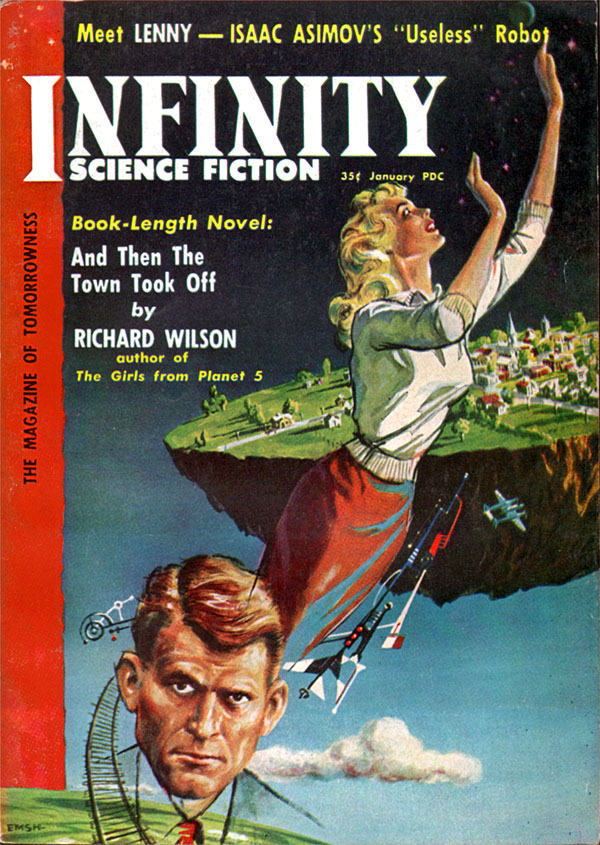
infinity-january-1958-smallThis is the fifth installment in Rich Horton’s retro-reviews of science fiction and fantasy digest magazines from the mid-20th Century. The first four were the February 1966 Analog, the December 1965 Galaxy, the January 1966 issue of The Magazine of Fantasy & Science Fiction, and If, October 1957.

Click the images for larger versions.

The last magazine I reviewed came from October 1957, the month Sputnik was launched. This one is dated January 1958, and presumably appeared on stands a month or so after Sputnik, but was editorially complete just prior to the launch. And I’ve got another October 1957 issue coming.

So — these are, I would argue, three examples of SF magazines on the very cusp of the Space Age.

Infinity lasted from the end of 1955 through 1958, a total of 20 issues. It was published irregularly but roughly bimonthly. The editor throughout was Larry Shaw, and his work was justly very well regarded. The most famous story he published was Arthur C. Clarke’s “The Star” in the very first issue.

Shaw also edited the companion magazine, Science Fiction Adventures, which became the John Carnell-edited UK magazine by the same name (Carnell’s magazine started as a reprint edition of the US magazine, but continued with original stories after the US version folded). An earlier US magazine of that name was edited by Lester Del Rey pseudonymously, and the title was used again later for one of Sol Cohen’s horrid reprint magazines.

This issue had a cover by Ed Emshwiller, illustrating Richard Wilson’s serial “And Then the Town Took Off”, and interior illustrations by Emsh, Bill Bowman, Richard Kluga, and John Schoenherr. The only ads are the ubiquitous SFBC on the back cover (inside and out), and on the inside front cover an inhouse ad urging the reader to subscribe to Infinity and Science Fiction Adventures.

Read More Read More

New Treasures: Rich Horton’s The Year’s Best Science Fiction & Fantasy 2012

New Treasures: Rich Horton’s The Year’s Best Science Fiction & Fantasy 2012

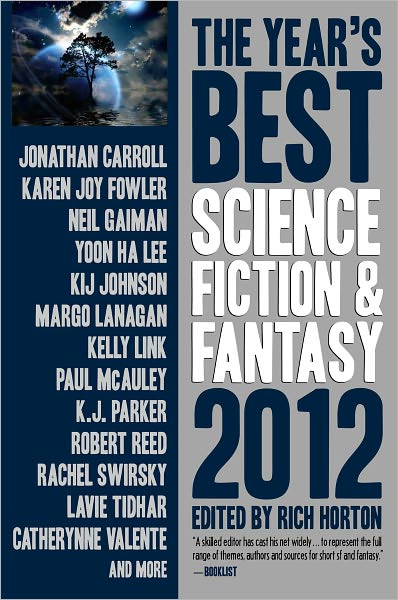
the-years-best-science-fiction-fantasy-2012-2We’re deep into Best of the Year anthology season now. Gardner Dozois’s The Year’s Best Science Fiction: Twenty-Ninth Annual Collection arrived on July 3 (29th volume!), Paula Guran’s The Year’s Best Dark Fantasy & Horror 2012 on June 19, David G. Hartwell and Kathryn Cramer’s Year’s Best SF 17 on May 29, and Night Shade Books published Volume 6 of Jonathan Strahan’s The Best Science Fiction and Fantasy of the Year (which we covered here) on March 6.

Naturally, my favorite Best of the Year anthology takes the longest to arrive: Rich Horton’s The Year’s Best Science Fiction & Fantasy 2012. This is fourth volume in this format; prior to 2009 Rich published separate Best of the Year volumes from science fiction and fantasy, from 2006 to 2008. So all told this is his tenth Best volume (eleventh, if you count Unplugged: The Web’s Best Sci-Fi & Fantasy in 2008. Which we do.)

The highlight of theses books for me is frequently the introduction, customarily the place where the editors rattle off statistics and lament the imminent death of the short fiction market (traditional since the late 1970s), or even publishing in general.  Rich seems to be growing more self-assured in his intros, and they can be quite entertaining. This from the latest volume:

There are also a few writers appearing here for the first time who have been doing exciting work for several years — I’m a bit late to the party, perhaps, with Lavie Tidhar, certainly, and with Nina Allan… Alan de Niro, Gavin Grant, Chris Lawson, Vylar Kaftan, and Marissa Lingen are all also writers I’ve had my eye on for a few years. (Speaking of the perils of gender identification, I recall that I publicly listed Lavie Tidhar as a woman and Vylar Kaftan as a man… at least my aggregate totals were correct!)

And I should probably also mention that some of the writers I’ve already anthologized twice are quite young, or at any rate quite new to publishing, such as C.S.E. Cooney, Genevieve Valentine, and Alexandra Duncan. The field remains in good hands.

This volume includes much of the most highly acclaimed SF and Fantasy short fiction from last year, including “The Last Sophia,” by BG website editor C.S.E. Cooney, Catherynne M. Valente’s “The Girl Who Ruled Fairyland — For a Little While,” Kij Johnson’s “The Man Who Bridged the Mist,” “Choose Your Own Adventure” by Kat Howard, and many more. There’s also a Recommended Reading list, which includes Rosamund’s superb tale from Black Gate 15, “Apotheosis.”

We covered last year’s volume here. The Year’s Best Science Fiction & Fantasy 2012 is 575 pages. It is published by Prime Books for $19.99 (trade paperback) or $6.99 (Kindle). Highly recommended.

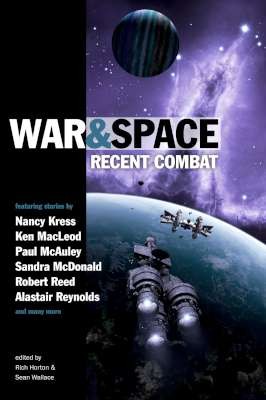
New Treasures: War & Space, edited by Rich Horton & Sean Wallace

New Treasures: War & Space, edited by Rich Horton & Sean Wallace

war-spaceMy copy of War & Space: Recent Combat finally arrived today, and it’s everything I hoped it would be: a thick anthology reprinting some of the best tales of space warfare from the last few decades, including one of my recent favorites, Ken MacLeod’s tale of a man who investigates a civilization implosion in a far-distant human habitat and the startling horrors he discovers, “Who’s Afraid of Wolf 359?” Here’s the opening lines:

When you’re as old as I am, you’ll find your memory’s not what it was. It’s not that you lose memories. That hasn’t happened to me or anyone else since the Paleocosmic Era, the Old Space Age, when people lived in caves on the Moon. My trouble is that I’ve gained memories, and I don’t know which of them are real.

Exactly the kind of book I like to snuggle into my big green chair with. (Side note to website editor C.S.E. Cooney: yes, I ended a sentence with a proposition. Give me a break, it’s Friday). Here’s the book description:

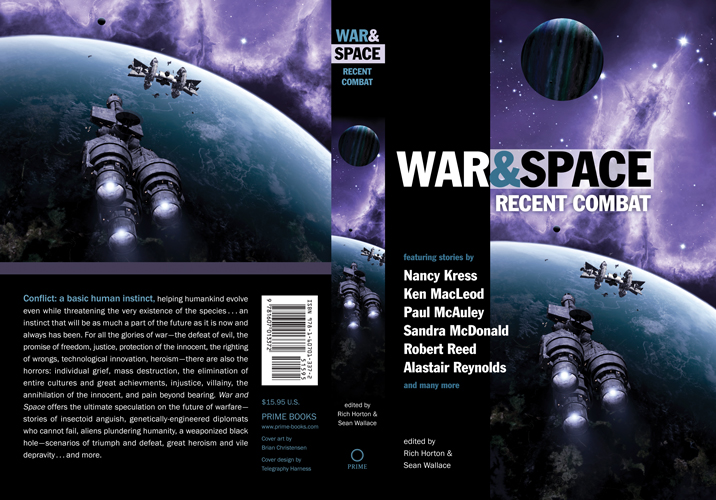
Conflict: a basic human instinct, helping humankind evolve even while threatening the very existence of the species… an instinct that will be as much a part of the future as it is now and always has been. For all the glories of war-the defeat of evil, the promise of freedom, justice, protection of the innocent, the righting of wrongs, technological innovation, heroism-there are also the horrors: individual grief, mass destruction, the elimination of entire cultures and great achievments, injustice, villainy, the annihilation of the innocent, and pain beyond bearing. War and Space offers the ultimate speculation on the future of warfare-stories of insectoid anguish, genetically-engineered diplomats who cannot fail, aliens plundering humanity, a weaponized black hole-scenarios of triumph and defeat, great heroism and vile depravity… and more.

War & Space includes short stories from Nancy Kress, Paul McAuley, Robert Reed, Alastair Reynolds, Catherynne M. Valente, Tom Purdom, and many others. You can get additional details here.

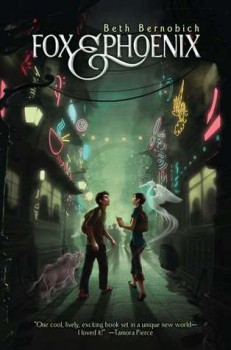
Rich Horton Reviews Fox and Phoenix by Beth Bernobich

Rich Horton Reviews Fox and Phoenix by Beth Bernobich

fox-and-phoenixFox and Phoenix
Beth Bernobich
Viking ( $17.99, hc, 368 pages, October 2011)
Reviewed by Rich Horton

A few years ago Beth Bernobich published a delightful YA novelette called “Pig, Crane, Fox: Three Hearts Unfolding” in Steve Berman’s anthology Magic in the Mirrorstone. Now her first YA novel has appeared, a sequel to the earlier story. It’s also very nice, another benchmark in an evolving career that may become something quite special if Bernobich keeps doing work as interesting as she has done to date.

In “Pig, Crane, Fox” the main protagonist, Kai, is a boy working in his Mother’s magic shop. He (as with most people in his milieu) has a spirit companion, the pig Chen. He and his friends regard themselves as pretty streetwise – and maybe they are, to some extent. Then they get involved with the Princess Lian, as her father, ruler of their city-state, establishes a contest for her hand. Kai is mature enough to ask instead for Lian to be granted her real wish – to study at the major university in the Phoenix Empire.

The setting is explicitly Chinese-derived, though not in any recognizable China. It’s quite fantastical in nature – magic is everywhere – but with a distinctly Science-Fictional attitude informing things, such as the way magic is used. That setting, that mix of SF and Fantasy (a characteristic of much of Bernobich’s work, in different ways) was a big part of the attraction of the story, but so were the well-realized characters.

Read More Read More

Rich Horton and Sean Wallace explore War and Space

Rich Horton and Sean Wallace explore War and Space

warandspace1Rich Horton has been a Contributing Editor for Black Gate since…. you know, I’m not even sure I remember. When we were in Kindergarten, maybe.  Or possibly since that drunken weekend when we assembled Goth Chick in our old laboratory. Good times, good times.

There was a day when I thought Rich and I would conquer science fiction together. We were two freelance journalists telling it like it is. When Tor started printing books with ink made in Singapore sweat shops, we blew the lid off the whole thing. Sleep didn’t matter, friendships didn’t matter. Only the truth mattered. And hot babes. Babes were on us like… like… well, not really. But anyway, we were unstoppable. The world was ours for the taking. At least, that part of the world that didn’t include women.

Then Rich met Sean Wallace, and Sean offered him something I never could: an actual wage. Rich dropped me like a hot potato for a career as one of the hottest anthologists in the field, and never looked back. Last time I saw him he was driving a Lamborghini Diablo and talking to J.K. Rowling on his cell.

I confronted Sean on the front steps of the Prime Books skyscraper in ’06. I was in a snarling rage, and threatened his life. He punched me in the nose and made me cry.  Then he bought me a hot chocolate and a bus ticket back to Chicago, and that was that.

That was nearly a dozen acclaimed anthologies ago, including three volumes of The Year’s Best Science Fiction and Fantasy, my favorite of the annual survey anthologies. Now Rich and Sean have teamed up for War and Space: Recent Combat, a reprint anthology collecting some of the best tales of space warfare from the last few decades, including “Who’s Afraid of Wolf 359” by Ken MacLeod, “Art of War” by Nancy Kress, and “The Political Officer” by Charles Coleman Finlay. This isn’t your typical military SF collection however, as Sean makes clear in a question to a reader in the comments section of his blog:

Will you still like it even if it’s not, well, in the vein of Baen military sf? I have to admit that we went a bit broader with this, and while we love it a lot, I just hope people aren’t expecting something a bit more militaristic?

Coming from a guy with a mean right hook, that sounds great to me.  War and Space will be released on May 2 by Prime Books. It is $15.95 for 384 pages in trade paperback.