Fantasia 2018, Day 22, Part 5: Lords of Chaos
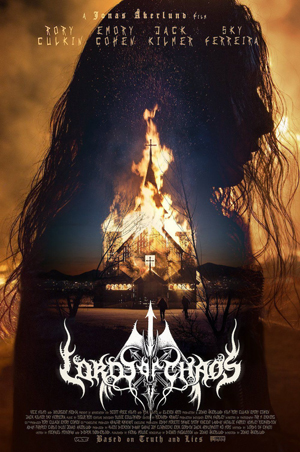 My last film of Fantasia 2018 was a late surprise. The Festival often starts with a screening slot still to be announced, as the Directors negotiate to add one last film to their line-up. This year, just a few days before Fantasia ended, they announced that they’d close this year’s festival with a screening of Lords of Chaos, a film by Jonas Åkerlund based on the true story of the band Mayhem in the early 1990s. It’s a drama, with a lot of very dark comedy, involving murder, suicide, and church burnings. The version of the film that played Fantasia was the same unrated version that premiered at the Sundance festival earlier this year; apparently cuts will have to be made before the movie can be shown again in a North American theatre. (I can’t say with absolute certainty what those cuts will be or what the reason for them is, but the leading theory I heard is that they have to do with the film’s realistic depiction of suicide.)
Lords of Chaos is based on the book of the same name by Michael Moynihan and Didrik Søderlind, with a script by Dennis Magusson in collaboration with Åkerlund. It’s worth noting that in the mid-80s Åkerlund was briefly a member of Bathory, a band that laid the groundwork for the black metal scene that emerged a few years later. Definitions are tricky in metal, and some will argue that Bathory was one of the creators of black metal; the point is that Åkerlund has roots in this world as well as being an experienced director with a long list of credits.
The film he’s made now claims to be “based on truth and lies.” Starting in 1987, we’re introduced at once to young Norwegian metal musician Øystein Aarseth (Rory Culkin), who is our narrator: “this is my story, and it will end badly,” he promises. Aarseth, under the name Euronymous, leads the band Mayhem, which has hit a plateau — but when a new singer sends in an audition tape (along with a dead mouse), Euronmymous sees new hope for the band. Per Yngve Ohlin (Jack Kilmer), who takes the name Dead, is deeply troubled but immensely talented, and Mayhem takes off, helped also by Euronymous’s knack for self-promotion: he positions Mayhem as “true Norwegian black metal,” in contrast to the proliferation of un-true Swedish death metal bands. Mayhem, he implies, is at the vanguard of a movement, harder and more unyielding than anyone else. More evil.
And so we get a moment in which an enthusiastic young fan approaches Euronymous to gush about the band, Euronymous stares at him in a long silence, then points to a patch on the fan’s jacket and reads out “Scorpions” in a flat and chillingly ironic tone. The old-school German hard rock band’s used like a bludgeon, a sign of the un-trueness of the fan, who is crushed; and we realise how Euronymous can and will pick instantly on a small tell to dominate and manipulate people around him. Because the fan, Kristian (Emory Cohen), isn’t driven away but instead becomes even more determined to gain Euronymous’s approval. Dead commits suicide, but if Euronymous is affected, he doesn’t show it much. With his parents’ money he opens a metal record store, and in the basement holds meetings of a “black circle” of favoured musicians. “I was building my own empire,” he reflects. “Everything that had happened had made me immune to reality.” Kristian, still a fan, wants to be a part of this group — for he’s a musician, too, and, it turns out, a talented one. Brought into the circle, he takes new names, Varg Vikernes and Count Grishnackh, and slowly emerges as a rival for Euronymous among the black circle. The two young men compete with each other to say and do ever more extreme things, driving each other further and further, and it is very clear that Euronymous’s early promise is true: this can only end badly.
 The two final movies I’d watch at the 2018 Fantasia International Film Festival were both in the big Hall Theatre. It’s perhaps appropriate that the first of those two aspired to be a crowd-pleasing blockbuster. Detective Dee: The Four Heavenly Kings (Di Renjie zhi Sidatianwang, 狄仁杰之四大天王) was directed by veteran Tsui Hark and written by Chang Chialu. It’s nominally a prequel to two other movies, though no knowledge of those films is required.
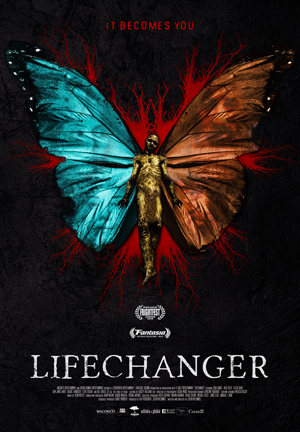 For my last movie of 2018 in the Fantasia screening room I selected a Canadian horror movie called Lifechanger. Written and directed by Justin McConnell, it follows an entity named Drew (narrated by Bill Oberst Jr), who, born human, at age 12 developed the ability and need to change bodies with other people (which Drew does repeatedly through the movie, tying the film together with voice-over ruminations; thus the “narrated by” in the previous parenthesis). The process kills the other person, and leaves Drew trapped in a swiftly decaying body. For decades, he’s had to keep changing bodies every few days, the inevitable rot slowed only slightly by doses of cocaine. Lately, though, he’s convinced himself he’s fallen in love with a woman named Julia. Drew wants to be close to her, but how can he do that given what he is?
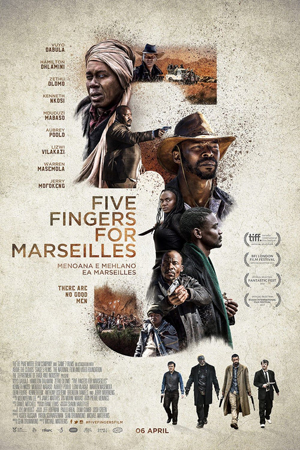 I went by the screening room early on August 2, the last day of the 2018 Fantasia International Film Festival. It was my final chance to see some of the things I’d missed at the festival, and if I watched three movies in the screening room before heading off to watch the two films I wanted to see that evening at the Hall Theatre, then I’d total 60 movies on the year. And I knew going in what the first film I wanted to see at the screening room was, a film that had gathered a goodly amount of buzz around the festival. On the first day of the festival I’d begun Fantasia 2018 with the revisionist Western
 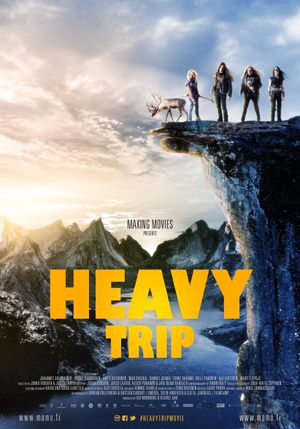 I had time for one more movie in the Fantasia screening room before I’d head over to the J.A. De Sève Theatre to watch a film called Madeline’s Madeline, an experimental film about a girl in a theatre group struggling to define herself. It’d be the last movie I’d see in the De Sève at this year’s festival, but before it started I opted to watch a Finnish comedy about death metal. (There’s a reason for that choice, involving the final film of the festival; more on that in a few posts.)
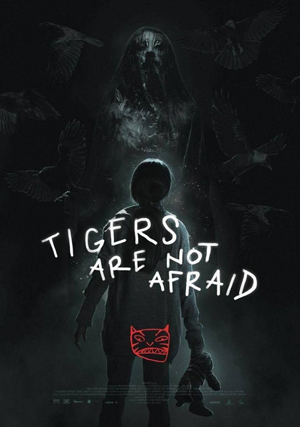 I was at the Fantasia screening room early on August 1 to watch a movie I’d missed when it played in a Fantasia theatre: Tigers Are Not Afraid (Vuelven), written and directed by Issa López. I’d heard a number of people around the festival rave about it, and I was intrigued. 10-year-old Estrella (Paola Lara) is a girl in a Mexican city ravaged by drug violence. When her mother goes missing, she falls in with a gang of four boys who live on the street. But their leader, a scarred child named Shine (Juan Ramón López), has stolen a cell phone containing a video incriminating an aspiring local politician (Tenoch Huerta) in brutal criminal activity. Now his cartel’s after them, and death is all around. So, perhaps, is magic; but magic is not always safe.
 On Tuesday, July 31, the first movie I planned to see alongside a general audience was a Hong Kong action movie called The Brink. After that, I’d pass by the screening room before heading home. There’d be only two more days of Fantasia after this one, and I wanted to catch up on things I’d missed in theatres. I was specifically curious about a Korean movie called The Outlaws, about a cop who’s working against the clock to catch a Chinese gang who’re trying to take over territory in a district of Seoul. Two promising action movies; I had reasonable hopes for the afternoon.
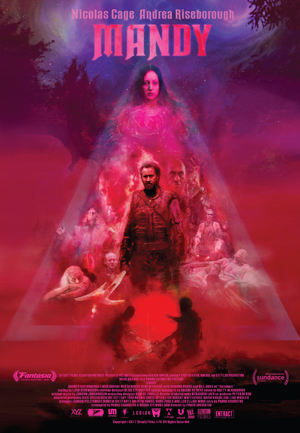 I was at the J.A. De Sève Theatre early on Tuesday, July 31, for a press screening of Mandy. It’s the second film by Panos Cosmatos (director of Beyond the Black Rainbow), who also wrote the script with Aaron Stewart-Ahn. The movie stars Nicolas Cage as Red Miller, a lumberjack who lives in a cottage in the deep woods of the Shadow Mountains with his wife Mandy (Andrea Riseborough), a metalhead artist, in the long-ago year of 1983. Mandy unwittingly catches the eye of a cult leader (Linus Roache), whose minions, the Children of the New Dawn, abduct her. Bad things happen. Miller is tortured. And, inevitably, he embarks on a quest for bloody revenge.