Fantasia 2020, Part XXXII: Minor Premise
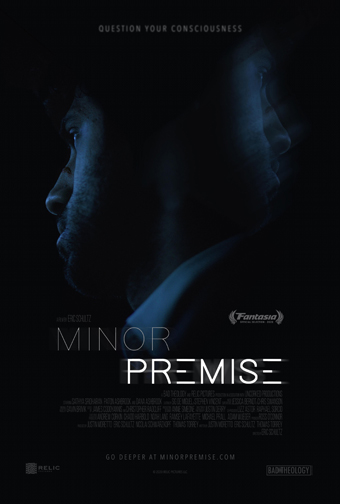 Every story’s got a genre, even if the story’s the sole example of its genre, so by extension a lot of stories use genre conventions and trust that the audience will accept them even if they’re unlikely or unbelievable. Often the audience does, especially when the conventions are so common they don’t register as conventions. But a story usually works better the more it can justify its conventions. Especially when the justification, and the convention, work with the story’s theme.
Take Minor Premise, the first film I saw on the twelfth day of Fantasia. It’s the debut film by director Eric Schultz, with a script Schultz wrote with Justin Moretto and Thomas Torrey, and it tells the story of Ethan (Sathya Sridharan), a neuroscientist who thinks he’s worked out something fundamental about the human psyche and developed a way to control consciousness. He experiments on himself, hoping to balance his emotional landscape and enhance his intellect. Things don’t go according to plan. Ethan shatters himself, so that different parts of his mind are in control of him at any given point, and his more coherent parts must work with his ex-girlfriend Allie (Paton Ashbrook) to find a way to undo the experiment — before the physical stresses of the division kill Ethan. Mysteries abound, as Ethan’s memory isn’t consistent across all his different moods; he’s become different people, and some of them may have their own agendas.
A lone mad scientist developing a technology beyond modern science is a convention freely used in science-fiction and horror stories. It’s uncommon in reality, where much research is done in teams. But it’s a well-established storytelling device, going back to the Romantic era and Mary Shelley’s Victor Frankenstein. The trick is making the audience believe that the scientist of questionable mental stability is able to make their breakthrough on their own. The scientist has to be written as somebody who’s that smart, and that individualistic. And the breakthrough has to be something credible — an obvious advance that’s close enough to reality, or depicted as close enough to reality, that you believe a single researcher in a lab could come up with it.
Minor Premise does all this. It’s a well-told story in general, strongly constructed and well-paced. But it handles its science-fictional conventions with an eye on its characters, and its thematic ideas play into both. This is a film about the nature of character, and the specific character of its lead is examined in a way that’s both dramatic and specifically science-fictional.
Of course, for that to work, the character has to be credible. And Ethan is. He’s vain, and smart, and the writing shows him to be smart enough that we understand his vanity while also seeing his blind spots. We see how he could have been smarter in the past, and why he thinks his life would be better if he had been that much smarter; we see how, as an intelligent man, he values his intelligence and assumes that if he were even more brilliant he’d be able to see through other people before they betray him. We can see why he’d attract someone like Allie, and why he’d inevitably drive her away.

 One of the crucial differences between the way a storyteller approaches the tale they’re telling and the way the audience experiences that tale is that the storyteller typically knows the ending in advance. If they don’t start with the ending and work to that, they’ve usually still worked out multiple drafts of the story, if only in their head. The audience, on the other hand, at least on their first experience of a story doesn’t get to the end until they’ve gone through the whole of the work leading there. Even if they’ve heard something of the ending, or guess at it, the body of the work is necessarily the main part of the experience. If you just get the ending, you haven’t really gotten the whole story.
 There is a certain tone I find in some works of science fiction, almost all from Europe, a ‘literary’ approach that uses science-fictional imagery with self-conscious irony in a way that at least approaches allegory and often satire. In prose I associate this approach with Lem and indeed Kafka; in film, with Tarkovsky’s science-fiction (adapting Lem and the Strugatskys) and Alphaville and On The Silver Globe. The focus in these works is less on world-building than on symbolism, and often on a narrative structure that layers stories within stories and plays with chronology. At their best, these tales emphasise the purely fantastic essence at the heart of science fiction: a type of wonder that uses a modern vocabulary.
 There’s an old line that says science fiction literalises metaphors. It’s a line that applies to fantasy and horror, too. It means that, for example, a realist book may say that somebody walking through their old house is haunted by memories like the ghosts of their past, while a horror story might have that person be actually haunted by an actual ghost representing that past. What is metaphor in one case is literal in the other. But still a metaphor, as well, still symbolising something more than itself. Part of the trick of writing stories of the fantastic is knowing how to handle the metaphorical and the literal — knowing exactly how literal to make the literalised metaphor, and how to explore what literalising the metaphor brings the story, and how to explore the metaphor as metaphor while keeping it a literal thing.
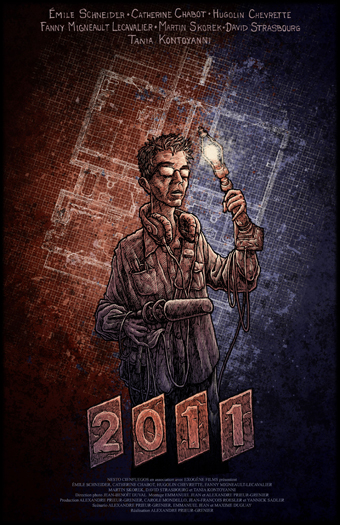 I’ve mentioned that many of the films I saw at this year’s Fantasia were haunted-house stories. Or: horror movies that revolve around a specific architectural location. That’s an intriguing coincidence in the year of COVID-19, but perhaps speaks to filmmakers finding a way to limit budgets and get the most use possible out of their locations. Which brings me to 2011, a film set in a single apartment and a kind of ghost story that begins and ends with the horror-thriller form. But this only becomes clear at the very end, for mainly this is an experimental and ambitious film that wanders through different genres and types of stories.
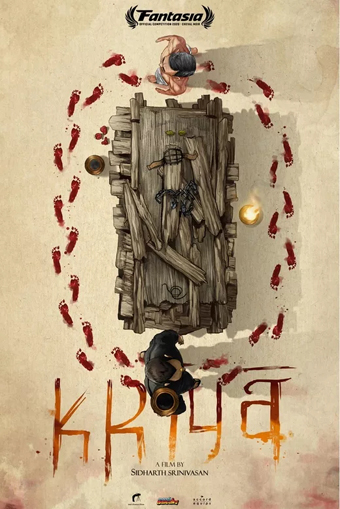 Religion’s a recurring subject for horror, and for a lot of reasons; there’s a lot in there to be scared about. More, from at least the 18th century onward writers have followed Edmund Burke and Ann Radcliffe in linking horror with the sublime. When horror fiction in the West has grappled with religion, naturally enough it’s tended to use Christian symbols, ideas, and sometimes even theology — whether in something as simple as the crucifix turning away a vampire, or in something more central to the story, as showing the birth of Satan’s child in The Omen or Rosemary’s Baby.
  The Japanese image of the three wise monkeys is as early as the 16th century: one monkey with hands over eyes, the next with hands over ears, the third with hands over mouth. See no evil, hear no evil, speak no evil; thus the monkeys’ names, Mizaru, Kikazaru, and Iwazaru, ‘not-seeing,’ ‘not-hearing,’ and ‘not-speaking.’ There’s a pun in Japanase on zaru, not, and saru, monkey, so collectively the trio’s simply ‘three monkeys,’ or sanzaru.