Browsed by
Category: Movies and TV

Old Dark House Double Feature VI: The Ghost and Mr. Chicken (1966) and Hillbillies in a Haunted House (1967)

Old Dark House Double Feature VI: The Ghost and Mr. Chicken (1966) and Hillbillies in a Haunted House (1967)

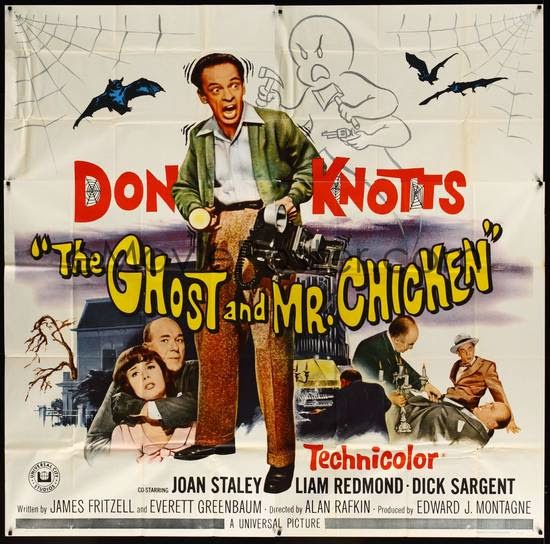
The Ghost and Mr Chicken poster

This time around, two old dark house flicks that are separated by about a year. A classic of the genre and one’s that’s a bit of a dud.

The Ghost and Mr. Chicken
Universal Pictures (1966)
Directed by Alan Rafkin
Written by Jim Fritzell and Everett Greenbaum
Starring Don Knotts, Joan Staley, Liam Redmond, Sandra Gould, Dick Sargent and Skip Homeier

Your opinion about The Ghost and Mr. Chicken will probably depend on how you feel about Don Knotts, someone who made a career of playing variations on the same character — a jittery, keyed up guy who often tried to cover up his bumbling with bluster.

Read More Read More

Things Your Writing Teacher Never Told You: I’d Rather Be a “Librarian” Than a Disney Princess

Things Your Writing Teacher Never Told You: I’d Rather Be a “Librarian” Than a Disney Princess

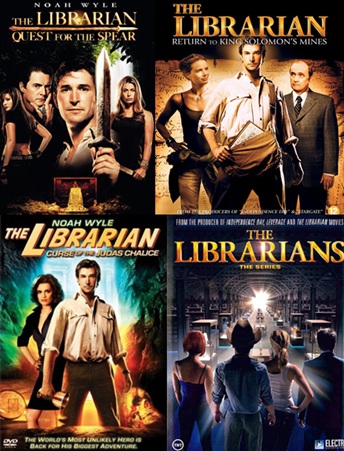
Librarian 1

On the advice of my students, I’ve finally delved into The Librarian/s franchise. If you haven’t encountered it yet, there’s three made-for-TV movies (The Librarian: Quest for the Spear; TL: Return to King Solomon’s Mines; and TL: Curse of the Judas Chalice), starring Noah Wylie, Bob Newhart, and Jane Curtin. They’re a wacky spoof of adventure films like Raiders of the Lost Ark and Congo. Seeing Bob Newhart wield a broadsword and fend off villains is worth the price of a theater admission.

In 2014 the franchise was turned into a TV series, The Librarians, which made the unique move of keeping the three movie leads on in bit or slightly bigger parts, while bringing in three new young assistant librarians and a guardian (bodyguard) who have the bulk of the adventures. They also introduced a new “caretaker,” (mentor and minder) who is the immortal Sir Galahad, played with disarming charm by John Larroquette. Christian Kane is one of the new librarians. He plays basically the same character he played on Leverage, which is delightful.

The series airs on TNT. The movies and previous seasons are available on Amazon Prime video, at the moment. Jonathan Frakes has directed eight episodes. Matt Frewer, Vanessa Williams, Rene Auberjonois, John de Lancie, Felicia Day, and Bruce Campbell (as Santa) are among the guest actors from the genre world.

Read More Read More

Peplum Populist: Perseus the Invincible (Perseus Against the Monsters)

Peplum Populist: Perseus the Invincible (Perseus Against the Monsters)

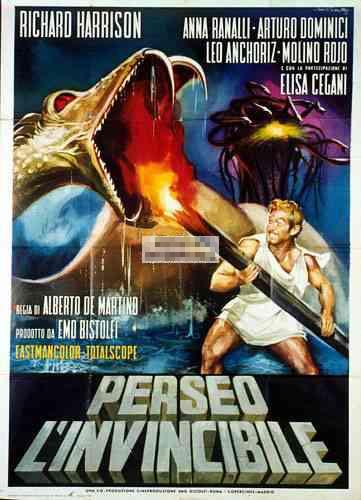
Perseus-the-Invincible-Poster-ItalianThe peplum film, a.k.a. the sword-and-sandal movie, was a dominant genre of Italian cinema from 1958 to 1965. Over a hundred pepla were produced, frequently in co-productions with other European countries, and often starring beefcake actors from the U.S. and U.K. like Steve Reeves, Reg Park, and Gordon Scott.

Buried in this heap of musclemen action pictures and low-budget ancient costume dramas are a few fantasy treasures. Locating these gems of the fantastic is an occasionally, uhm, Herculean task because peplum films are poorly represented on home viewing options in English-speaking countries. You can find hordes of them on streaming services — 75% of Amazon Prime’s library seems to consist of public domain sword-and-sandal movies — but most are horrendous and unwatchable pan-and-scan transfers from prints faded almost to gray smudges. The same is true of the numerous budget pack DVD collections. Even the occasional prestige disc releases are often inferior.

So in this first of an occasional column excavating for the sword-and-sandal films the Black Gate readership may wish to sample, I’m glad to report that one of the most fantasy-heavy pepla, Perseus the Invincible, is available in a decent version from (who else?) Amazon Prime under one of its alternate titles, Perseus against the Monsters. Pepla often skimped on outright fantasy beasts in their mythological stories, but Perseus the Invincible delivers creatures from legendary special-effects designer Carlo Rambaldi. That alone makes it worth a look.

An Italian-Spanish co-production, Perseo l’invincibile was released in Italy in February 1963, just as the sword-and-sandal craze was poised to wind down and the Western was waiting in the wings to take over. It reached the U.S. on television as part of the “Sons of Hercules” Embassy Pictures syndication package, where it was retitled Medusa against the Son of Hercules. It’s also gone by the names Medusa vs. the Son of Hercules and Valley of the Stone Men. There are at least three different cuts in circulation: the original Italian version, the U.S. syndication cut, and a Spanish cut with additional special effects like laser eye beams from Medusa.

Read More Read More

Retrofitting, And When It Doesn’t Work

Retrofitting, And When It Doesn’t Work

starwarsI don’t know if I’ve mentioned it before, but I’m married to a builder. Over the years I’ve observed (judging by the level of bitching) that it’s easier to start from scratch than it is to retrofit. Still, there’s a way to do it well, and a way to screw it up.
I think that’s true of writing as well. I’ve already talked about sequels, and how genre writers in particular have to be careful to remember the details of the worlds they’ve created previously. However, when an author who’s twenty years into a series gets the colour of someone’s eyes wrong, or forgets that they’ve once said their protagonist was an only child, you have to figure that’s an honest mistake, and cut the writer some slack.

But what about conscious, deliberate changes? I’m not talking about reboots, or spin offs. They have their own problems. And I’m not talking about the changes that naturally occur when you’re adapting one media to another. No, I’m talking about sequels where the writer/creator seems to think that no one will remember what’s already been established. You know, where the writer/creator says “Oh yeah, I know I said she was an only child, but now I need her to have a brother, so she does.”

Yes, I’m talking to you, George Lucas.

Read More Read More

The Public Life of Sherlock Holmes: Let’s Talk About The Dying Detective

The Public Life of Sherlock Holmes: Let’s Talk About The Dying Detective

Dying_ConreyLast week I wrote about the season four opener of BBC’s Sherlock, which was an improvement on season three and the abysmal Abominable Bride. But the second episode was yet another huge disappointment, so I’m not going to bother with a negative post about it. However, I’m going to talk about the Canonical story it was based on.

It’s no huge surprise that The Lying Detective was based on Arthur Conan Doyle’s tale, “The Dying Detective.” As far as that goes, The Lying Detective was actually a decent adaptation of the original story. That’s damning with faint praise, however, as I consider “The Dying Detective” to be one of the weakest stories in the Canon.

Appearing in December of 1913, it was the forty-sixth Holmes story to be published. It was one of just eight stories included in His Last Bow.

THE STORY

SPOILERS – I’m going to talk about a story that’s been out there for over one hundred years. And it features the most popular fictional character of all time. If you REALLY don’t want to be tipped off, jump over here and spend fifteen minutes reading it. You have been warned!

Holmes starves himself, looks ghastly, lays in bed, insults Watson, the villain comes over, helpfully confesses, is arrested and Holmes reveals that the was faking it. Yep, that’s the whole thing. Holmes lies in bed for all but a few seconds of the story (he jumps up to lock Watson in the room). No deducing, no finding clues, no nothing. His work in trying to pin a murder on Culverton Smith all happens beforehand.

Read More Read More

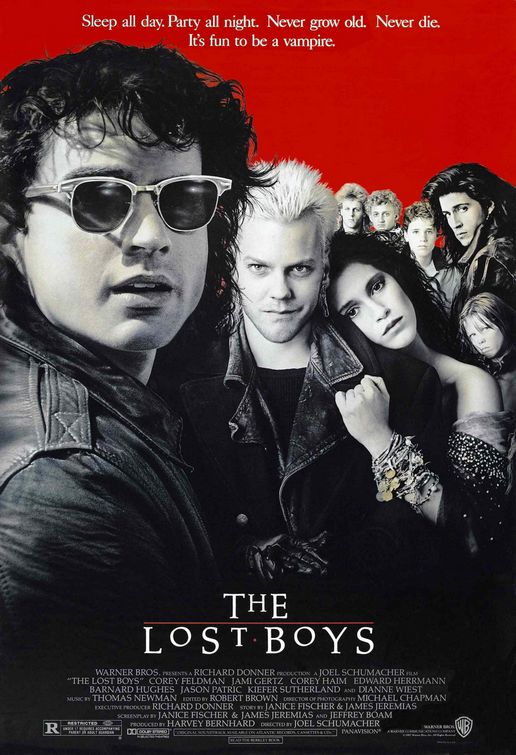
Goth Chick News: I’ll Be Happy to Look for The Lost Boys…

Goth Chick News: I’ll Be Happy to Look for The Lost Boys…

The Lost Boys poster-small

Though every period since the birth of celluloid entertainment can boast its share of vampire films, the 1980’s saw a definitely change in how our favorite movie monster was portrayed. The “decade of excess” also heralded the reign of the excessively sexy vamp.

Not that Dracula in all his iterations wasn’t alluringly sexual – this was the “naughty” angle to his story from the Victorian era. But the 80’s saw a new batch of vamps who not only blended in and lived among humans, but at whom we humans could not stop gaping. From Catherine Deneuve and David Bowie in The Hunger, to Chris Sarandon in Fright Night and Lauren Hutton in Once Bitten, vampires replaced capes with haute couture and picked us up in nightclubs rather than (or before) sneaking through our windows.

And what group of undead epitomized the 80’s better than The Lost Boys?

Correct. None at all.

Read More Read More

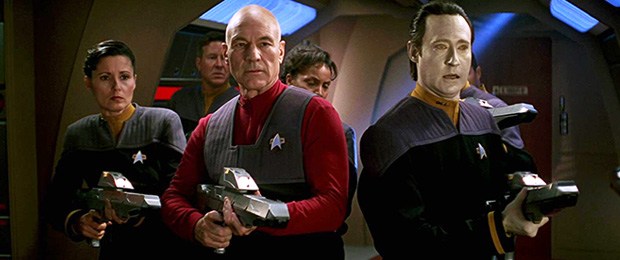
Star Trek Movie Rewatch: Star Trek: First Contact (1996)

Star Trek Movie Rewatch: Star Trek: First Contact (1996)

star-trek-first-contact

As a TOS fan who came to the other Star Trek series relatively recently, I have to admit that The Next Generation, although entertaining, didn’t grab me as much as its predecessor. Nor did the first entry in the TNG run of movies — Generations.

Fortunately, First Contact fares quite a bit better than that installment.

Part of the appeal this time around, in this the eighth of the Star Trek movies, is that it centers on the Borg. Who were the most effective of all Star Trek villains, in my opinion. They first appeared in Star Trek: Next Generation and then in each of the TV series after that. They turned up very frequently in Voyager, which featured Seven of Nine, a “recovering” Borg/human, as a regular member of the cast.

Read More Read More

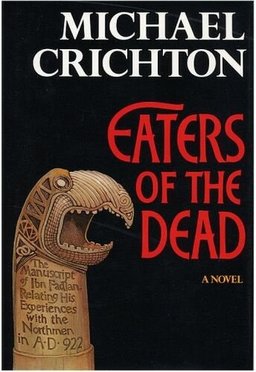
Eaters of the Dead by Michael Crichton

Eaters of the Dead by Michael Crichton

oie_8192953ghlqmqv0-1In 921 AD, Aḥmad ibn Faḍlān ibn al-ʿAbbās ibn Rāšid ibn Ḥammād was sent from Baghdad as ambassador to the Volga Bulgars (who lived in the boundaries of modern Russia) to help establish Islamic law for the newly converted nation. The short journal he kept of his travels is famous for its descriptions of the Volga Vikings, in particular the death rites of one of their chietains.

In Eaters of the Dead (1976), the fourth novel published under his own name (he’d previously released ten under pseudonyms), Michael Crichton asked two important questions: What if ibn Fadlan, during his sojourn among the Vikings, met a certain hero named Buliwyf? And what if there was a historical basis for the legend of Beowulf? His answer is a fun mix of travelogue and bloody adventure tale. Years later, it went on to serve as the basis for the The 13th Warrior, starring Antonio Banderas.

The first three chapters of Eaters of the Dead are mostly lifted straight from ibn Fadlan’s manuscript. Instead of a trusted and willing diplomat, though, Crichton recasts ibn Fadlan as reluctant traveler, forced to join the mission as punishment for his dalliance with the wife of a merchant friendly with the Caliph.

The greatest change to ibn Fadlan’s story is, of course, his fateful meeting with Buliwyf. In Crichton’s story, the Geatish Viking is present at the funeral for the chieftain. Before he can reach the Bulgars, ibn Fadlan is forced to join Buliwyf and his band. King Rothgar’s realm has been attacked by an ancient horror and he has sent one of his sons to ask the great hero for aid. Terror has come out of the mist — something so evil that the name can’t be mentioned lest it be summoned up. Later, ibn Fadlan learns they are called the wendol.

At this the old man said that I was a foreigner, and he would consent to enlighten me, and he told me this: the name of “wendol,” or “windon,” is a very ancient name, as old as any of the peoples of the North country, and it means “the black mist.” To the Northmen, this means a mist that brings, under cover of night, black fiends who murder and kill and eat the flesh of human beings.* The fiends are hairy and loathsome to touch and smell; they are fierce and cunning; they speak no language of any man and yet converse among themselves; they come with the night fog, and disappear by day — to where, no man durst follow.

Read More Read More

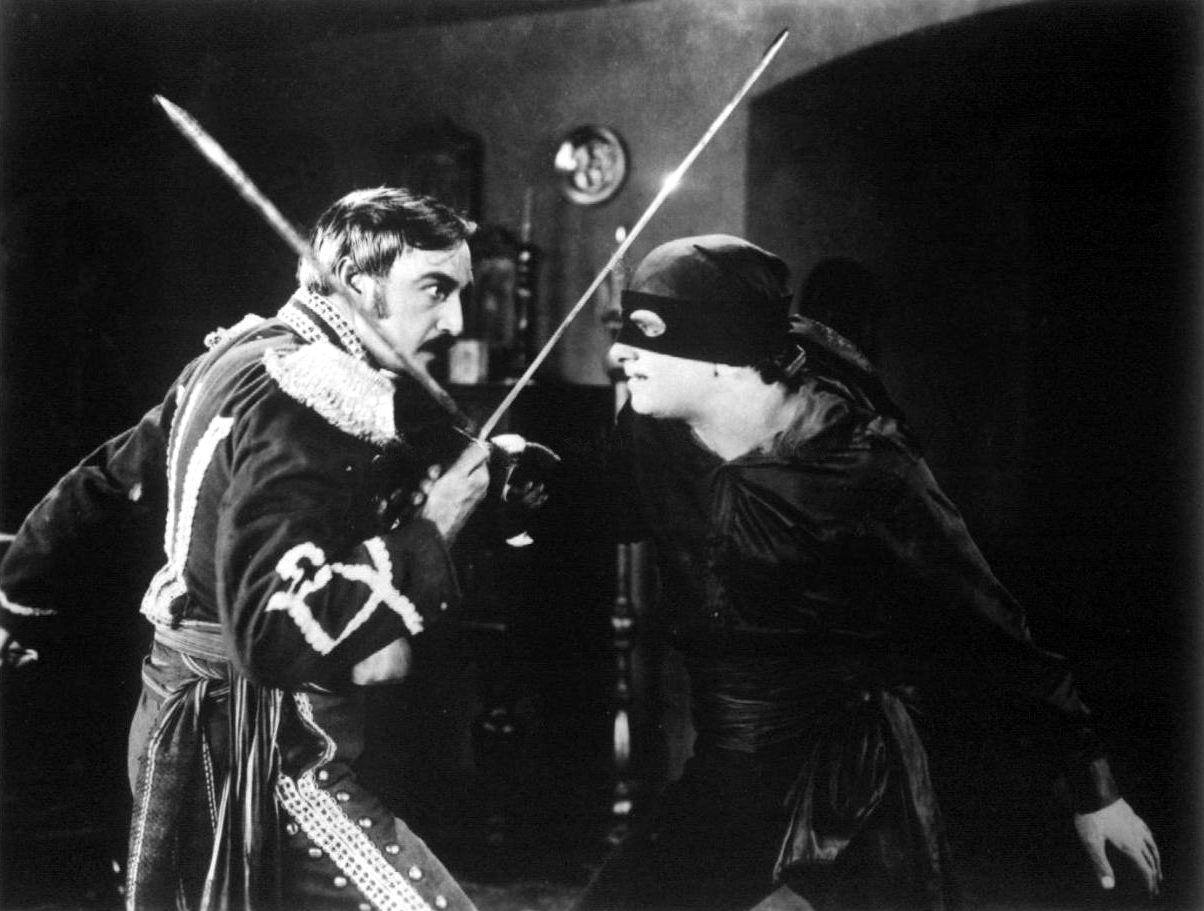
Silent Screen Swashbucklers, Part 1 of 2: Zorro Makes his Mark!

Silent Screen Swashbucklers, Part 1 of 2: Zorro Makes his Mark!

the-mark-of-zorro-1920-top-small

The Mark of Zorro (1920)

The swashbuckler tradition was born out of legends like those of the Knights of the Round Table and of Robin Hood, revived in the early 19th century by Romantic movement authors such as Sir Walter Scott. The genre really caught hold with the publication of Alexandre Dumas’ The Three Musketeers in 1844, and for the next century it was arguably the world’s leading form of adventure fiction, challenged only by the American Western.

The action and visual flair of the swashbucklers were perfect for the movie screen, and Hollywood brought them to life with brio and panache, starting most successfully with lavish productions of The Mark of Zorro (1920) and The Three Musketeers (1921), both starring Douglas Fairbanks, Sr. The 1920s through 1950s were the heyday of the Hollywood swashbuckler, but they continue to find favor with moviegoers right up to the present, notably in the recent Pirates of the Caribbean series. So it’s worth going back to see how those visual tropes around the hero-with-a-sword were first established during the silent film era, because much of what you see on the screen today had its roots almost a hundred years ago with those early cinematic pioneers.

I had a good time surveying these early swashbucklers, and I hope you’ll enjoy this overview. With luck, it’ll even inspire you to dip into this rich source of adventure film tradition yourself.

Read More Read More

The Public Life of Sherlock Holmes: Sherlock is Back With “The Six Thatchers”

The Public Life of Sherlock Holmes: Sherlock is Back With “The Six Thatchers”

thatchers_babySeason three of BBC’s Sherlock was an absolute train wreck, destroying what had been a great show. Then The Abominable Bride took the long-awaited Victorian-Era Cumberbatch/Freeman episode and turned it into some stupid psychological modern day shlock involving the dead, giggling Moriarty.

So, season four finally arrived, just shy of three years since season three ended. And you know what? The Six Thatchers wasn’t a disaster. It wasn’t up to the standards of the first two seasons, but it was better than season three.

In a recent interview, Steven Moffat said, “Mark Gatiss and I do not have the delusion that we know better than Sir Arthur Conan Doyle. That’s how the show works and always will. We reset to the most traditional and famous version of the format.”

And it was exactly when those two thought they knew better than Doyle: when they wrote episodes that alternately pandered to new generation fans and saying ‘look at how smart and clever we are’ (I’m talking about you, season three) that a great show turned to crap. Season three was all about the creators patting themselves on the back and showing how much they didn’t need Doyle to make a Sherlock show. And they lost a huge part of the original fan base in doing so.

Read More Read More