Browsed by
Category: Pulp

Experience the Best Science Fiction of 1926 with The Gernsback Awards, Volume One

Experience the Best Science Fiction of 1926 with The Gernsback Awards, Volume One

The Gernsback Awards-smallThe Hugo Award, science fiction’s most famous prize, was first dreamed up in 1953 for the 11th World Science Fiction Convention, and they’ve been given out every year since 1955. The prestigious Nebula, awarded by the Science Fiction and Fantasy Writers of America (SFWA), was first given out in 1966.

Now, I know what you’re thinking. “But wait! What about all the marvelous science fiction and fantasy published between 1926, the year that marks the birth of Amazing Stories and hence science fiction as a genre, and 1953? With no prestigious award to draw the attention of future generations, is all that pulp fiction doomed to obscurity? Can nothing be done?!?”

Admit it — that’s exactly what you thought, over-punctuation and all. You should think about switching to decaffeinated.

Well, calm down. As usual, there’s no thought that we have that Forrest J. Ackerman hasn’t thunk before. In fact, Forry sprang into action to rectify this serious crime against science fiction way back in 1982.

His ingenious idea was The Gernsback Awards, a series of awards given retroactively to early science fiction. Each year, the ten nominees for the award would be collected in a handsome volume that would allow modern audiences to read and judge for themselves the best of the year.

At least, it was meant to be a series of awards. For unknown reasons, only one volume ever appeared: The Gernsback Awards, Volume One: 1926. Still, that one volume is packed full of terrific fiction from Edmond Hamilton, Curt Siodmak, Murray Leinster, A. Hyatt Verrill, H. G. Wells, and others — not to mention great art by Frank R. Paul.

Read More Read More

Vintage Treasures: The Best of C M Kornbluth

Vintage Treasures: The Best of C M Kornbluth

The Best of C M Kornbluth2Cyril M. Kornbluth was one of the best science fiction writers of the 1950s. Like Stanley Weinbaum and Robert E. Howard, he died in his early thirties, leaving behind a handful of stories that would gradually make him famous.

Kornbluth was an early member of The Futurians, the legendary group of young science fiction fans that included Donald A. Wollheim, Isaac Asimov, Frederik Pohl, Robert A. W. Lowndes — and Mary Byers, who eventually became his wife.

Kornbluth might be virtually unknown today if not for the efforts of Pohl, his friend and collaborator, who became one of the most acclaimed editors and novelists of the 20th Century — and is still alive today. Kornbluth wrote nine novels, including six in collaboration with Pohl: The Space Merchants, Search the Sky, Gladiator at Law, Presidential Year, Wolfbane, and Not This August.

He also produced some of the most famous science fiction stories ever written, including “The Little Black Bag” and “The Marching Morons.”

On March 21, 1958, Kornbluth had arranged to meet with Robert P. Mills, editor of The Magazine of Fantasy and Science Fiction. An overnight storm had dumped snow in his driveway, and he had to shovel it out first. Running late, he was racing to make the train when he suffered a heart attack. He died on the train platform at the age of 34.

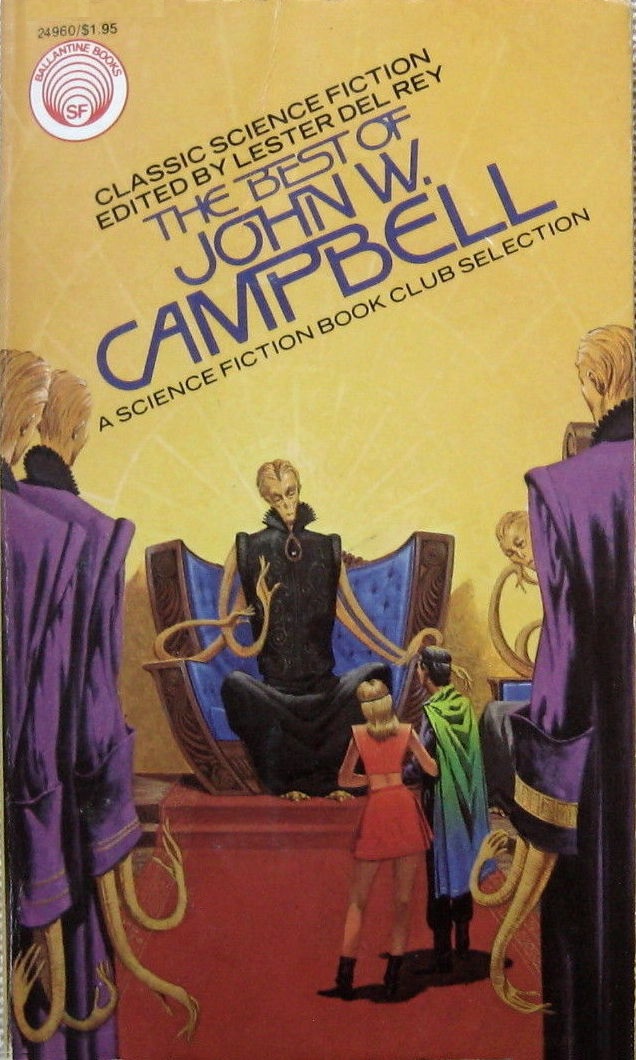
He left behind a body of brilliant work that included 57 short stories published between 1939 and 1958. In 1976, Pohl selected the 19 best for Lester Del Rey’s The Best of… series, collected as The Best of C M Kornbluth.

Read More Read More

Vintage Treasures: The Best of Henry Kuttner

Vintage Treasures: The Best of Henry Kuttner

The Best of Henry Kuttner-smallI’ve gotten used to introducing these vintage Best Of collections — as I did recently with The Best of Robert Bloch and The Best of Murray Leinster — assuming that most readers have no idea who the authors are.

There’s been a surge of interest in Henry Kuttner lately, however, and he’s been in the news half a dozen times this year at Black Gate alone. The most recent was just last week, when we listed him as one of the luminaries covered by Bud Webster’s Past Masters.

But before that, Connor Gormley wrote a Fantasy Face-Off featuring Henry Kuttner’s Elak of Atlantis vs. Robert E Howard’s Conan the Cimmerian, I discussed The Startling Worlds of Henry Kuttner and looked at his Weird Tales classic “The Graveyard Rats.” And we announced the lucky winners of the giveaway copies of Thunder in the Void, the deluxe collection of Kuttner’s Space Opera tales from Haffner Press.

It’s not just us with a recent Kuttner obsession. In just the last few years, there’s been a re-discovery of this brilliant pulp author. Haffner also published the detailed retrospective Detour to Otherness, a collection of tales co-written with his wife, C.L. Moore, and a generous volume of his weird menace tales, Terror in the House: The Early Kuttner, Volume One. He’s been a favorite over at Paizo’s Planet Stories imprint as well, and they’ve brought his classics The Dark World, Elak of Atlantis, and Robots Have No Tails back into print in handsome new editions.

Centipede Press and the Science Fiction Book Club produced a massive 915-page retrospective of Moore and Kuttner’s collaborative work in 2006, Two Handed Engine: The Selected Stories of Henry Kuttner and C.L.Moore.

And his 1943 short story “Mimsy Were the Borogoves” (co-written with Moore) was made into the feature-length film The Last Mimzy by New Line Cinema in 2007.

Seriously, that’s not bad for someone who died over 50 years ago.

Read More Read More

Galaxy Science Fiction, March 1951: A Retro-Review

Galaxy Science Fiction, March 1951: A Retro-Review

Galaxy Science Fiction March 1951-smallGalaxy’s March, 1951 issue is succinct, offering only five pieces of fiction.

I noticed this on the table of contents: “Next issue at your newsstand first week in March,” which means that the March, 1951 issue was available in early February. That’s fairly standard for magazines (probably so the reader feels like an issue is current), but I admit I still find it confusing.

“The Wind Between the Worlds” by Lester Del Rey – Instead of exploring the solar system, mankind inadvertently figures out how to transport between worlds, drawing the attention of the Galactic Counsel. As a provisional member, Earth can exchange matter with other members of the council. When someone sabotages one of the matter transmitters, it remains open, sucking in large amounts of air from Earth every second. It’s up to a couple of engineers and a bureaucrat to figure out how to switch off the transmitter before the U.S. (under increasing pressure to fix the problem) bombs the facility, which would leave the transmitter permanently open.

I like science fiction like this, where there are a variety of alien races with vastly different cultures and appearances. I also enjoyed how mankind never figured out how to travel through space; we simply figured out how to transport matter to distant areas. Plausible and entertaining.

“The Other Now” by Murray Leinster – Jimmy’s wife is killed in a car accident. But in the weeks that follow, he begins to see glimpses of another reality within his home – her cigarette butts in the ashtray, doors opened that he knows were closed. Then he sees her diary open and reads the latest entry. Not only is it the current date, but she writes of missing Jimmy since his untimely death.

This has a great Twilight Zone feel to it. Yes, I know it predates the show, but the comparison is still valid. Leinster may have been the first author to use the idea of parallel universes, given that his story “Sideways in Time” appeared in the June, 1934 issue of Astounding. I leave this open for discussion.

Read More Read More

When the 21st Century was Far Future: Frank R. Paul: The Dean of Science Fiction Illustration

When the 21st Century was Far Future: Frank R. Paul: The Dean of Science Fiction Illustration

Frank R Paul The Dean of Science Fiction Illustration-smallI consider Frank R. Paul to be one of the most important — if not the most important — artist in the history of science fiction.

It’s odd then that so few readers today are familiar with his work. Jerry Weist set out to correct that with Frank R. Paul: The Dean of Science Fiction Illustration, a dream project of his that was released only after Weist’s death in 2011.

Paul virtually created American Science Fiction, alongside Hugo Gernsback, in the late 1920s. He was the cover artist Gernsback chose for the first science fiction magazine, Amazing Stories — every single issue, for over three years, until Gernsback lost control of it in 1929.

That meant Paul crafted many of the defining images of early science fiction, including his interpretation of Buck Rogers (on the cover of Amazing August 1928), H.G. Wells’s The War of the Worlds (August 1927), and Edgar Rice Burroughs’s John Carter of Mars (Amazing Stories Annual 1927). He made exciting new concepts like space travel, picture-phones, aliens, and robots vivid and real to an America where most people didn’t even own a telephone.

When Gernsback left Amazing behind and founded a new stable of magazines — including Science Wonder Stories and Air Wonder Stories — he took Paul with him. Altogether, Paul painted over 300 magazine covers before his death in 1963, most of them for Gernsback.

Paul had numerous artistic firsts. He was the first to paint a space station, for the cover of the August 1929 Science Wonder. He painted the cover for Marvel Comics #1 in October, 1939, giving the world its first look at the Human Torch.

Paul did countless interior illustrations as well. In addition to his striking cover art, he executed a famous series of original paintings imagining life elsewhere in the solar system for the back covers of many of Gernsback’s magazines.

Read More Read More

Vintage Treasures: The Best of Robert Bloch

Vintage Treasures: The Best of Robert Bloch

The Best of Robert BlochRobert Bloch — who died in 1994 at the age of 77 — had a lengthy and enviable career as a dark fantasy and horror writer, producing over 30 novels and hundreds of short stories.

Of course, all of that was overshadowed by his greatest success: the 1959 novel, Psycho, adapted by legendary director Alfred Hitchcock as perhaps his most famous film.

But there’s a lot more to Robert Bloch than just Psycho, as most fans know. Bloch was one of the earliest members of the Lovecraft Circle and Lovecraft was his early mentor. Bloch began writing to Lovecraft in 1933, after discovering his stories in Weird Tales, and his first professional sales to the same magazine a year later — when he was only 17 — were heavily influenced by him. Bloch even used Lovecraft as a (doomed) character in his 1935 short story “The Shambler from the Stars.” Lovecraft returned the favor, killing off his character “Robert Blake” in “The Haunter of the Dark” (1936), which he dedicated to Bloch.

Bloch gradually expanded his correspondence to Clark Ashton Smith, August Derleth, and others laying the groundwork for what would eventually be known as the Cthulhu Mythos. Together, they built on Lovecraft’s work, kicking off a tradition that is still very much alive today.

Bloch didn’t just hobnob with the Lovecraft Circle — in 1935, he joined The Milwaukee Fictioneers, a group of pulp fiction writers including Ralph Milne Farley, Raymond A. Palmer, and Stanley Weinbaum. Around the same time, he became friends with C.L. Moore and her husband Henry Kuttner. Man, those pulp writers sure stuck together.

After Lovecraft’s death in 1937, Bloch continued writing for Weird Tales, but also expanded to other markets, including Amazing Stories, Famous Fantastic Mysteries, F&SF, and many others. Real notice came with his early story, “Yours Truly, Jack the Ripper,” which originally appeared in Weird Tales in 1943 and became one of the most reprinted fantasy tales of the 20th Century.

Read More Read More

Professor Jameson’s Space Adventures, or Zoromes Make the Happiest Cyborgs

Professor Jameson’s Space Adventures, or Zoromes Make the Happiest Cyborgs

Amazing Stories April 1938-smallI first ran across Neil R. Jones’s Prof. Jameson stories in junior high while reading Isaac Asimov’s Before the Golden Age — which, by the way, is one of my favorite anthologies.

Neil R. Jones’s first Prof. Jameson adventure appeared in the July 1931 issue of Amazing Stories. In this first story, “The Jameson Satellite,” Mr. Jones gives us all the background information that we’ll ever need to follow this wonderful over-the-top space adventures of Professor Jameson and his Machine Men colleagues, the Zoromes!

Within the first few pages, we learn that Professor Jameson of the 20th century had a horrible revulsion against being buried and subsequently becoming worm food after his death. So, to ease his mind, he arranged to have his body placed in a hermetically sealed rocket after his death and then launched into orbit around the Earth.

Following me so far? Good. So now we skip ahead 40,000,000 years to find the Professor’s orbiting Tupperware bowl still circling a now-dead Earth, which is itself orbiting a dying Sun which has cooled off and become a Red Giant (we now figure that this’ll actually take somewhere around 5 billion years to happen). So far so good? Good!

We then meet a group of intergalactic explorers who are at this very moment investigating our dying solar system. Their sensors pick up a metallic object orbiting the Earth.

Now of course the reader knows immediately what the object actually is. When they finally approach Earth and discover Prof. Challenger’s coffin-ship, they take it aboard their own greatly larger ship.

It turns out that the Zoromes aren’t your run-of-the-mill extra-terrestrial explorers. Nope, they are actually cyborgs! The Zoromes wanted dearly to explore the galaxy, but knew their mortal bodies wouldn’t survive a journey that might entail thousands of years, so they traded flesh and bone for metal and circuitry. Makes sense to me.

Read More Read More

Vintage Treasures: Tales of Outer Space, edited by Donald A. Wollheim

Vintage Treasures: Tales of Outer Space, edited by Donald A. Wollheim

Tales of Outer SpaceSometimes I think I owe Donald A. Wollheim for a big chunk of my childhood.

Today we’re looking at Tales of Outer Space, a collection of interplanetary adventure tales edited by Wollheim in 1954, a decade after he invented the mass-market SF anthology with The Pocket Book of Science Fiction in 1943 (the first book with the words “Science Fiction” in the title), and not long after he produced  the first original SF anthology, The Girl With the Hungry Eyes, in 1947.

That’s some pioneering stuff. But Wollheim spent most of his career as a pioneer. From 1947 to 1951, he was the editor of Avon Books, where he introduced mainstream America to mass-market editions of some of the best fantasy from the pulp era — including Ralph Milne Farley’s An Earth Man on Venus (which I discussed last month), A. Merritt’s The Moon Pool, and eighteen issues of the highly sought-after fantasy paperback magazine, The Avon Fantasy Reader, among many other accomplishments. He even published C. S. Lewis’s Silent Planet space trilogy.

In 1952, Wollheim left Avon to spearhead a new paperback imprint, Ace Books, where he remained for 20 years. While there, he added science fiction to their lineup for the first time and, in a stroke of brilliance which endeared him to future generations of paperback collectors, invented the Ace Double in 1952.

You may have heard of some of his other successes at Ace as well: he first introduced Tolkien’s The Lord of Rings to the US in 1964 (against Tolkien’s wishes, as it happened) and published Frank Herbert’s obscure hardcover Dune in a paperback edition that made it a bestseller in 1965.

That ought to be enough for anyone. But of course, as many of you know, it wasn’t enough for Wollheim. In 1971, he left Ace to found his own publishing company, which bore his initials. DAW was the first mass market publisher to specialize in SF and fantasy, and before his death in 1990, it had acquired and published over a thousand titles, making it one of the most successful genre publishers of all time.

Of course, most of that was in Wollheim’s future when he released Tales of Outer Space — but the seeds of greatness were already there for anyone who looked.

Read More Read More

Vintage Treasures: The Best of Murray Leinster

Vintage Treasures: The Best of Murray Leinster

The Best of Murray LeinsterI first encountered Murray Leinster… wow, I don’t even know when. Probably in The Hugo Winners, Isaac Asimov’s 1962 anthology collecting the first short stories to win science fiction’s coveted prize.

It featured Leinster’s 1956 novelette, “Exploration Team,” about a desperate rescue attempt on a distant planet — involving an illegal settler blackmailed into helping a lost colony, and his team of Kodiak bears. Lost colonies, deadly aliens, and even more deadly bears… that’s the kind of story that sticks in your mind when you’re twelve, believe me.

Leinster died in 1975; he published his last book, a novelization of the Land of the Giants TV series, in 1969. But he was a steady presence on bookstore shelves during my formative reading years for well over a decade after his death, with reprint titles like The Med Series (Ace, 1983) and The Forgotten Planet (Carroll & Graf, 1990).

The mass market reprints have tapered off over the last few years. The last were all from Baen, a trio of excellent collections all edited by Eric Flint and Guy Gordon: Med Ship (2002), Planets of Adventure (2003), and A Logic Named Joe (2005).

Since then, the wheels of publishing have ground on, as they do, abandoning Leinster by the side of the road. We did our part to keep his memory alive, of course. I reprinted one of Leinster’s earliest pulp tales, “The Fifth-Dimension Catapult,” from the January 1931 Astounding Stories of Super-Science, in Black Gate 9.

There have also been low-budget digital editions of his out-of-copyright pulp fiction, sure, but by and large the genre — as living genres should — has focused instead on new and emerging authors.

I used to think that was inevitable. Readers have long memories, but publishing industries don’t, and when an author has been out of print for over a decade, she’s likely to remain that way.

But the brilliant Lester del Rey, publisher of Del Rey Books, proved me wrong. In fact, he proved me wrong nearly four decades ago, with a fabulous line of top-selling paperbacks collecting the best short science fiction and fantasy from the writers of the Golden Age of SF — including The Best of Murray Leinster, a collection of some of the best short SF and fantasy of the 20th Century.

Read More Read More

Kirkus Looks at Galaxy Science Fiction

Kirkus Looks at Galaxy Science Fiction

Galaxy February 1951Over the last few months, Matthew Wuertz and Rich Horton have been tag-teaming a series of Retro Reviews here at Black Gate, looking at science fiction digests from the 1950s and 60s — especially H.L. Gold’s Galaxy, which Matthew has been covering issue by issue since the very first, cover-dated October 1950.

Meanwhile, Andrew Liptak at Kirkus Reviews has done his own retrospective, “Changing the Playing Field: H.L. Gold & Galaxy Science Fiction,” a detailed and affectionate look at Gold and the superb magazine he created:

Galaxy appeared in October 1950 as a monthly publication. It paid far better than its competitors, and Gold proved to be a far better editor than his counterpart at Astounding… With Gold at the helm, Galaxy Science Fiction began to change the tone of the genre. Astounding had taken advantage of the scientific rush that followed the development of the atomic bomb, and the resulting doomsday stories that followed. Gold went in another direction, explaining in an editorial that “The shape humanity is in is cause for worry, I believe, but not the kind of paralyzing terror that clutches science fiction writers in particular… Look, fellers, the end isn’t here yet.”

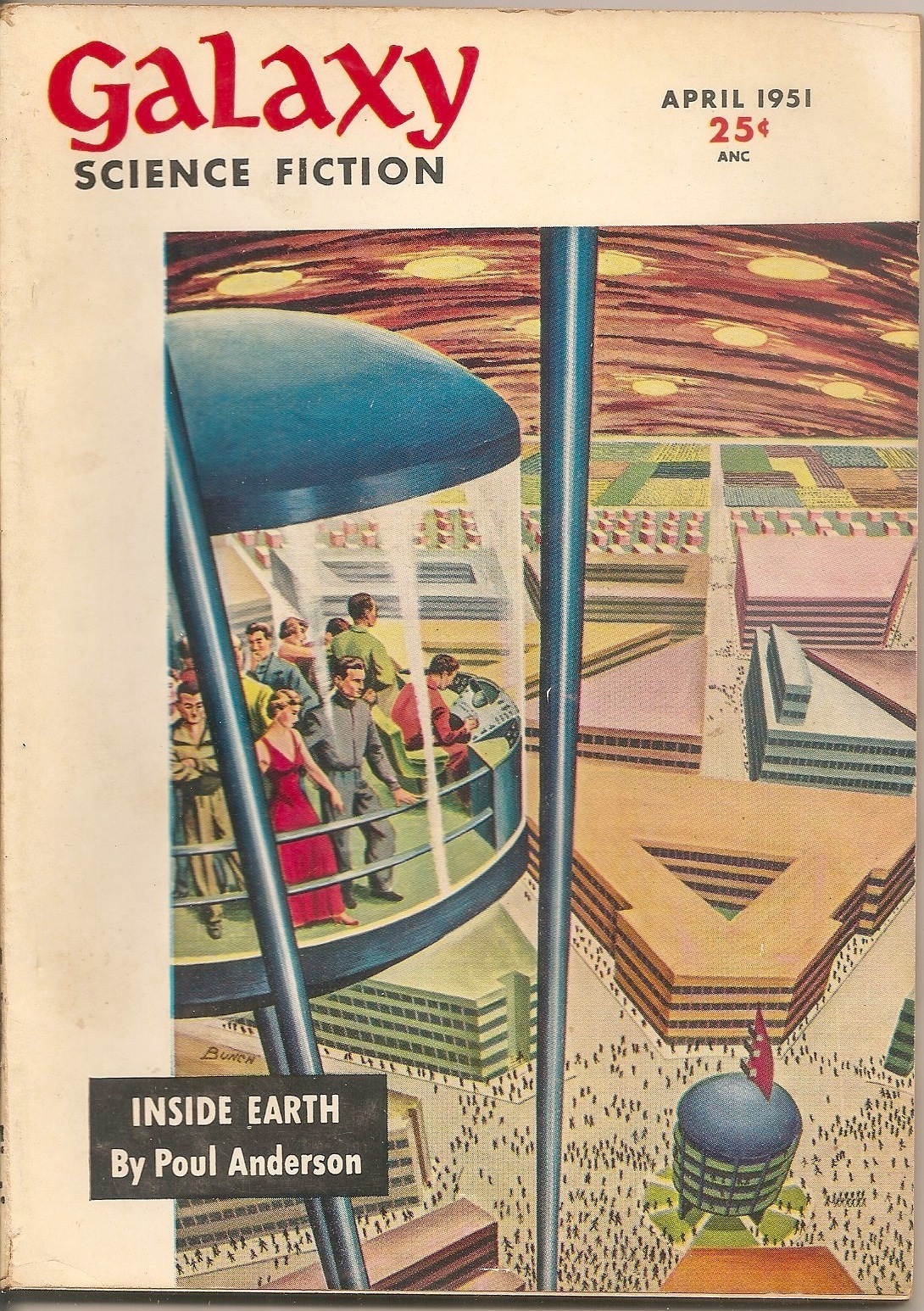
Strong, socially aware and satirical fiction became the mainstay with Galaxy, and 1951 proved to be an excellent year for the publication: “The Fireman,” by Ray Bradbury, appeared in the February issue, set in a dystopian world where literature was burned by government agents, and was later expanded into his landmark novel Fahrenheit 451. April brought Cyril Kornsbluth’s story “The Marching Morons,” and September saw Gold bring Robert Heinlein away from Astounding with his three-part story The Puppet Masters

Read More Read More