Fantasia 2016, Day 11 ,Part 1: Fragmentation and Fistfighting (Holy Flame of the Martial World and the Fragments of Asia 2016 Short Film Showcase)
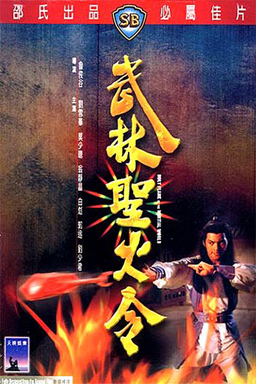 I’d marked four screenings on the Fantasia schedule to attend on Sunday, July 24. The first two were both at the small De Sève Theatre: a presentation of the 1983 Shaw Brothers film Holy Flame of the Martial World (Wu lin sheng huo jin), followed by a short film showcase. The showcase, Fragments of Asia 2016, promised half-a-dozen pieces from across Asia, both animated and live-action. Afterward I’d have time for food, and then two more movies would follow. Before all that, though, came one of the films I’d immediately highlighted when I first saw what was playing at this year’s Fantasia.
Each of the last two years I’ve been covering the Fantasia festival, they’ve shown a vintage film from the Shaw Brothers Studio, a classic martial-arts movie house from decades past. After last year’s Buddha’s Palm (Ru lai shen zhang) and 2014’s Demon of the Lute (Liu zhi qin mo), I was eager to see what would follow. That turned out to be Holy Flame of the Martial World, directed by Lu Chin-ku from a script he wrote with Cheung Kwok-Yuen from a story by Siu Sang. (I’ve seen references saying it was based on a comic, but can’t find a title or creator credits.) The print we saw was on 35mm film, possibly the last remaining such copy, and followed an equally-vintage trailer for Secret Service of the Imperial Court, also directed by Lu.
Holy Flame of the Martial World is one of several films from the Shaw Brothers house in the early 80s that turned to special visual effects to try to draw audiences in the wake of the success of Star Wars. The formula of ritualised martial-arts combat from earlier movies was expanded with mystical powers, supernatural beasts, and energy beams, all in the service of an aesthetic bent on entertaining the audience first, last, and always — character development and dramatic coherence be damned. In this case, the story’s engagingly complex and mostly coherent, with martial-arts factions proliferating, mystical quests, and a final high-powered showdown. A young couple are killed by baddies, and their infant son and infant daughter raised by enemy kung-fu teachers. Eighteen years later, the two children (Max Mok and Yeung Ching-Ching), without knowing the true story of their parents or who each other really is, seek the different halves of the ultimate weapon, the Holy Flame.

 The evening of Saturday, July 23, was going to be busy for me, with three shows at the De Sève Theatre. First, a showcase of short films called Born of Woman, which the Fantasia program told me would feature nine films by women directors “centred largely around themes of the body and interpersonal malaise.” Then after that two science-fiction features. The first would be Realive, about a man from our time (or close to it) who dies and is cryonically revived in 2083. The second would be Tank 432, about a squad of soldiers seeking shelter from a surreal battle within a battered tank. It looked like a promising night, and it got off to a good start in the late afternoon with the Born of Woman showcase.
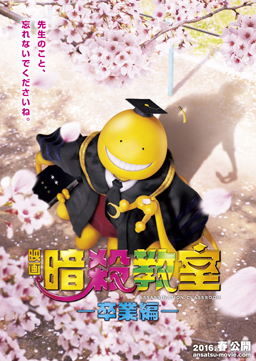 Saturday, July 23, was going to be a long day for me at the Fantasia film festival, filled with some tough choices about what to watch. Some of those choices were clarified early on, when thanks to the good work of the people at Fantasia I was able to watch a screener of Assassination Classroom: The Graduation. That resolved a schedule conflict later in the day, and just after noon I’d see my first theatrical screening: Nova Seed, a Canadian animated feature that was playing with an almost half-hour-long short film from Mexico, Revoltoso. After that I had a couple hours until the next set of movies, and I planned to get a good meal. This did not happen. Instead I’d end up taking a test drive of the future — or what seems to me like the future, or at least like a future.
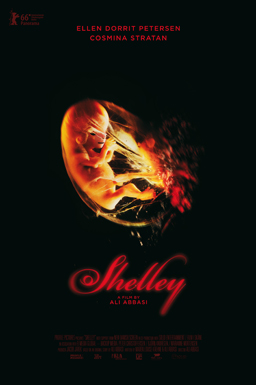 Weekends are busy at the Fantasia International Film Festival, and Friday, July 22, saw things beginning to ramp up for me after a slow few days. After much internal debate, I decided to see three movies, all of them horror films of different kinds. First came the Danish film Shelley, at the Hall theatre, about sinister events around a surrogate mother in an isolated household. Then would come a Japanese film, The Inerasable (Zange —Sunde wa Ikanai Heya), about two women investigating a ghost manifesting in an urban apartment. Finally would come an animated Korean zombie movie, Seoul Station (Seoulyeok). They promised three very different tones. And, as it turned out, delivered nicely.