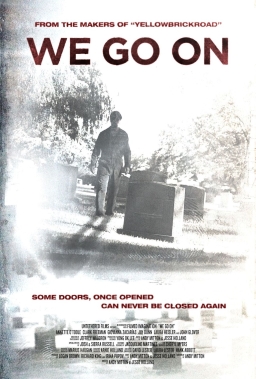
 I had errands keeping me away from the Fantasia film festival on Monday, July 25. Now, interruptions are a sad fact of life, but sometimes it’s easy to get back into the swing of things; and as it happened the next day I made it back to the De Sève theatre to watch an American horror film called We Go On, which served to get me back into the Fantasia spirit. Then the day after that I saw two more movies at the De Sève, an odd Swiss romance called Aloys followed by a French horror film called Therapy. The latter had been directed by 16-year-old Nathan Ambrosioni — his second feature film. Together the movies made an odd meditation on life, death, and horror.
We Go On was written and directed by Andy Mitton and Jesse Holland (the IMDB credits Holland with “story,” while Mitton gets credit as “writer” as well as for screenplay and story). Miles Grissom (Clark Freeman) is an adult man in Los Angeles suffering from a crippling fear of death. He therefore offers $30,000 to anyone who can prove that there’s life after death — reincarnation, ghosts, anything. Deluged with people who claim to have proof, Miles and his cynical mother (Annette O’Toole) begin a quest to investigate the most promising responses. Things do not go as Miles might have expected.
Nor do things go as the audience might have expected either, and in this case I mean that in the best way. We Go On is thoroughly unpredictable, with an unusual structure and a story that moves between horror and character-based drama. Miles and his mother almost alternate as leads, and one can make a strong argument that the crucial choice shaping how the climax plays out is hers.
More than that, when Miles first gets responses to his offer, he’s able to eliminate most out of hand except for three or possibly four. He then investigates those few contacts one by one; as you might expect he has no luck at first. Also as you might expect his early investigations end up returning to become relevant to the movie later on. But how they become relevant is interesting. In one case it’s plot-related, but another is more thematic, putting forward ideas about fear and the supernatural that inflect the rest of the movie.
…
Read More Read More
 Last July, I was lucky enough to see Anna Biller’s film The Love Witch at Montreal’s Fantasia International Film Festival. After screening there and at various other festivals, it opens today in New York, with more cities to follow. Here’s how I described it back in August:
 “It’s an accepted fact that all writers are crazy; even the normal ones are weird.” Wm. Goldman
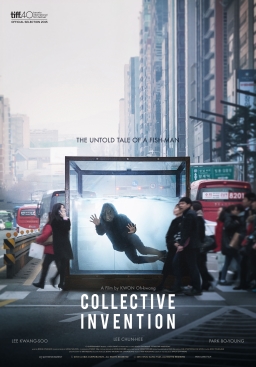 By July 29, the sixteenth day of the Fantasia Festival, I was beginning to feel exhausted. I’d had some thoughts of watching three movies that Friday, but in the end could only manage two. I made it down to the Hall Theatre in the afternoon to watch the Korean satire Collective Invention (Dolyeonbyuni), then came back right after for the raucous Japanese comedy Too Young To Die! (Too Young To Die! Wakakushite Shinu). Neither struck me as flawless, but both in different ways were interesting experiences.
 Impossible to predict some things. Notably: you can’t know how you’ll react to a work of art until you’ve experienced it. Looking at the movies Fantasia offered on Sunday night, July 24, I thought I’d try If Cats Disappeared from the World (Sekai kara neko ga kietanara), which promised a tale about a terminally ill man who makes a surreal Faustian bargain. After that, I decided I should watch Superpowerless, as it was a genre piece about an aging superhero who’d lost his powers. In truth, I had my doubts about both movies; Cats looked it might suffer from excess of romanticism and forced whimsy, while Superpowerless seemed like some kind of mumblecore satire treading ground comics had worked over decades past. In the event, I was wrong to doubt. If Cats Disappeared from the World would be likely the best movie I saw at Fantasia, and probably my favourite. Superpowerless, meanwhile, turned out to be the festival’s most pleasant surprise, the film which most greatly exceeded all my expectations.