Browsed by
Category: Magazines

These Just In…

These Just In…

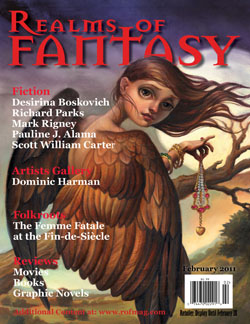
feb-2011-cover-web2 The first Realms of Fantasy resurrected under new publishers, Damnation Books, for February 2011 features the fiction of Desirina Bokovich, Richard Parks, Mark Rigney, Pauline J. Alms and Scott William Carter.  The last has a story entitled “The Time of His Life” which is described as:

It’s so difficult to find time for yourself amid the demands of family and work.  Wouldn’t it be great if you could just carve some out?  Maybe, maybe not.

Realms of Fantasy tends to favor a wee bit too much of fairy land for my tastes  (an unfair criticism, since that is, after all, a large part of its niche), but this sounded different and intriguing enough to get my immediate attention. Who after, all, hasn’t fantasized about having some private place to get away from it all?

In this case, the narrator discovers a room in which he can spend as much time as he wants on creative pursuits, but only minutes have gone by when he returns to the real life of kids and bitchy wife and work.  A Twilight Zone kind of tale that’s ultimately about resisting the allures of temptation and self-gratification.  The wife’s transformation from bitch to loving partner isn’t quite believable, though perhaps Williams is suggesting this has less to do with the wife’s actual attitude than the husband’s perception. And he does get right the marital tension between two equally tired (but for different reasons) partners with young children.  

black-static-291However, I have to wonder what the editors do here at this magazine.  Okay, maybe you can make an argument that intense cold could actually scorch, though I tend to associate it with extreme heat. But racing minds, chills going up a spine, the mere mention of a shudder should send off alarm bells to break out the red pencils and clean up clumsy phrasing that mars an otherwise decent story.

Horror magazine Black Static for February-March 2011 has new tales from V. H. Leslie, Ray Cluley, Maura McHugh, Ed Grabianowski and James Cooper.  In the “first lines that hook you into the story” department, here’s the opening to McHugh’s “Water”:

“The pot lids hopped and fizzed when Mark’s mother laid the wooden spoon down calmly, opened the back door of the kitchen, disappeared into the overgrown garden, and drowned herself in the river that flowed past their house.”

True horror lies not in the stuff of sexy vampires or ghost stories or chainsaw massacres, but within the mundane context of ordinary existence.

March/April Fantasy & Science Fiction Magazine Now on Sale

March/April Fantasy & Science Fiction Magazine Now on Sale

fsf-apr-may-2011The March/April double issue of Fantasy & Science Fiction goes on sale today.

Click on the image at left for a full-sized version of the cool cover art by Kent Bash, illustrating Sheila Finch’s novella “The Evening and the Morning.”

In addition to Finch, this issue features novelets by Albert E. Cowdrey and Francis Marion Soty, and short stories by Paul Di Filippo, James Patrick Kelly, Kali Wallace, James Stoddard, and others.

It also includes “Night Gauntlet,” a short story attributed to no less than six authors: Walter C. DeBill, Jr., Richard Gavin, Robert M. Price, W. H. Pugmire, Jeffrey Thomas, and Don Webb. Looking forward to that one!

F&SF is published six times a year; issues are a generous 258 pages.  It is the longest-running professional fantasy magazine in the country, and has been published continuously since 1949. It is a great way to sample some of the fast-rising new names in fantasy.

The cover price is $7.50; one year-subscriptions are a bargain at $34.97, and include the giant October/November anniversary issue. You can order subscriptions and browse their blog at www.sfsite.com/fsf/.

We covered the Jan/Feb issue of F&SF here.

TANGENT’s Best of 2010

TANGENT’s Best of 2010

It’s nice to be noticed…

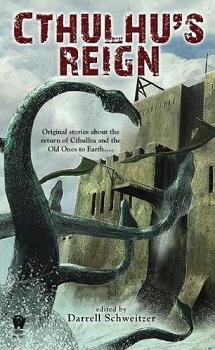
cthulhus-reignOne of my very own stories has just been included in the TANGENT ONLINE RECOMMENDED READING LIST for 2010. The tale is “This Is How the World Ends,” from the CTHULHU’S REIGN anthology (DAW).

Here’s the complete list.

Every year TANGENT creates such a list, with the goal of “working for you, finding the gold buried in the dross, the diamonds in the dungheap, and bringing these gems to your attention.” This year there are 190 short stories, novellas and novelettes recommended. The site indicates that “for every story you see on this list, there are at least four others that didn’t make the cut.” I am thrilled and honored to be included in the final list. Thanks, guys!

I have to note that there are four other stories from CTHULHU’S REIGN that also made the TANGENT list…for a total of five humdingers. A real indication of just how good this Cthulhoid anthology truly is.

(I would only add that Laird Barron’s “Vastation” really should be on the list as well…the mad genius of Laird’s story was one of the book’s most mind-blowing moments for me.)

stAlso on the list is a terrific story by an amazing writer, “In the Dreaming House” by Darrell Schweitzer, which ran in SPACE & TIME #110. Nobody writes a dark fantasy tale like Darrell…he is a true Master. BTW, you can still order this issue from the SPACE & TIME website. I’ve also got a new story, “The Gnomes of Carrick County,” coming up in S&T later this year. http://spaceandtimemagazine.com/wp/

Finally, there are several stories from BLACK GATE on the list…continuing to show how BG is one of the most important and vital fantasy mags in existence today. Carry on, Gents!

Peace,

John

John Klima Ends Print Version of Electric Velocipede

John Klima Ends Print Version of Electric Velocipede

ev21-224John Klima, the editor of the Hugo-Award winning magazine Electric Velocipede, has announced that issue #21/22 will be the final print issue:

After much discussion, I’ve decided to dissolve my partnership with Night Shade Books. Our final issue together is issue #21/22, which went to the printer in November. It should be arriving at the Night Shade offices soon and be shipping out any time now. Please watch here for more details.

While Night Shade has done a good job in supporting the magazine from a production standpoint, they are not in the business of periodicals and as such our subscription numbers and individual sales have suffered to the point that it made no sense to continue with our current model. Night Shade wants to focus its energies on its core business of publishing and selling books….

Night Shade has graciously offered to pay the contributors whose work I had accepted for publication in the coming year as Electric Velocipede issues #23 – 25. After some discussion with the contributors, we are going to post the content of these issues online for the readers and fans of Electric Velocipede. We’re still working out the logistics on our side for how that will happen, so you’ll have to watch here for the final details. If this works as planned, the magazine will be completely online in 2012, opening for submissions towards the end of 2011.

Electric Velocipede is one of the finest small press genre magazines on the market.  It has published work by Jay Lake, Jeff VanderMeer, Neal Barrett, Jr, Paul DiFilippo, Liz Williams, Charles Coleman Finlay, Hal Duncan, Jeffrey Ford, Tobias Buckell, Catherynne M. Valente, Marie Brennan, and many others.  It won the Hugo Award for best fanzine in 2009, and has been a four-time World Fantasy Award nominee.

Issue 21/22, a big double issue, contains fiction from William Shunn, Shannon Page and Jay Lake, Shira Lipkin, Jenna Waterford, Michaela Roessner, and many others. It is available for $12 directly on the website.

The complete announcement is here.

Short Fiction Review 34c: Interzone #232 Et Al…

Short Fiction Review 34c: Interzone #232 Et Al…

The last couple of weeks I looked at Douglas Lain’s “Noam Chomsky & the Time Box” and “Intellectual Property” by Michael R. Fletcher from the January/February Interzone.  Rounding out the issue’s fiction are stories by Sue Burke, Sarah L. Edwards and James Bloomer.  All share to one extent or another the time honored science fictional Frankenstein theme that ponders the relationship between technology and personal responsibility.

interzone-289_largeThe Edwards tale, “By Plucking Her Petals” is the one out right fantasy among the science fiction, though, for those who care about making such distinctions, arguably alchemy could be considered a “science” and the ethical implications of manipulating human appearance purely for cosmetic reasons is a longstanding SF trope.

Monticello Dabney makes potions that, while painful, can improve the looks of his mostly female clients. Typically, the alchemical applications are brewed from plants and animals, but on rare occasion a human donor can provide a particularly valuable elixir.

Dabney becomes fixated on the motivations of one such mysterious donor.  A “beauty and the beast” riff that has a few creaky plot points, but aims to place humanity over mere technology.

interzone-291-2Burke’s “Healthy, Wealthy and Wise” is a bit more ambiguous on that subject.  The narrator is a “Friend,” an Artificial Intelligence that belongs (though who exactly who or what belongs to whom is part of the point) to a U.S.  college student, Brianna, seking to escape her dreary midwestern existence through an exchange program trip to Madrid. One requirements, however, is for Brianna to be the caretaker of Letitia, an unmarried, non-professional middle aged woman in cancer treatment. Letitia doesn’t much care for Brianna for reasons partially related her health, but also her age and social standing.  The Friend works to try to patch things up between the two.  However, even such a seemingly altruistic gesture to improve human relations carries with it a subtle hint of perilous prospects.

Bloomer’s “Flock, Shoal, Herd” is the 2010 James White Award winning story. This is a “going native” story in which the consciousness of military operatives can are somehow or another embedded in the animals and fauna of the title. The war is over, and the narrator’s lover has decided she much prefers her expanded  consciousness somewhere other than in human form.  The narrator wants her back to resume the pleasures of human existence as does the government (represented by a character named Humphrey that I have to think is a nod to Bogart) for other reasons than reuniting the lovelorn.  Love doesn’t win out, because you can never go home again, but you can escape it.

For my money, overall a particularly strong issue.

Short Fiction Review 34b: Intellectual Property

Short Fiction Review 34b: Intellectual Property

2881Dhaka, the capital of Gano Projatontri Bangladesh.  With a  population of thirteen million the city was a madhouse. Buses and plastic Tata Kei Cars spewed thick smoke from their struggling two cylinder aluminum engines. The heat and pollution were stifling and the cacphony of car horns relentless.  This place was more than enough to drive you mad. It was dirty. It was overcrowded. It was dangerous.
I loved it

p. 16

We’re in cyber noir territory, and this kind of thing just hooks me in.  As I work my way through the January-February Interzone, I’m reminded of why this is one of my favorite SF magazines — I’m just an old cyberpunk at heart.  Having spent a good part of my working life with high-tech companies, the amoral shenanigans of near future corporations in the relentless pursuit of profit where human casualty is not a bottom line consideration is fascinatingly all too familiar. To bad it’s not outright fantasy rather than speculative fiction that hits close to the bone.

Case in point is Michael R. Fletcher’s “Intellectual Property” set in a third world country in which it is easier for a multinational to exploit human resources because, as Richard Blaine once put it, “Life is cheap.”  There are two alternating first person narrators.  The first is  a “deep cover agent for a Corporate Espionage Black Ops unit” whose world weary cynicism provides the opening lines above.  The second, Anomie, is a young woman bioengineered with a neural socket that allows a complete takeover of her consciousness by her research employer; a significant drawback is that once unplugged, she has no recollection of what her employers are using her for.

While you should be able to figure out the connection between these two characters before the story’s end, it is nice to have the good guys — or, at least, maybe not the good guys but the victims of the bad guys — win out.  Which is why it is fiction.

Howard Andrew Jones Reviews Level UP Issue 1

Howard Andrew Jones Reviews Level UP Issue 1

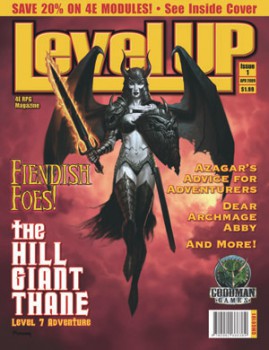
gmg9101coverlargeGaming magazines can be a great asset to planning a roleplaying game, but I’ve often considered them to not be worth the cost. This one, reviewed by our very own Howard Andrew Jones, looks like it gives quite a bit of bang for the buck (or, in this case, 2 bucks). The publisher, Goodman Games, has a solid track record for producing quality game supplements.
Level UP Issue 1

Goodman Games (55 pp, $1.99 magazine, April 2009)
Review by Howard Andrew Jones

I like this magazine. Issue 1 comes in at 55 pages, the first offering of a new quarterly publication from Goodman Games devoted to Dungeons and Dragons. It means to fill some pretty big missing boots – you probably know the ones I mean if you’re an old fan of the game – and I think it’s off to a good start.

Read More Read More

Fantasy and Lightspeed

Fantasy and Lightspeed

bgfantasy2John Joseph Adams is the editor of the anthologies By Blood We Live, Federations, The Improbable Adventures of Sherlock Holmes, The Living Dead (a World Fantasy Award finalist), The Living Dead 2, The Way of the Wizard, Seeds of Change, and Wastelands: Stories of the Apocalypse.

Forthcoming work includes the anthologies The Book of Cthulhu, Brave New Worlds, and The Mad Scientist’s Guide to World Domination.

And guess what else? He is now the editor of Fantasy Magazine and Lightspeed Magazine, the critically-acclaimed online short fiction magazines published by Prime Books.

Here are the guidelines for Fantasy.

Read More Read More

Some Little Infamy

Some Little Infamy

johannes-cabalI have been asked to write a few words on how the Johannes Cabal novels came to be published with a particular view to explaining some of the intricacies of the publishing trade. Because I am nothing if not didactic (“Didactic” means, among other things, to speak in a lecturely manner. I hope you’re taking notes – there will be a test afterwards), I have also added a few notes of advice at the end for folk who want to get into the professional novel writing gig.
There is no precise moment when Johannes Cabal leapt from my brow, side, or any other part of my anatomy. He was, as is often the way, formed by a slow aggregation of assorted ideas over quite a lengthy period that probably starts sometime in the mid to late 1980s. I had and, I must admit, still have a habit of inventing stories for my own amusement with no intention of writing them down. Usually the reason for not taking it too seriously is because I’m playing with other people’s characters, and the copyright situation discourages me from making the stories concrete; virtual fanfic, if you like.

Back in 1985 I saw a film that, as a Lovecraft fan, I was all set to hate. Instead, having seen Re-Animator I came out of the cinema enthused and excited by such a gonzo approach to Lovecraft’s work. Inevitably, I started playing around with ideas for a sequel. There used to be an old vicarage in Kearsley, southwest of Bolton on the road to Manchester, that caught my eye whenever I went by. It was a tall, severe, Victorian building with a large, circular window on its attic floor, glaring out from beneath the eaves. The window made me think of a Lovecraftian tale, and I imagined a rival to Herbert West living there. Unlike West, however, he used magic upon which he had imposed a scientific rigour. Herbert West comes to him to collaborate with predictably gory results.

I never got very far with this particular story because I found myself becoming more interested in the unnamed magic-using re-animator.

Read More Read More

Coming Soon — Black Gate 15!

Coming Soon — Black Gate 15!

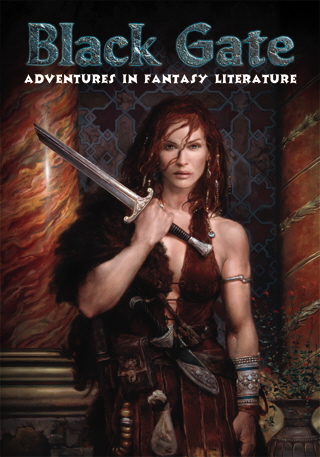
bg15_320aTeam Black Gate has been putting in a lot of overtime, and we’re just about ready to pull back the veil on our latest production. Black Gate 15 is another massive issue, with over 350 pages of fiction, reviews, and articles.  It contains 22 stories — more than any issue in our history — totaling over 150,000 words of adventure fantasy.

Jonathan L. Howard returns to our pages with “The Shuttered Temple,” the sequel to “The Beautiful Corridor” from Black Gate 13, in which the resourceful thief Kyth must penetrate the secrets of a mysterious and very lethal temple.  Howard Andrew Jones bring us another swashbucking tale of Arabian fantasy featuring Dabir & Asim, this time a lengthy excerpt from his blockbuster novel The Desert of Souls.

Harry Connolly returns after too long an absence with “Eating Venom,” in which a desperate soldier faces a basilisk’s poison — and the treachery it brings. John C. Hocking kicks off a terrific  new sword & sorcery series with “A River Through Darkness & Light,” featuring a dedicated Archivist who leads a small band into a deadly desert tomb, and John Fultz shares the twisted fate of a thief who dares fantastic dangers to steal rare spirits indeed in “The Vintages of Dream.”

Plus fiction from Vaughn Heppner, Darrell Schweitzer, Jamie McEwan, Michael Livingston, Frederic S. Durbin, Chris Willrich, Fraser Ronald, Maria Snyder, Brian Dolton, and many others.

In our generous non-fiction section, Mike Resnick educates us on the best in black & white fantasy cinema, Bud Webster turns his attention to the brilliant Tom Reamy in his Who? column on 20th Century fantasy authors, Scott Taylor challenges ten famous fantasy artists to share their vision of a single character in Art Evolution, and Rich Horton looks at the finest fantasy anthologies of the last 25 years. Plus over 30 pages of book, game, and DVD reviews, edited by Bill Ward, Howard Andrew Jones, and Andrew Zimmerman Jones — and a brand new Knights of the Dinner Table strip.

Black Gate 15 will be on sale next month. We’ll have a detailed sneak peek, with tantalizing story excerpts and artwork, right here in a few weeks. Stay tuned.

Cover art by Donato Giancola.