Vintage Treasures: George R.R. Martin’s “Nightflyers”
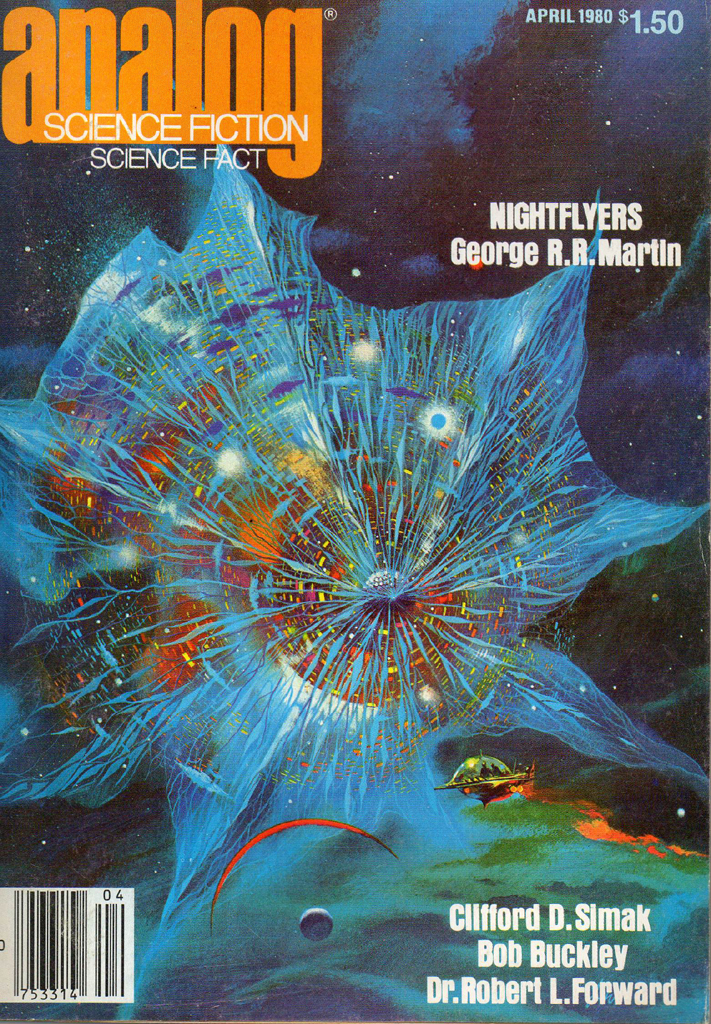 Over the weekend I put away a collection of 80s magazines I purchased a few months ago. In the process I discovered the April 1980 issue of Analog, which I read as a junior in high school in Ottawa, Canada.
There’s a lot to like about this issue, from the gorgeous cover by Paul Lehr — perhaps my favorite SF artist — to a famous short story by one of my all-time favorite SF writers: “Grotto of the Dancing Deer,” by Clifford D. Simak, which won both the 1980 Nebula Award and 1981 Hugo Award for Best Short Story. Even the ads reflect those things I personally found most exciting and fresh about SF and fantasy at the time: a full page ad from TSR for D&D, “The Ultimate in Adventure Games;” an ad for six microgames from Metagaming (the company that introduced me to role playing games), including the classic Ogre; and a subscription form for Ares, the short-lived SF gaming magazine from SPI.
This issue is an intriguing cultural artifact for other reasons. There’s an editorial from Stanley Schmidt in response to the recent kidnapping of 50 Americans at the US embassy in Iran, both a fascinating snapshot of a critical moment in American history, and a typical science fiction response:
What the Iranian crisis really demonstrates, at least as dramatically as any incident so far, is that if we want real freedom, we must produce our own energy… Technologies which can do this are possible, and we should not willingly settle for less. Readers of this magazine are well acquainted with the role space can play, but many people are not — and we need to get the action under way now.
If you read Analog in the 20th Century, you got used to this. Exploring space was pretty much the answer to everything — the energy crisis, the hole in the ozone, foreign policy crises, and crappy network television programming — and the magazine’s self-congratulatory tone clearly told its readership (including 15-year-old readers in Ottawa) that they were smarter and more informed than everyone else, especially on science and technology, topics far more important than cars, sports, and other things kids our age obsessed about. Analog told its readers they were destined for success. The future was ours.
But the real reason this issue is remembered is its cover story, George R.R. Martin’s novella of horror in deep space, the chilling classic “Nightflyers.”

 June’s Apex Magazine features ”Winter Scheming” by Brit Mandelo, “In the Dark” by Ian Nichols and “Blocked by Geoff Ryman (who is interviewed by Maggie Slater), as well as Seanan McGuire’s poem, “Wounds.” Ken Wong provides the cover art. Nonfiction by Tansy Rayner Roberts and editor Lynne M. Thomas round out the issue.
 A version for the Nook will also be available in the near future. Twelve issue (one year) subscription can be ordered at Apex and Weightless for $19.95;
 The May issue of Clarkesworld is currently
  ramblings. While I tend to think all this stuff really is the result of a bad acid trip, Critchley as a professor of philosophy for the most part keeps a straight face. Some of you may laugh out loud not only at the source material, but the attempt at exegesis.