Browsed by
Category: Role Playing Games

Take a Crash Course in the History of Computer Role Playing in The Ultimate RPG Handbook
Take a Crash Course in the History of Computer Role Playing in The Ultimate RPG Handbook

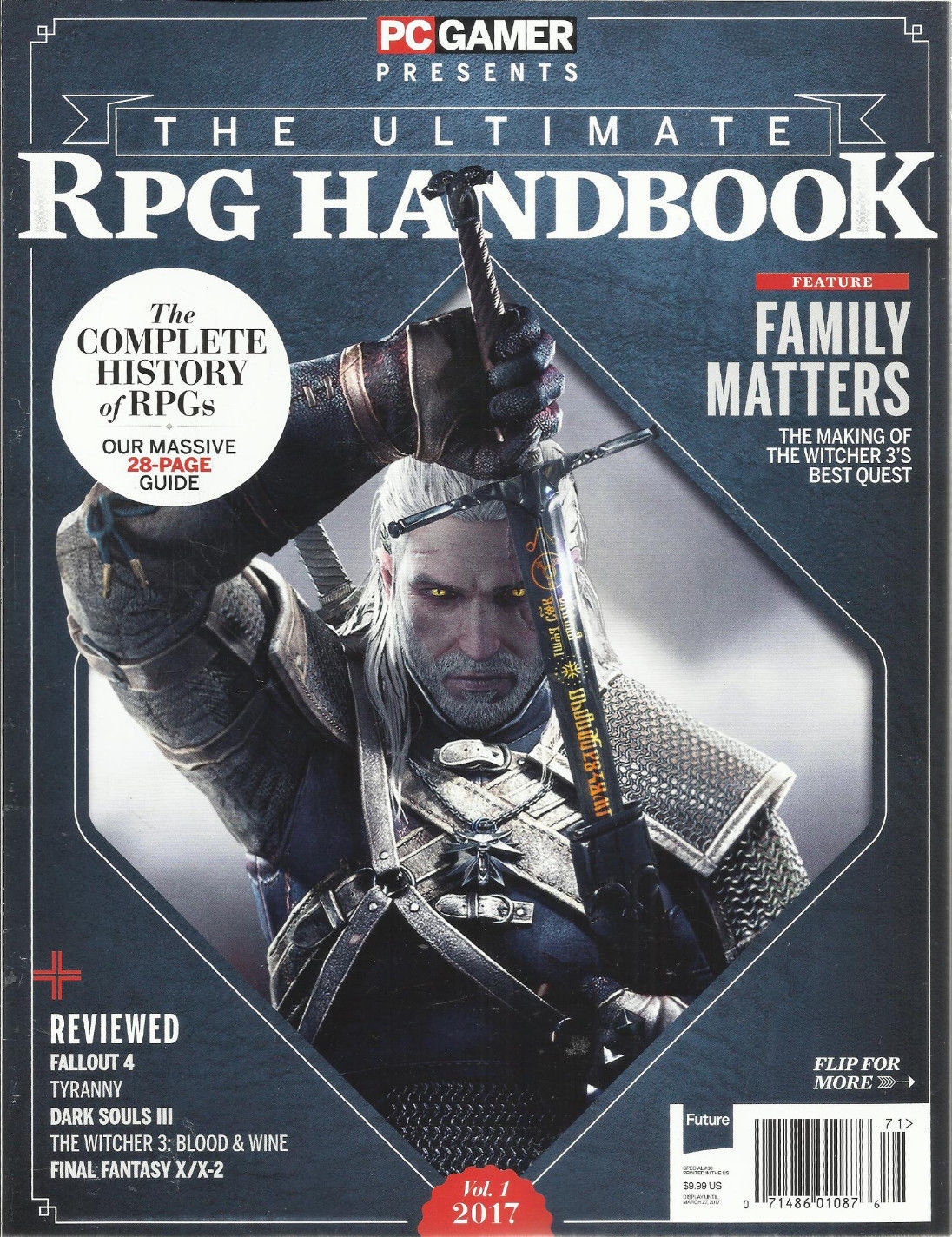
The Ultimate RPG Handbook-smallI’ve been a subscriber to PC Gamer magazine for over 22 years, since it launched as a British “Euro mag” in November 1993 (back in the days when computer hobby shops here in the US would carry British gaming magazines for the Amiga and the PC, and the magazines had disks taped to the cover. And there was such a thing as computer hobby shops.) The magazine has long had a terrific stable of writers — including Editor-in-Chief Gary Whitta, who famously left the magazine to become a screen writer. And he did, too, writing The Book of Eli and Rogue One, among others.

The artifact at right is PC Gamer Presents: The Ultimate RPG Handbook; I found it in the magazine section at Barnes & Noble on Saturday. It sorta looks like a regular issue of PC Gamer, except it has no ads, and is totally devoted to my favorite video game genre. Sweet!

Much of it is composed of reprints from the magazine, but there’s new stuff too — like Richard Cobbett’s massive 28-page full-color history of computer RPGs, starting with Temple of Apshai and Beneath Apple Manor, through Wizardry, Bard’s Tale, the SSI Gold Box Games, Star Control 2, Deus ExWitcher 3, and half a zillion titles in between. Cobbett lingers on several of the major series, like Ultima, and particularly influential games like Elder Scrolls:Arena, Baldur’s Gate, and Fallout 3. He doesn’t cover everything, of course, but his breezy style makes the whole thing entertaining and highly readable.

There’s plenty more crammed into the issue, including a feature on the future of RPGs, a long article on Witcher 3, and reviews of major new RPG releases like Fallout 4, Dark Souls III, and Tyranny (maybe they didn’t fit in the regular magazine?) There’s also a few production glitches, like the invitation on the cover to “Flip For More,” and an arrow pointing to the inside cover… which is totally blank. Nonetheless, whether you’re new to the genre or an obsessive collector who (like me) has every single game they mention, this is a terrific way to spend a few hours. Recommended.

The Ultimate RPG Handbook was published by Future Publishing in December 2016. It is 98 pages, priced at $9.99 (US edition), and 148 pages for £9.99 (UK edition). There is no digital edition, though one is promised. Get more details at the website.
Modular: Oz’s Bag of Holding: Breaking Out Basic D&D for the Next Generation

Modular: Oz’s Bag of Holding: Breaking Out Basic D&D for the Next Generation

D&D_Basic_Rules_1981I have here a bag of holding. I am going to pull some things out of it now…

Well, I’ve gone and done it. I’ve broken open the floodgates and moved my children on from Dungeon! The Board Game to the real deal.

This is fortuitous timing, as M Harold Page has launched a new series of posts (READ HERE) on Black Gate about introducing kids to tabletop role playing (which I have been reading with newly-relevant interest).

My daughter and son will soon be turning 8 and 6 respectively. Bringing the son in on things might have been a bit premature — he’s more apt to grab the miniatures and fight with them like action figures than to sit and patiently listen to a Dungeon Master try to paint a scenario in his mind’s eye.

To introduce these acolytes, I dug out my 1981 D&D Basic set (1981 edition). After decades of d20, revisiting this chestnut three decades later is kinda hilarious. D20 is so elegantly simple in concept: Hit a monster with AC 18? Roll a d20, add modifiers, and get an 18 or better. But with old-school D&D, no! You look at the monster’s AC and then have to consult a chart (I confess I’d forgotten what THAC0 even stood for). Cross-reference monster’s AC with character’s level to see what you have to roll. Basic? No, not really. Pretty damn cumbersome!

Read More Read More

Modular: The RPG Fusion of Dragon’s Dogma

Modular: The RPG Fusion of Dragon’s Dogma

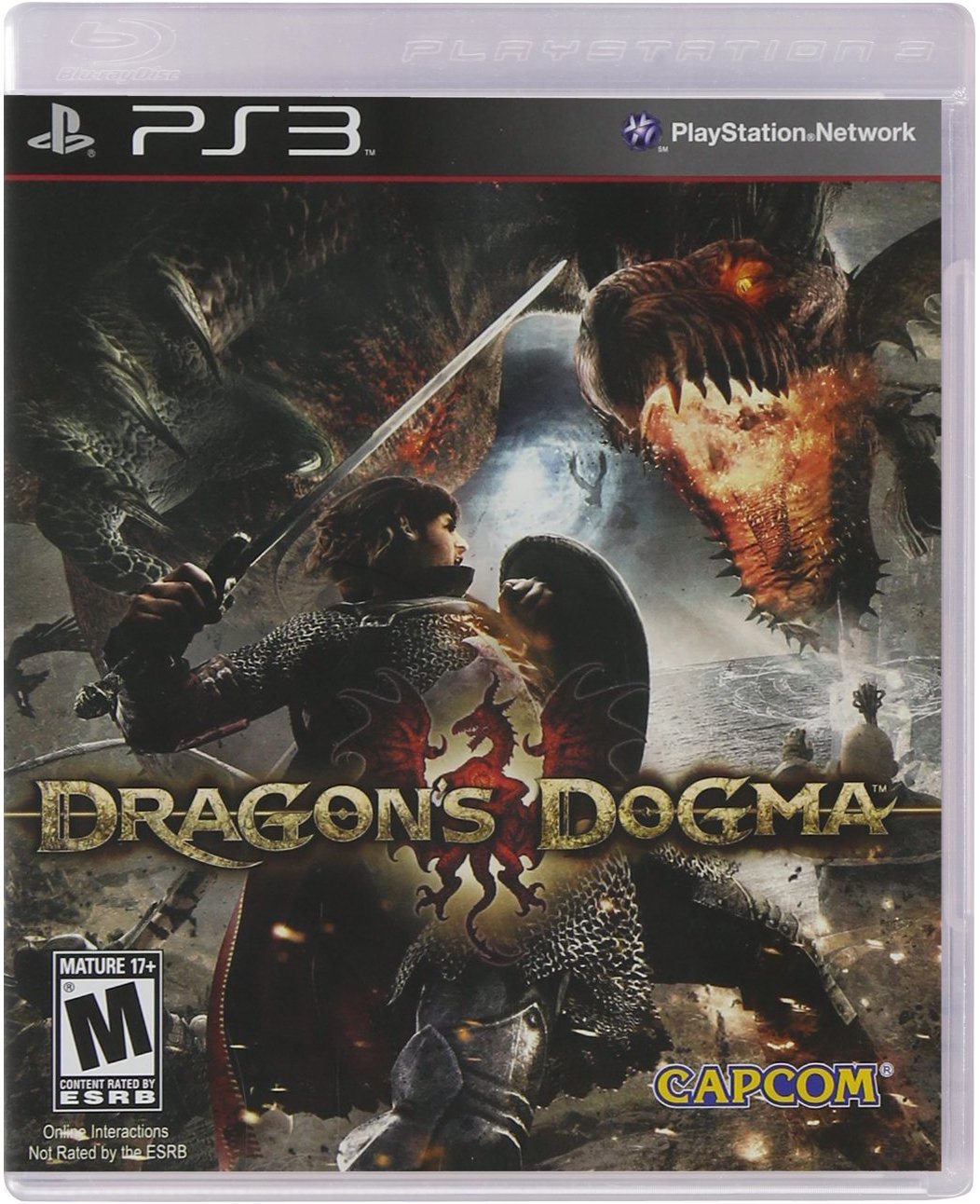
Dragon's Dogma-smallDragon’s Dogma is Capcom’s attempt at creating what could be considered Skyrim meets Monster Hunter. The game is an open-world RPG where you and your party fight giant monsters, and I do mean giant.

In their attempt to combine these two, they took one of my least favorite games and mixed it with one of my favorites; leaving me somewhere between the two.

A Dragon-Gone Day

The story of the game is that you are an Arisen; a being with the ability to lead beings called Pawns to battle. When your heart is eaten by a dragon, you begin a quest to get it back and save the world.

The game space is huge for a Capcom game, as you wander through a world full of monsters and really big monsters (but more on that in a minute.)

Unlike other RPGs where you’ll create one customized character, Dragon’s Dogma lets you create two. Your main pawn is your constant companion and you are free to completely customize them as you see fit. Pawns are the name of the game, and will determine whether you’ll succeed.

Read More Read More

Modular: Three Viking Age Supplements and One Role-Playing Game

Modular: Three Viking Age Supplements and One Role-Playing Game

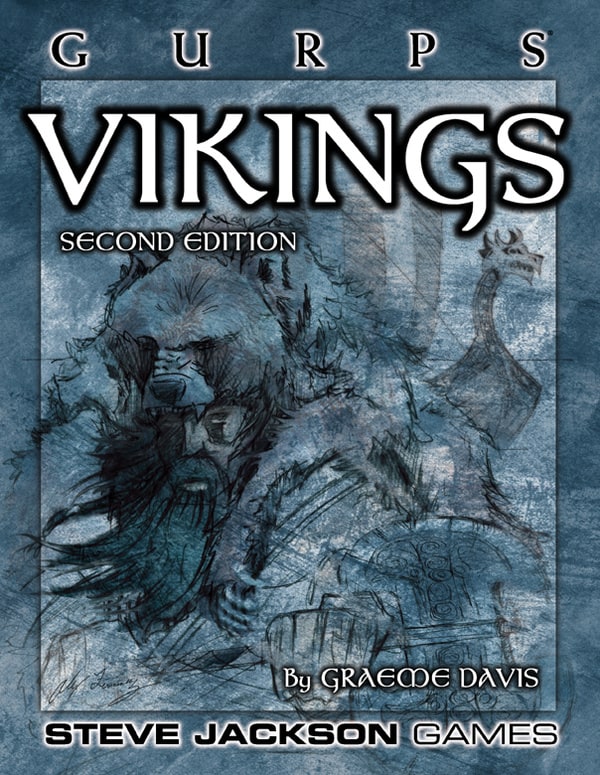
GURPSVikingsWhen I first discovered the Yggdrasill roleplaying game, I had the understanding that that Vikings-specific system existed in near-isolation. Oh how wrong I was! As I have purchased, downloaded and read Norse-themed rpg materials from DriveThruRPG and other sites, I have discovered that interest in the Northern ethos has been quite lively for some time. When, either out of mere curiosity or out of design to add to my home game, I first thought to collect Viking Age supplements, my mind naturally went to I.C.E.’s Vikings supplement for both Rolemaster and the Hero System: this was because, in my coming-of-age in the late 80s/early 90s, I was an ardent GM of MERP (Middle-Earth Role Playing, a scaled-down version of the Rolemaster rules set) and passionate about the Hero System in the form of Champions, a super-hero roleplaying game. But in those years, a young gamer with limited funds, I never could justify a pragmatic purpose for purchasing the I.C.E. Vikings supplement.

That situation has changed, now that I’m older and I have extra cash, but I still don’t have that I.C.E. supplement. The reason? Because it’s out of print and only available in hard copy via third party purveyors. The process of obtaining this seems like needless trouble when there are so many instant-gratification products available as immediate PDF downloads.

Today I will be reviewing, in the order in which I discovered and read them, three of these: GURPS Vikings, Troll Lord Games’s Codex Nordica, and Vikings of Legend for the Legend RPG System. All three of these seek to evoke a Viking Age roleplaying experience while using an existing rules set, the second type that I outline in my last post. I’ll say at the outset, though, that Codex Nordica read a lot like Vidar Solaas’s Vikings RPG, and I’m certain this is because of the similarity of the two systems that were being adapted for the Viking Age feel. Both Solaas’s D20 system and Brian N. Young’s Castles and Crusades engine have their foundations in Dungeons & Dragons, which has enjoyed so many iterations now that most of them aren’t even called Dungeons & Dragons anymore. Last post I allowed Solaas the distinction of having created an “original” Old Norse game, since he had to “hack” the D20 system so much. I’m tempted to award Young this same distinction, since in my view he visibly wrestled with many of the inflexibilities that I perceive in D&D games. But ultimately it belongs in the rpg supplement group; the following observation shares only one reason for this designation.

Read More Read More

Modular: How to Introduce Kids to Tabletop Role-Playing #2: Actually GMing Kids

Modular: How to Introduce Kids to Tabletop Role-Playing #2: Actually GMing Kids

stranger-things-netflix-dungeons--dragons
The munchkins at your table may behave remarkably like college-age players…

GMing for kids (read part 1) is pretty much like GMing for adults ; almost too much like.

Kids — especially geeky ones — don’t evolve into adulthood in a linear way. A 10-year-old can be like a 15-year-old and a 9-year-old sharing the same brain (and same bedroom, as Warhammer figures jostle with Lego). It’s very easy to GM to their more grown-up aspects and forget their younger ones, which can then throw a spanner in the works.

Obviously, it all depends on the kids and your relationship with them. However, here’s what I’ve learned…

Read More Read More

Modular: Everything You Ever Wanted to Know About The Temple of Elemental Evil

Modular: Everything You Ever Wanted to Know About The Temple of Elemental Evil

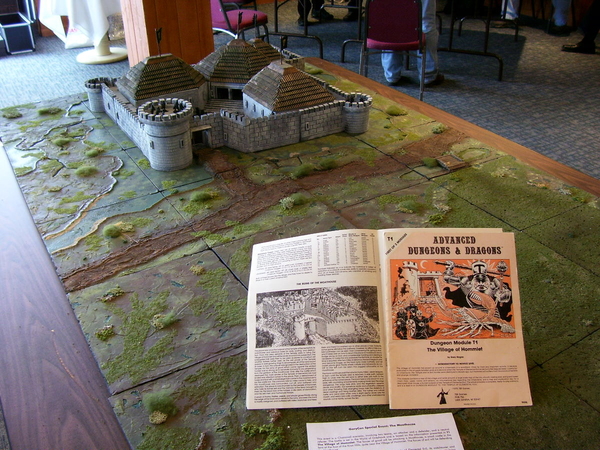
the-village-of-hommlet-moathouse

Chainmail re-enactment of T1: The Village of Hommlet
at Garycon II, 2010 (click for bigger version)

Okay — maybe a bit of hyperbole there. About a month ago, I wrote about my favorite AD&D module, T1 – The Village of Hommlet. I mentioned that its follow-up, The Temple of Elemental Evil, was delayed for several years before Frank Mentzer completed it. Read on to learn about how Gary Gygax developed Hommlet and the Temple through play sessions and my deduction of why Temple was delayed for a few years.

Gygax and Rob Kuntz were constantly adding new levels and different environments to the dungeons under Castle Greyhawk as the players continued to eat up new content, always wanting more. Gygax began focusing his attention on developing a new region, with a campaign focusing on Hommlet and the Temple of Elemental Evil. With his game simply growing too big, Gygax split it, giving Greyhawk and its dungeons to Kuntz while he continued to work on Hommlet and the Temple.

Gygax’ son and a friend were starting to play, so Gary used the Hommlet campaign as a new, low level adventure for them, distinguishing it from the high level Greyhawk play. Gygax was busy developing TSR products and the Greyhawk Supplement (I) had come out for the Original Rules.

The Hommlet campaign was different than the Greyhawk dungeon delves. There was a village, with a smithy, an inn, a local elder, set in a rural environment. The party could role play in the village then move on to the dungeons of the Temple. It’s possible that Gygax ran players through some iterations of Hommlet and the Temple in late 1975 and into 1976.

Read More Read More

Modular: Why Salt and Sanctuary is Making Me Salty

Modular: Why Salt and Sanctuary is Making Me Salty

salt-and-sanctuary-banner-small

Salt and Sanctuary is the latest PS4/Windows game from developer Ska Studios, who have made a name for themselves with their unique aesthetics. Staying true to their 2D roots, the game feels like a 2D Souls-like.

However, while the game may or may not have been intended to be compared to the Souls series (Dark Souls, Bloodborne, etc), the game misses the mark on what makes those games so amazing.

A Sea Journey

The game begins with you escorting a princess to an important meeting to bring about peace. Of course the ship gets attacked, and you find yourself washed up on the shore of a mysterious island with everything trying to kill you.

Read More Read More

Modular: A New Kind of Monster Manual: Volo’s Guide to Monsters

Modular: A New Kind of Monster Manual: Volo’s Guide to Monsters

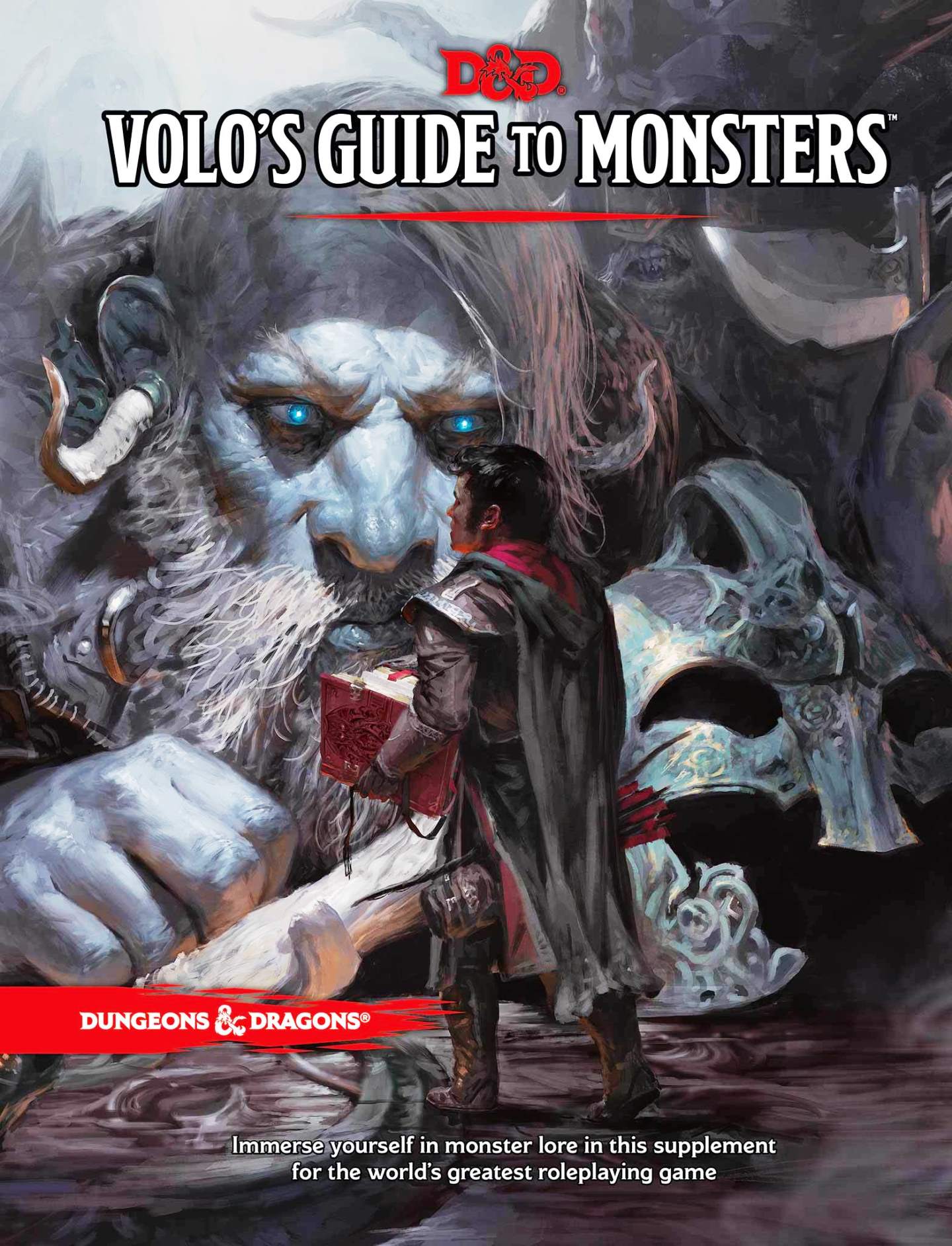
volos-guide-to-monsters-wotc-smallAt this point there have been scads of manuals with monsters for Dungeons & Dragons, going all the way back to the ’70s and that little booklet titled Monsters and Treasure. But last month a new kind of Monster Manual for 5th Edition Dungeons & Dragons crept onto the scene, and it’s different from any official D&D monster book that I’ve ever held.

You don’t often see the word “innovative” anywhere close to the word “monster” but I think I might just have to try it: this is an innovative look at how to use monsters in a D&D game. And if 5e isn’t your thing, it could be of use in most retro-clones and related D&D-like games as well. It could help your local DM bring the game’s monsters to more terrifying life.

It’s not just about monsters as stat blocks. It even begins with a framing story, in that it’s purportedly a lore book from a scholar of the fantastic and bearer of unlikely names, Volothamp Geddarm. Some reviewers seem to have been disappointed that Volo’s own comments (as well of those of a dissenting scholar) are only peppered through the manual, having seemingly missed that a manual written entirely by a biased and unreliable narrator might render all its information questionable while in game.

The book is divided into six broad sections, and, unlike the 5e Monster Manual itself, is well-indexed. Not only is there an index of monster stat blocks, there’s a list of the lairs in the book, and Appendix C provides listings of creature by type, by challenge rating, and by environment. Hopefully somewhere online there’s an official listing of ALL 5e monsters listed by these categories, for the ones in this book cover only the creatures included within.

Read More Read More

Modular: How to Introduce Kids to Tabletop Role-Playing #1: Picking a System and Genre

Modular: How to Introduce Kids to Tabletop Role-Playing #1: Picking a System and Genre

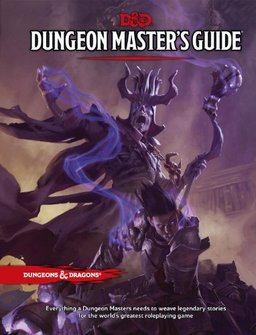
Dungeon Master's Guide-small
…perhaps in a fit of nostalgia, you made a Christmas present to yourself

It’s Christmas. You’ve got everybody together. Perhaps you’ve all watched Stranger Things  and now you have the urge to dust down your dice, dig out the Dungeon Masters’ Guide and introduce whatever kids just happen to be lying around to the imaginative world of your youth.

Or perhaps in a fit of nostalgia, you made a Christmas present to yourself of a recently published role-playing game, but the only available players right now are under 12. Or perhaps you’re like me, a life long player, and this is just a good moment to share the joy.

So how do you go about introducing kids to tabletop role-playing?

Really very easily, as it happens. The youngest child I’ve GM’d for was my 5-year-old-daughter when she crashed a party of 9-year olds, found all the traps and made off with the loot. Having done this a few times and talked to other gamer-parents, I’ve noticed a few things…

(Geek and Sundry beat me to the punch on this one (link), but my take is slightly different.)

Read More Read More

Weird Tales Reprints Published by Goodman Games

Weird Tales Reprints Published by Goodman Games

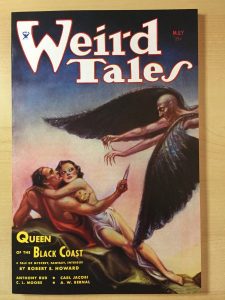
weird-tales-may-1934-450x600-225x300The Goodman Games site is one of my regular stopping points on the web. The company’s well known as an imagination factory that produces some of the most innovative and entertaining game supplements in print today. It’s also home of the popular Dungeon Crawl Classics role-playing game.

What it’s never been until now is a purveyor of Weird Tales, so I was intrigued when I discovered five facsimile issues of the famous magazine were available for purchase on the site.

I wrote publisher Joseph Goodman and asked him what this availability signified.  As I should have guessed, it involved Appendix N, Gary Gygax’s famed recommended reading list printed at the back of the original Dungeon Master’s Guide (from Advanced Dungeons & Dragons, if you’re not a gamer).

For those not in the know, that appendix launched a generation into the exploration of fantasy fiction, from Anderson to Zelazny. It was an immense influence on gamers and future writers alike and something Joseph Goodman has used as a touchstone for both the creation of adventures and the design of the Dungeon Crawl Classics game itself. Here’s what he had to say.

Read More Read More