Browsed by
Category: Role Playing Games

Modular: Dead Suns Adventure Path for Starfinder
Modular: Dead Suns Adventure Path for Starfinder

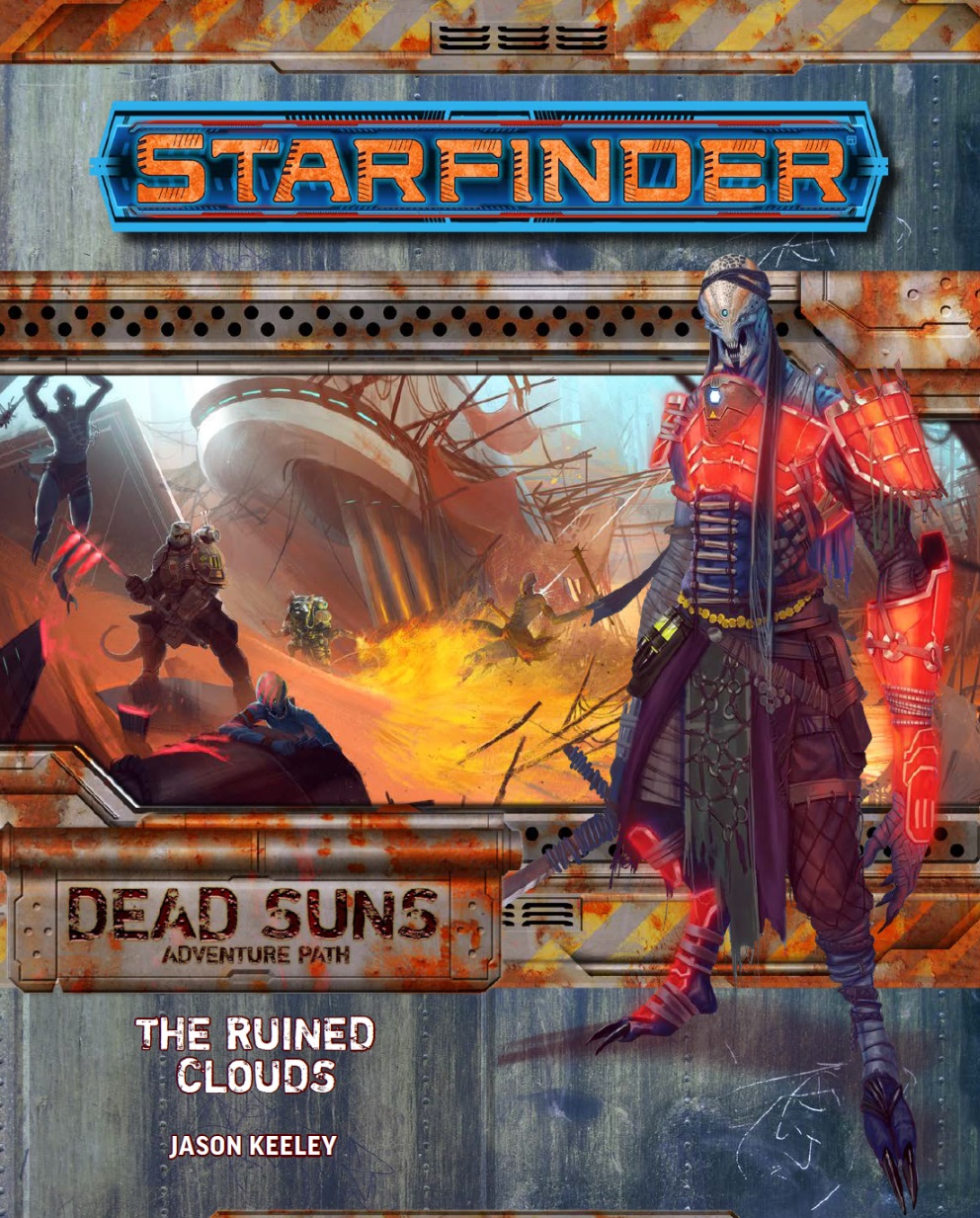
StarfinderDeadSuns4Last fall, the game publisher Paizo began releasing their line of Starfinder products, taking their Pathfinder setting into a distant science fantasy RPG setting. In addition to the main Starfinder Core Rulebook (Amazon, Paizo), they also began releasing the Dead Suns Adventure Path. With four of the six Dead Suns books now out, it’s about time to look back on what they’ve released to see what all the series has got to offer for fans looking for material.

Paizo’s Pathfinder Adventure Path books have long been a staple of the company’s product line. It provides a broad campaign of adventures across six 92-page books, each released on a monthly schedule. In addition to the adventure, each book contained setting, culture, and religious information, a Bestiary supplement, and original fiction.

Dead Suns continues that tradition in their Starfinder campaign setting, with the only significant difference in format being that these books are released on a bi-monthly schedule, so it takes a year to release the full Adventure Path as opposed to the two Adventure Path schedule for Pathfinder. Starfinder is on a less aggressive production schedule than Pathfinder, without associated Player Companion or Campaign Setting resources released monthly, so the Adventure Path provide supplements to the two hardcover Starfinder supplements slated for release each year. (The Alien Archive was released in the fall, and the Pact Worlds setting book is slated for release this month.)

As the first Starfinder Adventure Path, Dead Suns is a planet-hopping quest through the Pact Worlds, as the players get their own starship and begin following the clues across planets, running afoul of massive corporations, space monsters, undead starships and necrotech, and the troublesome Cult of the Devourer, as they uncover the secret behind a lost superweapon.
Read More Read More

Modular: Pathfinder 2nd Edition Announced – Never Say Never

Modular: Pathfinder 2nd Edition Announced – Never Say Never

Pathfinder_PlaytestrulebookYesterday, Paizo announced an upcoming playtest for a 2nd Edition of Pathfinder. Wow.

For years, Paizo officials have said that there would never be a second edition. I suspect that all evidence of those statements have been scoured from the Internet. A quick search didn’t find any. There might have been qualifiers along the way, such as ‘unless the demand is too great’ or some such. But I remember the message as ‘We won’t do a 2nd Edition.” With the inference, ‘Making you buy all of your stuff over again.’

I thought that they might be adhering to that pledge when they put out Starfinder, a science fiction RPG. That seemed like a smart approach if they couldn’t update the original Pathfinder.

But I believe that events conspired against them. The best thing that ever happened to Pathfinder was 4th Edition D&D (granted – it was the impetus for Pathfinder). The worst thing that ever happened to Pathfinder was 5th Edition D&D.

Read More Read More

Modular: Trouble in the ’80’s with Tales from the Loop

Modular: Trouble in the ’80’s with Tales from the Loop

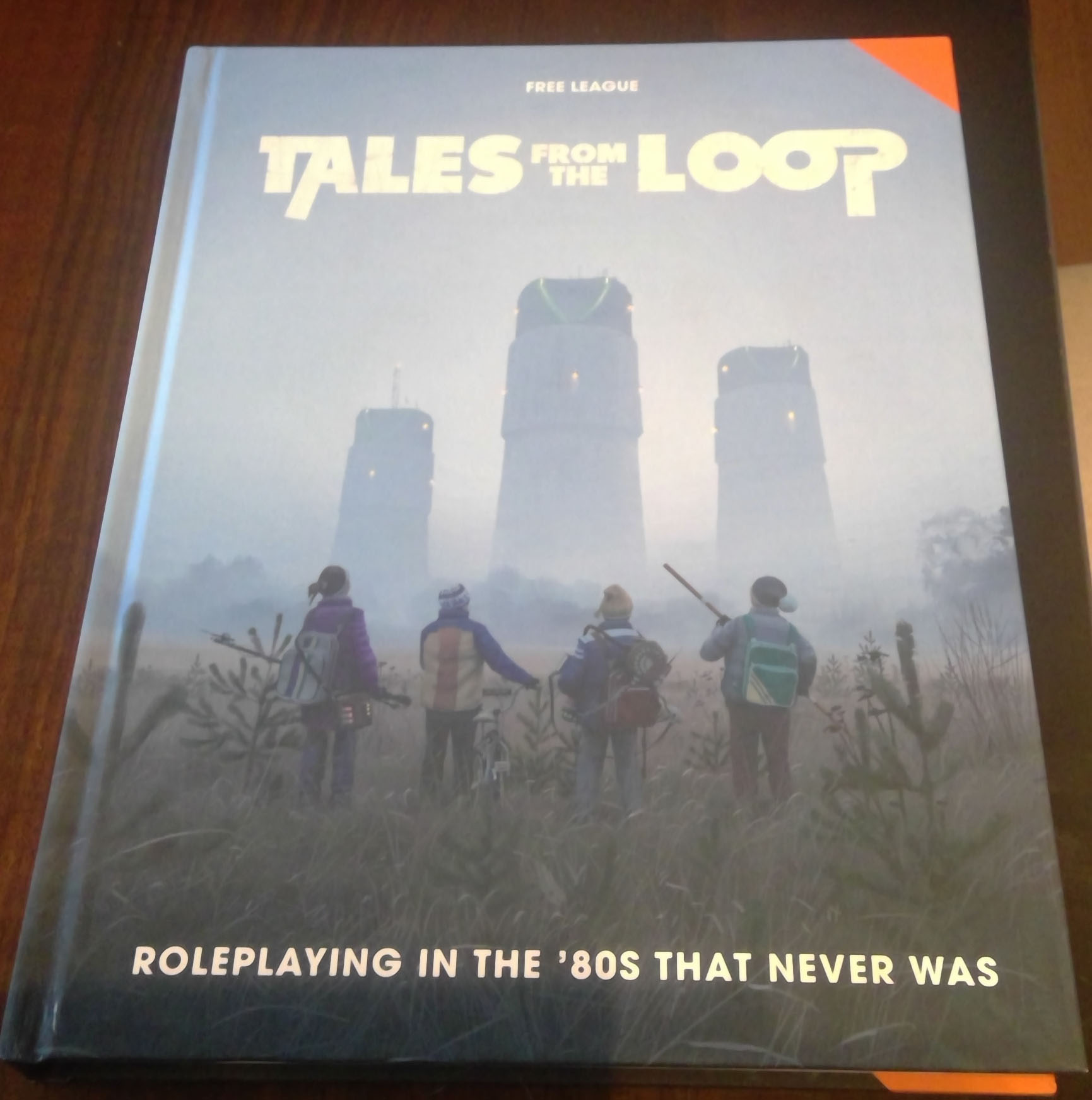
TalesFromTheLoopAs a child of the ’80’s, I grew up with the understanding that a group of kids might stumble upon a series of mysterious events and have to band together to deal with the challenges from it. Parents, law enforcement, and other authorities would be of no help, so there was no point in telling them what was going on. They either wouldn’t believe it or, worse, would stop the kids from fixing things. The kids, through determination and luck, were the only hope to set things right … whether it was finding a way to keep their families from being evicted, returning a strange visitor to another planet, or stopping rampaging monsters. Or, heck, even just making it through a day of detention.

E.T., The Goonies, Stand By Me, The Breakfast Club, Flight of the Navigator, The Last Starfighter, Lost Boys, SpaceCampGremlins. These are the types of films, along with more recent period pieces like The Iron Giant and Stranger Things, and maybe a touch of the SyFy Channel’s television series Eureka thrown in, that inspire the science fiction role-playing game Tales from the Loop from Modiphius Entertainment.

Tales from the Loop centers around a community in the 1980’s that is home to a research center and particle accelerator, called “The Loop.” There are actually two settings outlined in the book: the Swedish island of Svartsjolandet or the American town Boulder City. Whichever community your characters live in, you play a group of Kids who come into contact with a Mystery related to the particle accelerator, and join together to resolve the Mystery. The game can be extremely episodic, great for a standalone one-shot game, or played in a more “sandbox” format where the players are able to explore the setting in more depth, allowing for a more long-term campaign.

Read More Read More

Modular: First Time Out With I Love the Corps

Modular: First Time Out With I Love the Corps

256 ILTC Teens Playing

A house full of teens playing I Love the Corps!

“Cover the back of your necks! It’s going for your necks!”

“Use the black hole gun!”

“I’m out of Hero Points!”

“Kill them! Kill them!”

“Argh!”

Yes the house is full of teens playing a review copy of indy game I Love the Corps, a self-consciously SciFi game which hits the notes of 90s Military SF, with a dose of Aliens, plus video games like Call of Duty and Mass Effect (the referee’s book has a handy appendix of inspirations, including music). The lads range from 12 through to 16, with my son Kurtzhau, 14, in the middle and in the thick of it refereeing an ambitious one-shot he’s crafted involving rebel humans and sinister uploading aliens, epic scale space dreadnoughts, and more twists than a sack-full of broken micro USB cables.

Read More Read More

Why I’m Here – Part Two: Some Thoughts on Old Books and Appendix N

Why I’m Here – Part Two: Some Thoughts on Old Books and Appendix N

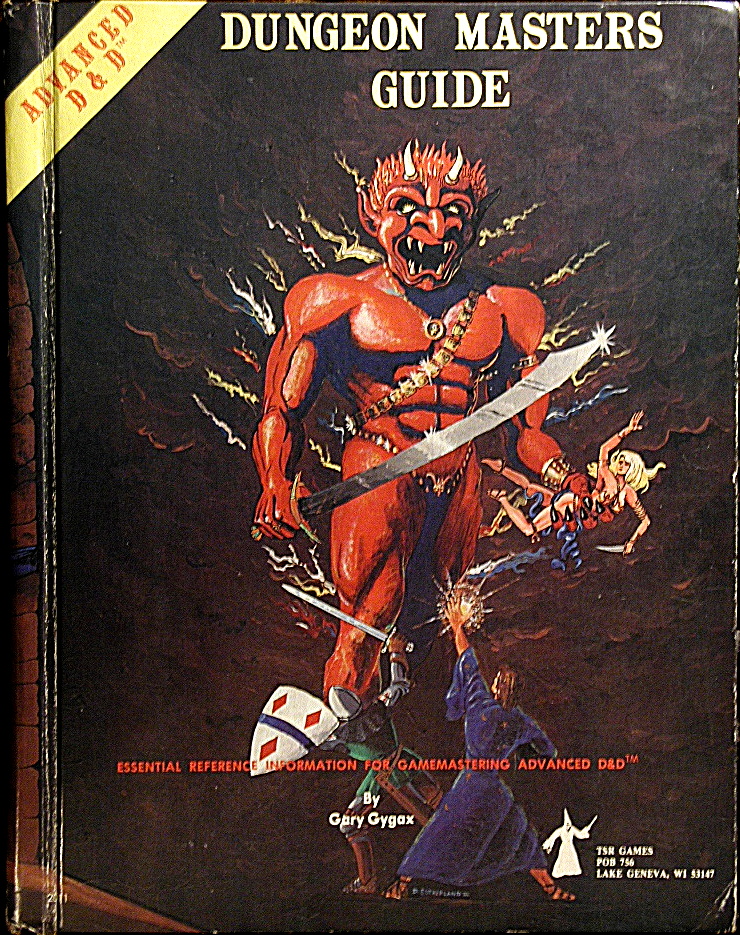
add-dmguideFour years ago, I posted an explanation of what I’m trying to do with my reviews for Black Gate. My stated goal was, and remains, to be someone who says to readers, “Here’s a book I think you’ll get a kick out of.” There were several people who did that for me, turning me on to books and authors I still hold dear, and I want to do that for others. Like most fans of something, I want to convince people the things I like are worth their time and are still relevant.

It can be hard to pierce the barrier built of cultural noise, the vast wealth of new fantasy being written every year, and the simple passage of time, and convince someone a book that’s fifty years old or more is worth his time. Pop culture reflects the larger society that produces it, and people want to see their concerns and interests in it. That people still read Sir Arthur Conan Doyle and Robert E. Howard more than eighty years after both their deaths, though, tells me it’s not a hopeless battle.

I’m not the only person doing this, not by any stretch of the imagination. Of particular interest has been the wealth of discussion about Appendix N that has taken place over the past five or six years on message boards, blogs, and podcasts. For the two of you who don’t know what Appendix N is, it’s a quirky list of fantasy and sci-fi books that inspired Gary Gygax, the primary creator of D&D. There are few works on it I haven’t got to, though I was recently taken to task for my negligence of A. Merritt.

The list was in the Dungeon Masters Guide. Back in the day, it didn’t mean too much to me, only because I’d already read most of the authors on the list, and so had most of my gaming friends. Still, it was cool to see Gygax liked the same books we did. Because so much of the present Appendix N conversation has tended to focus on gaming, something I don’t do anymore, I’ve mostly just listened. Other than a couple of conversations about individual books, I’ve sat off to the side.

Read More Read More

Modular: Xanathar’s Guide to Everything

Modular: Xanathar’s Guide to Everything

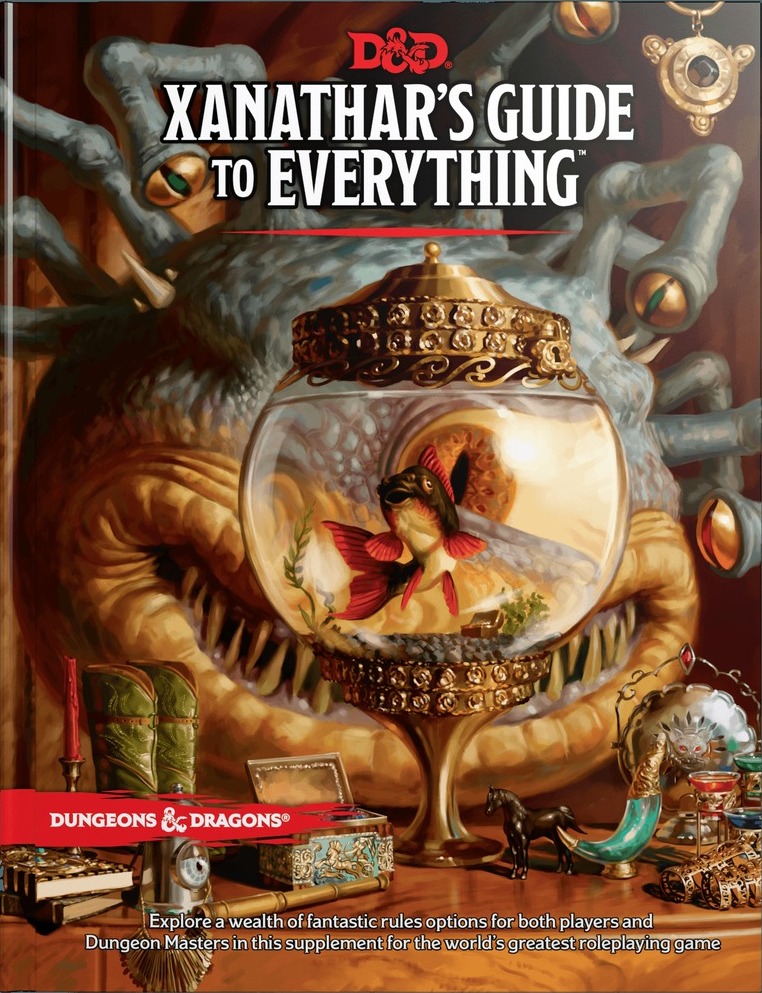
Xanathar’s Guide to Everything-smallIf you’ve jumped into the 5th edition of Dungeons & Dragons, I’ve got a book for you.

Until now, you haven’t really needed anything apart from the main three manuals (The Player’s Handbook, Monster Manual, and the Dungeon Master’s Guide). But with Xanathar’s Guide to Everything the Wizards of the Coast have created a handy companion with utility for both players and dungeon masters.

Sure, if you’ve followed the various expansion books closely you’ll have seen some good stuff: Volo’s Guide to Monsters helps flesh out some nasty critters so you can better bring them to life AND know their weaknesses, and the Sword Coast Adventurer’s Guide provides background material if you’re playing in a specific setting (or perhaps one similar to it). Xanathar’s, though, is something like the original Unearthed Arcana was for old school D&D.

It’s 192 pages are broadly divided into four categories. Chapter 1 is given over to new options for characters, Chapter 2 is stuffed with game master tools, Chapter 3 has spells, and the Appendix, for some reason, is mostly devoted to possible character names, some 15 pages of them. To me, that feels like the book’s only mis-step. Long lists of English, French, and Celtic names can be found in numerous places, and while the elf and dwarf (and other) categories can be useful for inspiration, I’d rather have seen these names left on an online companion and this space given over to some other useful subject – sandbox gaming, for instance – that never gets enough coverage.

But the rest… the rest is gold.

Read More Read More

Future Treasures: Warhammer 40K: Rogue Trader: The Omnibus by Andy Hoare

Future Treasures: Warhammer 40K: Rogue Trader: The Omnibus by Andy Hoare

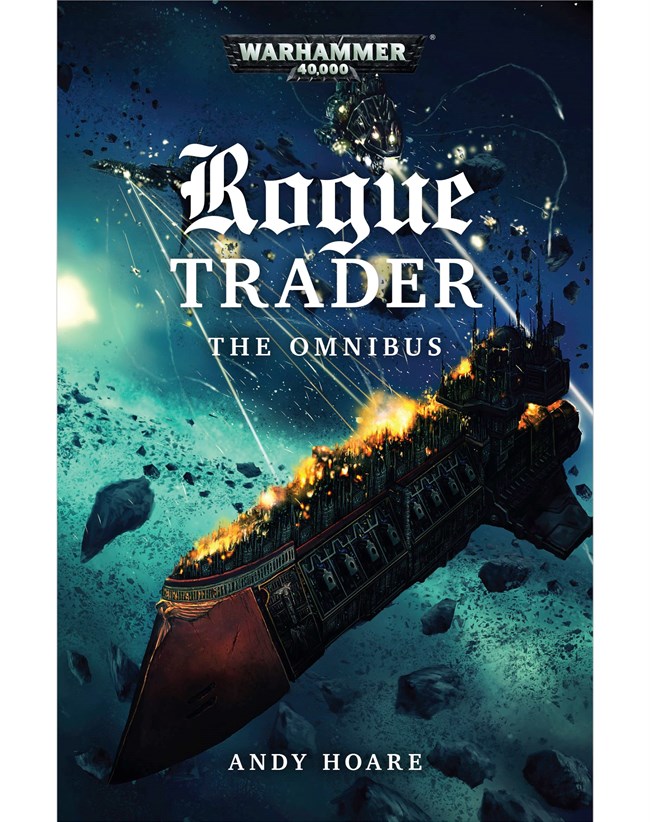
Rogue Trader the Omnibus-smallFantasy Flight released the epic Rogue Trader role playing game in 2009. One of the early fruits of their Warhammer 40,000 license, Rogue Trader allowed players to play intrepid merchant princes buying and selling outside the legal boundaries of the Imperium. I became a fan immediately, and it quickly became my favorite science fiction RPG.

Fantasy Flight lost the Warhammer 40K license last year, and the game is now out of print. I thought that would be the end of the brand, so I was pleased to see Black Library put Rogue Trader: The Omnibus on their schedule for next month. It’s a compilation of three novels and two short stories by Andy Hoare. Rogue Star (2006) and Star of Damocles (2007) chart the fortunes of rogue trader Lucian Gerrit on the Imperium’s fringes, and Savage Scars (2011) picks up the tale as the White Scars battle the T’au on the planet Dal’yth. Rogue Trader: The Omnibus arrives in trade paperback on January 23.

Explore the stars and the farthest reaches of the galaxy with the complete Rogue Trader omnibus, containing the novels Rogue Star, Star of Damocles and Savage Scars.

Licensed by ancient charter, Rogue Traders explore the uncharted regions of the galaxy, seeking new worlds to exploit on behalf of the Imperium. The fortunes of Rogue Trader Lucian Gerrit and his family are in decline, and his inheritance amounts to little more than a pile of debt and misery. In a final, desperate gamble to restore his family’s former glory, Gerrit strikes a deal on a forgotten Imperial world in the Eastern Fringe, but his timing could not be worse. The alien tau are seeking to expand their empire across the Damocles Gulf, and soon Gerrit is caught in the middle of a clash between two mighty star-spanning empires, neither of which is willing to back down.

Rogue Trader: The Omnibus will be published by Games Workshop/Black Library on January 23, 2018. It is 800 pages, priced at $21 in trade paperback. Read more at the Black Library website.

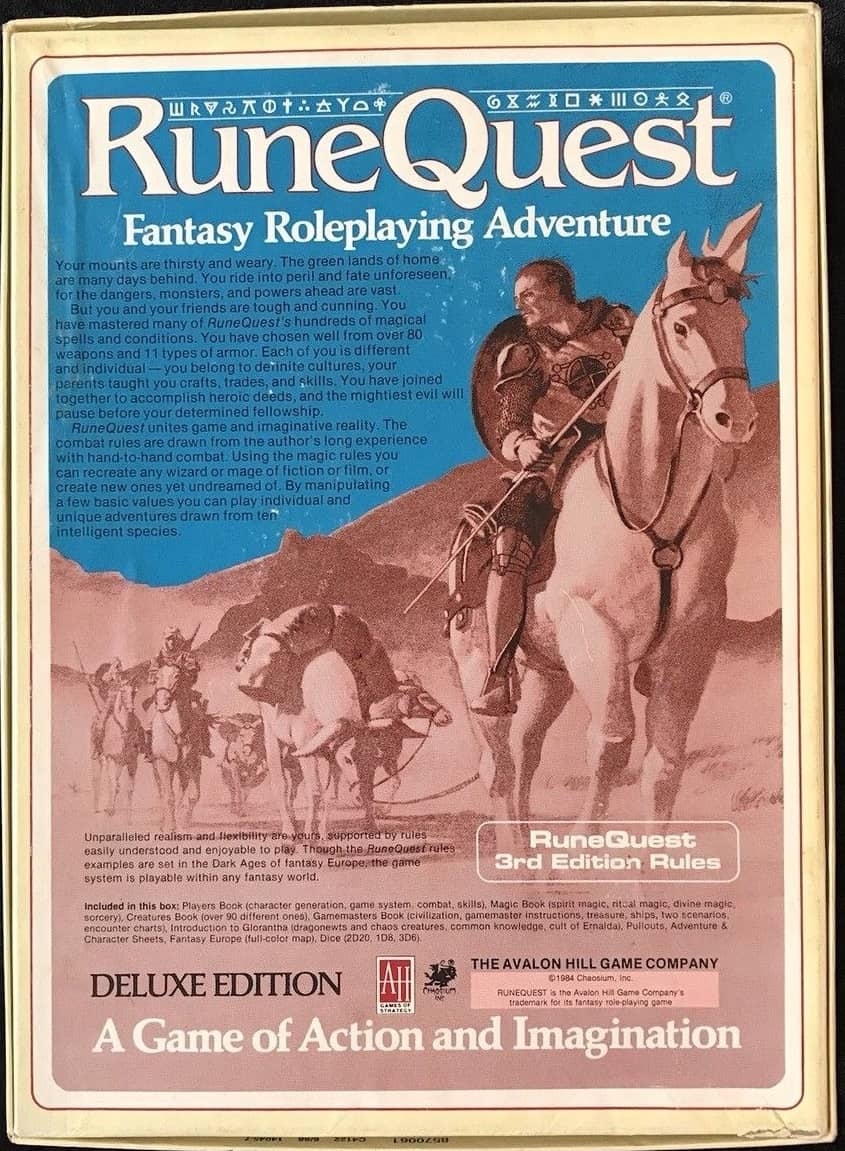
Modular: Resurrecting RuneQuest: An Investigation by the Tales of the Reaching Moon Editorial Staff

Modular: Resurrecting RuneQuest: An Investigation by the Tales of the Reaching Moon Editorial Staff

Runequest Deluxe Third Edition boxed set-small Runequest Deluxe Third Edition boxed set 2-back-small

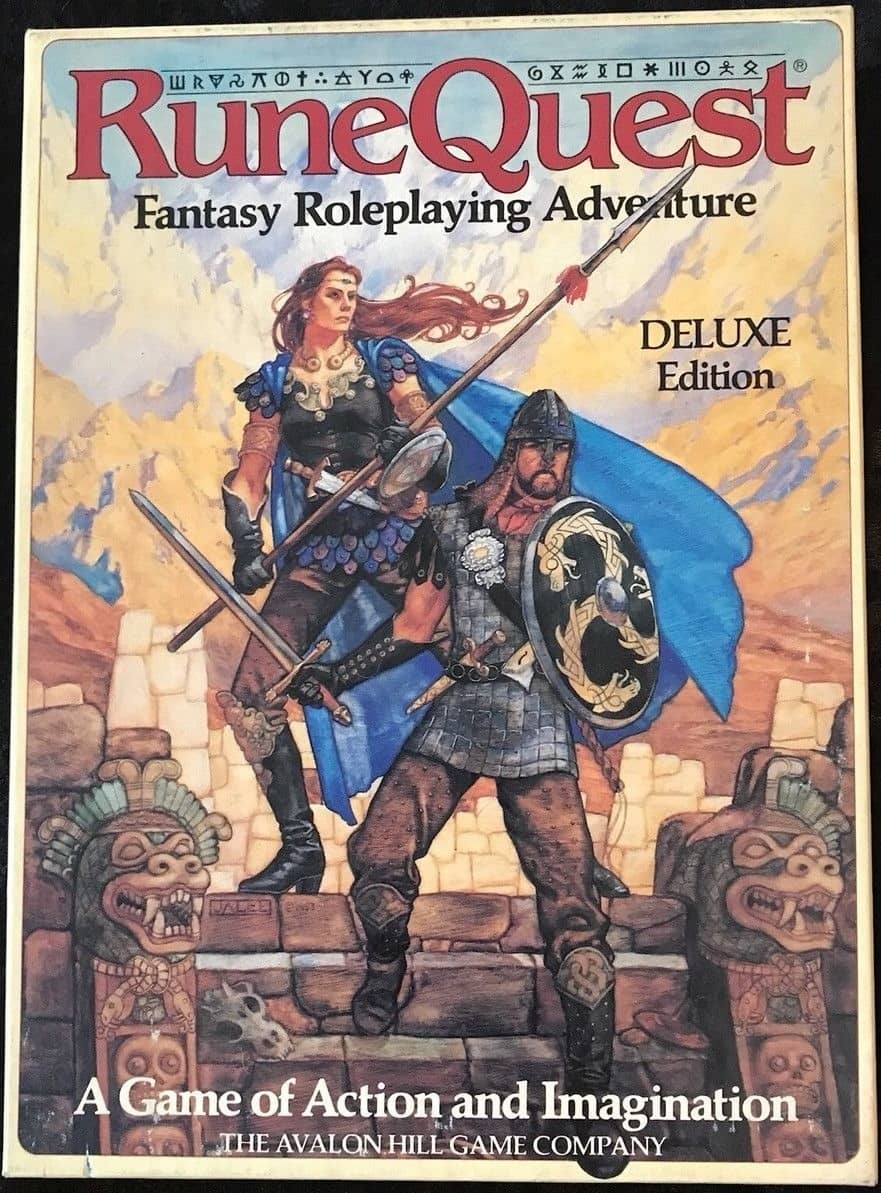
[This article was originally published in Tales of the Reaching Moon #5 in Spring, 1991, after the RuneQuest trademark had been sold to Avalon Hill and the game re-released in Deluxe and Standard boxed sets. Its publication was a catalyst for Avalon Hill bringing Ken Rolston on board and kicking off what became known as the (short-lived) “RuneQuest Renaissance.”

This article was actually based on a report commissioned by Avalon Hill itself in 1990 (prior to the decision to publish Eldarad). The original report was written by an award-winning game designer.]

Introduction

RuneQuest is a great game. We all know that. Unfortunately, things haven’t been going so good for the game for some time. We all know that too. We, the Tales of the Reaching Moon staff present here our thoughts about the history of the game, the hole RuneQuest is currently in, and what action we think Avalon Hill should take to dig its way out again.

Read More Read More

Simulations Publications Inc: The TSR Incursion

Simulations Publications Inc: The TSR Incursion

Around the end of 1981, brothers Kevin and Brian Blume wrested control of TSR away from founder Gary Gygax. The company would change dramatically under their leadership, until Gygax returned from his west coast exile in 1984 and (briefly) reclaimed his company. One ‘Blume Incident’ from 1982 is a pretty good example of the way they did things.

In 1958, Avalon Hill was formed, creating the modern wargaming industry, out of which role playing games grew. In 1969, James Dunnigan created Simulations Publications, Inc. — to be known as SPI — with Redmond Simenson as co-founder. He started the company to save an existing wargaming fanzine, Chris Wagner’s Strategy & Tactics, which was in a precarious financial state. Simenson was the graphic designer for the magazine and a huge part of its success. For the princely sum of $1 (yes, you read that right), SPI took on Strategy and Tactics and made it the industry’s leading newsletter, starting with the September, 1969 issue.

Strategy & Tactics would include a new wargame in every single issue from then through the current one, which is remarkable. With the popularity of the magazine, SPI also became Avalon Hill’s major competitor in the wargaming market and enjoyed great success in the seventies. Things were good. Then, as for JFK, came Dallas. Okay, not quite.

Dunnigan’s Dallas: The Television Roleplaying Game, was a licensed product, intended to cash in on the massively successful show. My first thought is to wonder how many Dallas fans wanted to play an RPG — apparently not many. It was a disaster. Simonsen commented that they produced “80,000 copies and that was 79,999 too many.”

Read More Read More

Modular: The Capharnaum RPG: A Kickstarter Combining the Campbellian Hero Path, Arabian Nights Multiculturalism, and Compelling Worldbuilding

Modular: The Capharnaum RPG: A Kickstarter Combining the Campbellian Hero Path, Arabian Nights Multiculturalism, and Compelling Worldbuilding

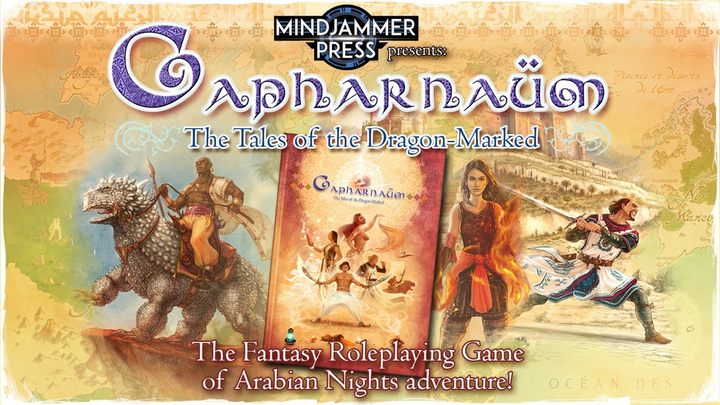
Capharnaum RPG

Two years after running our very successful Kickstarter for the transhumanist SF RPG Mindjammer, Mindjammer Press is back with a new project — the English-language version of a fascinating French-language RPG “Capharnaum – The Tales of the Dragon-Marked.” As a soundbite it’s billed as “a fantastic Arabian Nights RPG of deserts, dragons, and crusaders” — but it’s so much more than that. I first came across Capharnaum and its gorgeous artwork in the Paris Games Fair in 2009, and even then I couldn’t believe it hadn’t been brought to the English-speaking gamer. Now, with Capharnaum‘s second edition, the case is even more compelling.

The brains behind Capharnaum — The Tales of the Dragon-Marked are two experienced French game designers, Raphaël Bardas and François Cedelle. They’re joined by a large and extremely active gaming community based in Montpellier, the ancient town on the Mediterranean coast, but active throughout France, bringing together enthusiasts of ancient world Mediterranean and Arabian Nights-style gaming. In the aftermath of 9/11, Raphaël and François wanted to create a setting which refracted the cultural conflicts of our time in a historical-fantasy context, but which equally provided a gameplay which transcended those conflicts and offered a route to coexistence and appreciation of our diversity.

Read More Read More