Browsed by
Category: Editor’s Blog

The blog posts of Black Gate Managing Editor Howard Andrew Jones and Editor John O’Neill

Pathfinder Tales: “The Walkers from the Crypt” by Howard Andrew Jones

Pathfinder Tales: “The Walkers from the Crypt” by Howard Andrew Jones

pathfindertales_360Howard Andrew Jones’ four-part story “The Walkers from the Crypt” has now been posted in its entirety at The Pathfinder Tales site at Paizo.com:

Elyana had no time to waste educating the young bard. There were but a few minutes left before the hounds would reach them.

She’d caught sight of the animals almost a half hour ago as she and her four companions fled across the grasslands of southern Galt. The seemingly inexhaustible hounds had slowly gained on their horses, and the party had finally picked out a rise from which to make a stand.

Vallyn gazed apprehensively out at the wedge-shaped formation of hounds sprinting forward through the high grass. “How can they keep running like that?”

“They’re dead,” Arcil said in his low, smooth voice. “They need neither breath nor rest.”

Pathfinder Tales are complete short stories set in the detailed world of Golarion, home to the Pathfinder role playing game. Novels released under the Pathfinder Tales brand include Prince of Wolves by Dave Gross, Winter Witch by Elaine Cunningham, and Plague of Shadows by our own Howard Andrew Jones. Pazio has also begun presenting complete tales set in the same setting on their website — including pieces from Monte Cook, Ed Greenwood, Dave Gross, Richard Lee Byers, and others.

“The Walkers from the Crypt” features the continuing adventures of Elyana, Vallyn, Stelan, and other characters from Howard’s new novel Plague of Shadows, in a complete standalone adventure. Read more about Plague of Shadows here.

You can read Part One of “The Walkers from the Crypt” here, and all four parts are now available at Paizo.com.

Diana Wynne Jones (1934 – 2011)

Diana Wynne Jones (1934 – 2011)

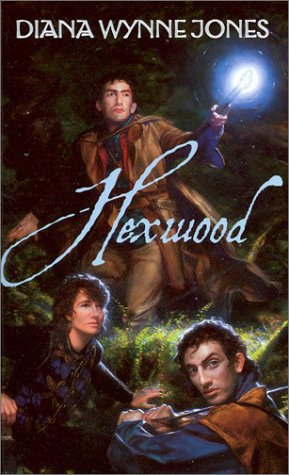
hexwoodDiana Wynne Jones, author of dozens of fantasy books including Howl’s Moving Castle, Archer’s Goon, Hexwood, and Dark Lord of Derkholm, died on Saturday, March 26, 2011.

The first Diana Wynne Jones novel I ever bought was Howl’s Moving Castle, in 1986. Everyone at the science fiction bookstore where I shopped — the House of Speculative Fiction, in Ottawa, Canada — was talking about it, and Pat Caven the owner pressed it into my hands.  It was by no means the last.

Jones studied English at St Anne’s College in Oxford, where she famously attended lectures by J. R. R. Tolkien and C. S. Lewis before she graduated in 1956. She began her writing career with plays, and had three produced in London between 1967 and 1970.

In 1970 she switched to prose with her first novel, Changeover, a comedy marketed for adults. She began writing for young adults with her second book, Wilkins’ Tooth (1973, published in the US as Witch’s Business), and never looked back.

Although Jones is widely admired as a YA fantasy writer, she had a surprising range. Perhaps my favorite of her books is The Tough Guide To Fantasyland (1996), a hysterical tourist guide which skewers dozens of fantasy clichés as it catalogues the common places, weird items, people, governments, and situations readers are likely to encounter as they journey through a typical fantasy novel.

tough-guideHer later novel Dark Lord of Derkholm (1999), set in a Fantasyland which steadfastly adheres to the conventions she described,  is seen by some as a conceptual sequel to The Tough Guide.

Jones was nominated — and won — numerous awards in her lifetime. Her novel Archers Goon was nominated for a World Fantasy Award; The Tough Guide To Fantasyland was nominated for both a Hugo award and a World Fantasy Award, and Dark Lord of Derkholm won the 1999 Mythopoeic Fantasy Award for Children’s Literature. The same year she won the Karl Edward Wagner Award in the UK.

She received the World Fantasy Award for Life Achievement in 2007, perhaps the highest honor our field has to offer.

Her novels have enjoyed extended life in other media: Archer’s Goon became a BBC television serial in 1992, and Howl’s Moving Castle was famously adapted as an animated feature by Hayao Miyazaki in 2004.

Jones continued to work until late in life, publishing her last novel, Enchanted Glass, last year. She was diagnosed with lung cancer in 2009, and died on March 26, 2011.

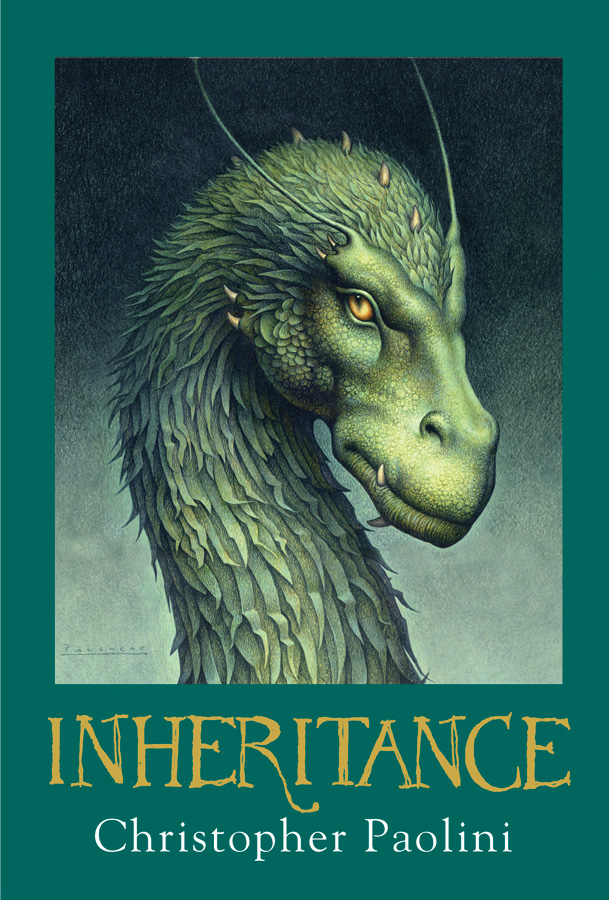
Inheritance by Christopher Paolini to be Released November 8

Inheritance by Christopher Paolini to be Released November 8

inheritanceI share a lot of books with my kids. I have two sons, ages 15 and 13, and an 11-year-old daughter. As you can imagine, they have a wide range of tastes. It’s uncommon for two to enjoy the same book (or series), and virtually unheard of for all three to agree. They couldn’t even agree on Harry Potter – my youngest two enjoyed the books, but my oldest turned up his nose.

The solitary exception is Christopher Paolini’s Inheritance Cycle. All three have devoured every book in the series, and all three have been clamoring for more.

For years. The first novel, Eragon, famously completed when when Paolini was only 19, was released in 2002. My oldest, Tim, read it first, and immediately started asking me when the next one was coming out.

Eldest arrived in 2005, and by then Tim’s brother Drew had read the first one.  Within two weeks of Eldest‘s publication date, both of them were asking me to check Amazon.con for news of the third. Brisingr landed in 2008, and by then (of course) my daughter had leaped enthusiastically on the bandwagon.

It’s now been almost three years that I’ve put up with endless questions about the arrival of the fourth book (the most recent was last Saturday. Man, these kids do not give up). So it was with considerable relief that I saw news articles this week about the fourth and final volume, Inheritance, scheduled for release by Knopf Books on November 8, 2011. Thank. God. I thought I was going to be pestered about this book until retirement.

You’re on your own for a plot summary, or any further details. I’m already tired of hearing about this book, and I first heard about it yesterday.  Read all about it on Paolini’s website Alagaesia.com, or better yet ask a nearby teenager. They’re sure to have all the details.

New Treasures: Who Killed Science Fiction? by Earl Kemp

New Treasures: Who Killed Science Fiction? by Earl Kemp

who-killed-science-fictionIn 1960, only 34 years after the launch of Amazing Stories, the first true science fiction magazine, fan Earl Kemp mailed a set of questions to 108 SF writers, editors, artists and fans. 71 responded, including Isaac Asimov, Robert Heinlein, Hugo Gernsback, E.E. “Doc” Smith, Poul Anderson, Ray Bradbury, Fritz Leiber, Andre Norton, Kurt Vonnegut, Robert Silverberg, John W. Campbell, Horace Gold, Marion Zimmer Bradley, and many others. The questions were:

1) Do you feel that magazine science fiction is dead?
2) Do you feel that any single person, action, incident, etc., is responsible for the present situation? If not, what is responsible?
3) What can we do to correct it?
4) Should we look to the original paperback as a point of salvation?
5) What additional remarks, pertinent to the study, would you like to contribute?

Kemp published the results in his one-shot fanzine SaFari Annual #1 in 1960. Only 125 copies were printed, and it instantly became a collector’s item. A candid dialog on the flaws and fate of the genre between most of its brightest lights, Who Killed Science Fiction? achieved near-legendary status in the SF community, and SaFari Annual #1 won a Hugo Award in 1961 based on that sole issue.

Read More Read More

Happy 80th Birthday, William Shatner!

Happy 80th Birthday, William Shatner!

william-shatnerMy fellow Canadian William Shatner turns 80 today.

For much of my life I watched him, in his role as Captain Kirk, help program Americans to accept Canadians as their leaders.  Made things a lot easier when I moved to the U.S. in 1987 to finish my Ph.D, let me tell you. Not to mention numerous D&D games, in which elves (and anything else with pointed ears) immediately referred to me as “Captain.”

It did not, unfortunately, make picking up girls easier. For which I blame fellow Canadians Dan Aykroyd, Mike Meyers, and especially Jim Carrey. Doofus.

Anyway, back to Shatner. The Great One was born on March 22, 1931, in Montreal, Quebec. He had a starring role in Roger Corman’s 1962 film The Intruder and numerous appearances in film and television, including the classic Twilight Zone episode “Nightmare at 20,000 Feet,” and “Cold Hands, Warm Heart” for The Outer Limits. In 1964 he guest-starred with Leonard Nimoy in The Man from U.N.C.L.E. episode “The Project Strigas Affair.” I’m serious — check it out. Shatner plays a pest exterminator, and Nimoy a sinister-looking assistant Balkan diplomat. It’s sort of like watching the Trek episode “A Piece of the Action,” if you’re drunk enough.

From 1966 to 1969 Shatner was cast as James T. Kirk, captain of the USS Enterprise, in the role that defined his career, and made things easier for a generation of Canadians living in the U.S. He reprised the role in Star Trek: The Animated Series from 1973 to 1974, and in seven Star Trek feature films between 1979 to 1994. He was a lead in the popular Boston Legal, currently stars in the CBS comedy $#*! My Dad Says, and has a cameo in the upcoming Horrorween.

Happy Birthday, William Shatner! You are a god among men.

Vintage Treasures: Science Fiction in the Golden Age

Vintage Treasures: Science Fiction in the Golden Age

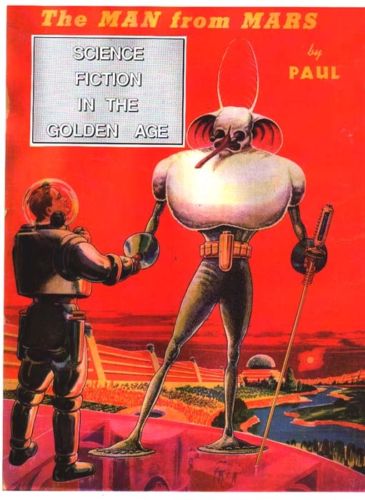
sf-golden-ageJames Van Hise, renowned comic and pulp expert and editor of The Rocket’s Blast ComicCollector magazine, has compiled a terrific collection of non-fiction articles from the dawn of the science fiction pulp era.

Science Fiction in the Golden Age arrived in the mail a week ago, and I’ve been mesmerized by it ever since. It gathers articles, letters, interviews, advertisements and artwork that appeared in pulps, fanzines and other sources between 1908 and 1955, including a H. G. Wells piece in a 1908 issue of Cosmopolitan speculating about life on Mars  with four illustrations, all reproduced here in color  a 1938 report on John W. Campbell’s plans as the new editor of Astounding Science Fiction, a review of E.E. “Doc” Smith’s Galactic Patrol from 1950,  a report from “Inside the Graf Zeppelin” from Science & Invention (1929), and a lot more.

Authors include Hugo Gernsback, Leigh Brackett, Edgar Rice Burroughs, Thomas Sheridan, and Ray Bradbury, and the vintage art from pulps and fan magazines includes classic work by Frank R. Paul and others, as well as unused art intended for the first edition of The Skylark of Space. I particularly enjoyed the house ads for magazines and novels, including Amazing Stories and Otis Adelbert Kline’s The Planet of Peril.

This is clearly a labor of love from someone who spent years reading and gathering literary gems and curiosities from some extremely rare sources, including Air Wonder Stories, Fantastic Adventures, Scientifiction, Fantasy Review, Boys Magazine, Writers Digest, Fantasy Advertiser, and many other pulps and fanzines. The only criticism I have is that the page numbers in the TOC are rather useless, given that most of the magazine isn’t paginated.

Science Fiction in the Golden Age is the first in a planned series, although since this one came out in May 2005 and no new volumes have followed, I’m not sure about the state of those plans. Volume One is 160 pages, 8 1/2 x 11 (side-stapled) with full color front and back covers by Frank R. Paul. I bought mine from the author on eBay for $20; additional copies are still available.

Howard Andrew Jones on How Captain Kirk Led Me to Historical Fiction

Howard Andrew Jones on How Captain Kirk Led Me to Historical Fiction

captain-kirkMan, that Howard Andrew Jones is, like, everywhere.

Today he’s at Tor.com, writing about how James T. Kirk led him on a many-year mission to explore strange new worlds of historical fiction:

I’d read that Star Trek’s creator Gene Roddenberry had modeled Captain Kirk after some guy named Horatio Hornblower. I didn’t think I’d like history stories, but I sure liked Star Trek, so I decided to take a chance. Once I rode my bicycle to the library and saw how many books about Hornblower there were, I figured I’d be enjoying a whole lot of sailing age Star Trek fiction for a long time to come.

Of course, it didn’t turn out quite like that. Hornblower wasn’t exactly like Kirk, and his exploits weren’t that much like those of the Enterprise, but they were cracking good adventures. Thanks to my own curiosity but mostly to the prose of the talented C.S. Forester, my tastes had suddenly, and accidentally, broadened beyond science fiction… I no longer thought of historical fiction as a strange, untouchable world, and as I grew older I tried more and more of it, sometimes because a period interested me and sometimes just because I liked a cover or a title. That’s how I found the work of Cecilia Holland, and it’s why I wasn’t afraid to try out a book by Harold Lamb titled The Curved Saber after I was spellbound by Lamb’s biography of Hannibal, the great Carthaginian general…

The complete article is here, and you can learn the mind-boggling details about Howard Andrew Jones month at Black Gate here.

Bradley Beaulieu’s The Winds of Khalakovo Released This Week

Bradley Beaulieu’s The Winds of Khalakovo Released This Week

windsofkhalakovocover_smBlack Gate blogger Bradley Beaulieu’s first novel The Winds of Khalakovo was published by Night Shade Books on Monday. I asked him to tell us a little bit about it, and his influences:
Thanks for having me on Black Gate. It’s great to be able to talk to some of the fans of the magazine, because unlike other places where I often feel like a relative newcomer a welcome guest, so to speak here I feel at home. I feel like I’m among friends, like we’re all part of an extended family: those who love adventure – and epic-based fantasy. So I was excited about the chance to share the news about my debut novel, The Winds of Khalakovo, just released by Night Shade Books.

The Winds of Khalakovo is a story about Nikandr, the Prince of a Grand Duchy modeled loosely after Muscovite Russia. The Nine Duchies of Anuskaya have been beset by a decade-long blight, by a wasting disease that strikes commoner and royal alike, and by the Maharraht, a rebellious splinter group that wants nothing more than the destruction of the Grand Duchy and her people. While searching for a way to heal the islands, Prince Nikandr stumbles across a boy, a boy who has the power to break worlds, and he finds that the Maharraht are bent on using this boy to achieve their goals. But the boy also has the power to heal, and it falls to Prince Nikandr to unlock his secrets before the Maharraht can use him to lay waste to his home of Khalakovo.

Read More Read More

Will Mars Needs Moms be one of the Biggest Box Office Bombs in History?

Will Mars Needs Moms be one of the Biggest Box Office Bombs in History?

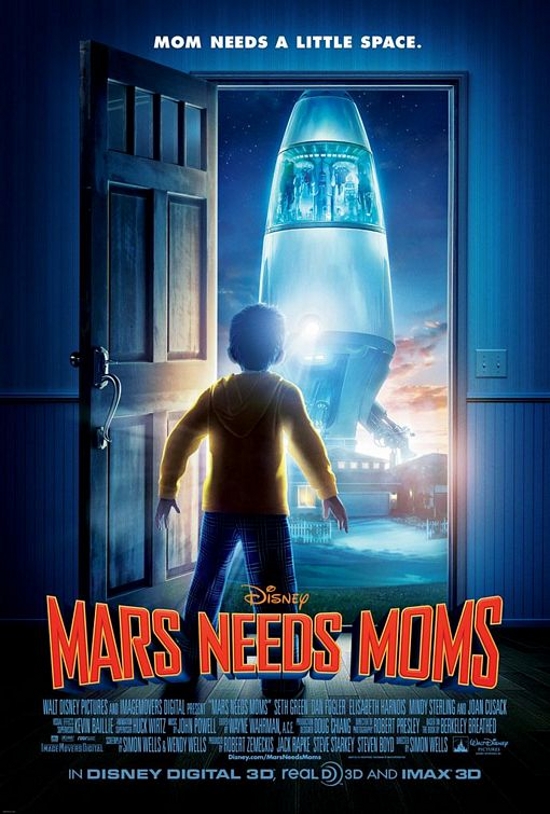
mars-needs-momsThe New York Times is reporting that Mars Needs Moms, which opened on Friday, “is on track to become one of the biggest box-office flops ever.”

In the movie business, sometimes a flop is just a flop. Then there are misses so disastrous that they send signals to broad swaths of Hollywood. Mars Needs Moms is shaping up as the second type.

Walt Disney Studios spent an estimated $175 million to make and market Mars Needs Moms, which sold $6.9 million in tickets at North American theaters in its opening weekend. That grim result puts the 3-D animated adventure on track to become one of the biggest box-office bombs in movie history, on par with such washouts as The Adventures of Pluto Nash, Cutthroat Island and The Alamo.

Much of the blame for the film’s poor reception is being placed on high ticket prices, especially for Imax.  While it costs between $8 and $9 to seat a child for a typical movie, ticket prices for 3-D screenings average around $13 — and $15.50 for the Imax version.

The film is based on the 2007 book Mars Needs Moms! by Berkeley Breathed, creator of Bloom County. It follows the adventures Milo, of a 9-year-old boy (voiced by Robot Chicken creator Seth Green) whose mother (Joan Cusack) is abducted by Martians.

The NYT predicts the impact on Disney “will be severe.” Disney has already closed down ImageMovers Digital, Robert Zemeckis’ animation division. Zemeckis, the Oscar-winning director who helmed Back to the Future, Forrest Gump, and The Polar Express, was a producer for Mars Needs Moms.  His last film using the same motion-capture animation style, A Christmas Carol (2009) was also a disappointment for Disney, and now the studio has canceled his next planned feature, a 3D remake of Yellow Submarine.

I thought the trailer looked good, and Breathed’s book was terrific. My kids want to see Mars Needs Moms, so I guess I’ll discover firsthand if the film is enjoyable… but the odds aren’t promising.

First Teaser Trailer for Conan the Barbarian

First Teaser Trailer for Conan the Barbarian

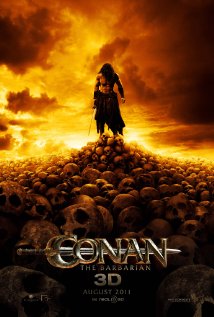
conan-3dThe first trailer for the new 3D remake of Conan the Barbarian has been unleashed this week by Lionsgate.

The trailer is quite brief (one minute), and doesn’t show much beyond a lot of smoke, a few poorly nutritioned villains, a beautiful woman, and some goofy dialog on how to achieve contentment through slaying.  That part reminded me of Buffy the Vampire Slayer, but with more swords and a better soundtrack.

The brief film description reads:

The tale of Conan the Cimmerian and his adventures across the continent of Hyboria on a quest to avenge the murder of his father and the slaughter of his village.

I don’t remember anything about his father in the original version. But as Howard Andrew Jones is constantly telling me, I probably need to read more Robert E. Howard.

The finished film will be released on August 11, 2011.  It is directed by Marcus Nispel and stars Jason Momoa (Stargate: Atlantis) as Conan.

The film also stars Ron Perlman, Stephen Lang, and Rose McGowan, who’s preparing her own take on a Robert E. Howard character in the upcoming Red Sonja, also scheduled for release this year.