Browsed by
Category: Books

The Seven Greyhawk Classics of the Ancient World

The Seven Greyhawk Classics of the Ancient World

against-the-giants1I’ve been pretty hard on Greyhawk novels. They’ve been the butt of more than a few jokes — both mine and others — from those of us who enjoy reviewing and talking about the fantasy genre.

I’m generally pretty forgiving, especially with novels of adventure fantasy. What can I tell you — I’m a fan.  But when books can’t be bothered to clamber over the very low bar of my expectations, I’m as capable of a harsh review as anyone.

The novels of Gary Gygax — and in particular his Greyhawk books — routinely limboed under that bar with room to spar, and I’ve said as much in print several times over the years.

Now, I’m second to none in my admiration of Gygax. I consider the man one of the great creative minds of the 20th Century, full stop.

I believe his work with D&D and Advanced D&D — especially the original hardback rules, and the incredibly inventive adventure modules that accompanied them, such as Descent into the Depths of the Earth and The Temple of Elemental Evil — was directly responsible for the mainstream acceptance of fantasy, as manifested in modern role playing obsessions like World of Warcraft and Warhammer.

But his novels?  Poo poo.

tomb-of-horrorsHowever, Gygax wasn’t the only one to pen Greyhawk novels.

Some of them — especially the so-called Greyhawk Classics published in honor of TSR’s 25th anniversary — are remembed quite fondly.

Written by Paul Kidd, Ru Emerson, Keith Francis Strohm, and Thomas M. Reid, and based on some of TSR’s most famous adventure modules, including Against the Giants, Tomb of Horrors, and Keep on the Borderlands, the seven Greyhawk Classic novels formed a nostalgic return to some of the most fondly-remembered adventure settings in gaming.

They were published in mass market paperback by TSR (later Wizards of the Coast) between July 1999 and February 2002, beginning with Against the Giants and ending with Tomb of Horrors.

Here’s the other thing you need to know about the Greyhawk Classic novels: you can’t have them.

They’re among the most collectible D&D novels ever published, and that’s saying something.

Read More Read More

The Thackery T. Lambshead Cabinet of Curiosities

The Thackery T. Lambshead Cabinet of Curiosities

The Thackery T. Lambshead Cabinet of CuriositiesThackery T. Lambshead
Edited by Ann and Jeff VanderMeer
Harper Voyager (320 pp, $22.99, July 2011)

Dr. Thackery T. Lambshead (1900 – 2003) was a fictional collector of the arcane. His cabinet was no mere front room shelving unit of Cracker Barrel knick knacks and China plates. Think pickled punks, death rays and human skulls that scream uncontrollably during new moons. It is unclear whether Lambshead’s entire home was his cabinet, as visitors were not regularly allowed and tours were given only under duress, but it has been rumored that the whole of his estate in Wimpering-on-the-Brook, England was of museum exhibition quality. If you were speculating where the wonder-bits of the world went, the terrifying bygones, the transmundane thingamajigs – Thackery T. Lambshead had them.

Though he spent his hundred-and-three years surrounded by dangerous oddities, precarious art installments and occult objects, Dr. Lambshead didn’t shuffle off to the Greater Unknown through a latent Crowley curse, an infection from preserved plague rats or squashed under one of his many mechanical animals (rumored to be gods). He died of dishwater-dull heart failure. It’s not exactly that I rejoice in his demise…it’s just…well, now that he’s gone Ann and Jeff VanderMeer have finally been able to intensely study his collection and thereby release, The Thackery T. Lambshead Cabinet of Curiosities, an anthology of what they and other artistic scholars found.

Read More Read More

New Treasures: The Monster’s Corner

New Treasures: The Monster’s Corner

monstersMonsters!

I have a weakness for monsters.  And who doesn’t, really? I have a theory that sword & sorcery readers all loved monster movies as a kid. We talk about a fondness for the literature of the rugged individual, but secretly we just want to read about monsters.

But enough about me.  The topic at hand is monsters.  And the book at hand, compliments of today’s mail and the publicity department at St. Martin’s Press, is The Monster’s Corner, an anthology of all-new stories edited by Christopher Golden.

All new monster stories, I hasten to point out. 19 tales of classic and original creepy-crawlies, all told from the point of view of the monster. Here’s the marketing blurb:

Demons and goblins, dark gods and aliens, creatures of myth and legend, lurkers in darkness and beasts in human clothing… these are the subjects of The Monster’s Corner, an anthology of never-before published stories assembled by Bram Stoker Award-winning author Christopher Golden.

With contributions by Lauren Groff, Chelsea Cain, Simon R. Green, Sharyn McCrumb, Kelley Armstrong, David Liss, Kevin J. Anderson, Jonathan Maberry, and many others, this is the ultimate anthology on the dark heart of a monster.

I like it. I also like the author line-up: a fine mix of names I admire — including David Moody, Tananarive Due, Michael Marshall Smith, Gary A. Bruanbeck, and the marvelous Tom Piccirilli — and a terrific sampling of up-and-coming novelists whose work I have not yet tried. A great way to survey the horror field while enjoying some fine monster fiction, I think.

Christopher Golden’s previous anthology for St. Martin’s Press was The New Dead, which I quite enjoyed (when my teenage sons finally let me have it back, anyway). The Monster’s Corner is 389 pages in trade paperback, with a cover price of $14.99. The official on-sale date is Sept. 27.

An Excerpt from Shadow’s Lure by Jon Sprunk

An Excerpt from Shadow’s Lure by Jon Sprunk

s-lure

By Jon Sprunk
Pyr Books (391 pages, $16, June 2011)

Warning: Adult language


Caim pitched forward as a stray root snagged his toe. With both hands bound behind his back, he would have fallen if not for the men holding him upright.

They had been marching for some time now, first across snow-covered fields and then along a hunting trail through woods that turned out to be deeper and more extensive than he first assumed. The trees grew taller than Caim had ever seen before, some more than ten times his height. Masses of black briars with finger-long thorns made travel in a straight line impossible. In the distance rose the dark outlines of hills against the starry sky. If they were the southern tip of the Kilgorms, that would put him roughly southwest of Liovard.

His captors were fifteen cloaked men, including Keegan and his large comrade. Kit flitted among them, peering under their hoods and occasionally darting ahead. Every so often she returned to report her findings, which weren’t much. They were local men, which he had already guessed. None of them wore anything heavier than a thick woolen jacket, but each man held some type of implement in hand, however, whether it was a simple truncheon or a rusty thresher. The big man, Ramon, was their leader, although how Kit discovered that when the men hardly spoke was a mystery to Caim.

A light appeared through the trees ahead. Small and flickering at first, it grew brighter as they traveled, even as the path became more uneven, sometimes disappearing altogether for a few yards before it reappeared. Another few minutes brought the party to a wide clearing lit up by three bonfires. Sturdy boles as wide as a man’s height surrounded a patch of ground seventy paces across.

Read More Read More

Greer Gilman and Cloud & Ashes

Greer Gilman and Cloud & Ashes

Cloud & AshesI recently finished reading Greer Gilman’s second novel, 2009’s Cloud & Ashes. I’ve never come across Gilman’s first book, Moonwise, but I’m now looking forward to tracking it down.

Cloud & Ashes is a complex, powerful work. It repays careful attention, attentiveness to patterns of imagery, and readiness to work out unknown words from context (this is less a book to read alongside an open dictionary than alongside an open internet connection, which can find obscure, archaic, and dialect words). It demands rereading, and I won’t claim to understand all of it. But I think I can say a few things with confidence — to start with, that it’s a stunning, compelling work of language, and that the apparent occasional difficulty of the text is not only necessary but part of the novel’s overall effect.

In a world much like our own, in a time and place that resembles Scotland or northern England around 1600 in its culture and language use, a generational story of mothers and daughters is played out which derives from and intersects with the seasonal myths of the land. Witches are a real and powerful presence. Companies of guisers travel about, presenting dramas of archetypal powers. And at crucial points of the year, as summer goes out or comes in, everyone takes part in rituals of death and rebirth; a woman must play the part of Ashes each winter, in order to bring in a new spring.

Read More Read More

Swords and Sorcery at its Pinnacle: A Look Back at The Fantastic Swordsmen

Swords and Sorcery at its Pinnacle: A Look Back at The Fantastic Swordsmen

the-fantastic-swordsmen

For those who put entertainment first, heroic fantasy offers it in its purest form.
          — L. Sprague de Camp, The Fantastic Swordsmen

Although many of its foundational writers had already sailed into the west, swords and sorcery reached a Weird peak in the 1960s. In 1961 Fritz Leiber coined the term “swords and sorcery” in the journal Ancalagon. The Swordsmen and Sorcerer’s Guild of America (can I get a membership, please?) began the first of its secretive meetings. And the Lancer published, L. Sprague De Camp and Lin Carter-edited Conan series with its splendid Frank Frazetta covers was everywhere. These were heady times for the genre. Although the mass-produced works of the era can still be readily found and enjoyed today, I can only imagine when books like The Swords of Lankhmar could be found in drugstore wire spinner racks and the like.

In that strange time of tie-dye and Tolkien, when shining kingdoms lay spread across the pages of paperback books, Pyramid Books published four swords and sorcery anthologies. Edited by fantasy/science fiction author L. Sprague de Camp, the series began with Swords and Sorcery (1963) and concluded with 1970’s Warlocks and Warriors.

Read More Read More

Goth Chick News: Kelley Armstrong’s Bestselling Otherworld Series Celebrates Its 10th Anniversary and Hollywood Digs Up an Old Fav

Goth Chick News: Kelley Armstrong’s Bestselling Otherworld Series Celebrates Its 10th Anniversary and Hollywood Digs Up an Old Fav

image002It’s only September 1st but the bales of hay and plastic skeletons have already lined the shelves of the local craft stores for over a month. Though I dutifully grouse about Christmas music echoing through the malls in mid-October, Halloween accoutrements in July simply means that for a few short months of the year, my home décor is in trendy step with the retail market.

And though I won’t amp up the props that send the neighbor kids screaming back down the sidewalk until the official start of the “the Season” on October 1st, the appearance of jumbo bags of assorted candies and plastic Iron Man costumes at Target means I’m well within my rights to break out the black food coloring and a few bottles of Vampire Wine.

Which I will drink while sinking my fake pointy teeth into some awesome, pre-season offerings.

Believe it or not, I learned it’s been ten years since Bitten, the first novel in Kelley Armstrong’s New York Times bestselling Otherworld series. In that time hundreds of thousands of you have ravenously devoured the adventures of Armstrong’s witches, demons, and werewolves.

In her latest outing, Spell Bound, Armstrong pulls out all the stops, bringing all of her supernatural characters together in what is clearly the first battle of an Otherworld war; and I can’t wait to dig in.

Read More Read More

Edgar Rice Burroughs’s Venus, Part 1: Pirates of Venus

Edgar Rice Burroughs’s Venus, Part 1: Pirates of Venus

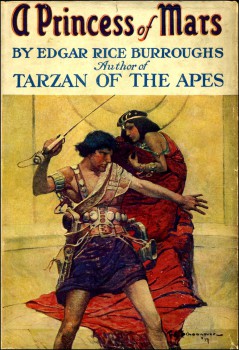
pirates-of-venus-first-edition-coverNext year brings the hundredth anniversary of Edgar Rice Burroughs’s first two published novels: A Princess of Mars and Tarzan of the Apes, as well as a big-budget film version of A Princess of Mars from Disney. (The film is saddled with the unfortunately bland title of John Carter. Fear of a Red Planet?) The effect these novels had on popular cultural was immense: they created a whole medium, they altered the nature of reading for pleasure. Pulp magazines existed before Edgar Rice Burroughs had the idea he could write better than the tripe found in the publications where he was working to place ads; but it was the success of first Under the Moons of Mars (the serial title for A Princess of Mars) and then Tarzan of the Apes in 1912 that made the pulps into the artillery of the Reader Revolution. The pulps turned the U.S. into a nation of readers, and ERB fired the first two shots in the revolution.

Then, twenty years into the revolution, he fired off the few rounds of his “Venus” series.

I have planned some festivities for the upcoming centenary of the Burroughs Upheaval. One is an ambitious project I have wanted to try on Black Gate for the last two years. But as a prologue to my 2012 ERB projects here in 2011, I’ve chosen to present a look at Burroughs’s least popular series, the last one he started before his death.

These posts will have a different structure from my usual free-form analysis style. Inspired by columns I’ve seen on the movie review sites I frequent (particularly “Franchise Me” on CHUD.com), I’ve laid out a template for tackling each of the five installments of the Edgar Rice Burroughs “Venus Saga.” An experiment? Or an admission that trying to go academic on this series feels like the wrong approach? I’m not sure myself, but here it goes….

Read More Read More

Fictional Frontiers Interviews Howard Andrew Jones

Fictional Frontiers Interviews Howard Andrew Jones

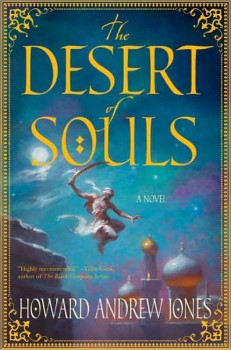
the-desert-of-soulsSohaib Awan at Fictional Frontiers interviews Black Gate Managing Editor Howard Andrew Jones on his first novel The Desert of Souls, non-Western fantasy, juggling modern expectations in historical fiction, and much more:

Fictional Frontiers: I’m spouting hyperbole here, but I think it’s so well earned…. give us an overview of The Desert of Souls.

Howard: Like a lot of adventure fiction, it starts with the discovery of a body. Of course, it’s the body of a dead parrot. The parrot’s beloved by Jaffar — I guess it’s a little Disney joke, because you know, Jaffar and the parrot. But of course Jaffar was a real character… arguably the most famous vizier in Arabian history. Anyway… his guard captain Asim suggests an adventure into the market. So he and Jaffar and the scholar Dabir go out into the city in disguise, and a dying man presents them with a strange and beautiful artifact, a golden door pull, and he asks them to keep it safe.  And that’s where things really take off. Dabir and Asim are tasked by Jaffar with learning the pull’s origin and purpose. Naturally they’re not the only ones after the thing, and they soon learn it may open a gateway to an unearthly realm, accessed in the ruins of the lost city of Ubar, which is sort of like an Atlantis of the sands.

The complete podcast runs 22 minutes, and is available here.

Goth Chick News: Cool Stuff from the Chicago Comic-Con

Goth Chick News: Cool Stuff from the Chicago Comic-Con

image004Ah, August in Chicago.

Bicyclists along the lake front, street festivals, the Navy Pier Ferris Wheel… and so many guys dressed like storm troopers you can’t spit a piece of gum without hitting one.

It’s once again Comic-Con time in the city.

Each year, following the bacchanalia in San Diego in July, the less manic, more edgy and far more spandex-laden version makes its way to my favorite city and thanks to my Black Gate creds, I get VIP access every August. The big Hollywood bunny-huggers in California can keep their con. Give me the artsier, indy-er and far more laid back Midwest version where you can still hobnob with the entertainment industry; but instead of seeing them from behind black draped partitions, you walk right up, shake hands and have a chat.

Amazing cartoonists, emerging authors, small-movie moguls and performance artists all mix with Iron Man-costumed day traders and slightly overweight Batmen.

A better afternoon you couldn’t hope to spend.

In the coming weeks it will be my distinct pleasure to bring you in-depth looks at some of my absolute favorite finds from the 2011 show. But being one of those “open at least one present on Christmas Eve” kind of girls, I couldn’t wait for the interviews to start taking shape.

So, here are a few of the most unique sights that caught my attention, in a good way. Believe me, there were a lot of sights that caught my attention in an entirely different way altogether, but I’ll stow my snark and stick to the cool stuff, listed in no particular order.

Read More Read More