Browsed by
Category: Books

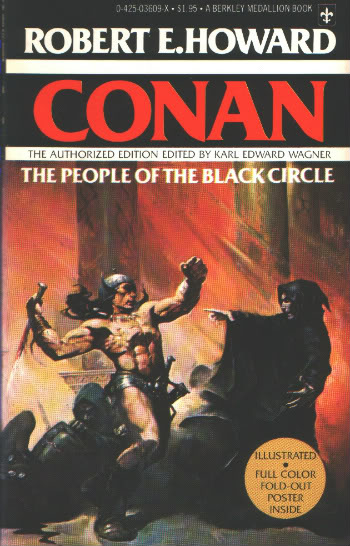
Vintage Treasures: The People of the Black Circle by Robert E. Howard
Vintage Treasures: The People of the Black Circle by Robert E. Howard

people-of-the-black-circleI may have more books by Robert E. Howard in my collection than any other writer.

I’m not certain, as I haven’t counted, and if you allow anthologies then he’ll be beaten out handily by folks like Isaac Asimov and Martin H. Greenberg. But the venerable Mr. Howard occupies more than two shelves in my library, which is astounding for someone who died at the age of thirty.

I came to Howard early. The first story I read by REH was “Pigeons from Hell,” which Charles Saunders mentioned in a speech he gave to the Ottawa Science Fiction Society in 1981, the year his groundbreaking Imaro was released. “Horror doesn’t usually scare me,” he told us. “‘Pigeons From Hell’ scared me.”

I think the second REH tale I read was the Solomon Kane tale “Skulls in the Stars,” which I enjoyed even more. (I wrote about the two Bantam Solomon Kane collections, Skulls in the Stars and The Hills of the Dead, last year.)

But I wasn’t a Conan fan. Most of it was prejudice — in those days, all those novels with barbarians on the cover were considered the lowest form of fantasy, and I generally snubbed them. Oddly, I don’t think I even associated Conan with Robert E. Howard.

I surreptitiously tried a Conan book in my early teens, a collection of tales mostly by L. Sprague de Camp and Lin Carter, if I remember correctly. Didn’t impress me. That was all I needed to confirm that I was better than this stuff and return to reading books of quality, like Perry Rhodan and Alfred Hitchcock and the Three Investigators.

All that began to change with The People of the Black Circle, a Christmas gift from my brother Michael.
Read More Read More

Some Thoughts on Grimus

Some Thoughts on Grimus

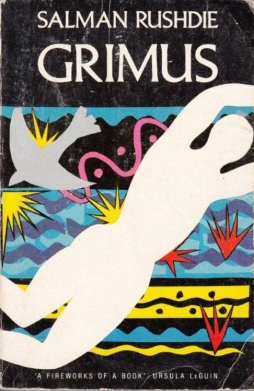
GrimusBrian Aldiss has told a story (and I have no reason to doubt it) in which he, Arthur C. Clarke, and Kingsley Amis were the jury for a 1975 Sunday Times science fiction award. One of the books they were strongly considering for first prize was a novel called Grimus, by a 25-year-old first-time writer who worked in advertising. But as they deliberated, the publisher pulled the book from the competition, evidently because said publisher didn’t want the book given the label of ‘science fiction.’ Odd to think of the impact on the writer’s career: “Had it won,” Aldiss has been quoted as observing, “he would have been labelled a science-fiction writer, and nobody would have heard of him again.” As it happened, Salman Rushdie’s second novel, 1981’s equally-fantastic Midnight’s Children, won the Booker Prize (as well as both the 25th anniversary and the 40th anniversary “Booker of Bookers” prize, which pitted all the books that had won the prize up to those points against each other); he’s gone on to have a distinguished and controversial career, though one famously marked by the outrage his writing provoked in certain quarters.

Reading Grimus, I find that, whatever his publisher might have wanted, it’s easiest to define it as that subset of fantasy called science fiction. At times, and perhaps by the end of the book, that’s even the best way in which to read it. But the novel’s so strange and supple it moves quickly and effortlessly from one genre to another, one narrative approach to the next. It reinvents its form as it goes, incorporating what came before while opening up new ways for its tale to proceed. You can see why a jury of writers would look at it as a potential prize-winner; it’s remarkable, and if I found it only sporadically involving on a human level, its fluidity of prose and image still made it work — there’s a pleasure in storytelling, here, and in the plasticity of story, in story that refuses to be bounded by any descriptor and so spills out to embrace all genres.

Read More Read More

Pass the Salt, Please

Pass the Salt, Please

DinnerAccording to some people, I spend an inordinate amount of time thinking about food. That’s right, I’m one of those people who start planning lunch while we’re still sitting at the breakfast table. But, see, there’s a reason for that: something might need to come out of the freezer, or come in from the garden.

I also have a good grasp on where my food comes from. As a child, one of my aunts kept chickens in her patio, and we kids used to flush rabbits for my uncle and his friends to kill with sling shots – real slings, by the way, not catapults.

Now that I live in the country, I buy meat and cheese from the people who produce them – my neighbours. I also have a very large garden where I grow my own produce, and as it happens, there’s not a lot about freezing, canning, and preserving that I don’t know.

One thing’s for sure: it takes up a lot of time. And in a pre-industrial age – the time period that most of us use for our secondary world fantasies – it took up almost all of the time. So why don’t we see more of it in our books? Well, it’s just that, for most of us, how to get dinner, where dinner comes from, how to pay for it, grow it, etc. isn’t the story we want to tell – nor the story our readers want to read.

But as I’ve suggested already (and no doubt will again), this is information we need to know. Not doing this right – or not doing it or at all –  is the mark of an amateur. Sometimes, in our modern technological world, we’re so far removed from how the food gets produced, that we can easily make serious mistakes – or worse, overlook significant motivation – by not understanding where food comes from, and how it was produced in a pre-industrial age.

Read More Read More

Set Sail on the Waters of Darkness

Set Sail on the Waters of Darkness

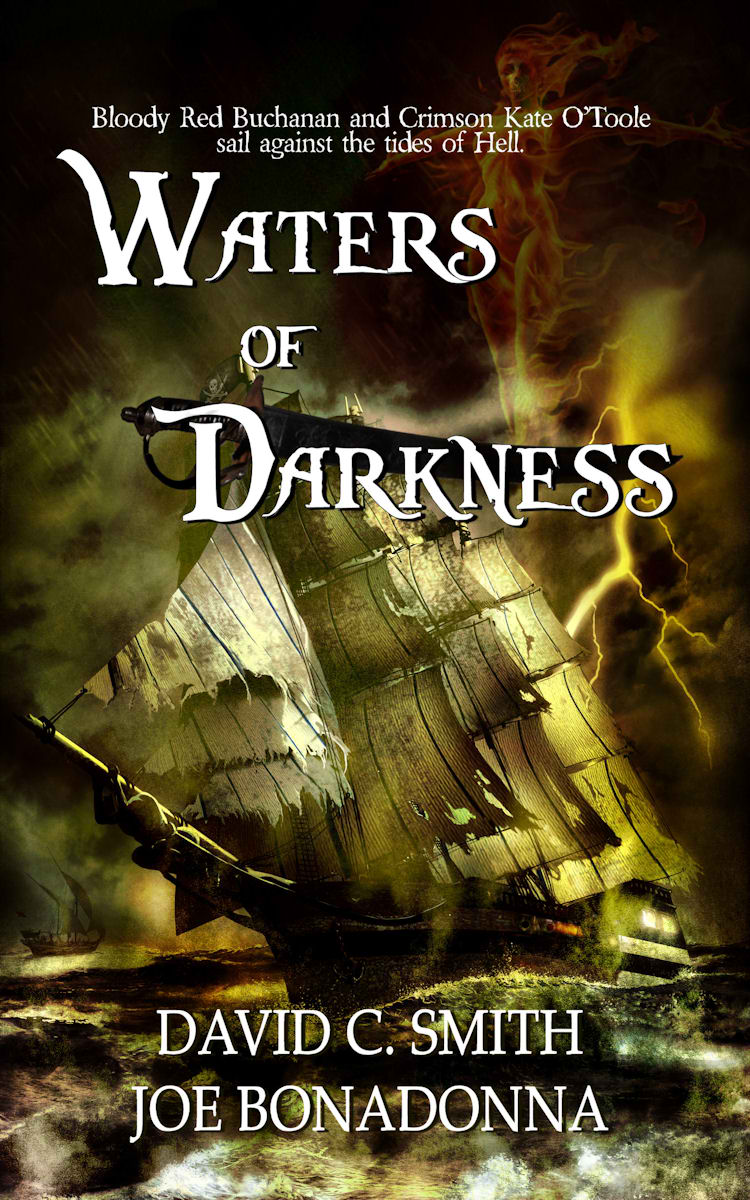
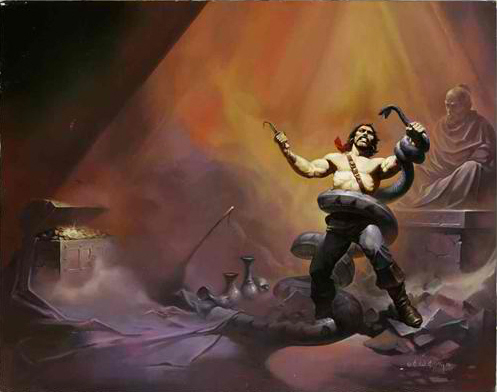
waters darknessfrazetta pirate-smallWaters of Darkness is the new novel from David C. Smith and Joe Bonadonna, published by Damnation Books. Longtime readers of my column will recognize Bonadonna as the author of the well-received sword & sorcery title, Mad Shadows and the recent space fantasy, Three Against the Stars. David C. Smith will be familiar to Robert E. Howard fans for his series of Red Sonja novels in the 1980s.

The shade of Robert E. Howard lingers over every page of Waters of Darkness, the first collaboration by these two talented authors to see print.

The principal characters, Crimson Kate O’Toole and Bloody Red Buchanan, would have fit in nicely had this 17th Century swashbuckler first seen print in the pages of Weird Tales in the 1930s. A quest for fabled treasure sets these two buccaneers sailing for the Isle of Shadow in the far distant Eastern Seas.

They find themselves combating an evil priest of Dagon and the sorcerer in his thrall along the way and most of the crew of the Raven pays the cost for their having crossed paths.

Read More Read More

New Treasures: Dangerous Waters, by Juliet E. McKenna

New Treasures: Dangerous Waters, by Juliet E. McKenna

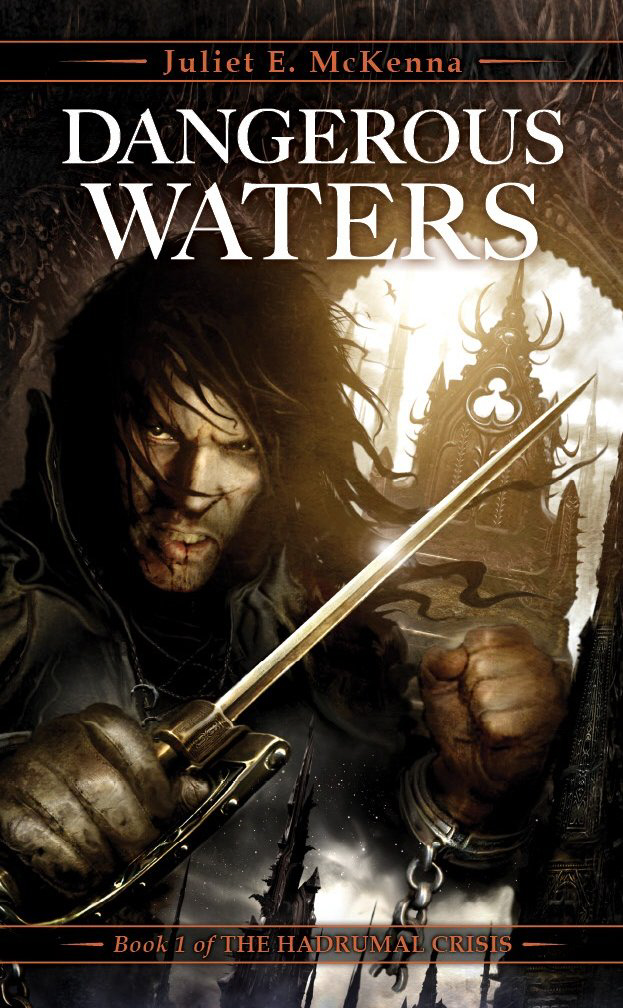
Dangerous Waters Juliet E McKennaI’m such a sucker for paperbacks. Seriously, put a rogue with a sword and a ship on the cover, and I’ve got that thing to the cash register faster than you can say, “Paper or plastic?”

I think it’s partly because I find paperbacks very inexpensive. That wasn’t always the case. When I  made my weekly pilgrimage to downtown Ottawa bookstores in my teens, clutching ten bucks of hard-earned babysitting money, that was barely enough to get 2-3 paperbacks — if I was selective.

I agonized over each choice. Keith Laumer’s The Time Bender, or Fritz Leiber’s Swords Against Death? Edgar Pangborn’s West of the Sun, or Arthur C. Clarke’s Imperial Earth? These are the life choices that kept me up at night.

Today things are easier. For one thing, paperback prices haven’t budged in over 15 years. I paid $7.99 for a paperback copy of Connie Willis’s To Say Nothing of the Dog in 1998, and I paid $7.99 for the copy of Juliet E. McKenna’s Dangerous Waters I bought last week.

That’s an incredibly long period for anything to be stable in publishing — look at how paperback prices quadrupled in the 15 years between 1965 (around a buck) and 1980 (around 4-5 bucks).

Paperback prices won’t stay this way for long. But while they do, I’m enjoying them. $7.99 (minus my 10% Barnes & Noble member discount) is still an impulse buy for me. Which means I can pick up a book based on nothing more than a cool cover, and take it home guilt free.

I have no idea what it says on the back of Dangerous Waters, but I think I’ll read it now and find out.

Read More Read More

Teaching and Fantasy Literature: More on Writing Fantasy Heroes

Teaching and Fantasy Literature: More on Writing Fantasy Heroes

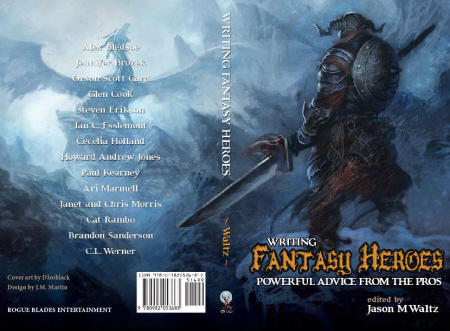
Writing Fantasy HeroesLast week I began a review of Writing Fantasy Heroes: Powerful Advice from the Pros, Jason M. Waltz’s collection of essays on craft. Most of the authors seem to assume the reader is a newcomer to fiction writing, but some of the advice is sufficiently specialized that many veteran writers will also find it useful. It’s also a pleasure to see the authors pull back the curtain on their own work, walking the reader through passages, sometimes in early draft, that illustrate the particular technique or concern of each chapter.

Picking up where we left off last week, we find Ian C. Esslemont coming up with something genuinely new to say about the old adage, “Show, don’t tell.” For the benefit of newer writers, he goes over the familiar territory: why to avoid infodumps, how to recognize them in one’s own drafts, ways to replace them with opportunities for dramatic action, classic blunders like “As you know, Bob” dialogue. Stick with Esslemont to the end, though, despite the groanworthy title of “Taking a Stab at Sword and Sorcery,” and he complicates the choice between showing information and telling it with a third possibility I’ve seen handled in other ways, but never right in a discussion of “Show, don’t tell.”

Read More Read More

Sean T. M. Stiennon reviews The Black Prism

Sean T. M. Stiennon reviews The Black Prism

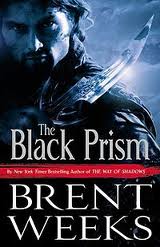
How could I have ever doubted this cover, this beard?

The Black Prism
Brent Weeks
Orbit Books (640 pages, hardcover first edition August 2010, $25.99)

I’ll admit that, if I hadn’t already devoured Brent Weeks’s Night Angel novels, I probably wouldn’t have picked up The Black Prism (despite the cool, shadowy cover of a man in a magnificent goatee brandishing a mirror-polished blade).  The reason for that is a shallow one: The magic system sounded stupid. It is, in short, rainbow magic, sorcery based on splitting white light into one or more of its component colors to create a magical effect. But the Night Angel books were awesome, and I gave Weeks a chance to impress me again.  It took me ten pages to be thoroughly hooked on his story, and another hundred pages to be sold on his unique approach to magic.

In the world of the Seven Satrapies, trained drafters can draw color out of appropriately shaded objects (or white light viewed through a tinted lens) and draw it into their bodies to create a substance called luxin.  The properties of luxin differ dramatically based on its color: Red luxin is a hyper-flammable jelly, while super-violet luxin (just above the visible spectrum for most people) is as light and strong as spider-silk.  Each color also carries with it a particular emotional state that overtakes the person drafting it.  Green is wild and impetuous, orange slick and dissimulating.  It’s a simple idea with complex uses, both for war and for technology, and the applications Weeks finds for various kinds of luxin are a big part of the The Black Prism’s unique appeal.

Monochromes draft one color, and represent the majority.  Bichromes, the elite among drafters, have access to two, usually contiguous on the color spectrum (i.e., red and orange), and a small handful are polychromes, commanding three or four.  Only one man — the Prism — can split light into all seven stable colors, and he is regarded as high priest of the one god Orholam, the source of all light.  When there is imbalance in the world caused by one color being drafted more than another, it is his vocation to correct it.

Read More Read More

An Interview With Mystery Writer Todd Robinson

An Interview With Mystery Writer Todd Robinson

Todd Robinson author photoTodd Robinson, also known as Big Daddy Thug, is similar to Pat Benatar in one essential way – he hits you with his best shot. His debut novel, The Hard Bounce, is a fast-paced, heart-pounder of a gritty mystery. Unlike Benatar, who shoulder shimmied her way out of knife fights, Robinson looks like he could punch a knife out of your hand, catch it mid-air, and fling it past your ear as a warning without breaking a sweat. He’s broad, bearded, often in black – and thank the literary gods – a peaceable author, too busy writing to get in many fights.

Robinson is the Chief Editor of ThugLit, a crime journal dedicated to “writing about wrongs.” His novel, The Hard Bounce, came out in January. It focuses on Boo and Junior, two regular guys who are bouncers at a Boston punk rock bar. Their security company, 4DC (Dirty Deeds Done Dirt Cheap), is hired to find a missing girl. What begins as an easy job quickly spirals out of control.

Robinson kindly took time out of his editing and writing to speak a piece to Black Gate.

Read More Read More

Romance and Revisions: The Outlaw of Torn by Edgar Rice Burroughs

Romance and Revisions: The Outlaw of Torn by Edgar Rice Burroughs

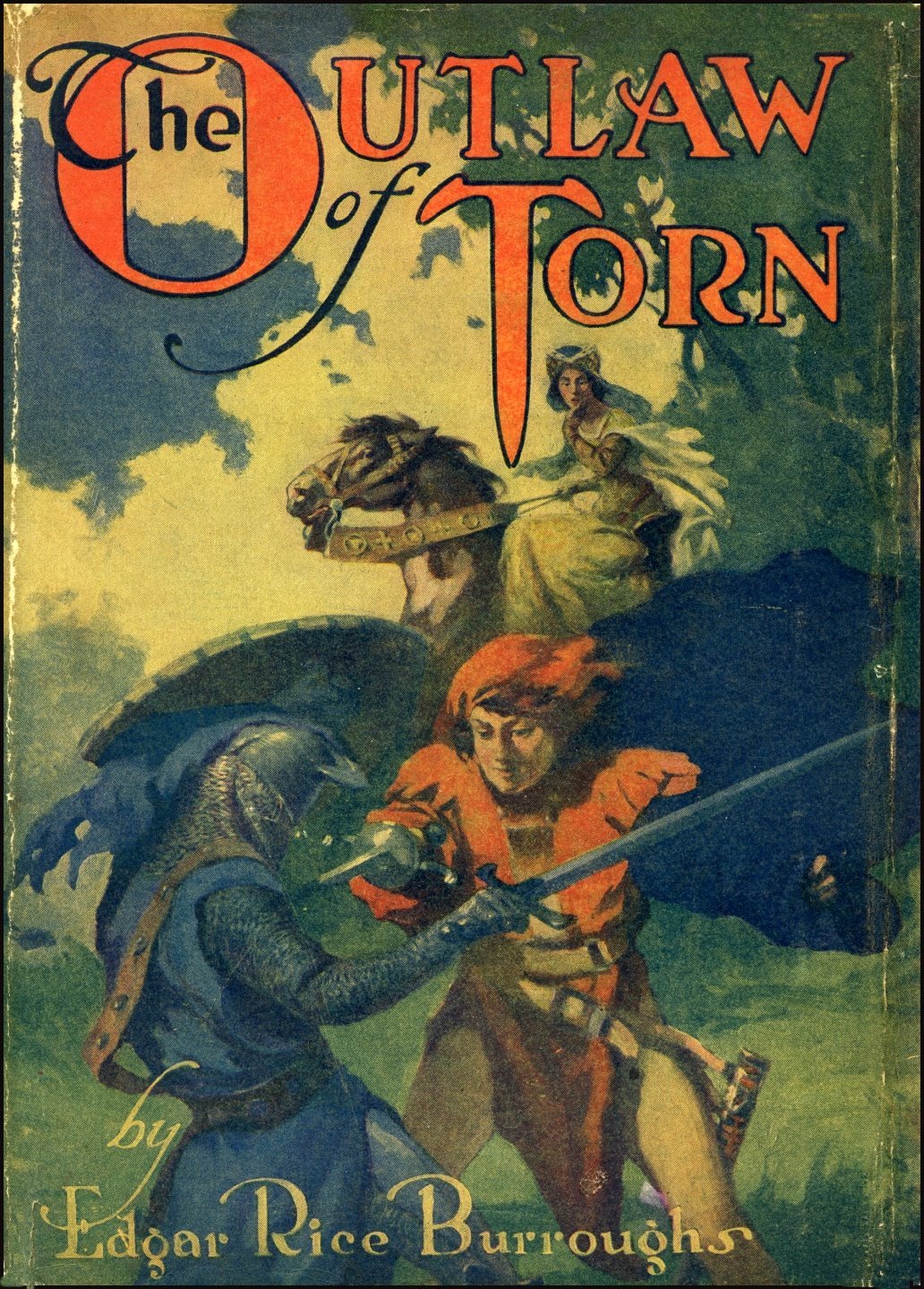
Outlaw of Torn 1st ed“Not since Arthur of Silures kept his round table hath ridden forth upon English soil so true a knight as Norman of Torn.” –Joan de Tany

“I am very doubtful about the story. The plot is excellent, but I think you worked it out all together too hurriedly.” –Thomas Newell Metcalf, letter to Edgar Rice Burroughs, 19 December 1911

“I am not prone to be prejudiced in favor of my own stuff, in fact it all sounds like rot to me…” –Edgar Rice Burroughs, letter to Metcalf, 14 March 2012

In Irwin Porges’s groundbreaking and Chartres Cathedral-sized biography, Edgar Rice Burroughs: The Man Who Created Tarzan (Brigham Young University Press, 1975), only two of ERB’s books have solo chapters dedicated to them: Tarzan of the Apes, of course — and The Outlaw of Torn.

Unless you are a hardheaded Burroughs devotee, I’ll wager a ducat you have never crossed paths with the title The Outlaw of Torn. Considering that chronologically it is squashed between his two most famous books, A Princess of Mars and Tarzan of the Apes, it makes sense that The Outlaw of Torn gets overlooked. That it belongs to the genre of Medieval Romance, a mite mustier than high Martian adventure or swinging times in the African rainforest, compounds the issue.

But this Middle Ages adventure deserves the primacy that Porges awarded it. Burroughs’s second novel taught him hard truths about the business of writing and what he was capable of. ERB was one of the first writer-businessmen; the long labor getting his second book to work and sell schooled him in the reality of making a living as an author of popular adventure.

The Outlaw of Torn also turned out, after all the toil put into it, a flat work manufactured too obviously as a copy of earlier romances. Burroughs thought highly of the book, and in 1927 wrote to his publisher: “I think it is the best thing I ever wrote, with the possible exception of Tarzan of the Apes, and next to it, I believe will rank The War Chief of the Apaches.” But instead of embracing further stories in this style, Burroughs turned and ran for the jungle with his next outing. A lesson learned, even if he could not admit it years later.

Read More Read More

Blue Sonja: The Last Red Sonja Post

Blue Sonja: The Last Red Sonja Post

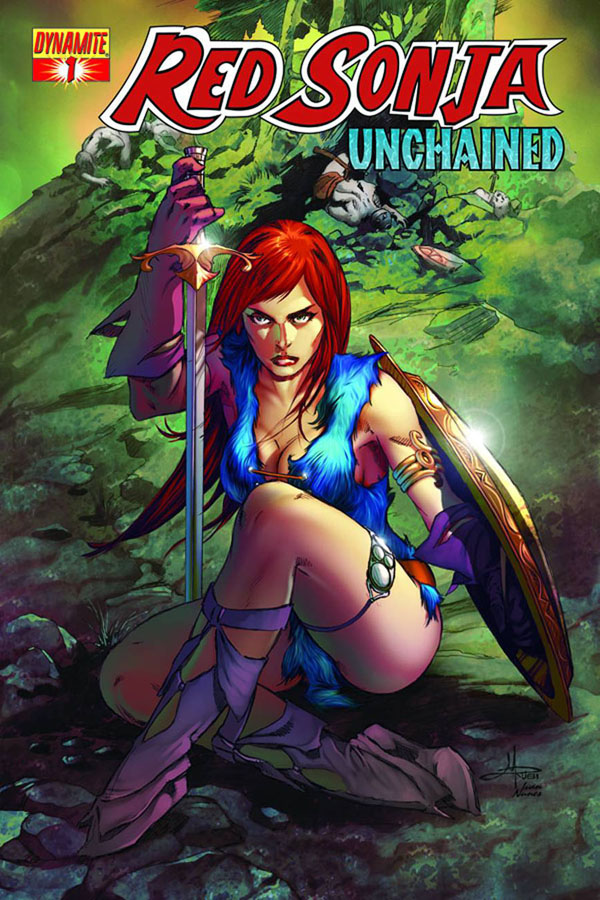
Unchained 1 BlueI started this series of posts with the intention of only writing one. “In Defense of Red Sonja” was meant to be a stand-alone post about how the character was more than just a female version of Conan the Barbarian, more than just a fan-service redhead in a chain mail bikini, more than a misogynist rape-challenge. I’ve been collecting comics from the “Bronze Age” (approximately 1970 through 1985) for years and Red Sonja wasn’t the only female character to pop up. There was Spider-Woman, She-Hulk, Ms. Marvel … all clearly starting as female versions of established male heroes and all eventually transcending those limits to become their own concepts.

That first post quickly grew in size, reaching over three-thousand words before even going into her appearances in Marvel Feature or her self-titled book. As it covered three distinct themes (how she differed from Conan, where the bikini came from, what the vow meant), I thought it would be better to break it into three separate articles. By the time the third post came out, I’d gotten enough positive reaction that I thought it might be nice to keep exploring how the character grew over the course of her own title. It was at this point that I realized just how much humor got slipped in to various panels of the title, which got me in the habit of highlighting a couple images each week. The novels and film were good ways to show how the character translated into other media, as well as how she was still evolving. And it was all a lot of fun.

So why is this the end? There were two more Marvel Comics series in the early eighties, as well as two Dynamite Entertainment series (Red Sonja and Queen Sonja) currently running. Not to mention a slew of one-shots and mini-series. I’ve got enough material to easily keep this column running at least another three years. And it is tempting to try.

Read More Read More