Browsed by
Category: Books

Future Treasures: Adrift by Rob Boffard

Future Treasures: Adrift by Rob Boffard

Adrift Rob Boffard banner

Rob Boffard is the author of the Outer Earth series, which was recently re-packaged in a brick-sized (1,024 pages!) omnibus volume selected by Unbound Worlds as one of the Best Sci-Fi and Fantasy Books of February. His newest novel is Adrift, the tale of a group of tourists caught in a cat-and-mouse game with a deadly alien ship in deep space. It arrives in trade paperback from Orbit next month.

In the far reaches of space, a tour group embarks on what will be the trip of a lifetime – in more ways than one…

At Sigma Station, a remote mining facility and luxury hotel in deep space, a group of tourists boards a small vessel to take in the stunning views of the Horsehead Nebula. But while they’re out there, a mysterious ship with devastating advanced technology attacks the station. Their pilot’s quick thinking means that the tourists escape with their lives – but as the dust settles, they realise they may be the only survivors…

Adrift in outer space on a vastly under-equipped ship, they’ve got no experience, no weapons, no contact with civilization. They are way out of their depth, and if they can’t figure out how to work together, they’re never getting home alive.

Because the ship that destroyed the station is still out there. And it’s looking for them…

Adrift will be published by Orbit on June 5, 2018. It is 416 pages, priced at $15.99 in trade paperback and $9.99 for the digital edition. Read the first chapter at the author’s website.

Vintage Treasures: Four for Tomorrow by Roger Zelazny

Vintage Treasures: Four for Tomorrow by Roger Zelazny

Four for Tomorrow-small Four for Tomorrow-back-small

If you’ll allow me to wax nostalgic for a moment (I know, I know…. when do I do anything else?), I’d like to spend a moment fondly remembering an era when relatively unknown writers could make a huge splash with a mass market paperback collection.

Roger Zelazny’s first collection Four for Tomorrow was published as a paperback original in March 1967 by Ace Books, with a rather uninspired (and very green) cover by Jack Gaughan. Now, Zelazny wasn’t exactly an unknown writer in 1967 — the year before he’d published his first novel ..And Call Me Conrad, which tied with Frank Herbert’s Dune for the Hugo Award for Best Novel, and his second, The Dream Master, an expansion of his Nebula Award-winning novella “He Who Shapes.” In fact, it was a busy time for Zelazny — his novelette “The Doors of His Face, the Lamps of His Mouth” won the 1966 Nebula Award, and his groundbreaking Lord of Light, one of the finest SF novels ever written, won the 1968 Hugo Award.

It was Zelazny’s time. And it’s certainly no surprise that his slender 45-cent collection Four for Tomorrow, which collected four of his best-known longer works from his fledgling career, was a huge success. It was reprinted more than half a dozen times over the next 25 years, and is still fondly remembered.

Read More Read More

Birthday Reviews: Bruce Coville’s “The Passing of the Pack”

Birthday Reviews: Bruce Coville’s “The Passing of the Pack”

Cover by Gary Lippincott

Bruce Coville was born on May 16, 1950.

Best known as a YA author, Coville won the Golden Duck Award in 1992 for his novel My Teacher Glows in the Dark, won it again in 2000 for I Was a 6th Grade Alien, and in 2006 won a Golden Duck for an audio production of Robert Heinlein’s novel Rolling Stones. His novels have twice been nominated for Mythopoeic Awards and in 2000, he received a Skylark Award from NESFA. He received the Empire State Award for Excellence in Literature for Young People from the New York Library Association in 2012.

“The Passing of the Pack” was originally written for the young adult anthology Werewolves: A Collection of Original Stories, edited by Jane Yolen and Martin H. Greenberg in 1988. Coville included the story in his collection Oddly Enough in 1994 and when that volume and its successor were collected in the omnibus Odds Are Good: An Oddly Enough and Odder Than Ever Omnibus, the story saw print again. In 2011, Coville issued the story as an e-book.

Throughout most of history, wolves have been seen as an enemy. They threaten the livestock on small villages and, when particularly hungry can also threaten humans. Bruce Coville channels that fear of wolves in the opening of “The Passing of the Pack,” which describes a wolf attack on a sixteen year old boy and then flashes back to the first time wolves attacked his village when he was five years old.

The story looks at the character’s life as a fatherless boy in a small village, specifically how he was treated almost as an outsider by the rest of the villagers. When he came to the defense of a girl he had befriended, the accusation of witchcraft against her was applied to him as well. By this time, Coville has shown an affinity for him by the wolves and his rescue by the animals is not really a surprise.

Read More Read More

New Treasures: Verdigris Deep by Frances Hardinge

New Treasures: Verdigris Deep by Frances Hardinge

Verdigris Deep-small Verdigris Deep-back-small

Frances Hardinge has twice been nominated for the Andre Norton Award for Young Adult Science Fiction and Fantasy, for her novels Cuckoo Song and The Lie Tree. Verdigris Deep has previously been published in the US under the title Well Witched (2008), and was nominated for the Locus Award for Best Young Adult Book. Amulet has now released it under its original title as part of a set of matching editions with Fly By Night, Fly Trap, and others. Farah Mendlesohn at Strange Horizons said:

Verdigris Deep confirms what I already suspected: Frances Hardinge is the best new fantasy writer for children since Diana Wynne Jones. There is simply no one to match her…

Three children, Josh, Ryan, and Chelle… steal money from an old wishing well. Initially, nothing much happens: then Ryan looks in a mirror and sees water running from his eyes, and passes a poster on which a woman comes alive, her eyes streaming like a fountain. The woman commands him to fulfil the wishes attached to each coin they stole. When Ryan contacts Chelle and Josh he discovers that each of them has acquired “powers” to aid this directive: Josh can now affect electricity and any item that can carry current, while Chelle has become a radio receiver for the wishers—in their vicinity she spills their every thought. Ryan’s “power” remains hidden for a while, mere warts on his hand; but as things proceed the warts develop into eyes which can see the wishes people make as long smoky threads emerging from the chest.

Serving the spirit in the well begins as empowering fun: Ryan, Chelle, and Josh help a young man to win a Harley Davidson, and facilitate a young woman none of them like in finding her true love, but as the story develops it darkens: wishes become more worrying, some of them are out of date and no longer accord with people’s desires yet must still be fulfilled, others are downright nasty or require nastiness to achieve… As the book rolls on to its crescendo, water and emotions flood the page. The ending is deeply satisfying: it is incomplete, problematic, and flows off the edge of the page.

Verdigris Deep was published by Amulet on April 10, 2018. It is 287 pages, priced at $10.99 in hardcover and $9.99 for the digital edition. The cover is by Vincent Chong.

The Roots of Grimdark:The Black Company by Glen Cook

The Roots of Grimdark:The Black Company by Glen Cook

No one will sing songs in our memory. We are the last of the Free Companies of Khatovar. Our traditions and memories live only in these Annals. We are our only mourners.

It is the Company against the world. Thus it has been and ever will be.

from The Black Company

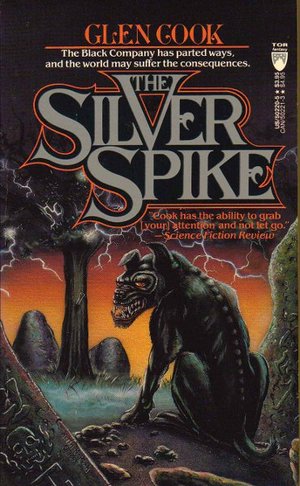
oie_1471611MVbvsrErYou never know, when you pick up a book, the impact it will have on your life. In 1984, my friend Carl tossed me a copy of The Black Company (1984), a book I’d end up rereading half a dozen times over the next thirty-five years. It turned out to be the first book in what eventually grew into a ten book series (eleven actually, as the first new Black Company book in eighteen years, Port of Shadows, is to be published in September) and one of my favorite works of epic fantasy. Several of Cook’s other books are better written, better plotted, and more cohesive than The Black Company, but none of them has left as indelible a mark on me as this one.

The setup of the novel is this: a mercenary company unknowingly signs on to the service of Sauron’s wife the Lady, a great and powerful sorceress. Her empire has risen up in rebellion against her and her minions, the Nazgul Taken. Assassinations, intrigue between world-shaking sorcerers, and massive battles unfurl in a world notable mostly for its corruption, constant deceit, and an assumption that nothing ever really goes right. Never an especially good bunch of guys, by the book’s end, several important members of the company have grasped the awfulness of their employer and have started to have second thoughts about remaining in her pay. That may not sound original in 2018, but back in 1984, villains as protagonists was mind-blowing.

The novel is presented as a volume from the annals of the Black Company, a notorious band of sell-swords, as written by the company’s annalist and surgeon, Croaker. Not a senior officer, but not a grunt either, he serves as the perfect narrator of the book’s calamitous and epic events. He’s rarely in on the plotting out of the Company’s next missions, but he’s usually in a position to participate in the more important aspects of them.

There’s a sizable epic fantasy-sized cast in The Black Company, but by focusing so intently on a single character, Croaker, the story’s told on a very human scale. Croaker’s primary concerns, as a member of the company and as its doctor, are for the lives of his brothers-in-arms, more than for the concerns of empire. Through him we get a feel for the most prominent of the company’s soldiers and wizards. We see huge events from the perspective of someone effected by them but without any significant control over them. This is not a book about the destinies of kings and princes or heroes and wizards, but men who carry spears, grumble about bad rations, and worry about paying off their debts from losing at cards.

Read More Read More

Birthday Reviews: Dave Wolverton’s “We Blazed”

Birthday Reviews: Dave Wolverton’s “We Blazed”

Cover by Michael Sabanosh

Dave Wolverton was born on May 15, 1957. He also writes using the pseudonym David Farland.

Wolverton won the Grand Prize from the Writers of the Future in 1987 to start off his career with his story “On My Way to Paradise,” which he expanded to book length. The novel version received a special citation from the Philip K. Dick Awards. His novelette “After a Lean Winter” was nominated for the Nebula Award in 1997. After his wins and nominations, Wolverton served as a judge for both the Philip K. Dick Award and the Writers and Illustrators of the Future. His historical novel In the Company of Angels received the Whitney Award and he won the International Book Award for Best Young Adult Novel for Nightingale.

“We Blazed” was written for the anthology Peter S. Beagle’s Immortal Unicorn, edited by Beagle with Janet Berliner, and Martin H. Greenberg. It was reprinted in the June 2011 issue of Leading Edge, whole number 61, edited by Chris Baxter. Later that year Wolverton re-issued the story as an e-book under his David Farland pseudonym.

Wolverton’s “We Blazed” is a wonder of misdirection. Seemingly the story of an immortal man on a quest to find his equally immortal lover, Wolverton provides some wonderful twists. No reason is given for Alexander Dane’s longevity, nor that of Kaitlyn, whom he is trying to find, but he walks through an Earth impossibly in the future, almost completely amnesiac except knowing that he is looking for Kaitlyn.

Read More Read More

Tell Me a Story: Upside-down Magic by Sarah Mlynowski, Lauren Myracle, and Emily Jenkins

Tell Me a Story: Upside-down Magic by Sarah Mlynowski, Lauren Myracle, and Emily Jenkins

Upside Down Magic-small Upside Down Magic-back-small

When it comes to my own preference, I like my audiobooks dark, spooky, snarky, and full of drama. But I’m not the only person in this house! In fact, I share it with (among several other mammals) a pair of elementary school aged girls for whom I am the staff. I mean mom. They’re five and eight, and some of my favorite books aren’t appropriate to play when they’re around. (I’m fairly progressive but I’m not ready to explain what exactly they’re doing on the movie set in Jim Butcher’s Blood Rites, for example.)

Finding strong, good quality stories that are suitable for them and tolerable to me is a priority. Enter  Sarah Mlynowski, Lauren Myracle and emily Jenkins’ Upside-Down Magic, a series of children’s novels that are delightful, original, and convey the kind of messages I don’t have to worry about them repeating in school the next day.

The central protagonist of Upside-Down Magic is Eleanor “Nory” Horace. Her father is the headmaster of a prestigious boarding school, and she’s preparing for entrance exams. By studying her shapeshifting. Nory is a “fluxer”, someone whose magic manifests as allowing her to change form. Nory is in most ways going through a normal adolescence in the world of Upside Down Magic. All people develop some kind and degree of magical ability, which manifests around their tenth birthday. Fifth grade, then, means transitioning from general education to magic school. Nory is expected to follow her father and siblings’ footsteps by entering the American magical equivalent of Eton.

Read More Read More

Future Treasures: Free Chocolate by Amber Royer

Future Treasures: Free Chocolate by Amber Royer

Free Chocolate Amber Royer-smallAmber Royer first got my attention with her funny and thoughtful guest post at Unbound Worlds last month, promoting her upcoming space opera Free Chocolate from Angry Robot:

I play a bit with gallows humor in Free Chocolate – after all, half the book takes place on an alien warship where your superior officers can eat you should you disappoint them – and, yeah, it’s a fine balance. You don’t want to make death meaningless, even as the characters acknowledge the precariousness of their situation. Because if death becomes meaningless – or, worse, funny – then the remaining characters’ lives aren’t so important anymore… You know, every writer’s worst nightmare. We want our characters to be like that unnamed actor, finding dignity and a sense of psychological well-being, even in the face of absolute horror and near-certain death.

Speaking of which… I once read that science fiction is a society’s hopes, fantasy its daydreams, and horror its nightmares. (I cannot find the citation for this one – sorry, awesome writer, from the mid-90s.) I think that’s another reason SF writers so seldom venture into pure comedy… with sci-fi, you spend so much time building a world that needs to be convincing, an entire vision of the future, or an alternate past, or an alien landscape, and you put so much of yourself into sharing the things you hope and fear. You want it to be bulletproof in the reader’s mind. It’s hard, then, to acknowledge the absurdity of many of those fears, the impossibility of some of the hopes, to let yourself be laughed at, even in a positive way.

Free Chocolate is a far-future tale in which chocolate is Earth’s only unique commodity… one that everyone else in the galaxy is willing to kill to get their hands, paws and tentacles on. Here’s the description.

Latina culinary arts student, Bo Benitez, becomes a fugitive when she’s caught stealing a cacao pod from one of the heavily-defended plantations that keep chocolate, Earth’s sole valuable export, safe from a hungry galaxy.

Forces array against her including her alien boyfriend and a reptilian cop. But when she escapes onto an unmarked starship things go from bad to worse: it belongs to the race famed throughout the galaxy for eating stowaways! Surrounded by dangerous yet hunky aliens, Bo starts to uncover clues that the threat to Earth may be bigger than she first thought.

Free Chocolate will be published by Angry Robot on June 1. It is 448 pages, priced at $9.99 for both the paperback and digital editions. The cover is by Mingchen Shen.

John DeNardo on the Best Science Fiction, Fantasy & Horror in May

John DeNardo on the Best Science Fiction, Fantasy & Horror in May

Artificial Conditions Martha Wells-small Fury From the Tomb-small Afterwar Lilith Saintcrow-small

Over at Kirkus Reviews, the always organized John DeNardo has already compiled his list of the most interesting genre fiction of the month. And as usual, it’s crammed with titles that demand our immediate attention. Starting with a new release by one of the most popular authors to ever appear in Black Gate, the marvelous Martha Wells.

Artificial Condition by Martha Wells (Tor.com, 160 pages, $16.99 in trade paperback/$9.99 digital, May 8, 2018) — cover by Jaime Jones

Looking for a short novel that packs a punch? Check out the fun Murderbot Diaries series by Martha Wells. In the first one, All Systems Red, attempts by the people of a company-sponsored mission on another planet to mount a rescue are complicated by a rogue robot who hacked its own governing module and ends up with identity issues. In the new book, Artificial Condition (the second of four planned short novels), the robot’s search for his own identity continues. To find out more about the dark past that caused him to name himself “Murderbot,” the robot revisits the mining facility where he went rogue where he finds answers he doesn’t expect.

All Systems Red was nominated for the 2018 Philip K. Dick Award, and is currently up for both the Locus Award and Hugo Award for Best Novella. The third installment in the series, Rogue Protocol, will be released on August 7, 2018. Read the first two chapters of Artificial Condition at Tor.com.

Read More Read More

Vintage Treasures: The House of Many Worlds by Sam Merwin, Jr.

Vintage Treasures: The House of Many Worlds by Sam Merwin, Jr.

The House of Many Worlds-small The House of Many Worlds-back-small

Sam Merwin Jr. was one of the most influential SF editors of the pulp era. He took over the reins at Thrilling Wonder Stories and Startling Stories in Winter 1945 from Oscar J. Friend, and immediately adopted a more mature attitude, attracting more adult readers and better writers. At first he assumed Friend’s editorial pseudonym, Sergeant Saturn, but eventually he simply went by the title Editor. By 1950 he was also editing Fantastic Story Quarterly and Wonder Stories Annual, making him one of the most important names in the field. His letter columns were avidly followed by fans of all ages, and he’s widely credited with steering his SF magazines out of the kid’s section and towards an adult readership.

Merwin quit editing in 1951 to become a freelance writer, and found some success with mysteries, and writing stories for DC’s Strange Adventures and Mystery in Space in 1952-1953. He briefly edited Fantastic Universe in 1953, and was an associate editor at Galaxy around the same time.

But Merwin is remembered today chiefly for two linked time travel novels, The House of Many Worlds and Three Faces of Time. They were published in a paperback omnibus edition by Ace in 1983, with a cover by comic artist Frank Brunner (above).

Read More Read More