Browsed by
Category: Books

New Treasures: Velocity Weapon by Megan E. O’Keefe

New Treasures: Velocity Weapon by Megan E. O’Keefe

Velocity Weapon-small Velocity-Weapon-back-small

Two years ago I wrote a couple of articles about Megan E. O’Keefe’s Scorched Continent trilogy. The opening volume, her debut novel Steal the Sky, was nominated for the David Gemmell Morningstar award, and Beth Cato called it “like an epic steampunk Firefly.” The last book in that series appeared in 2017, so I’ve been keeping my eye out for something new from her, and it finally arrived early this summer. And it looks like space opera, my favorite new genre! Is the world good to me, or what. Here’s what Kirkus said about it.

The last thing Sanda Greeve remembers is her ship being attacked by rebel forces. She’s resuscitated from her evacuation pod missing half a leg — and two centuries — as explained to her by the AI of the rebel ship that rescued her. As The Light of Berossus — aka Bero — tells her, she may be the only living human for light-years around, as the war wiped both sides out long ago. Sanda struggles to process her injuries and her grief but finds friendship with the lonely spaceship itself. Sanda’s story is interspersed with flashbacks to the war’s effects on her brother, Biran, as well as scenes from a heist gone terribly wrong for small-time criminal Jules. The three narratives, separated by a vast gulf of time, are more intertwined than is immediately apparent. When Sanda rescues Tomas, another unlikely survivor, from his own evacuation pod, she learns that even time doesn’t end all wars….

Meticulously plotted, edge-of-your-seat space opera with a soul; a highly promising science-fiction debut.

That’s tantalizing enough for me; I bought a copy last week. I want to dig into this one right away — which may mean I have to spring for the audio version. I’ve been traveling a lot recently (9 states in the last two weeks), and I find listening to books while I’m driving is a lot more productive that trying to stay awake reading in a hotel room.

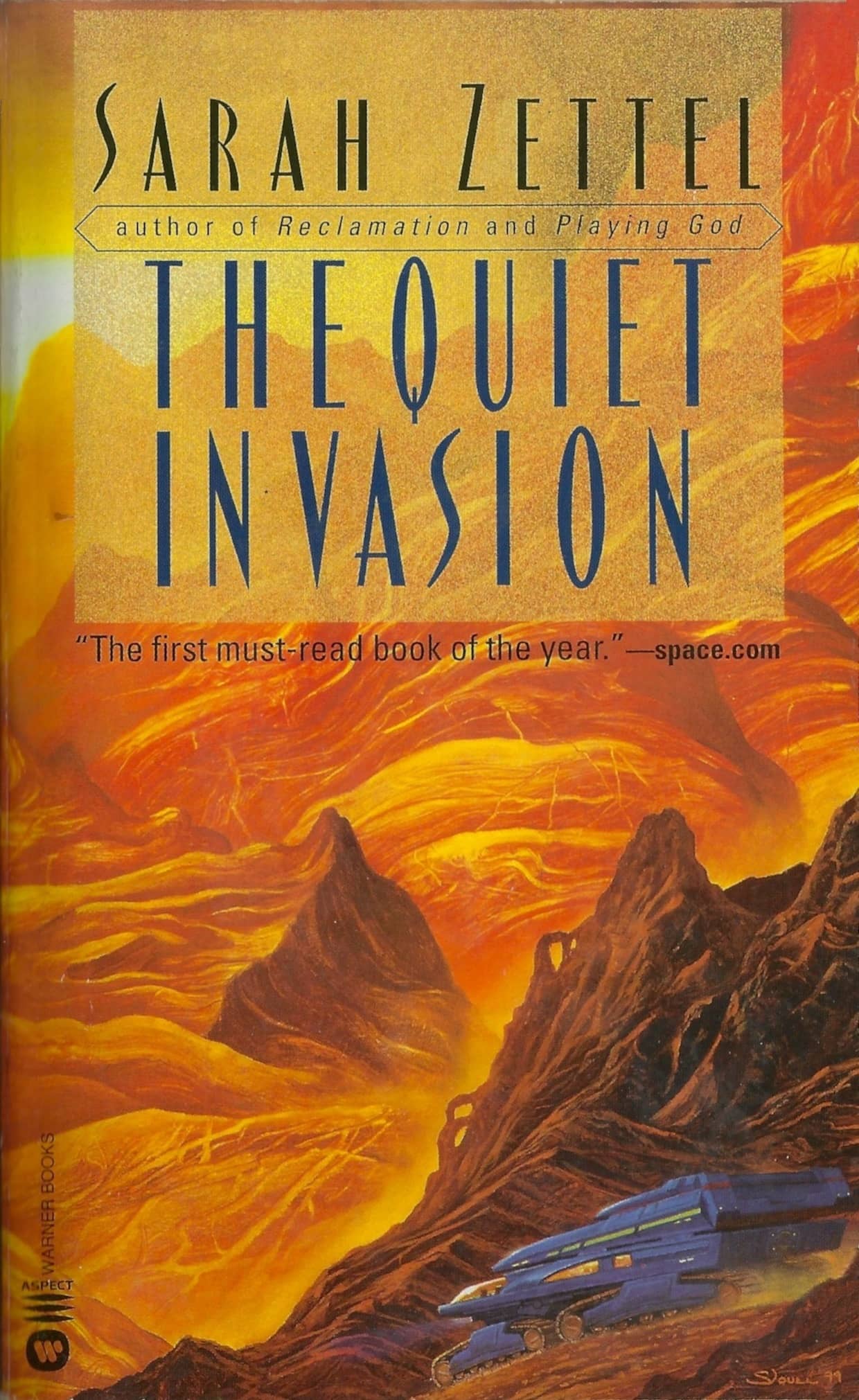
Velocity Weapon was published by Orbit in June, 2019. It is 505 pages, priced at $15.99 in trade paperback and $9.99 in digital formats. The cover is by Sparth. See all our recent New Treasures here.

Making our Journey to Machine Domination More Fun: The Robots of Gotham by Todd McAulty

Making our Journey to Machine Domination More Fun: The Robots of Gotham by Todd McAulty

The Robots of Gotham cover wrap-small

Wearing aluminum hats won’t help us anymore. Apple’s Siri, Amazon’s Alexa, and Google’s Assistant likely conspire against humanity, and no doubt will copulate and have gendered, machine children. That is one vision of the future. The Robots of Gotham will at least make our journey toward machine domination more fun. Todd McAulty’s first-person blog-style is profoundly easy to consume. Highly recommended for everyone who has a smartphone!

What is the best way to deal with being constantly surveilled by devices? Reading fiction about robot invasions can help, preferably paperbacks (eBooks and Kindles are monitoring you). Todd McAulty’s The Robots of Gotham has already received great praise from Publisher’s WeeklyBooklist, the Toronto StarKirkus Reviews, and numerous authors. Here is more.

Artificial Intelligence

I am by no means an expert in artificial intelligence, which makes my perspective even more alarming (exciting?). Many readers likely share this history, and it is why you’ll enjoy Todd McAulty’s The Robots of Gotham.

As a teenager (1980’s), I had the experience of interacting with Apple IIe and TI94 computers (when data was never stored on disk or was saved to tape), which had users game with a computer that served as a dungeon master. Digitized, text-based adventures like Infocom’s Zork provided a surreal version of Choose-Your-Own-Adventure books. Practicing science for decades, I’ve witnessed computers grow from simple calculators to devices that measure, store, analyze and report data with limited human intervention.

Read More Read More

Zombies Need Anthologies! PLUS Short Fiction Crafting

Zombies Need Anthologies! PLUS Short Fiction Crafting

ZNB KickstarterBanner10

Howard: Today I’m turning over my Black Gate megaphone to Joshua Palmetier, gifted writer, mathematician, and the mind behind Zombies Need Brains’ line of anthologies. Joshua publishes a lot of Black Gate writers, so we naturally have fingers crossed his upcoming Kickstarter will fund and hope that you’ll check out. Regardless, though, this article has some great insight on writing good short fiction and getting out of the slush pile. Take it away Joshua!

Zombies Need Brains’ latest Kickstarter is nearing its end (ONLY HOURS LEFT!) and, with the possibility of an open call for submissions if we fund, I thought that I’d spend some time talking about how you can better your chances of getting from the ZNB slush pile into one of our anthologies. The competition is pretty steep and only getting worse with each Kickstarter. (Last year, Portals had 550 submissions alone and we ended up taking seven; we had a lot of anchor authors for that one, though.) I’ve talked before about how to brainstorm your way to an idea that isn’t standard, but also isn’t so far out there it’s off theme. So let’s suppose you already have an idea of what you want to write. A core concept.

Read More Read More

Vintage Treasures: Cold Iron and Sister to the Rain by Melisa Michaels

Vintage Treasures: Cold Iron and Sister to the Rain by Melisa Michaels

Cold Iron Melisa Michaels-small Sister to the Rain-small

I was preparing a Vintage Treasures article on Melisa Michaels on Saturday, and particularly her two-volume urban fantasy series featuring private eye Rosie Levine, Cold Iron (1997) and Sister to the Rain (1998), when I stumbled on this disturbing Facebook post by Rich Horton:

I have just learned that Melisa Michaels has died. I knew she had cancer, and she had recently reported that there wasn’t much more to be done, but it’s still sad news, and it seems to have come more quickly than she thought.

But I wanted to celebrate her — she was one of the first people to, as it were, welcome me to the SF community, when I first went online, and when I joined SFF Net. We had many great conversations (online) about SF and other matters. She is one of the people I really owe a debt to for helping me make friends in this field.

I read her novels, the Skyrider SF series and the Rosie Levine Fantasy/Mystery series, with much enjoyment… Melisa always made tremendous contributions to SFWA — as I recall, she was the first webmaster of the SFWA web page, right at the dawning of the WWW. I didn’t keep close track of her later on, especially after the demise of SFF Net, but we had reconnected to a small degree on Facebook. I offer condolences to her family, and I celebrate a life well-lived.

I didn’t know Melisa the way Rich did, but I was still very saddened by the news. And I thought we could help celebrate her life here by showcasing her novels. Rich discussed Cold Iron when it first appeared over 20 years ago; here’s an excerpt from the review at his website, Strange at Ecbatan.

Read More Read More

Future Treasures: Chilling Effect by Valerie Valdes

Future Treasures: Chilling Effect by Valerie Valdes

Chilling Effect-smallI’m still on a space opera kick. I know, I know, this has lasted for months now, and I should have moved on. But there’s just so many to choose from. It’s even spinning off sub-sub-genres, like Firefly-inspired space adventures (Aurora Rising, Starflight, and Becky Chambers’s Wayfarers Trilogy), gothic space opera (Gideon the Ninth by Tamsyn Muir), and now offbeat satires like Chilling Effect by Valerie Valdes.

Chilling Effect is Valdes’ first novel, but it’s getting lots of great press. Kirkus Reviews says “Valdes is a debut author, but this zany, rollicking adventure doesn’t show it. Jam-packed with weird aliens, mysterious artifacts, and lovable characters, there isn’t a single dull page… A tremendous good time and an impressive debut.” I’m in the mood for something a little less serious, and this looks like it will fit the bill.

A hilarious, offbeat debut space opera that skewers everything from pop culture to video games and features an irresistible foul-mouthed captain and her motley crew, strange life forms, exciting twists, and a galaxy full of fun and adventure.

Captain Eva Innocente and the crew of La Sirena Negra cruise the galaxy delivering small cargo for even smaller profits. When her sister Mari is kidnapped by The Fridge, a shadowy syndicate that holds people hostage in cryostasis, Eva must undergo a series of unpleasant, dangerous missions to pay the ransom.

But Eva may lose her mind before she can raise the money. The ship’s hold is full of psychic cats, an amorous fish-faced emperor wants her dead after she rejects his advances, and her sweet engineer is giving her a pesky case of feelings. The worse things get, the more she lies, raising suspicions and testing her loyalty to her found family.

To free her sister, Eva will risk everything: her crew, her ship, and the life she’s built on the ashes of her past misdeeds. But when the dominoes start to fall and she finds the real threat is greater than she imagined, she must decide whether to play it cool or burn it all down.

Chilling Effect will be published by Harper Voyager on September 17, 2019. It is 448 pages, priced at $16.99 in trade paperback and $11.99 in digital formats. See all our recent coverage of the best upcoming science fiction and fantasy here.

New Treasures: Echoes: The Saga Anthology of Ghost Stories edited by Ellen Datlow

New Treasures: Echoes: The Saga Anthology of Ghost Stories edited by Ellen Datlow

Echoes The Saga Anthology of Ghost Stories-small Echoes The Saga Anthology of Ghost Stories-back-small

Saga Press has produced some really extraordinary Saga Anthology volumes over the last few years, all edited by John Joseph Adams. They include:

Loosed upon the World: The Saga Anthology of Climate Fiction, edited by John Joseph Adams (2015)
What the #@&% Is That?: The Saga Anthology of the Monstrous and the Macabre, edited by John Joseph Adams (2016)
Cosmic Powers: The Saga Anthology of Far-Away Galaxies, edited by John Joseph Adams (2017)

Last week saw a massive new entry in their annual anthology series. Echoes: The Saga Anthology of Ghost Stories collects brand new stories (and three reprints) by a Who’s Who of modern horror writers: John Langan, Nathan Ballingrud, Paul Tremblay, Pat Cadigan, Seanan McGuire, Joyce Carol Oates, Richard Bowes, Gemma Files, Nick Mamatas, Terry Dowling, Aliette de Bodard, Dale Bailey, Alice Hoffman, Garth Nix, Jeffrey Ford, M. Rickert, and many others. It’s a feast for horror fans, in a year that hasn’t seen many decent scary anthologies. Over at Tor.com, Lee Mandelo already has an enthusiastic review.

Echoes is an absolute behemoth of an anthology… Some are ghost stories with science fictional settings, others purely fantastical, others still realist — but there’s always the creeping dread, a specter at the corner of the story’s vision. The sheer volume of work Datlow has collected in Echoes fills out the nooks and crannies of the theme with gusto… I was immensely satisfied by the big tome, and I’d recommend it for anyone else who wants to curl up around a spooky yarn — some of which are provocative, some of which are straightforward, all of which fit together well.

Here’s a few of Lee’s story recommendations.

Read More Read More

Vintage Treasures: In the Drift by Michael Swanwick

Vintage Treasures: In the Drift by Michael Swanwick

In the Drift Ace Science Fiction Special-small In the Drift Ace Science Fiction Special-back-small


Ace Special edition of In the Drift (1985). Cover by Ron Lieberman

In the Drift was Michael Swanwick’s debut novel. It came in third for the Locus Award for Best First Novel, and was warmly reviewed by the usual sites, including Analog, Locus, and the New York Daily News.

It’s a science fantasy novel that imagines what might have happened if the 1979 partial meltdown of Reactor Number 2 at Three Mile Island, New York — a PR nightmare that almost single-handedly brought America’s brief infatuation with atomic power to an end — had instead been a full-blown nuclear disaster, contaminating the surrounding geography for hundreds of years and precipitating an era of mutants and monsters.

Now, that already sounds like something I’d be interested in. But what drew me to In the Drift — sucked me in like a nuclear-powered vacuum cleaner — was a casual read of the very first page. It’s a gorgeously rendered visualization of a postapocalyptic dark age, filled with vampires and mutants, laser guns, and an Italian Market. Seriously. Check it out below.

Read More Read More

The Golden Age of Science Fiction: Donald M. Grant

The Golden Age of Science Fiction: Donald M. Grant

Cover by Richard Robertson

Photo by Andrew Porter

Cover by Stephan Peregrine

The World Fantasy Awards are presented during the World Fantasy Convention and are selected by a mix of nominations from members of the convention and a panel of judges. The awards were established in 1975 and presented at the 1st World Fantasy Convention in Providence, Rhode Island. Traditionally, the awards took the form of a bust of H.P. Lovecraft sculpted by Gahan Wilson, however in recent years the trophy became controversial in light of Lovecraft’s more problematic beliefs. The Professional Special Award has been part of the award since its founding. In 1980, the year Grant received the award for his work on Fantasy Newsletter, the convention was held in Baltimore, Maryland. Grant had previously received the award in 1976 and would receive the award again in 1983. In addition, Grant received A World Fantasy Con Special Convention Award in 1984 and was named a Grand Master in 2003.

Donald M. Grant became interested in reading science fiction and fantasy when he was 10 years old. He co-founded his first publishing company, Grant-Hadley, with Thomas Hadley in 1945 and they published Rhode Island on Lovecraft. The next year, Kenneth Krueger joined the company and Grant was inducted into the military. The company changed its name to The Buffalo Book Company and they published The Time Stream, by John Taine and the first edition of The Skylark of Space, by E.E. “Doc” Smith. Grant and Krueger wound up leading the company, which took on the name The Hadley Publishing Company, which published four more volumes over the next three years.

Read More Read More

The Barnes & Noble Sci-Fi & Fantasy Blog on the Best Science Fiction & Fantasy Books of August 2019

The Barnes & Noble Sci-Fi & Fantasy Blog on the Best Science Fiction & Fantasy Books of August 2019

Hollow Kingdom Kira Jane Buxton-small The Cruel Stars John Birmingham-small The Gurkha and the Lord of Tuesday Saad Z. Hossain-small

Andrew Liptak was fired from his position as Weekend Editor at The Verge two weeks ago, which means that we’ll no longer get to enjoy his monthly Best SF Books lists (you can see while we’ll miss them so much right here). Fortunately he was just hired on to write news items for Tor.com, and he’s picked up some freelance work at The Barnes and Noble Sci-Fi & Fantasy Blog, which seems like the perfect home for him.

In the meantime, Jeff Somers at the B&N Blog continues his excellent work cataloging the most interesting new releases each month. For August he’s itemized 22 items, including new books by Julie E. Czerneda, Kameron Hurley, Marie Brennan, R.F. Kuang, Tricia Sullivan, and many others. Here’s a few of the highlights.

Hollow Kingdom, by Kira Jane Buxton (Grand Central Publishing, 320 pages, $27 in hardcover/$13.99 digital, August 6, 2019) — cover by Jerrod Taylor

Kira Jane Buxton’s debut puts a deliriously original spin on the viral zombie apocalypse as human civilization’s collapse is witnessed — and challenged — by S.T., a pet crow. S.T. may be a bird, but he loves many aspects of human culture, and he’s alarmed when his owner, Big Jim, begins to behave strangely and undergo physical changes. Realizing that something is terribly wrong, S.T. teams up with bloodhound Dennis and is soon tasked with saving as many pets as possible, even as humanity descends into chaos. It’s a darkly hilarious twist on the formula, proving again why the zombie novel subgenre is nigh-unkillable.

Read More Read More

A (Black) Gat in the Hand: Hugh B. Cave’s Peter Kane

A (Black) Gat in the Hand: Hugh B. Cave’s Peter Kane

Cave_KaneCoverEDITED“You’re the second guy I’ve met within hours who seems to think a gat in the hand means a world by the tail.” – Phillip Marlowe in Raymond Chandler’s The Big Sleep

(Gat — Prohibition Era term for a gun. Shortened version of Gatling Gun)

Matt Moring of Steeger Books (and Altus Press, and Black Mask, and…) allowed me to write the introduction to Hugh B. Cave’s The Complete Cases of Peter Kane. Matt has kindly let me reproduce that intro as an entry here for A (Black) Gat in the Hand.

Hugh B. Cave was the last of the great pulpsters. From hundreds of short stories in the pulp magazines of the thirties, to his final novel in 2004, Cave wrote over a thousand shorts and over three dozen novels. He was also a war reporter and later even owned and managed a coffee plantation in Jamaica.

While H.P. Lovecraft, Clark Ashton Smith, August Derleth and Robert E. Howard are better remembered for weird menace/horror stories, Cave is worthy of standing alongside them. But early in his career, Cave also wrote extensively in the mystery field.

He was one of the few to write for the last three (named) editors of the king of mystery pulps, Black Mask: the legendary Joseph ‘Cap’ Shaw, Fanny Ellsworth and Kenneth S. White.

Black Mask’s major competition came in the form of Dime Detective Magazine, which touted itself as “twice as good – for half the price” (Black Mask cost 20 cents at the time; though the price would shortly drop to 15 cents, in part due to Dime Detective’s success at the cheaper cost).

Editor Kenneth White (the same mentioned above) was instructed to lure as many writers from Black Mask as he could, paying an extra penny a word as enticement. And with a going rate of one to two cents for pulp writers (Black Mask’s three cents a word was indicative of its standing and quality in the field), the four cent rate made a significant difference to writers. As the prolific Erle Stanley Gardner supposedly replied to observations that he always seemed to use his hero’s last bullet to knock off the story’s antagonist:

“At three cents a word, every time I say ‘Bang’ in the story I get three cents. If you think I’m going to finish the gun battle while my hero still has fifteen cents worth of unexploded ammunition in his gun, you’re nuts.”

Writers were forbidden from doing novel serializations (The Maltese Falcon was first a serial) and were also instructed to create their own characters, which could not appear elsewhere, for the magazine. The onslaught was successful, with many of the era’s most popular writers switching to Dime Detective. Carroll John Daly (who brought the iconic Race Williams with him), Erle Stanley Gardner, Frederick Nebel and Norbert Davis (whose humorous stories were frequently rejected by Shaw but who flourished at his new home) were among those lured to Dime Detective.

Read More Read More