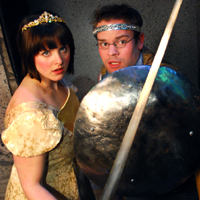
I don’t think I’ve gone to see a children’s play since my youngest brother was in a community church production of Grease. I’ve certainly never attended one with an eye out for analysis.
What would be the point? It’s children’s theatre. It’s so easy to dismiss with contempt, unless you’ve got a sparkly-eyed niece accompanying you, all gung-ho to see sword-fighting Princesses and golden Dragon puppets singing and dancing – which I didn’t. I had to guard against any immediately snarky but-I-studied-acting-in-college reactions.
See, I’ve got this new gig reviewing shows. This means free theatre. I love theatre. I love it. And I’m not the kind of girl who can afford this particular jones regularly – only when very special friends are in very special productions. So – free ticket? The word “Dragons” in the title? And, oh, hey – fantasy! I write this stuff! I read this stuff. I’m totally game.
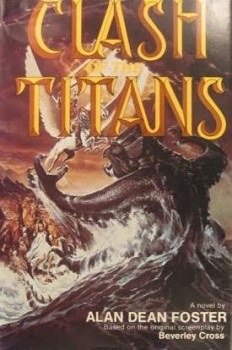
Update:Alan Dean Foster has generously provided some comments of his own about the novelization. Please see the comments section.
2010: The Year We Remake Clash of the Titans.
I have never thought that re-making Ray Harryhausen’s final movie, the 1981 telling of the Myth of Perseus and Medusa, was a smart idea. I don’t, in principle, oppose re-makes (what good would that stance do in these strange times anyway?), but the original Clash of the Titans is a 100% auteur film, a movie that exists because Ray Harryhausen did the stop-motion effects. Harryhausen defines the movie. Any re-make would simply tackle an old myth with new—and not necessarily more interesting—effects to cash-in on Generation X name recognition. And then when I actually read the plot description of the 2010 Clash, I shook my head in mystification . . . this Hades vs. The Other Gods concept is antithetical to Greek Mythology. The original Clash alters many elements of Perseus’s story, but it still feels similar to how the Archaic and Classical Greeks must have imagined their Heroic Age.
A deeper reason that I’m doubtful of the re-tooled Clash of the Titans is the enormous personal investment I have in the original film. No other movie from my childhood has had such a direct effect on my later interests as an adult. Unlike many childhood loves, Clash of the Titans holds up perfectly today; the magic remains, and many scenes still give me shivers. Nostalgia alone does not carry the film; it can carry itself quite proudly.
But . . . I’m not here today to review the original Clash of the Titans. I’m planning to do an extensive analysis of it later this month, but for the first post of 2010 I’ve decided to take a different tactic as a warm-up and approach Clash of the Titans from a side road; a road rarely taken in film or book critiques: the movie novelization.
Heroscape Master Set 3: Dungeons and Dragons Battle for the Underdark Wizards of the Coast ($21.99, Jan 2010)
Reviewed by Howard Andrew Jones
Here at the Jones household we have the new Heroscape Master Set 3. Judging by the amount of Heroscape I’ve been playing with the kids, the game may have us.
The new master set is smaller than either of the first two, although its 50 interlocking terrain pieces can simulate a variety of battlefields — and can add in to any existing terrain sets a Heroscape gamer already owns. If you’re a relative newcomer to the concept of Heroscape, like I was until just recently, it’s a do-it-yourself game board of surprisingly sturdy interlocking hexagonal tiles. Some of the tiles are part of larger platforms, and some are merely a hexagon. Different colors suggest grass, or rock, or sand, or swamp — or even swamp water or regular water. They can be combined in an almost endless array of patterns, limited only by imagination and the amount of tiles.
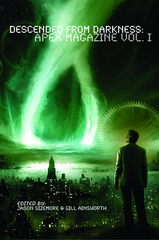
Well, entering the year (both in terms of typing the title and having lived to see it) was a little weird to write. The first chapter of The Martian Chronicles is January 1999, which from the vantage point of the middle of the 20th century, when the German V-rockets had landed not on another planet, but London, that seemed about right for when humanity might be “reaching for the stars” as it was called. The book ends in April 2026 which, with luck, proper diet and exercise, and health care reform I might actually still be alive to see. And which more than likely humankind, assuming it hasn’t blown itself up, will remain earthbound.
So much for the fantasies of the Golden Age of science fiction writers.
As 2009 comes to an end I find the events of the last twelve months firing past my sub-conscious like the recap sequence before one of those lame “it was all a dream” mini-series endings.
Unfortunately any list of highlights from 2009, besides proving that reality is far more frightening than fiction, would also be intensely boring. I’ll leave that to CNN and NPR.
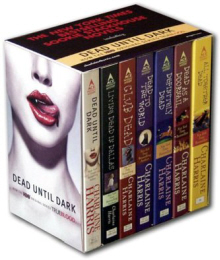
Instead, here are a few random thoughts – on Dacre Stoker’s Dracula the Un-Dead, the Travel Channel’s Ghost Adventures show, HBO’s True Blood and the new Sookie Stackhouse novel, the upcoming film version of Elizabeth Kostova’s The Historian, the return of the Halloween, Costume and Party Show to Chicago, and more.
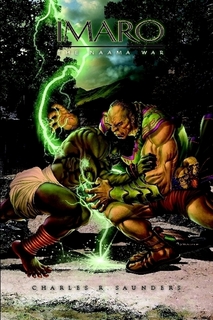
Back when BlackGate‘s editor John O’Neill lived in Ottawa in the early 80s, he was a member of a small SF fan club. His first meeting featured a reading from the editor of an excellent local fanzine, Stardock, who had just completed his first novel. The author was Charles Saunders, the novel was Imaro, and the reading he never forgot.
DAW released the first three Imaro novels between 1981 and 1985, then dropped the series for reasons arising from textbook bad marketing decisions, a lawsuit from the Edgar Rice Burroughs estate over a poorly chosen cover quote (“The Epic Novel of a Black Tarzan”), and publishing delays.
For the whole sordid tale, read Charles de Lint’s introduction to the Night Shade edition of the first novel.
Night Shade books released the first two books, Imaro and The Quest for Cush, in handsome new editions in 2006 & 2007, and Saunders self-published the third volume, The Trail of Bohu, through his Sword & Soul Media press last year.
The true tragedy of the saga of Imaro is that the fourth novel has never been published – until now.
SOARING ON THE WINGS OF MYTH:
James Cameron’s AVATAR revels in the grand traditions of fantasy
The other day I slipped on a pair of 3-D glasses and was transported to a primordial world of alien beauty and high adventure. I was watching James Cameron’s new film AVATAR, which has become a full-fledged cultural phenomenon. Much has been made of the film’s absolute perfection of special effects because Cameron creates a fantasy world that is truly believable. Thanks to his breakthroughs in computer-generated imagery and sheer breadth of imagination, AVATAR is more than a mere film… it’s an EXPERIENCE.
SKULLS starts right here at blackgate.com on Jan. 6
Comparisons to other blockbuster fantasy/sci-fi films are inevitable. Everything George Lucas attempted to do in his three STAR WARS prequels, Cameron actually succeeds at, i.e. building a fully realized and eminently believable fantasy world that is breathtaking in scope and packed with sheer wonder. But that perfection of simulated reality, that ability to make the fantastical seem genuine was NOT what I enjoyed most about this movie.
All the visual flair would be meaningless if the film didn’t draw upon the classic power and inspiration of the great fantasy tales. AVATAR is a fantasy fan’s ultimate cinematic experience. The fact that this fantasy is wrapped in the guise of science fiction only makes it more appealing and marktable to the average moviegoing audience. Both sci-fi and fantasy fans will be enraptured by the AVATAR experience.
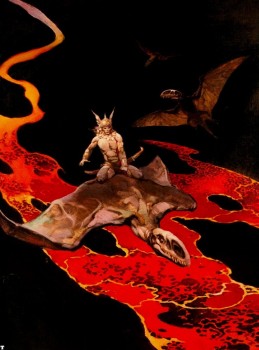
Cameron’s inspirations for AVATAR span the gamut of everything from Edgar Rice Burroughs’ BARSOOM (John Carter of Mars) stories to Lucas’ STAR WARS (which were inspired by FLASH GORDON comic strips, among others), to the deep myths of the Old West, stone-age adventures, Jungle Tales comics, American Indian mythology, and wraps it all in a lush visual style worthy of the master Frank Frazetta himself.
One of the tropes Cameron plays with in this story–to great visual and emotional effect–is the riding of winged creatures by the Na’vi alien warriors.
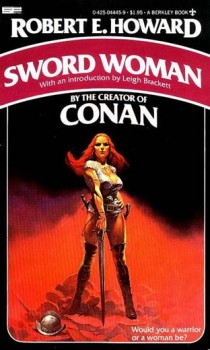
It’s strange that Robert E. Howard’s most famous female character is one he didn’t actually create: Red Sonja, the work of comic book writer Roy Thomas and artist Barry Windsor-Smith, based on the historic adventuress Red Sonya from the story “The Shadow of the Vulture.” Red Sonja has been erroneously credited to Howard for years; even the movie Red Sonja lists him as the creator on the main credits.
This accidental attribution might explain the scant attention given to a fierce, red-haired, sword-swinging woman that Howard did create: Dark Agnes of Chastillon, sometimes called Agnes de le Fere. She appears in two stories and a fragment, and if Howard had sold the stories during his lifetime he might have written far more about her. She’s much-neglected in discussions of the author, and none of her stories have been in print since Ace’s 1986 printing of Sword Woman, which was first published by Zebra in 1977 and then re-printed by Berkley in 1979.
Another reason for the general obscurity of the abbreviated Dark Agnes cycle is that the stories are lesser pieces that feel rough alongside Howard’s classics. But their content is worth examining to see the author exploring the first-person female point of view. Detractors who consider Robert E. Howard—and sword-and-sorcery in general—misogynistic will discover a genuine surprise in Dark Agnes.
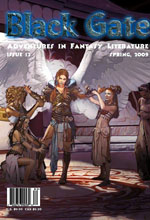
Luke Forney reviews the latest issue of Black Gate at his blog.
Black Gate kept my attention far better than any other fiction magazine… Almost all of the stories I found immediately wonderful, engaging, and very easy to lose oneself in. The quality was beyond impressive, and the extras (reviews sections) were brilliant.
Luke compares John C. Hocking to Robert E. Howard:
“The Face in the Sea” by John C. Hocking: This wonderful story tells of Viking-like people returning from a raid on their enemy’s stronghold to recover their princess, and one shaman’s all-out assault to stop them. A very well told story, reminiscent of Robert E. Howard. I’ll be looking for more by Hocking.
And was equally impressed by L. Blunt Jackson:
“Spider Friend” by L. Blunt Jackson: A brilliant fable-like tale, with an ending that I didn’t see coming, but that didn’t interrupt the wonderful style that Jackson worked throughout. One of the best “modern fables” I have read.
He also comments favorably on our non-fiction:
This issue also contained a number of comic strips, and two brilliant review sections. I have never seen a magazine have such a detailed, extensive reviews section that covered so many books. It was a wonderful surprise… The fiction reviews section was lovely, and covered far more than the large press magazines do.
He closes with a fine suggestion:
Anyone who is a fan of adventure or fantasy should immediately check out Black Gate… it contains a LOT of content (224 pages, full magazine size, not digest), good stories, interesting essays, wonderful departments, even an illustration for each story, which is a feature sadly missing in most other magazines. Grab issue 13 while you can, and keep your eyes peeled for the next issue!
 I don’t think I’ve gone to see a children’s play since my youngest brother was in a community church production of Grease. I’ve certainly never attended one with an eye out for analysis.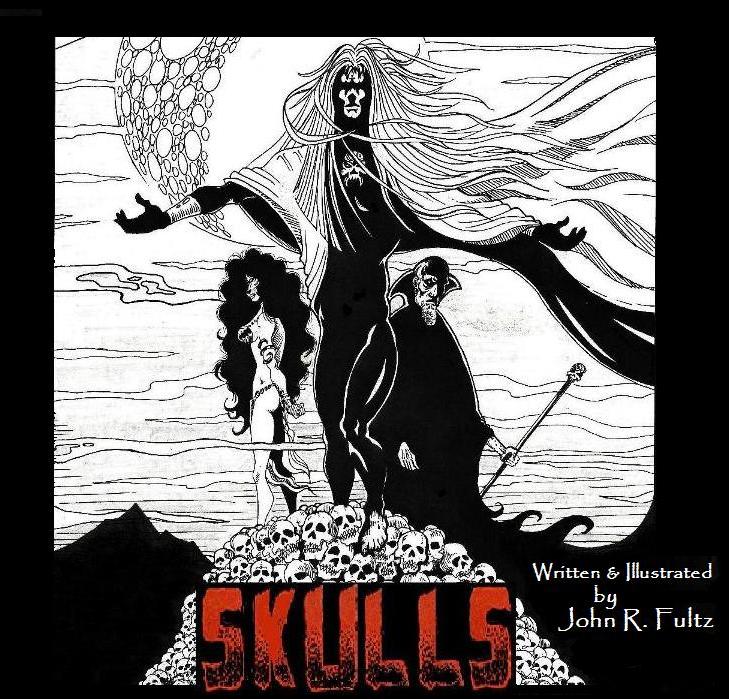
 Update: Alan Dean Foster has generously provided some comments of his own about the novelization. Please see the comments section.
 Well, entering the year (both in terms of typing the title and having lived to see
 it) was a little weird to write. The first chapter of The Martian Chronicles is January 1999, which from the vantage point of the middle of the 20th century, when the German V-rockets had landed not on another planet, but London, that seemed about right for when humanity might be “reaching for the stars” as it was called. The book ends in April 2026 which, with luck, proper diet and exercise, and health care reform I might actually still be alive to see. And which more than likely humankind, assuming it hasn’t blown itself up, will remain earthbound.
 As 2009 comes to an end I find the events of the last twelve months firing past my sub-conscious like the recap sequence before one of those lame “it was all a dream” mini-series endings.
  Back when Black Gate‘s editor John O’Neill lived in Ottawa in the early 80s, he was a member of a small SF fan club. His first meeting featured a reading from the editor of an excellent local fanzine, Stardock, who had just completed his first novel. The author was Charles Saunders, the novel was Imaro, and the reading he never forgot.
 Cameron’s inspirations for AVATAR span the gamut of everything from Edgar Rice Burroughs’ BARSOOM (John Carter of Mars) stories to Lucas’ STAR WARS (which were inspired by FLASH GORDON comic strips, among others), to the deep myths of the Old West, stone-age adventures, Jungle Tales comics, American Indian mythology, and wraps it all in a lush visual style worthy of the master Frank Frazetta himself.
 It’s strange that Robert E. Howard’s most famous female character is one he didn’t actually create: Red Sonja, the work of comic book writer Roy Thomas and artist Barry Windsor-Smith, based on the historic adventuress Red Sonya from the story “The Shadow of the Vulture.” Red Sonja has been erroneously credited to Howard for years; even the movie Red Sonja lists him as the creator on the main credits.
 Luke Forney