Browsed by
Category: Blog Entry

Original Fiction: “THE WEIRD OF IRONSPELL” by John R. Fultz

Original Fiction: “THE WEIRD OF IRONSPELL” by John R. Fultz


http://sheikman.blogspot.com

In the grand tradition of the heroic fantasy pulps comes “The Weird of Ironspell” — a serialized novella of original Sword-and-Sorcery adventure coming to you over the next few weeks. Catch a new self-contained chapter every Wednesday right here at blackgate.com. The saga continues…


 “The Weird of Ironspell” by John R. Fultz

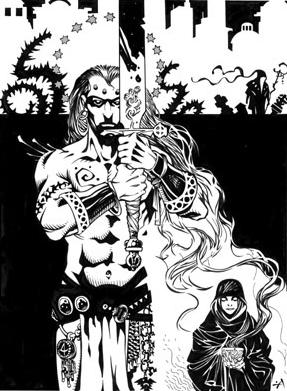
Illustrations by Alex Sheikman 


2. The Moon God’s Bride

They marched out of the wasteland, where the bones of dead cities lay smothered beneath a sea of black sand.

Their captain was tall and broad of shoulder, his dark hair flapping like ravens’ wings about his wolfish face. The hilt of a silver sword gleamed on his back. The other three were strangelings, two with tapered ears and jewel-bright eyes, the third a grizzled gnome with a face like twisted oak. They had survived the death-worshippers of the waste, the leagues of killing sand, the murderous winds, and the terrible things that slumbered beneath the ruined temples. The scars of battle shone upon their arms and chests like tarnished jewels. 

The quiet folk of Omzir greeted them with suspicion, as all things are met that crawl out of the desert. Yet when the townsfolk saw their gold and silver coins of ancient mint, they welcomed the travelers like old relatives. Ragged children followed them through the dusty streets like famished dogs.

The captain’s name was Ironspell. He asked for wine and roasted meat. Dranba, the keeper of the town’s only drinking house, offered plenty of wine to earn their gold, but explained that water and food were scarce. He spoke the western dialect since he had once traveled with caravans, so he translated for Ironspell and the strangelings. Jealous townsfolk labeled him a slave to foreign dogs, but Dranba did not care, for in only a few days Ironspell’s generosity made him the richest man in Omzir.

Read More Read More

A Quick Quote on “Pulps vs. Slicks”

A Quick Quote on “Pulps vs. Slicks”

As you read this, I’m in Atlanta to see my brother graduate from medical school. Which means that this is “time-bomb post” I put in the queue to automatically go off and post itself while I’m away. Which also means that I’m keeping this a bit short, as I don’t have the weekend to write up something more in-depth.

What I’ve decided to do instead is let somebody else do most of the work for me. I’m going to share a quote about the pulps that I came across when I was doing my research for my two posts about Frederick “Max Brand” Faust. This comes from Jon Tuska’s essay “Frederick Faust’s Western Fiction” from The Max Brand Compnaion (Greenwood, 1996). Tuska makes an interesting comparison between writing for the pulps and writing for the “slicks,” the glossy magazines that offered supposedly greater prestige for writers who could break into them. Tuska shows a reversal of how people view pulp literature vs. “mainstream” literature:

Both [Faust] and [his agent] Carl Brandt areed that the only way to cope with the depressed economy was for Faust to move into slick magazines which paid much better. Faust, studying the market, readily realized that restrictions in the slicks were more rigid and confining than they ever had been in the pulps. Writing for Western Story Magazine, he had to concern himself with such general notions as a pursuit plot, which [editor] Blackwell preferred, or delayed revelation. Writing for the slicks, he realized that the editors sought to dominate a contributor’s mind. Attitudes and ideas were everything. Beyond entertainment, which both pulp and slick fiction alike provided, slick fiction had to deliver an ideological message to readers which agreed with the editorial policies of the magazine and these were dictated by the advertisers and their agencies. Perhaps it is for this reason that so much of the slick fiction of the 1930s and 1940s had become hopelessly dated while pulp fiction from that same period still pulsates with imagination and iconoclasm. Ideology is time-bound.

In other words, take that Saturday Evening Post and Collier’s! Long live Black Mask, Weird Tales, and Astounding! (And Black Gate carrying on their legacy.)

See you next week.

Frank Frazetta enters Valhalla

Frank Frazetta enters Valhalla

death-dealer2Frank Frazetta, the greatest fantasy artist of his generation, died today at age 82.

Frazetta got his start in comics in the early 1950s, working with legendary artists such as Al Williamson, Roy Krenkel, Al Capp, and Harvey Kurtzman on Buck Rogers, Flash Gordon, and Li’l Abner, as well as many titles at EC Comics.

In 1964 Frazetta did his first movie poster for (of all things) Woody Allen’s first film, What’s New Pussycat?  This eventually led to cover paintings for some of the most popular paperbacks of the 60s and 70s, most notably the works of Edgar Rice Burroughs, including Tarzan and John Carter of Mars.

For fantasy fans Frazetta is best remembered for his groundbreaking Sword & Sorcery images — such as “Death Dealer” (right), the cover to Lin Carter’s 1973 anthology Flashing Swords 2 — and most especially his colorful and visceral depictions of Conan, which revolutionized fantasy art.

Until Frazetta, Conan was primarily depicted as a white, clean-cut warrior in pseudo-roman garb, straight off the set of a Cecil B. DeMille film (see the covers of Robert E. Howard’s first Gnome Press editions from the 1950s, such as Conan the Barbarian).

But Frazetta swept away all who had come before, re-envisioning Conan as a muscular, dark-skinned titan, a true barbarian in spirit and appearance. Since Frazetta, in defining work by artists like Ken Kelly, Sanjulian, Barry Windsor Smith, Mark Schultz and Gary Gianni, Conan has been revealed as both heroic and fearful, a thick-sinewed, long-haired mongrel, a truly striking figure in all respects.

Frank Frazetta died at a hospital near his home in the Pocono Mountains of Pennsylvania.

For a sampling of some of his finest work, visit the unofficial Frazetta Fantasy Art Gallery.

Short Fiction Roundup: WLT

Short Fiction Roundup: WLT

may10coverWorld Literature Today (WLT), a publication of the University of Oklahoma, has an issue devoted to “International Science Fiction,” though a cursory review of the contributing authors makes it seem that “international” has a mostly eurocentric slant. In any event, you can read Kij Johnson’s story, “26 Monkeys, Also the Abyss,” as well as various non fiction pieces and a poem that have been posted on line.

Pyr Books Fall Winter 2010-2011 Season

Pyr Books Fall Winter 2010-2011 Season

thewolfage1Editorial director Lou Anders has posted Pyr’s complete Fall Winter 2010-2011 catalog online.

There’s a lot of great stuff to look forward to, including James Enge’s third Morlock book, The Wolf Age:

Wuruyaaria: city of werewolves, whose raiders range over the dying northlands, capturing human beings for slaves or meat. Wuruyaaria: where a lone immortal maker wages a secret war against the Strange Gods of the Coranians. Wuruyaaria: a democracy where some are more equal than others, and a faction of outcast werewolves is determined to change the balance of power in a long, bloody election year.

Their plans are laid; the challenges known; the risks accepted. But all schemes will shatter in the clash between two threats few had foreseen and none had fully understood: a monster from the north on a mission to poison the world, and a stranger from the south named Morlock Ambrosius.

Morlock first appeared in Black Gate 8, in the story “Turn Up This Crooked Way.” 

Now he’s all grown up, and taking on Strange Gods in werewolf cities.  It makes us proud.

hornsofruinThere’s plenty more on the Pyr list to command your attention, including Tim Akers’ The Horns of Ruin, which sounds very intriguing indeed:

Eva Forge is the last paladin of a dead God. Morgan, God of battle and champion of the Fraterdom, was assassinated by his jealous brother, Amon… When a series of kidnappings and murders makes it clear that someone is trying to hasten the death of the Cult of Morgan, Eva must seek out unexpected allies and unwelcome answers in the city of Ash. But will she be able to save the city from a growing conspiracy, one that reaches back to her childhood, even back to the murder of her god? 

All this plus Pierre Pevel’s The Cardinal’s Blades, Adrian Tchaikovsky’s Salute the Dark, and new novels from Paul McAuley, Mark Chadbourn, Mark Hodder, Jasper Kent, Sam Sykes, Joel Shepherd, James Barclay, and many more.

Check out all the details (and the fabulous cover art) here.

Goth Chick News: A Decomposing Neverland — an interview with Douglas Clegg

Goth Chick News: A Decomposing Neverland — an interview with Douglas Clegg

neverlandImagine the family vacation from hell.

I know you can do that because you’ve had one, and I know you’ve had one because everybody has. Usually the “from hell” part has to do with long-term forced exposure to family members in an environment you have no hope of escaping for the duration of your tortured imprisonment (known as the “vacation”).

For me it was a remote cabin in the Canadian woods; go north, turn left at anything that looks like fun, and drive for another four hours. The location alone was the perfect setting for a knife-wielding maniac to off a few sinful teenagers including at least one cheerleader; which is probably what got me to where I am today. But enough about me…

What if your personal family vacation from hell, contained a real Hell? I mean a dictionary-definition Hell complete with a soul-eating demon? It is under this premise that we follow author Douglas Clegg into the no-Tinker-Bell, Peter Pan-less nightmare called Neverland.

Beau Jackson is destined to spend another summer with his extended family in their run-down “summer home” on Gull Island. Isolated and remote, the island is privy to even more nasty little secrets than the ones the adults spill out each evening during their alcohol-induced arguing, and Beau’s cousin Sumter is up to no good at all in that broken down shed at the back of the property.

Sumter has always been a little off, maybe even a little evil. But what he’s got hiding in a box back there is about to rip the fabric between reality and Sumter’s sadistic imagination, taking Beau and the rest of the Jackson family along for the ride.

Read More Read More

Original Fiction: “THE WEIRD OF IRONSPELL” by John R. Fultz

Original Fiction: “THE WEIRD OF IRONSPELL” by John R. Fultz

http://sheikman.blogspot.com
In the grand tradition of the classic heroic fantasy pulps comes “The Weird of Ironspell” — a series of all-new Sword-and-Sorcery adventures coming to you over the next few weeks, a new self-contained chapter every Wednesday right here at blackgate.com. The saga begins now…

“The Weird of Ironspell” by John R. Fultz

Illustrations by Alex Sheikman

1. Born of Stone

The child would never know its father. 

In the amber glow of their hearth fires, villagers traded whispers about its mother. The witch had come out of the forest heavy with child. Some said she dallied with a demon, or a wood-spirit, but the witch never revealed her secret paramour. She gave birth in the light of a silver moon, while wolves howled like ghosts among the hills. 

As the child grew, its mother worked like a man at her anvil, forging a blade for her son. She smelted a strange, gleaming metal from the heart of a stone that had fallen from the sky while she was in labor. The village elders said she must be weaving a great spell, and her hammer rang across the village like a doomful bell. In the space of a month she had finished the sword. She christened it with several drops of her own blood, which flowed down the blade’s length and sank into the metal, taking on the shapes of crimson runes. 

Read More Read More

The Spider vs. The Empire State

The Spider vs. The Empire State

Layout 2The Spider Revival: Part III

The Spider vs. The Empire State
Norvell Page (Ace of Aces Books, 2009)

I have previously written about the revival in trade paperback of the adventures of The Spider, the bloodiest of all 1930s pulp heroes. My reviews of The Spider: Robot Titans of Gotham and The Spider: City of Doom, both published by Baen, contain plenty of background about the character and his main author, Norvell Page, so if you’re unfamiliar with the blood-soaked vigilante insanity of this region of the pulp universe, I’d advise that you start there.

This third collection of Spider adventures comes from a new publisher (Ace of Aces Books) and presents for the first time three connected novels that were originally published consecutively in The Spider Magazine. These three novels, which ran in the September, October, and November 1938 issues, form “The Black Police Trilogy,” one of the darkest episodes in the character’s history. Norvell Page and his editor Harry Steeger decided to put newspaper headlines and national fears into their pulp adventures: an allegory for Nazism, viewed as it might arise in the middle of contemporary New York State. It Does Happen Here might serve a good alternate title.

The first book of the trilogy, The City That Paid to Die, came out exactly a year before the Nazi invasion of Poland. The U.S. and the rest of the world were in an uneasy position with the seemingly unstoppable rise of fascism in Europe and the apparent weakness of the liberal democracies. A few small fascist sympathetic groups bubbled up in the U.S., but by 1938 the isolationist nation was becoming concerned about the ambitions of the regimes of Adolf Hitler and Benito Mussolini. It was an era ripe for terror and panic—and Norvell Page seized those feelings to create a pulp adventure uncomfortably close to 1938 concerns.

Read More Read More

Black Gate 14 now available in PDF

Black Gate 14 now available in PDF

bg-14-cover3Black Gate 14 is now available in PDF format for just $4.95. 

Black Gate 14 is a landmark issue ­ and at 384 pages, it’s also the largest in our history. The print version retails for $15.95, but now you can order the complete magazine — including the wraparound cover — for the same price as all our PDFs: $4.95/copy, or as part of a 4-issue PDF subscription for just $17.95.

Existing subscribers can purchase the issue for just $2.95.

Here’s what  Grasping for the Wind has to say about our latest issue:

One of the best collections of fiction on the market – whether books, magazines, or online. The latest edition has just been released, and Black Gate 14 is massive, topping out at 384 pages …  this massive collection of fiction shows why, even with their irregular publishing schedule, Black Gate is one of the most popular magazines (print or online) available today.

The issue includes a Morlock novella from James Enge, and new fiction from John C. Hocking, Michael Jasper & Jay Lake, Pete Butler, Robert J Howe, Martin Owton, Chris Braak, Matthew David Surridge,  and much more — including an 8-page Knights of the Dinner Table strip!

The complete Table of Contents, with artwork and brief story excerpts, is here, and you can read the complete reviews from Grasping for the Wind and Locus Online here.

Order the magazine on our Subscription page here.

Cover art by the great Bruce Pennington.

Short Fiction Roundup: Serialization

Short Fiction Roundup: Serialization

apex-blogReturn with us now to those thrilling days of yesterday, when publishers employed serials as a way to keep reader interest in wondering what happens next.  Apex is presenting a 20 part serial of “Jesus and the Eightfold Path” by Lavie Tidhar.  You can start reading here.