The Book Fair
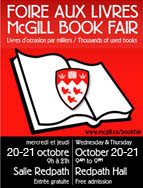 The McGill book fair is the largest English-language used book sale in Montreal. It’s been held for decades, every October, on the second Wednesday and Thursday after Thanksgiving (which in Canada is on the second Monday in October). Every year an eclectic mix of thousands of books are sold, helping to raise money for scholarships.
I’ve been coming to the sale for about a dozen years. I’ve found novels by Lord Dunsany, a biography of C.S. Lewis, a book about Hypatia of Alexandria, a Dennis Wheatley omnibus, Fighting Fantasy Gamebooks, Paul Park’s Celestis, a volume combining Bede’s Ecclesiastical History with The Anglo Saxon Chronicle, collections of poetry by John Clare and Francois Villon and Elizabeth Barrett Browning and Robert Southey and Don Marquis, a graphic novel by Posy Simmonds — and all of these (along with books by Neal Stephenson, Tad Williams, and T.H. White) in just one year, 2008, when I bought a total of 65 books for $161.

 Last week I was in Seattle and Portland, where I made pilgrimages to venues possible interest to readers here. One was Powell’s Books, which claims to be the largest independent bookstore of both used and new books in the nation. It’s an amazing place, with floors of books in a range of almost every conceivable category that would put any Barnes and Noble “superbookstore” to shame even in its heyday. Needless to say, the science fiction and fantasy aisle alone is something you could easily browse for an hour or two.