Last Sunday I told you all about NIGHTMARE WORLD comics which I had the good fortune of discovering last month at the C2E2 show in Chicago.
I also learned from you that I wasn’t the only one scaring the crap out of myself as a kid by reading this sort of contraband content by flashlight; and from the emails I got, you lot have been sneaking around doing things you’ve been told not to for some time.
Which is why you are very welcome here.
And now, fortune pats me on the head for the third time this week in the form of an email from the man himself, NIGHTMARE WORLD creator Dirk Manning.
Moved by our mutual admiration of classic tales of terror and intrigued by the readers of Black Gate, to whom he had not previously been introduced, Mr. Manning agreed to brave the probing and in depth (insert lightning and thunder sound effects here) Thirteen Questions…
Are the restraints nice and snug?Then let’s begin.
We’re all guilty of it. Yeah, we mean well, but our need to see our literary heroes in just one more adventure is tragically unfair to them. As readers, our fantasies of characters navigating awful situations and hair-raising exploits are harmless enough. But what of us as writers? How can we excuse the need we feel to put our beloved characters through just one more physical and emotional wringer?
Because let’s be clear. For the characters, adventures are painful, scary experiences they feel lucky to put behind themselves. Those sword fights could, at any moment, end tragically. And gunplay? Don’t get me started.
I know, I hear all of the diehard fanboys of this or that series clamoring for a more balanced viewpoint. They will mention how brave and skilled this or that protagonist is, and are always ready to give some example of stoic adventuring and daring-do. And I suppose there are those of the adventurati that really are stone-cold warriors and flinty-eyed sorcerors to whom deadly danger is like mother’s milk. But would you want to have a drink with any of them? No, the characters we love the best, who really get to us, are those we can empathize with, to who we can relate.
If you can relate to the hardened killer type, you have one type of problem, while the rest of us have another: we long to visit very trying times on characters we feel deeply about. Robert E. Howard’s tales of Conan of Cimmeria are typical examples of a hero set upon by a troubling world, who is forced time and again to use his battle prowess and wits to see his way clear.
At work today, the Internet failed. A monstrous failure. A failure that neither Nancy the Techie from Never-Never or Nice Mike from St. Louis could fix for me. Something about reconfiguring a router. All sorts of passwords I didn’t have access to. Cords everywhere.
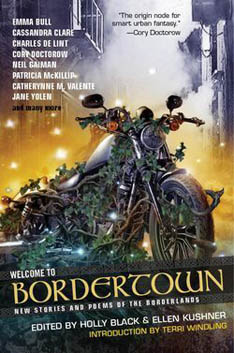
And I thought to myself, “I know why this is happening. It’s happening because I just read Cory Doctorow’s story ‘Shannon’s Law’ in Welcome to Bordertown.”
That too, was full of things I didn’t understand. Binary and BINGO, routers and nodes, carrier pigeons and calligraphy, systems and bytes and packets, oh my!
Now, I’m a reasonable creature. Last time it was gnomes. This time, the Internet crashes. I can deal. It’s all coincidence, right? Synchronicity?
Anyway, I really liked the Cory Doctorow story, despite feeling like an idiot while I read it. I’d never read one before — a Doctorow story, that is — although I have heard the Zeitgeist speak his name (about a bazillion times), and maybe read an article or three by him on Boing-Boing (which always gives me an almost knee-jerk reaction of BOINGyness).
Despite getting my dizzy on from all his techie terms (as I again did later in the day at work, during the good three hours I spent with tech support on the phone), what I did understand was that the protagonist dude Shannon is formidable and funny, the green-haired girl Jetfuel is uber-delish, and the Trueblood Synack is an unsolvable mystery. There is also a really great line about truthiness, “in the neighborhood of true,” which cracked me up.
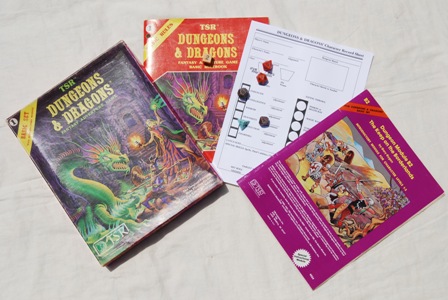
‘Basic’, it’s a term I always took as a kind of derogatory statement regarding the type of D&D that I was first introduced to. I mean, why wouldn’t someone think that since there was an ‘Advanced’ version of D&D out there with all those wonderful hardcover books? Everything you need is right at your fingertips!
Well, that might have been the case, and eventually I would convert to those lofty hardcovers, but in my fundamental and formative years I played from a ‘box’ that provided everything I needed on my path to adventure.
I have a special love for TSR’s Basic rules and the boxes that provided them. They are kind of like a browning picture of you riding a bike before the world was more than school and what to play afterward. I’m reminded of simpler times when there weren’t multiple editions of the game, when the internet wasn’t weighted down with reference materials for feats, powers, prestige classes, and the like.
With the release of Dungeons and Dragons 4th edition, there came the opportunity for independent game companies to introduce whole new lines of products that focused on expanding the gaps left in the core materials presented by Wizards of the Coast. In this review from Black Gate #14, I look at supplements from two of these product lines, published by the fine people at Goodman Games, covering various races and character classes.
Since the review was written, Wizards of the Coast has filled many of those gaps with their own materials, such as the D&D Player’s Handbook Races series, which includes the official supplements for both the Tiefling and Dragonbornraces.
This is the most complicated image ever presented on the Black Gate website.
A few days after I posted my article on the use of semicolons in fiction, I was at a writers’ group meeting and brought up the subject of the contentious punctuation mark. When I expressed my enjoyment of semicolons, one of the other writers present at the library table asked the most appropriate follow-up question:
“How do you feel about em dashes?”
Terrific query. Answer: I love ‘em. Many uses, wonderful informality, a real rhythm-maker. Great way to smash the cymbals on your drum set in the middle of a jazz riff. My major caveat about the em dash is that if overused, it draws enormous visual attention to itself that no reader can miss; the em dash is the most immediately obvious character on a page, and a slew of them is visible with a single glance. You know how annoying a long drum solo can get.
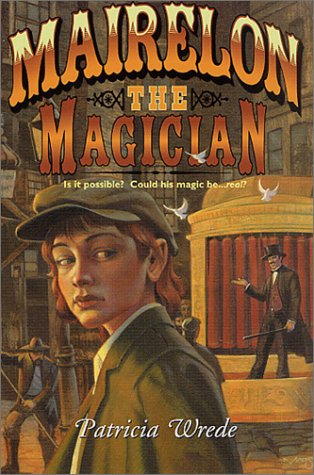
Mairelon the Magician, by Patricia C. Wrede
Tor Books (280 pages, hardcover, May 1991)
Mairelon the Magician is a little bit mystery, a little bit comedy, but mostly a mixture of alternate history and fantasy. It’s a light, fun sort of book; no world-altering plots or pitched battles, but a fair amount of sneaking around, spying, and working out who’s plotting what against whom. (It’s not much of a spoiler to say that the majority of the incidental characters are plotting something.)
I think it works better in concert with its sequel, Magician’s Ward, which adds a bit of romance to the already eclectic mix, but the first book is enjoyable on its own.
I really have only two reservations. First, I found the pacing of the climax to be slightly off, although this may be because I was looking at it with the wrong set of genre lenses; it may fit better into mystery than fantasy.
The second reservation is more of a warning than a complaint: if you’re American, do not watch British shows or movies, and know you have a hard time with dialect, avoid this book — or at least hunt down a period drama to watch first, just to get into the rhythm of the language. Otherwise the amount of thieves’ cant will make the story nearly unintelligible.
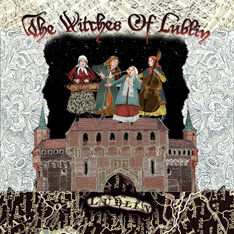
I think I first heard about The Witches of Lublin on Facebook.
You know me, I’m a sucker; you put the word “witches” in the title and I’m on it. So I grabbed up my broomstick, and flew over to Ellen Kushner’s FB page where she’d posted the link about it, and I said, “This looks incredibly cool!” (Or something to that effect.) “A radio play! I love radio plays!”
And then, about five seconds later, I had a little present in my email’s Inbox.
“Because you beg so prettily,” Ellen wrote.
And there is was, the not-quite-final-draft of Witches of Lublin. I sat down and read it in a gulp.
You can read a fuller synopsis about The Witches of Lublin story here, at the super bedazzling website created for the radio play, but basically it is about a family of women klezmer musicians in Poland of the late 18th century. They’re poor, proud and trying to make their way by making music, even though it is considered immodest for females to play in public. When word of their talent spreads beyond the little ghetto where they live and reaches the Count’s ears, things start to get dangerous — and magical.
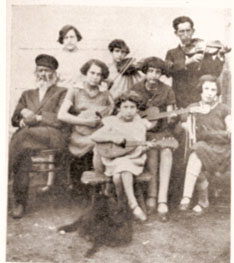
Klezmer band with women. From the Yale Strom archives.
Co-writer Yale Strom’s research uncovered the facts that there were women klezmer musicians, and that when klezmers would play for gentile nobility, their reward could sometimes be beatings, death or even kidnappings.
This history formed the springboard for this work of fiction by Strom, Schwartz and Kushner based on Jewish women’s lives in 18th Century Europe, klezmer music and feminist history, with a healthy dose of magical realism thrown in.
You can see how I might say, in the trembling wake of reading this: “Oh, Ellen, oh pretty please, DO let me interview you about Witches for Black Gate Magazine!”
To which Ellen replied, quintessentially and in so many words, “Here, kid. I’ll do you one better.”
All of a sudden, I was interviewing the entire team of The Witches of Lublin’s creators — playwrights, composer and director — in a sort of mad merry-go-round-robin of emails. Which I now present to you for your reading pleasure.
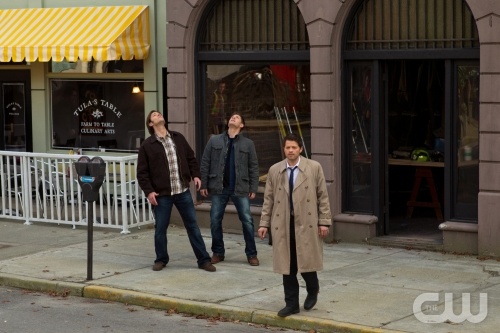
Sam (far left) and Dean (middle) are frozen in time while the Archangel Castiel (right) begins negotiations with Fate.
After a few weeks without Supernatural, I’ve been looking forward for the show to come back. There are a lot of dangling cliffhangers this season and I’m looking forward to seeing how they come together.
This episode contains a riff on the Final Destination theme, where events are conspiring to create elaborate death scenarios. The first death involves a man triggering a Rube Goldberg-like series of events that end in being decapitated by his garage door.
It turns out that there have been a string of bizarre deaths, several of them within the same families. This draws the attention of Sam and Dean, but it’s bigger than what they find. They find a piece of gold thread at each of the death scenes, but not really any other clues. Billy’s wife, Ellen, discovers that …
Yes, that’s right, Billy’s wife, Ellen. Her daughter, Jo, is out investigating a connected series of deaths in California. Now, for the reader and viewer who’s been following the show, this may seem startling for a number of reasons. Billy’s not married, for one, and Ellen and Jo are hunters who died last season.
Anyway, Billy’s wife, Ellen, discovers that the families of all of the victims came over to the U.S. at about the same time in 1912. In fact, they came over on the same ship … called the Titanic.
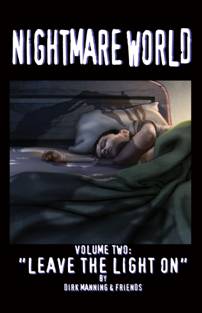 Last Sunday I told you all about NIGHTMARE WORLD comics which I had the good fortune of discovering last month at the C2E2 show in Chicago.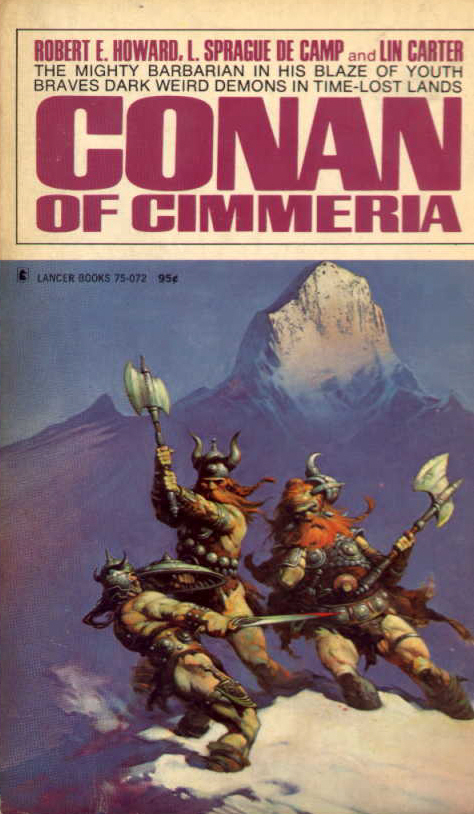
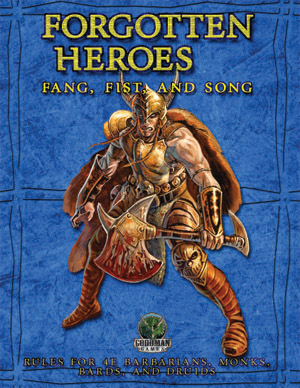 With the release of Dungeons and Dragons 4th edition, there came the opportunity for independent game companies to introduce whole new lines of products that focused on expanding the gaps left in the core materials presented by Wizards of the Coast. In this review from
  This is the most complicated image ever presented on the Black Gate website.