Browsed by
Category: Blog Entry

Teaching and Fantasy Literature: Murphy’s Law (Pedagogical Corollaries)
Teaching and Fantasy Literature: Murphy’s Law (Pedagogical Corollaries)

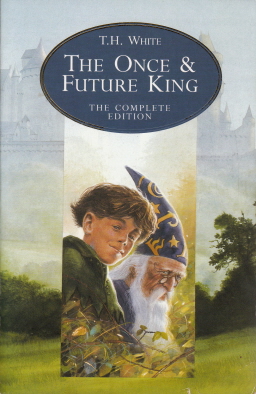
the-once-and-future-kingWhen teachers write publicly about teaching, we usually write about the things that went well. It’s not just that we’re full of ourselves or want to save face — though we fall prey to human nature like anybody else. It’s that we like being helpful, and talking about the things that worked seems more likely to help our readers than talking about the things that didn’t. Maybe some offhand comment that accidentally turned out to be illuminating for a student will help some other student, somewhere, so off I send it into the ether.  If teachers are more visibly full of ourselves than other people are, it’s because the work we do can be utterly humbling.

Of course, some lesson plans just fall down and spit. Some things that could be done well go horribly wrong in the execution. We all have bad brain days. Only a small minority of disasters are fun or useful to read about, though. If teaching mistakes were as frequently entertaining as parenting mistakes are, you’d see a lot more sitcoms set in the faculty lounge.

Why did I make my Intro to Myth students read such very long stretches of Tolkien’s “Valaquenta,” when I myself nod off reading it? What was I thinking when I sent my minimally English-proficient Mandarin speakers off to read The Once and Future King? Why did I hector that poor creative writing student to make his dragon-riding antihero more sympathetic, when an antihero was so clearly what he wanted to write?

For every awesome thing I can’t wait to tell you guys about, there’s an equal and opposite gaffe.


Sarah Avery’s short story “The War of the Wheat Berry Year” appeared in the last print issue of Black Gate. A related novella, “The Imlen Bastard,” is slated to appear in BG‘s new online incarnation. Her contemporary fantasy novella collection, Tales from Rugosa Coven, follows the adventures of some very modern Pagans in a supernatural version of New Jersey even weirder than the one you think you know. You can keep up with her at her website, sarahavery.com, and follow her on Twitter.

Universal Classic Monsters: The Essential Collection

Universal Classic Monsters: The Essential Collection

universal-classic-monsters-the-essential-collection-classicmonsters_bluraycollection_3d_rgb-560x739This year, the home video divisions of all the major distributors banded together and plotted a full-scale assault on the wallets and bank accounts of Blu-ray owners during September and October. Only the wealthiest could possibly survive an attack that began with the first Hi-Def release of the Indiana Jones films. But the supreme weapon, the ultimate October Surprise, is Universal’s huge ebony slab of fear, nostalgia, and latex make-up: Universal Classic Monsters: The Essential Collection. Spanning twenty-three years and nine films (advertised as eight, sorry Spanish Dracula), the long-anticipated set brings the Masters of Halloween into glorious 1080p for the first time, and in perfect seasonal position to drain your money before you waste it on a Jack Sparrow costume that forty other people are also going to wear to that same party.


Few movie series have had such an impact on filmmaking and popular culture as Universal’s stable of ghouls. They are as much a part of Halloween as Pixie Styx and pumpkin carving. I can’t imagine there are Blu-ray owners with any shred of geek cred out there who won’t want to add this to their shelves. When I received mine in the mail, I rejoiced at the anticipation of a week full of evenings revisiting some of my favorite movies in beautiful restored editions. The box set did not let me down—except for the one film that doesn’t really belong on it, but I anticipated that.

Universal Classic Monsters: The Essential Collection comes packaged in a black slipcase with a side-bound color booklet of trivia. The eight discs contain Dracula (1931), the Spanish-language Dracula, Frankenstein, The Mummy, The Invisible Man, Bride of Frankenstein, The Wolf Man, the 1943 color re-make of The Phantom of the Opera, and Creature from the Black Lagoon.

Taking the discs in chronological order, as I did during the week:

Read More Read More

Vintage Treasures: World of Wonder, edited by Fletcher Pratt

Vintage Treasures: World of Wonder, edited by Fletcher Pratt

world-of-wonder2I’m gradually making my way, with considerable delight, through the vintage science fiction and fantasy anthologies I bought for a few bucks from the collection of Martin H. Greenberg.

I’ve already covered From Off This World (1949) and The Giant Anthology of Science Fiction (1954), both edited by Leo Margulies and Oscar J. Friend. This week, I’ve been fondling Fletcher Pratt’s 1951 World of Wonder, subtitled An Introduction to Imaginative Literature.

Pratt, author of The Well of the Unicorn and The Blue Star, was already a noted fantasy author in his own right by 1951. The science fiction anthology was still a relatively new beast, but the handful that had been published at that point had been generally well received.

Nonetheless, Pratt felt it necessary to grouse about lack of respect in his lengthy introduction:

Now let us not kid ourselves. The stories in this book are fiction, they are literature, whatever definition one chooses to give to those often-disputed terms. A good many people tend to look down on science fiction and fantasy (there is no word that really covers both exactly) because the bulk of it has appeared in magazines with garish covers. They forget that the color of the skin is no guarantee of the flavor of the apple.

Like many books in Greenberg’s collection — especially the vintage anthologies — this one had notes scrawled in the margins, the most prominent being “Fantastic — use. Conflict resolution?” beside H. Beam Piper’s “Operation RSVP.” Greenberg reprinted “Operation RSVP” in Amazing Science Fiction Anthology: The Wild Years 1946-1955 (which I discussed back in June.)

Read More Read More

The Paris Fashion Week of Fantasy Games

The Paris Fashion Week of Fantasy Games

empires-of-the-voidSix months ago, I attended the Spring Games Auction at Games Plus in Mount Prospect, Illinois, the premiere auction in the country for serious game collectors. Last Friday, I was checking the calendar. They occur every six months, which meant the next one was… holy cats! Saturday morning. I packed up my rental car the next morning and headed out, after making a blood oath to my wife Alice that I would be fiscally responsible this year. Or at least act within the bounds of forgiveness, I told myself.

The auction did not disappoint. The Saturday auction focuses on science fiction and fantasy board games, as well as role-playing games of all kinds. They start promptly at 10:00 am and run for the next seven hours, rattling off about ten games per minute; hundreds every hour, and thousands over the course of the day. For me, it’s the Paris Fashion Week of games — my chance to see all the latest and greatest in new games without having to leave the comfort of my metal folding chair.

Just as last time, the real wonders weren’t dusty artifacts from the early days of gaming, but a panorama of gorgeous and enticing new titles. And again, my knowledge of modern science fiction and fantasy gaming proved woefully inadequate, as time after time, games I’d never seen before made their way to the auction block.

Now, it’s dangerous to be ignorant at an auction. It’s easy to overbid on an item that looks expensive and rare, only to find Amazon has it on clearance for ten bucks. It’s even easier to drop out of the bidding when the going gets tough, confident you can find it cheaper online — only to find copies commanding outrageous prices on eBay. I’ve done both, and while most collectors agree that the greater pain is the memory of that rare item that got away, that’s because they haven’t met Alice and her corrective-therapy broomstick of agony.

So I played it safe this time. I watched a lot of marvelous games go to other bidders, jotting down the titles as they did. I gave up on a used copy of Fantasy Flight Games’ Sky Traders, a game of intrigue and trading in an era of skyships, when bidding shot past $27; it’s in stock at Amazon for $35. Same with Guards! Guards!, a fabulous-looking Discworld game from Z-Man Games, which sold for $40 (new for $57 online), and — perhaps the hardest to let go — a magnificent space combat game based on David Weber’s bestselling series, Honor Harrington: Saganami Island Tactical Simulator, which the fellow next to me bought for $40 (cheapest copy I can find online is $75). And plenty of others, including Zombietown, Dark Minions, Peregrine Games’ Prince of Chaos, and the curious Gnomes of Zavandor.

Later this week, I’ll talk about those items I did bring home, including Empires of the Void, a terrific-looking space exploration game from Red Raven Games. That post will be much more cheerful, I promise.

New Treasures: Ian Tregillis’ Bitter Seeds

New Treasures: Ian Tregillis’ Bitter Seeds

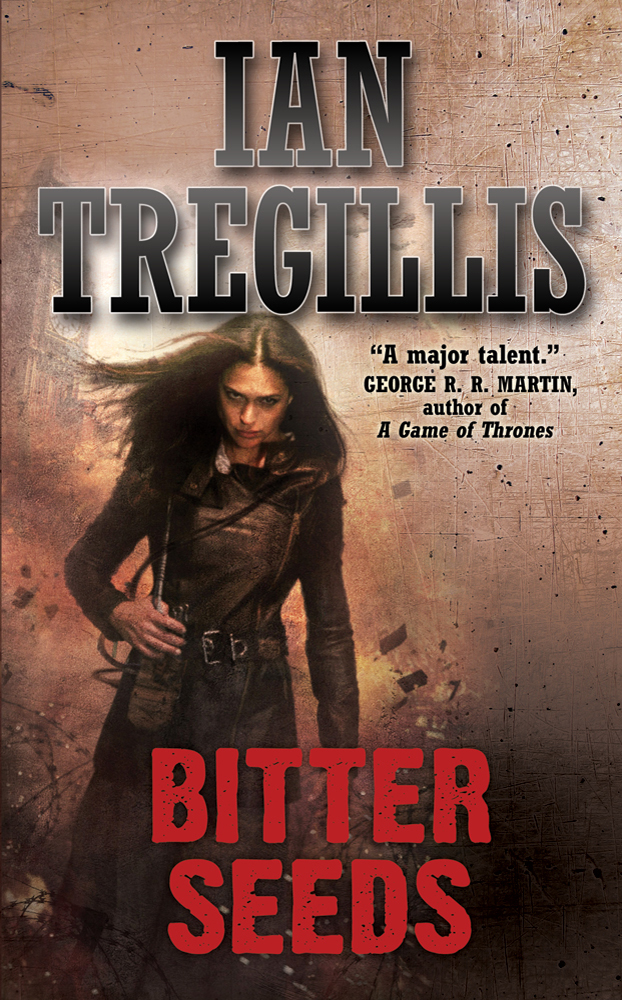
bitter-seeds-smallI somehow managed to overlook Ian Tregillis’s debut novel, Bitter Seeds, and that situation might not have changed if I hadn’t accidentally stumbled into his reading at the World Science Fiction convention.

In front of a packed audience, Ian spun a tale of Nazi supermen, the warlocks of Britain, and a desperate battle to prevent the twisted psychics of Germany from winning World War II in a supernatural alternate history. I heard less than a minute of his summary of the second novel, but it was more than enough to grab my attention. I got my hands on the first volume, just released in paperback, as soon as I could.

It’s 1939. The Nazis have supermen, the British have demons, and one perfectly normal man gets caught in between.

Raybould Marsh is a British secret agent in the early days of the Second World War, haunted by something strange he saw on a mission during the Spanish Civil War: a German woman with wires going into her head who looked at him as if she knew him.

When the Nazis start running missions with people who have unnatural abilities — a woman who can turn invisible, a man who can walk through walls, and the woman Marsh saw in Spain who can use her knowledge of the future to twist the present — Marsh is the man who has to face them. He rallies the secret warlocks of Britain to hold the impending invasion at bay. But magic always exacts a price. Eventually, the sacrifice necessary to defeat the enemy will be as terrible as outright loss would be.

Alan Furst meets Alan Moore in the opening of an epic of supernatural alternate history, Bitter Seeds by Ian Tregillis is a tale of a twentieth century like ours and also profoundly different.

Bitter Seeds was published by Tor Books on April 24, 2012. It is 467 pages for $7.99 in both paperback and digital format. The Coldest War, the sequel and second volume in what’s now being called The Milkweed Triptych, was published in hardcover on July 17, 2012.

See all of our recent New Treasures selections here.

Black Gate Online Fiction: “The Daughter’s Dowry” by Aaron Bradford Starr

Black Gate Online Fiction: “The Daughter’s Dowry” by Aaron Bradford Starr

daughters-dowry-cropA famous explorer relates one of his earliest adventures, an exciting sea journey to a sunken tower where a legendary treasure awaits:

I inserted the key into the lock, amazed at how free of corrosion or accumulated grit the inner mechanism was. Yr Neh cocked his ears forward in surprise as well. Our eyes met, and we smiled to each other as I turned the key.

It didn’t open. I felt the tension in the key, then its complete freedom of movement. Puzzled, I put an ear to the side. It was ticking softly. Yr Neh backed away warily, and I had begun to do the same when the box jumped into the air before me.

Flashing and turning, the box changed shape as it fell, landing again on the floor completely transformed. It was now a complex faceted spike of brightest gold. The point pounded into the floor and continued through the stone.

I lunged for the rope, diving through the shallow water on the floor. There followed a moment of silence, broken only by the squeak of the rope from which I still clung, soaked to the skin. Yr Neh sighed in relief, and I joined him. Then the shattered floor collapsed.

Aaron’s first published story was “Mortal Star” in Black Gate 8, which SF Site called “complex and fascinating in design… A very fine story that is impossible to predict.”

You can read the complete catalog of Black Gate Online Fiction, including last week’s 25,000-word novella of dark fantasy “The Quintessence of Absence” by Sean McLachlan, and Jason E. Thummel’s adventure fantasy novelette “The Duelist,” here.

“The Daughter’s Dowry” is a complete 9,000-word novelette of heroic fantasy offered at no cost, with original art by Aaron Bradford Starr.

Read the complete story here.

Weird Tales 360 Arrives This Week

Weird Tales 360 Arrives This Week

weird-tales-360-smallWeird Tales 360,  the first issue helmed by new editor Marvin Kaye, is scheduled to ship this Friday, October 19.

It’s an auspicious and entirely appropriate number, I think. After changing direction several times over the last few years, Weird Tales has now turned 360-degrees and returned to where it started: publishing classic weird fiction.

The theme of the first Kaye issue is “The Elder Gods,” and the table of contents makes it clear that he is whole-heartedly embracing the Lovecraftian fiction that helped make Weird Tales one of the most sought-after magazines of the pulp era:

FICTION: THE ELDER GODS

  • “The Long Last Night” by Brian Lumley
  • “Momma Durtt” by Michael Shea
  • “The Darkness at Table Rock Road” by Michael Reyes
  • “The Runners Beyond the Wall” by Darrell Schweitzer
  • “Drain” by Matthew Jackson
  • “The Thing in the Cellar” by William Blake-Smith
  • “Found in a Bus Shelter at 3:00 am, Under a Mostly Empty Sky” by Stephen Gracia

FICTION: UNTHEMED

  • “To Be a Star” by Parke Godwin
  • “The Empty City” by Jessica Amanda Salmonson
  • “Abbey at the Edge of the Earth” by Collin B. Greenwood
  • “Alien Abduction” by M. A. Brines

Read More Read More

Vintage Bits: Black Isle Resurfaces

Vintage Bits: Black Isle Resurfaces

black-isle-smallInterplay, publisher of some of the most acclaimed fantasy role playing games of all time – such as the Bard’s Tale series, Wasteland, Dragon Wars, Baldur’s Gate, Fallout, and Icewind Dale — has announced that the legendary development studio behind many of its most popular titles, Black Isle Studios, has reformed.

Black Isle was owned by Interplay and created in 1996 by Feargus Urquhart. It was formed from the crack team of developers who had created Fallout. Over the next few years, they developed many hits, including Fallout 2, Planescape: Torment, and Icewind Dale. Working with a tiny outfit in Canada named BioWare, they also produced Baldur’s Gate and Baldur’s Gate II: Shadows of Amn.

Interplay began to experience serious financial difficulties in 2001-2002, after publishing a number of high-budget failures such as Messiah and Kingpin. Black Isle was dissolved as Interplay imploded, a move that shocked the industry. All the employees were laid off on December 8, 2003.

Their last titles were the poorly-received PC game, Lionheart, and Baldur’s Gate: Dark Alliance II for the Playstation 2. At the time they were dissolved, they were working on Baldur’s Gate III: The Black HoundBaldur’s Gate: Dark Alliance III and Fallout 3, none of which ever saw the light of day. A nearly bankrupt Interplay eventually sold the rights to the Fallout series to Bethesda, who developed and released its own version of Fallout 3 in 2008.

The closing of Black Isle was a serious blow to RPG gamers, and it marked the end of Interplay as a force in the industry. As someone whose all-time favorite games include Dragon Wars and Icewind Dale, I saw it as the end of an era. Interplay survived for most of the next decade by re-packaging its classic games, especially Fallout, Baldur’s Gate, and Icewind Dale, as well as their sequels.

Most of the star developers associated with Black Isle, including Feargus Urquhart and Chris Avellone, are not on board for this new iteration. Urquhart and Avellone founded the successful Obsidian Entertainment (Star Wars: Knights of the Old Republic II, Neverwinter Nights 2). But Mark O’Green and Chris Taylor (designer of the original Fallout) have both reportedly returned.

No announcement yet on what titles the resurrected Black Isle is working on. But I’m certainly looking forward to finding out.

Smaller is Better

Smaller is Better

interzone-242Arriving in the mail the other day was not one, but two small parcels from TTA Press, mini versions of Black Static and Interzone, now both in a more compact, dare I say it, iPad-ish, format, with spine and laminated color cover. Sort of like a book (or, if you prefer, the aforementioned  iPad).

Kinda cool. The rationale seems to be a way to pack more content at what I assume is a more inexpensive way to print it (which may also be why both issues will now come out at the same time, six times yearly,  instead of alternate months.) Even if it isn’t completely a cost issue, the new versions are quite handsome and, even better, more handy.

black-static-30A definite updagrade. Kudos to Andy Cox and crew for trying to preserve the magazine in print format.

Hey, maybe it’s like vinyl records in a digital age: it may be a minority format, but there are people who still want to buy it (I’m one of those in both camps).

The September–October issue of Interzone has new stories by Ken Liu, Debbie Urbanski, Lavie Tidhar, Priya Sharma, CW Johnson, and Karl Bunker. Black Static has stories from James Cooper, Ray Cluley, Daniel Mills, Susan Kim, Carole Johnstone, and David Kotok.

Click either cover to see a full-size version.

You can subscribe to one or both here.

New Treasures: Three Parts Dead by Max Gladstone

New Treasures: Three Parts Dead by Max Gladstone

three-parts-dead-smallThe fall is a big time for fantasy releases. We see a lot of press releases and advance proofs in the build-up to the holiday season, and everyone here has their favorites. I’m usually a fan of serial fiction — Fritz Leiber’s Fafhrd and the Gray Mouser tales, Jame Enge’s Morlock the Maker, Howard Andrew Jones’s Dabir and Asim novels — and I’m always on the lookout for the next breakout fantasy series.

But this year the book that most grabbed my attention was a first novel by Max Gladstone. I first saw the cover hanging on the wall at a Tor party at Wiscon in May, and I’ve been anxiously awaiting it ever since. Set in a decaying city on the verge of destruction, Three Parts Dead offers a high-stakes tale of dead gods, necromancers, and dark dealings in a richly-imagined urban landscape.

A god has died, and it’s up to Tara, first-year associate in the international necromantic firm of Kelethres, Albrecht, and Ao, to bring Him back to life before His city falls apart.

Her client is Kos, recently deceased fire god of the city of Alt Coulumb. Without Him, the metropolis’s steam generators will shut down, its trains will cease running, and its four million citizens will riot.

Tara’s job: resurrect Kos before chaos sets in. Her only help: Abelard, a chain-smoking priest of the dead god, who’s having an understandable crisis of faith.

When Tara and Abelard discover that Kos was murdered, they have to make a case in Alt Coulumb’s courts — and their quest for the truth endangers their partnership, their lives, and Alt Coulumb’s slim hope of survival.

Set in a phenomenally built world in which justice is a collective force bestowed on a few, craftsmen fly on lightning bolts, and gargoyles can rule cities, Three Parts Dead introduces readers to an ethical landscape in which the line between right and wrong blurs.

Three Parts Dead was published by Tor Books on October 2. It is 333 pages, and sells for $24.99 in hardcover and $11.99 for the digital version.