Browsed by
Category: Blog Entry

The Life and Times of a Midlist Author
The Life and Times of a Midlist Author

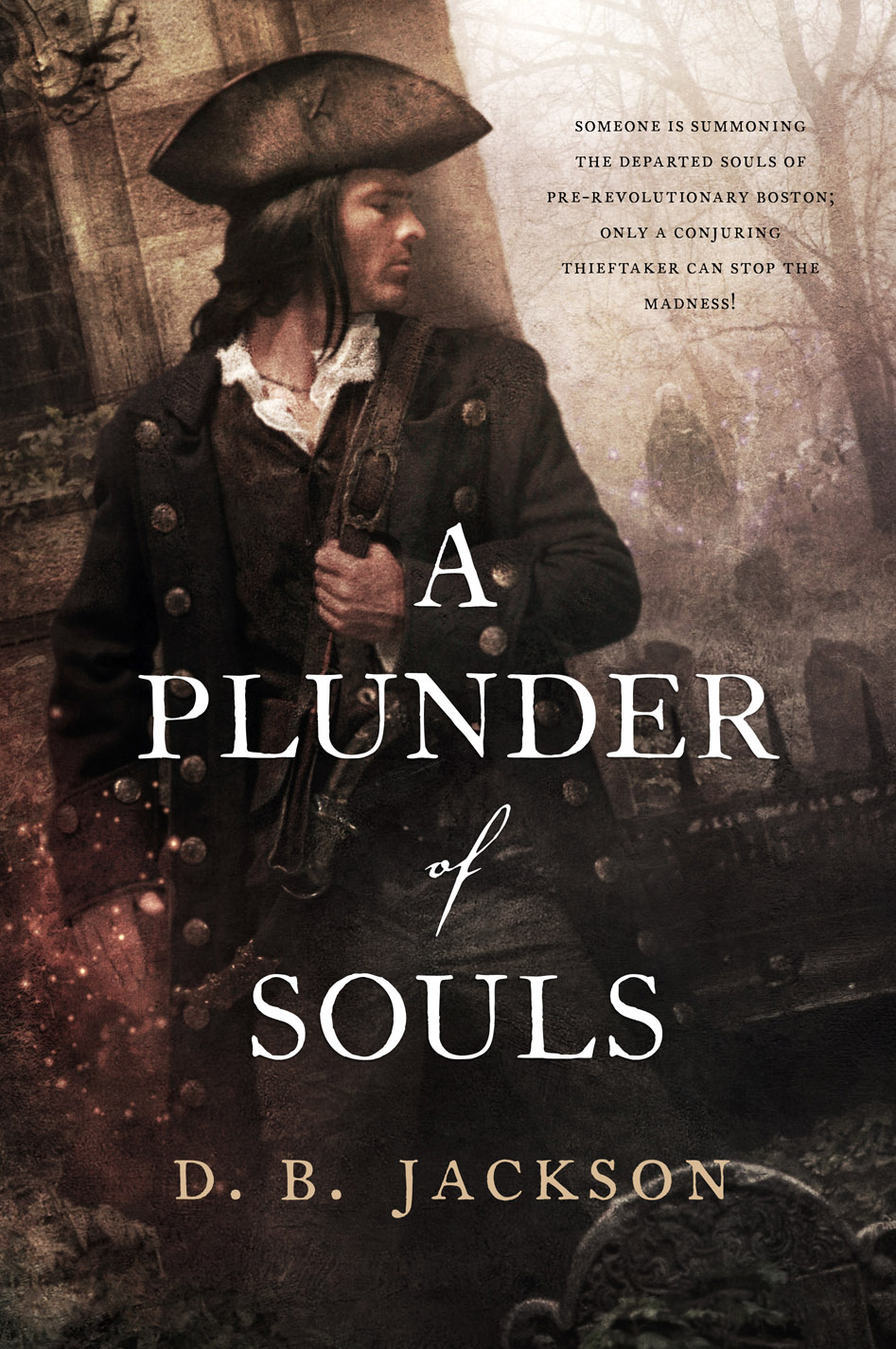
A Plunder of Souls-smallLate last summer, I was interviewed by Garrett Calcaterra for a Black Gate article on the writing life of midlist authors. That article, which also drew upon interviews conducted with Patrick Hester, Wendy Wagner, and M. Todd Gallowglas, can be found here and is still worth reading.

But I thought it might be interesting, a year later, to revisit the life of at least this midlister to see how things are going. A bit of background first: Under my own name, David B. Coe, I have been writing professionally for twenty years now, and I’ve been a published author for seventeen. “What’s the difference?” you ask. Well, I signed my first publishing contract and received my first (microscopic) advance in the summer of 1994. But that first book needed to be edited, revised, edited again, revised again, copyedited, and proofed. And it needed to be fitted into the already crowded publishing schedule of Tor Books. It finally was released in May 1997.

Which brings us to the first of many hard truths about the publishing industry: It moves at its own, sometimes glacial, pace. Yes, this is one reason why some writers grow so impatient with the business that they turn to self-publishing, which offers more immediate gratification for those who are eager to see their work in print. But for more reasons than I can go into today, that is not a path I have chosen to follow.

Writing now as D. B. Jackson, I am the author of the Thieftaker Chronicles, a historical urban fantasy series set in pre-Revolutionary Boston. The first two books, Thieftaker (Tor Books, 2012) and Thieves’ Quarry (Tor Books, 2013), have been received very well critically and did well enough commercially that Tor bought two more books from me. The first of these, the third in the series, is called A Plunder of Souls and it drops on July 8, 2014. (Please buy it. In fact, feel free to buy a few copies; they make great gifts and come in an attractive package complete with artwork by Chris McGrath. We now return to our regularly scheduled blog post . . .)

The fourth Thieftaker novel, Dead Man’s Reach, will be out next summer. And here we come to hard truth number two: For most full-time writers not named Martin, Gaiman, or Rothfus, one release per year is not enough to make a living. Most of the writers I know have a couple of projects going at once. I’m no exception.

Read More Read More

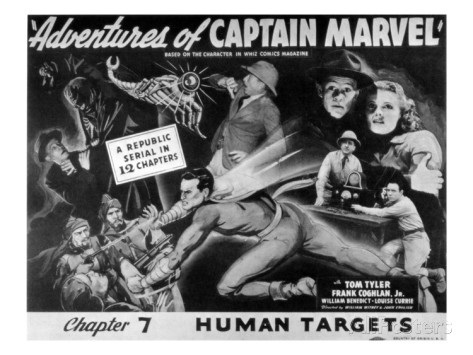
A Date with the Scorpion: The Adventures of Captain Marvel, Chapter Seven: Human Targets

A Date with the Scorpion: The Adventures of Captain Marvel, Chapter Seven: Human Targets

human targets lobby cardOkay boys and girls, settle down. Before watching newsreel footage of Winston Churchill walking through the ruins of London or thrilling to the terrifying spectacle of Lon Chaney Jr. changing into a human Scottish Terrier in The Wolf Man, let’s Join Billy, Betty, the Scorpion, and the rest for this week’s chapter of The Adventures of Captain Marvel, “Human Targets.”

We begin with two terse title cards that will bring everyone up to date. “The Scorpion — Tricks Bentley and Fisher into revealing the hiding place of their lenses.” “Captain Marvel — Saves Bentley’s lens and hurries to Fisher’s estate.” Now speak the wizard’s name and let his arcane arts give you powers so great that you need never fear for your lunch money again!

In a flashback to last week’s episode, we see Captain Marvel arrive at Fisher’s “estate” (to me it just looks like a big house that needs painting and must be hard to heat) and break down the door as the Scorpion hides behind the drapes. When he grabs the lens, the World’s Mightiest Mortal is knocked out by Fisher’s electrical protection apparatus. He drops to the floor, joining the unconscious Whitey and the dead Fisher.

The Scorpion pries the lens out of Captain Marvel’s hand and hightails it out of there. (Only the most cynical child would say that the fabulous artifact of the lost Scorpion Dynasty looks like a painted wooden dowel with shiny stickers stuck on each end.)

Read More Read More

Ancient Worlds: If Your Family Tree Doesn’t Branch…

Ancient Worlds: If Your Family Tree Doesn’t Branch…

circe-animals
This woman leads a good life.

It has been a frustrating few weeks around here.

What I want to do is spend the time not tied up in other obligations writing or working in the garden. What I’ve gotten over the last month is a seemingly endless series of storms (not common in Wisconsin in June; we go more for blizzards than twisters up here), obligations, shenanigans and chaos, and just when I think I’ve got twenty minutes to myself, a minor family crisis pops up.

Which makes this week’s topic – Medea’s visit to Circe – feel particularly apt.

Bear with me, that’s not as brutal a segue as it initially seems.

When we left off our discussion of the Argonautica, Medea had made the startling decision to murder her brother. Well, technically, Jason murdered him, but Jason isn’t the brains of anyone’s operation.

Jason couldn’t find the brains of the operation.

Jason is dumber than a box of hair.

Read More Read More

True North

True North

cns77The hobby of tabletop roleplaying games was born in the American Midwest, but very quickly spread beyond the wargames clubs of Wisconsin and Minnesota. Forty years after the publication of Dungeons & Dragons, RPGs are played and enjoyed throughout the world. Many countries outside the United States can rightly boast of their own roleplaying games and designers, some of which, such as Britain’s Warhammer games, have arguably proved as influential as D&D. Since today is Canada Day, I thought it fitting to post a short tribute to two Canadian roleplaying game designers whose work, while perhaps not as widely known as that of Arneson and Gygax, is nevertheless worthy of note, particularly by those of us who have come to appreciate and indeed prefer what has come to be called “old school” gaming.

As everyone interested in such things knows by now, Dungeons & Dragons first appeared in 1974. The originality of its concept inspired others to create similar games of their own, the first being Ken St. Andre’s Tunnels & Trolls, published in 1975. Many more followed, including Chivalry & Sorcery, written by two wargamers at the University of Alberta, Edward E. Simbalist and Wilfried K. Backhaus. C&S was published by Fantasy Games Unlimited in 1977 and owes its existence to some questions Simbalist and Backhaus asked after playing D&D, as they explain at the start of the rulebook:

Chivalry & Sorcery began innocently enough with a discussion about the vacuum that our characters seemed to be living in between dungeon and wilderness campaigns. In the Fantasy Wargames Society of the University of Alberta a degree of dissatisfaction emerged over the limited goals that were available to our characters. The solution was to develop an all-encompassing campaign game in which dungeon and wilderness adventures were just a small part of the action.

Initially called Chevalier, Simbalist admitted in an interview that Chivalry & Sorcery was “a D&D clone in some respects.” The pair even intended to pitch the game to TSR for publication, but chose instead to work with FGU. Chevalier “contain[ed] all of the seeds that would soon spring forth as Chivalry & Sorcery,” which Simbalist believed was “a dramatic departure from the slash and hack approach to RPG that existed in those early days.”

Read More Read More

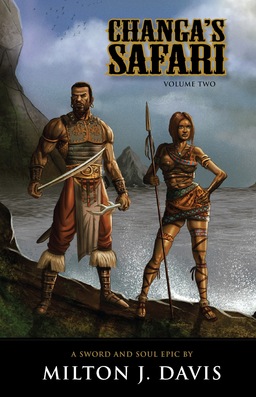
Changa’s Safari: Volume 2 by Milton Davis

Changa’s Safari: Volume 2 by Milton Davis

oie_122213ZGX0sjXjI read fantasy — and swords & sorcery in particular — because it’s fun. Like most middle-class Americans I lead a very safe life, which I’m very happy about, but from which I sometimes like to take a break. Occasionally I need to hear the whoosh of a sword just missing Conan’s head, to peer down into the dark alleys of Tai-tastigon from the rooftops of strange gods’ temples, to smell the fires of Granbretan’s vile sorceries. Sometimes I need to get out of my content, comfortable place and journey to places unknown and fantastic.

Milton Davis, sword & soul maven, delivers exactly that kind of trip in Changa’s Safari: Volume 2 (2012). The story of swashbuckling merchant Changa Diop traveling the 14th century Indian Ocean, it continues the adventures of Changa’s Safari: Volume 1 (2010), which was reviewed by Charles “Imaro” Saunders on Black Gate several years ago.

Once a prince of the Bakongo, Changa was sold into slavery when his father was killed by the sorceror Usenge. He was rescued from the slave-fighting pits of Mogadishu by a kindly merchant. His rescuer, Belay, taught him how to be a trader and eventually made him his heir.

Vol. 1 tells of the arrival of a great Chinese fleet off the East Africa coast and Changa’s journey alongside it back to China with his own fleet. There he confronts — boldly and with plenty of sword flourishing and magic — all manner of things you’d hope to meet in this kind of story: evil demigoddesses, pirates, conniving courtiers, and a Mongol horde. You know, the good stuff.

Volume 2 picks up a short time after Changa and his ships have left China for home. Home is Sofala, once a prosperous port in present-day Mozambique. It’s a long way from the Straits of Malacca (where the book opens with a tremendous multi-ship battle against Sangir pirates) to Sofala, which leaves a lot of room for adventure.

Read More Read More

Black Gate Online Fiction: “Seven Against Hell” by Janet Morris and Chris Morris

Black Gate Online Fiction: “Seven Against Hell” by Janet Morris and Chris Morris

Poets in Hell-smallBlack Gate is very pleased to offer our readers the complete short story “Seven Against Hell” by Janet Morris and Chris Morris, an exclusive sample from the new collection Poets in Hell.

In hell, souls sometimes roam diverse underworlds, straying from their native realms. The ancient Old Dead have many judges and gods of hell; the New Dead have few. In hell, if you die you are reborn on the Undertaker’s table, perhaps old or young, forgetful or deformed, to sin more and hunt the manifold hells for relief from damnation. Few find it. Among the teeming damned of hell are all who ever broke even one of the 613 Commandments, from every culture of humanity, whether they knew the rules or harbored faith or not. If you lived, you sinned, you died — and ended here, a soul in torment. Hell is never fair.

Diomedes and six of his fellow Argives come up from Erebos in Hades’, summoned to a meeting in dissolute New Hell City where the modern dead hold sway and a poetry festival is under way. This summons is from a friend of old, one he can’t refuse, who needs a favor. Even in perdition, a hero must answer a call to duty….

Janet Morris and Chris Morris have edited 17 volumes of the highly acclaimed Heroes in Hell anthology series. In his Black Gate review Joe Bonadonna said the latest volume, Poets in Hell, has “A little something for everyone: heroic fantasy and sword & sorcery, thrillers, horror, romance, touches of science fiction and steampunk – they’re all here.”

The complete catalog of Black Gate Online Fiction, including stories by David C.  Smith, Jon Sprunk, Tara Cardinal and Alex Bledsoe, E.E. Knight, Vaughn Heppner, Howard Andrew Jones, John C. Hocking, Michael Shea, Aaron Bradford Starr, Martha Wells, Nina Kiriki Hoffman, C.S.E. Cooney, and many others, is here.

Poets in Hell was published by Perseid Press on June 11, 2014. It is 410 pages, priced at $19.99 in trade paperback and $6.66 (yes, $6.66) for the digital version. Learn more here.

Read the complete short story “Seven Against Hell” here.

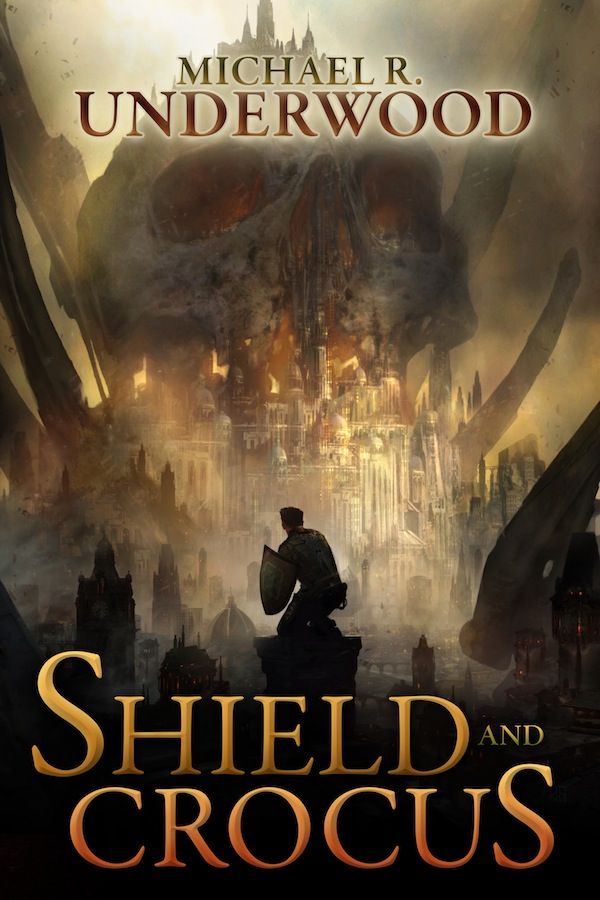
New Treasures: Shield and Crocus by Michael R. Underwood

New Treasures: Shield and Crocus by Michael R. Underwood

Shield and Crocus-smallI used to tell folks submitting to Black Gate that the easiest way to grab my attention was with a unique setting. Writers — especially beginning writers — make greats efforts to impress with prose and plot, but very few seem to have the ability to imagine some place other than Middle Earth or a tavern in a D&D game.

It’s the same when I’m choosing a new novel. It’s the ones with the most imaginative settings that really win me over. And Michael R. Underwood’s Shield and Crocus — set in a city built on the bones of a fallen giant, ruled by five criminal tyrants — has by far the most intriguing setting I’ve come across this year.

The city of Audec-Hal sits among the bones of a Titan. For decades it has suffered under the dominance of five tyrants, all with their own agendas. Their infighting is nothing, though, compared to the mysterious “Spark-storms” that alternate between razing the land and bestowing the citizens with wild, unpredictable abilities. It was one of these storms that gave First Sentinel, leader of the revolutionaries known as the Shields of Audec-Hal, power to control the emotional connections between people — a power that cost him the love of his life.

Now, with nothing left to lose, First Sentinel and the Shields are the only resistance against the city’s overlords as they strive to free themselves from the clutches of evil. The only thing they have going for them is that the crime lords are fighting each other as well — that is, until the tyrants agree to a summit that will permanently divide the city and cement their rule of Audec-Hal.

It’s one thing to take a stand against oppression, but with the odds stacked against the Shields, it’s another thing to actually triumph.

In this stunning, original tale of magic and revolution, Michael R. Underwood creates a cityscape that rivals Ambergris and New Crobuzon in its depth and populates it with heroes and villains that will stay with you forever.

Michael R. Underwood is the author of Geekomancy and Celebromancy. I was much impressed with his reading at Wiscon 2012. He was also the North American Sales Manager for Angry Robot Books (in which capacity he’s sold me a book or two.)

Shield and Crocus was published by 47North on June 10, 2014. It is 416 pages, priced at $14.95 in trade paperback and just $4.99 for the digital edition.

The Public Life of Sherlock Holmes: The Crimes Club

The Public Life of Sherlock Holmes: The Crimes Club

CrimesClub_DoyleHoudini
Doyle with Harry Houdini

Violette Malan wrote a post about Isaac Asimov’s Black Widower mysteries. These were stories about a group of men, members of a private club, who met monthly and tried to solve a guest’s mystery.

The Black Widowers were based on a real-life group that Asimov was a member of, The Trap Door Spiders. Founded by science-fiction author Fletcher Pratt, I believe that the roots go even deeper and can be traced back to Sir Arthur Conan Doyle.

Name That Crime – In December of 1903, six men met for lunch at the Carlton Club in London. That meal was the genesis for the formation the following year of Our Society, better known as The Crimes Club. The founding members, including Doyle, met at London’s Grand Central Hotel on July 17, 1904 for a dinner.

The Crimes Club would meet three or four times annually on a Sunday evening. After dinner, a member and/or a guest would give a talk about a celebrated crime, recent or historical, and the members would discuss and debate it, likely over drinks and cigars. Often, lawyers who had been involved in the case would provide inside information.

Doyle was pleased with the opportunity to hear what had happened to persons in the famous cases, as well as to see trial exhibits and even handle actual evidence.

Such items included strychnine pills found on convicted poisoner Dr. Thomas Neill Cream when he was arrested and bones from the right arm of the Radcliffe Highway Murderer, John Williams.

Williams’s burial site had been dug up when a water main was being laid in 1910. Club member George Sims saw a unique opportunity and grabbed the bones!

And of course, they talked about Saucy Jack: Jack the Ripper!

Read More Read More

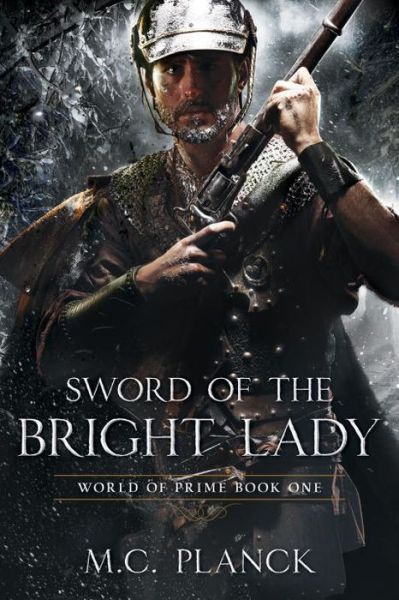
Future Treasures: Sword of the Bright Lady by M.C. Planck

Future Treasures: Sword of the Bright Lady by M.C. Planck

sword-of-the-bright-lady-mc-planck-smallM.C. Planck is the author of The Kassa Gambit, an SF novel released in hardcover by Tor last year. For his second novel, he turns to fantasy, with the tale of a mechanical engineer transported to a world in midst of an eternal war.

Christopher Sinclair goes out for a walk on a mild Arizona evening and never comes back. He stumbles into a freezing winter under an impossible night sky, where magic is real — but bought at a terrible price.

A misplaced act of decency lands him in a brawl with an arrogant nobleman and puts him under a death sentence. In desperation he agrees to be drafted into an eternal war, serving as a priest of the Bright Lady, Goddess of Healing. But when Marcius, god of war, offers the only hope of a way home to his wife, Christopher pledges to him instead, plunging the church into turmoil and setting him on a path of violence and notoriety.

To win enough power to open a path home, this mild-mannered mechanical engineer must survive duelists, assassins, and the never-ending threat of monsters, with only his makeshift technology to compete with swords and magic.

But the gods and demons have other plans. Christopher’s fate will save the world… or destroy it.

Sword of the Bright Lady is the first novel of World of Prime. The conceit of a contemporary hero transported into a fantasy world isn’t used as much as it used to be — obvious examples are John Carter of Mars, The Chronicles of Thomas Covenant, and Joel Rosenberg’s Guardians of the Flame novels — but I still find it an interesting one.

Sword of the Bright Lady will be published by Pyr Books on September 9, 2014. It is 440 pages, priced at $18 in trade paperback and $11.99 for the digital edition.

The Top 50 Black Gate Posts in May

The Top 50 Black Gate Posts in May

GodzillaMillenniumIt was all about the king of monsters at the Black Gate blog last month.

Ryan Harvey’s Godzilla review was our top article in May. His mammoth 5-part history of the Big Guy was also picked up by Boing-Boing, among other places, exposing the series to thousands of new readers; the final installment came in at #3 for the month. If you visited the site last month and read nothing but Godzilla articles, you weren’t the only one.

My analysis of John C. Wright’s conservative manifesto “Heinlein, Hugos, and Hogwash,” and the frequently hilarious response in the blogosphere, was our second most read article last month. Garrett Calcaterra’s well-researched “Can SF Save the World From Climate Change?” came in at #4.

Rounding out the Top Five was Fletcher Vredenburgh’s warm appreciation of Keith Taylor’s sword & sorcery classic, Bard.

The complete Top 50 Black Gate posts in May were:

  1. Godzilla (2014) Is a True Godzilla Film and a Unique Blockbuster
  2. A Ride Along with the Thought Police: John C. Wright, Foz Meadows, and Rachel Aaron
  3. A History of Godzilla on Film, Part 5: The Travesty and the Millennium Era (1996–2004)
  4. Can SF Save the World From Climate Change?
  5. A Perfect Artifact from the Glory Days of 1970s Swords & Sorcery: Keith Taylor’s Bard
  6. Read More Read More