Browsed by
Category: Blog Entry

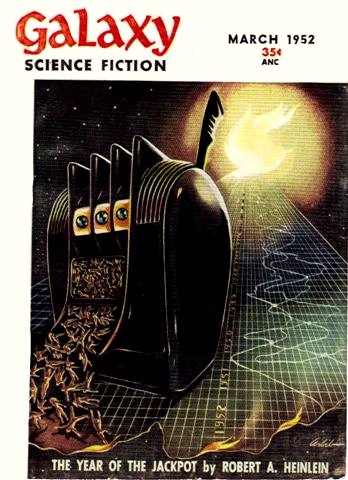
Galaxy Science Fiction, March 1952: A Retro-Review
Galaxy Science Fiction, March 1952: A Retro-Review

March 1952 Galaxy magazine-smallThe March, 1952 issue of Galaxy opens with a word from the editor, H. L. Gold. Gold introduces Willy Ley, who’s beginning his monthly department, “For Your Information,” that will vary from complete articles to brief reports on “significant developments in science.”

Along with the introduction, Gold states that a number of readers have asked what he’s like, so shares some details. Of his name, he writes, “Named H(orace) L(eonard) after a prompt casualty in the Princess Pat Regiment. I can’t pretend to be fond of my name, but I don’t use initials to escape it; that was decided upon by an editor, though other editors have used the whole thing. Having had 32 pen names, I find the problem shrug-worthy.” 32 pen names? Was he going for a world record?

About Galaxy, Gold writes, “Galaxy, of course, is my own dream come true. I know I sometimes push too hard, but that’s because everyone wants his dream to be perfect.” I’m glad he did. It was a good dream.

“The Year of the Jackpot” by Robert A. Heinlein — Potiphar Breen is a numbers guy — statistician, analyst, or any role where he can use his skills in numbers and patterns. The latest pattern is an increasing number of odd behaviors, such as women publicly disrobing for no apparent reason. He interviews one of the women, Meade Barstow, and the two of them begin meeting routinely. When the statistics show the approach of an unknown climactic event, Potiphar and Meade flee the city, hoping to avoid becoming a statistic of their own.

I couldn’t quite buy in to the premise of the story, but I let that go. It does move along pretty quickly, and when things start to go bad, they go really bad. And by that point, the predictability of it all isn’t as important as pure survival.

Read More Read More

Art of the Genre: Photographs from a Long Lost Lake Geneva

Art of the Genre: Photographs from a Long Lost Lake Geneva

Cartographer Dennis Kauth wants a piece of Larry Elmore's beautiful mind!
Cartographer Dennis Kauth wants a piece of Larry Elmore’s beautiful mind!

Over the past four years, I’ve struck up a friendship with Nick Parkinson, son of the late fantasy and D&D artist Keith Parkinson. We both live in San Diego and it is always nice to share thoughts on the sweeping industry of games as a whole.

One thing very few people understand who look into fantasy art is that the bulk of all artists DO NOT play RPGs.  Of the ‘Big Four’ for TSR (Elmore, Easley, Parkinson, and Caldwell), only Keith actually played Dungeons & Dragons.

Todd Lockwood was a D&D player until he started working at TSR in the late 1990s and he often speaks about how the ‘magic was gone’ once he started actually designing the game. That is a subject I’ll look at another day, however, although it is intriguing.

Anyway, I’m getting a bit off target here, so let me refocus. Nick and I had a conversation where I was looking to acquire a few old character sheets from ‘famous’ players for an io9 article a friend was writing and he said he’d just seen some of his father’s old sheets when he’d moved a few months before.

A week later, I didn’t get the character sheets, but he did send over a nice grouping of old TSR photographs and I was very interested to see the ‘process’ of how these great creators worked together to make some of the famous images we all know and love.

Read More Read More

September Short Story Roundup

September Short Story Roundup

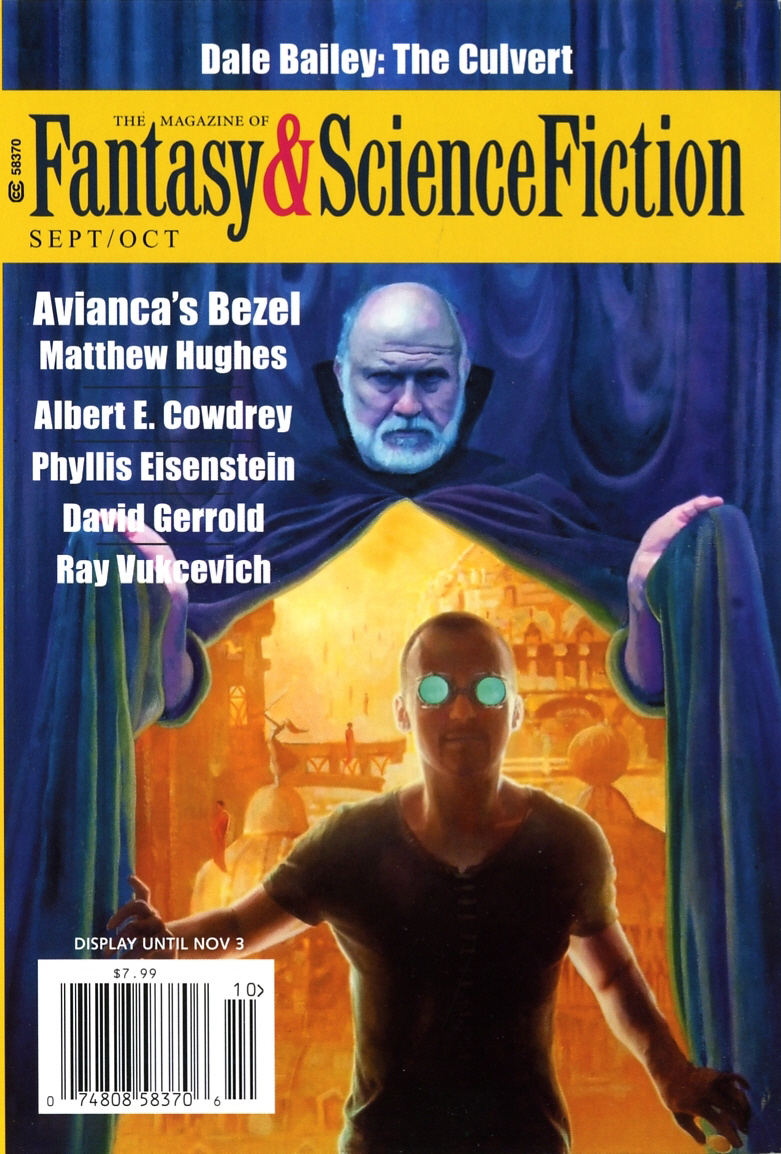
Magazine of Fantasy and Science Fiction Sept Oct 2014-smallSeptember was a good month for swords & sorcery stories. While the next issue of Heroic Fantasy Quarterly is still several months away, Fantasy & Science Fiction (presently celebrating its sixty-fifth year of publication) has a trio of tales. Swords and Sorcery Magazine, as every month for the past two and a half years, presented two new stories.

I started subscribing to F&SF earlier this year, but until now there haven’t been any S&S stories. Now in the September/October 2014 Issue, they’ve presented three. The first is a novelette by Phyllis Eisenstein. “The Caravan to Nowhere” is a tale in her long-running saga of the minstrel Alaric. It’s actually a reprint, with the story first appearing in the recent anthology Rogues, edited by Gardner Dozois and George R. R. Martin. The first story in the series, “Born to Exile,” appeared in the same magazine all the way back in 1971.

Alaric is a far-traveling minstrel with magical powers. He can shift his location from one spot to another instantaneously. In a world where such sorcery is usually feared, he is always on the move, seeking fresh opportunities and material for new songs. At the story’s start, he joins a caravan into the desert hunting not just inspiration, but also legendary hidden treasure and a lost city. While the caravan master, Piros, dismisses the tales as only drunken fancy, Alaric decides it’s still worth joining the party.

Alaric discovers that in addition to its purpose of buying salt, the caravan is journeying into the heart of the desert to acquire a supply of the Powder of Desire. It gives its users visions of great wonders, but it’s ultimately dangerous and debilitating. Piros’s dissolute son is himself addicted to the substance. When they arrive at the source of the powder, things take a dangerous turn.

Read More Read More

Volkswagen Ad Reunites William Shatner and Leonard Nimoy

Volkswagen Ad Reunites William Shatner and Leonard Nimoy

You’ve probably heard the recent reports about William Shatner’s possible return in the upcoming Star Trek 3, where he and Leonard Nimoy would appear together as Kirk and Spock one more time.

Pretty exciting stuff for an old-time Star Trek fan like me. Although the big event has just been scooped by a German Volkswagen ad released this week, which features both Leonard Nimoy and William Shatner (not to mention the Star Trek theme music, which probably wasn’t cheap to license for a car ad) in a charming 45-second spot. Yes, the ad is in German, but you’ll have no trouble following the dialog (Hint: The German phrase for “Captain Kirk” is “Captain Kirk.”)

The complete spot is below. Enjoy.

The Public Life of Sherlock Holmes: The First Great Holmes (Gillette)

The Public Life of Sherlock Holmes: The First Great Holmes (Gillette)

I recently wrote about John Barrymore’s film, Sherlock Holmes, which was based on William Gillette’s massively popular play about the great detective.

In 1897 or 1898, Arthur Conan Doyle decided to “revive” Sherlock Holmes, who had gone over the ledge at the Reichenbach Falls in 1893. He wrote the first draft of a play starring the detective.

Gillette_Poster1Since he already had scored a hit with his non-Holmes play, A Tale of Waterloo, Doyle must have figured that the public would ring up the cash register in seeing their favorite detective again: this time on the stage.

Doyle lost interest in the project, but his agent sent the five-act play off to noted Broadway producer and agent Charles Frohman. Frohman, who died aboard the ill-fated Lusitania, felt that the play was not commercial enough as it was and told Doyle that popular American actor William Gillette should revise and then star in it.

The uninterested Doyle gave his permission and Gillette transformed Holmes into more of a melodrama star and less of a stodgy British detective.

Gillette read all of Doyle’s original stories, took four weeks off from his current tour for the popular Secret Service and rewrote the play. That November, a fire in San Francisco’s Baldwin Hotel destroyed all of the scenery and sets of Secret Service; and also the only script of Sherlock Holmes!

It’s Elementary – Gillette asked Doyle if he could marry Holmes for the play. Doyle’s reply via telegram has become famous: “You may marry him, murder him or do anything you like to him.”

Read More Read More

Announcing the Winners of Free Copies of Mark Rigney’s Check-Out Time

Announcing the Winners of Free Copies of Mark Rigney’s Check-Out Time

Check Out Time Mark Rigney-smallLast month, we told you that you had a chance to win a free copy of Mark Rigney’s latest Renner & Quist novel, Check-Out Time. All you had to do to enter was send us an e-mail with the title “Check-Out Time.” Two winners were drawn at random this morning from all qualifying entries.

We are pleased to announce the winners are:

Barbara Barrett
Galt, CA

Yusuf S Nasrullah
Boston, MA

Congratulations! You should receive your copies in the next 5 – 10 days. In the meantime, enjoy our feature review by William Patrick Maynard, who called the book “Funny, moving, enlightening, entertaining – Mark Rigney’s Renner & Quist series is in a class of its own.”

Check-Out Time will be published by Samhain Publishing on October 7, 2014. It is 250 pages, priced at $15 in trade paperback and $5.50 for the digital edition. Be sure to read Mark’s article on the series, The Adventure Continues: the Return of Renner and Quist, published right here in February.

Thanks to all those who entered our contest and thanks again to Samhain Publishing and Mark Rigney for making it all possible!

The Monsters of Golarion: Monster Codex for Pathfinder

The Monsters of Golarion: Monster Codex for Pathfinder

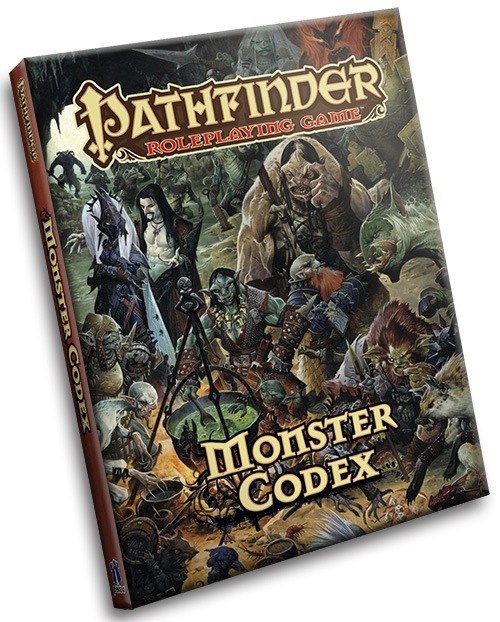
MonsterCodex

If you’ve played fantasy roleplaying games for any length of time, you’ve no doubt fought your fair share of goblins, orcs, and trolls. They can certainly begin to blend together. If you’ve fought one, you’ve fought them all, right? One of the jobs of the Dungeon Master is to find ways to keep things interesting. As I said in a post last week, “A fantasy roleplaying game is defined as much by the caliber of the villains and monsters as it is by the caliber of the players and heroes.”

One way to mix things up is to introduce more monsters, and certainly fantasy roleplaying games have no shortage of supplements that outline new and varied types of monsters.

But another way to keep things interesting is by varying up the existing pool of common monsters, giving them rich backstories and cultures, motivations and plots. In short, finding ways to really make what should be a common monster into something completely new. If you take a basic goblin template and add on 12 levels of barbarian, you have something decidedly more challenging to face!

Of course, creating all of this variability takes time and planning, which seems to be in ever-shorter supply these days. And this brings us to the Pathfinder RPG‘s newest solution: Monster Codex (Paizo, Amazon)

Read More Read More

New Animated Series About a Teen Aboriginal Superhero from Creator Jay Odjick

New Animated Series About a Teen Aboriginal Superhero from Creator Jay Odjick

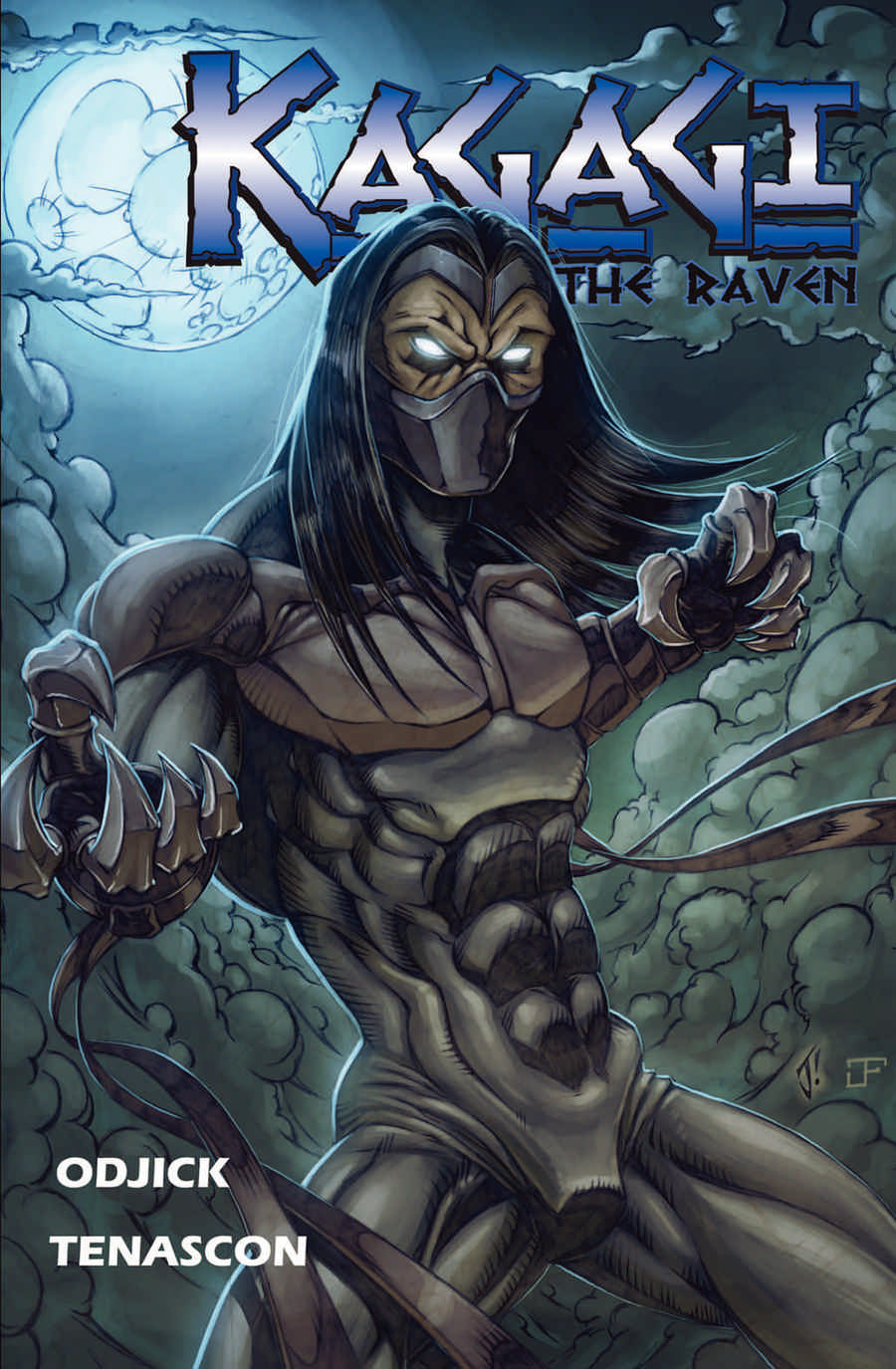
Kagagi-smallIn Ottawa, I get to talk to local game designers, local writers, local comic book publishers, local artists and novel publishers. I’m not trying to be a booster of Canada’s capital or anything, but we have some wickedly cool stuff going on around town.

This weekend, at Can-Con, Ottawa’s Literary Science Fiction, Fantasy and Horror Convention, I set up an interview in front of a live audience to talk to Jay Odjick, an Algonquin graphic novelist, to talk to him about being a writer and artist and about Kagagi (pronounced with two hard Gs).

Jay is a loud, hilarious, talented, self-deprecating, straight-talking comic creator who earlier in the week had been interviewed by CBC radio and afterwards tweeted “…managed to talk for twelve minutes on the radio without swearing.”

His immediate lead story about where and when he started to be a comic creator started when he was five years old and he was part of a two-man con aiming to unmask a celebrity Spider-Man to prove that it wasn’t the real Spider-Man.

Some years ago, like many comic creators, Jay made up his own superhero. But instead of being just another caped creation added to the immense pantheon of comicdom, he created the startlingly original Kagagi, based on the legend systems of the Algonquin tribe.

Central to this is the Wendigo curse (the supervillain) that is inflicting itself upon not only humanity, but those other parts of the Algonquin legend structures.

Read More Read More

Vintage Treasures: The Outlaw of Torn by Edgar Rice Burroughs

Vintage Treasures: The Outlaw of Torn by Edgar Rice Burroughs

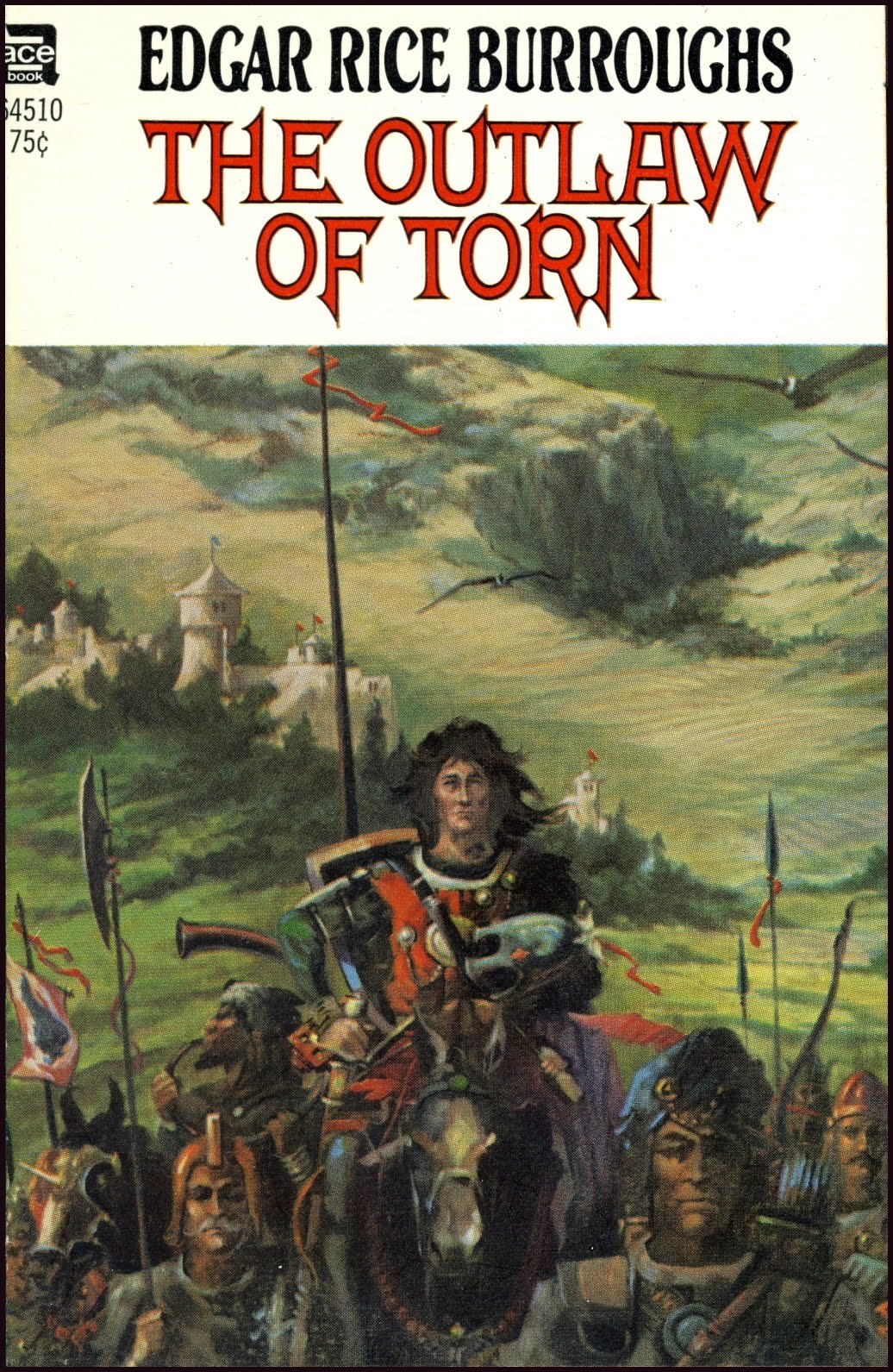
Outlaw-of-Torn-Ace-smallTruth be told, I’ve never been much of a fan of Edgar Rice Burroughs. I think he’s a taste you acquire young or not at all, and I missed the window by not reading any ERB before I turned 25. Talk about a wasted youth.

Of course, it’s entirely possible I simply haven’t read the right book yet. If I were going to be shipwrecked on a desert island tomorrow, and I just happened to get tipped off in advance, I would probably grab a copy of The Outlaw of Torn to bring with me. I’ve wanted to read it ever since I laid eyes on it many years ago, and I’ve had it recommended to me many times by ERB fans since.

At seventeen he was the greatest swordsman in England. At eighteen his reputation as a fearless outlaw had spread throughout the land and there was a tremendous price upon his head. At nineteen he was the leader of a fierce band of more than a thousand men, from nobleman to serf, the only requirements being willingness and ability to fight and an oath to obey the Outlaw of Torn.

Who was this Norman of Torn, the fame of whose daring exploits was ringing throughout the land? Where did he come from? Was he of noble blood or was he of commoner origin?

Through savage combats the Outlaw fights his way in his love for the beautiful daughter of the most powerful baron in England to find the secret of his birth.

On the other hand, our resident ERB expert Ryan Harvey didn’t think too much of The Outlaw of Torn, calling it “stodgy and drearily artificial; it lacks the zest of the best of Burroughs’s work” in his feature review. And Ryan has rarely steered me wrong. I suspect he’d suggest a different book for my ill-fated voyage. (Of course, a true friend might also suggest a different travel agent…)

The Outlaw of Torn was originally serialized in New Story Magazine starting in January 1914, and published in hardcover by McClurg in 1927. The Ace paperback edition above was published in 1965; it is 255 pages, priced at $0.75. The cover is by the great Roy Krenkel, Jr. (Click for bigger version.)

Collecting Lovecraft, Part II

Collecting Lovecraft, Part II

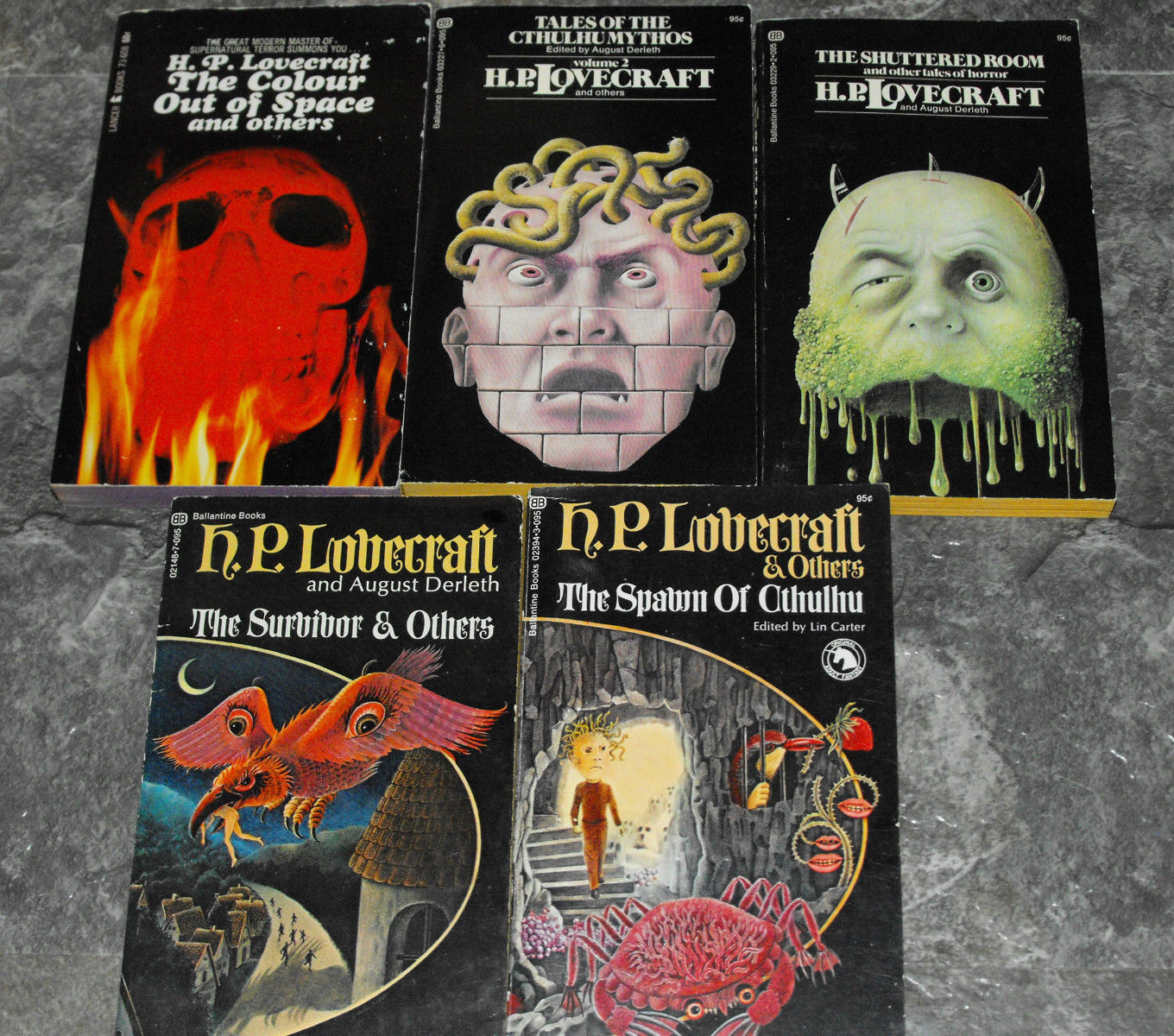
Lovecraft Ballantine Paperback collection-small

It’s almost too easy to get the complete works of H.P Lovecraft. Barnes and Noble, just for example, sells a handsome single-volume complete edition of his work (all 1112 pages!) for just $18. So why on earth would you ever want to spend your time and money collecting vintage paperbacks containing only a fraction of his complete works?

I made a half-hearted attempt to answer that question in the first article of this series, Collecting Lovecraft. Collecting is an emotional hobby, not a rational one, so trying to fathom the collecting urge purely on a rational basis is only going to get you so far. In truth, it usually boils down to something as simple as fondness for cover art, or nostalgia for the particular edition that first introduced you to an author.

Above you can see a colorful assortment of Lancer and Ballantine paperback editions of H.P. Lovecraft originally published between 1967 and 1973: The Colour Out of Space (1967), Tales of the Cthulhu Mythos, Volume 2, edited by August Derleth (1969), The Shuttered Room and Other Tales of Horror, by Lovecraft and Derleth (1973), The Survivor and Others by Lovecraft and Derleth (1971), and The Spawn of Cthulhu, edited by Lin Carter (1971). Truthfully, I’m not too fond of these covers, and they don’t hold any particular nostalgia for me — they were all out of print long before I discovered Lovecraft. So why was I so determined to buy them?

Back in August the New York Times published a fascinating article about Zero Freitas, the Brazilian millionaire collecting every vinyl record ever made. I don’t mean one copy of every record, I mean every single piece of vinyl with music on it in the world. He’s amassed millions so far. I distinctly remember the first time I read the piece, I nodded along and thought, “Yeah, I get it.”

Read More Read More