Browsed by
Category: Blog Entry

NaNoWriMo: How to “Pants” Through Your Novel like a Rampaging Panzer Division in 1940 France (and Why You Should)

NaNoWriMo: How to “Pants” Through Your Novel like a Rampaging Panzer Division in 1940 France (and Why You Should)

http://en.wikipedia.org/wiki/German_tanks_in_World_War_II#mediaviewer/File:Panzer025.jpg
First, Art and Music.

Hopefully, we don’t much like Nazis. Even so, it’s hard not to admire the way the panzer divisions rampaged across Europe, redefining modern warfare as they went. We’ll come back to them.

First, Fine Art and Music.

A friend of mine is a well-known Scottish landscape artist. He goes about his paintings pretty much how you would expect: roughs them out on the canvas itself, then adds layers of precision until he has an amazing picture. However, a friend of his, another professional artist (who shall remain nameless) starts painting in the top left hand corner of the canvas, and like a color laser printer zigzags across the thing until the picture is complete.

This, I am assured, is not normal.

Read More Read More

World War One: An International, Multiracial Conflict

World War One: An International, Multiracial Conflict

batallion
Tirailleurs Sénégalais in World War One, 43rd Battalion. Senegalese troops fought with distinction throughout the war on both the Western Front and the Dardanelles.

With the centennial of World War One in full swing, there’s a lot of press repeating the received truths about the war. If one listens to the UK media, it sounds like the British dealt with the Germans almost single-handed, saving Brave Little Belgium with a bit of help from the French and of course the Commonwealth allies.

American media coverage, such as it is, stresses the American role, while glossing over the first three years they missed. Neither of these national media spend much time on the wide diversity of people involved in the conflict.

Read More Read More

Fanfiction and Me

Fanfiction and Me

Starlog 40-smallI was introduced to fanfiction after The Empire Strikes Back came out in 1980, when I was around fifteen. This was long before the Internet, and fanfic was printed in fanzines, fan-produced magazines that were mimeographed or xeroxed, or if the editor could afford it, offset printed. But finding them, if you didn’t already know someone who knew about them, was nearly impossible.

As a lonely, feral, anxiety-ridden, teenage fan, my only connection to the fandom world at all was Starlog magazine. Back then, Starlog was a lifeline for me, and it not only featured articles and news about TV shows, movies, and books, but also fan groups and conventions. (I chose the university I went to because Starlog had an article that mentioned its student SF/F club and convention, but that’s another story.)

The magazine also had a section of small cheap personal ads in the back for fan-related merchandise. One issue, a fanzine called Facets, dedicated to fanfic about Harrison Ford’s various characters (mostly Han Solo and Indiana Jones) bought an ad, and I sent my money in (I don’t remember how much, probably less than $10) and bought a couple of small fanzines.

I was hooked. The back of each fanzine was filled with ads and flyers for other Star Wars fanzines, and I dived in and ordered more.

At their height of popularity in the 80s and early 90s, Star Wars fanzines were gorgeous productions. There were zines that were more than 300 pages long; with color covers and black and white illustrations; and filled with stories, poems, and cartoons. The best editors would copyedit the stories and some made suggestions and asked for revisions, helping the writers produce their best work.

Read More Read More

New Treasures: Neil Gaiman’s The Graveyard Book, Volume Two, Adapted by P. Craig Russell

New Treasures: Neil Gaiman’s The Graveyard Book, Volume Two, Adapted by P. Craig Russell

The Graveyard Book Volume Two-smallBack in August, I reported on the arrival of Neil Gaiman’s The Graveyard Book, Volume One, the first half of a handsome hardcover graphic novel adapting Gaiman’s famous contemporary fantasy.

I’m very pleased to report that the second half has now arrived, and it looks just as sharp as the first. Volume Two includes the last three chapters of Gaiman’s novel, skillfully adapted by Russell and illustrated by several of the top artists in the field.

The second volume of a glorious two-volume, four-color graphic novel adaptation of Neil Gaiman’s #1 New York Times bestselling and Newbery and Carnegie Medal-winning novel The Graveyard Book, adapted by P. Craig Russell and illustrated by an extraordinary team of renowned artists.

Inventive, chilling, and filled with wonder, Neil Gaiman’s The Graveyard Book reaches new heights in this stunning adaptation. Artists Kevin Nowlan, P. Craig Russell, Galen Showman, Scott Hampton, and David Lafuente lend their own signature styles to create an imaginatively diverse and yet cohesive interpretation of Neil Gaiman’s luminous novel.

Volume Two includes chapter six to the end of the book.

Once again the colorist is Lovern Kindzierski, who brings a solid cohesiveness to the project, tying together so many disparate art styles with a unified look.

The Graveyard Book, Volume Two was published by Harper Books on July 29, 2014. It is 164 pages, priced at $19.99 in hardcover and $12.99 for the digital edition.

Art of the Genre: The Top 10 Dragon Magazine Covers of the 1970s & 80s

Art of the Genre: The Top 10 Dragon Magazine Covers of the 1970s & 80s

Dragon_88_Cover_largeToday would have been the 56th birthday of artist Keith Parkinson, and so I dedicate this post to his memory.

Over on my own Art of the Genre site, I talk a lot about Dragon Magazine.  And why not, there are tons of them, and most are filled with great artwork. Typically, I review at least one Dragon a week, and after doing this for a couple of years I felt it was high time I composed one of my infamous ‘Top 10’ lists here on Black Gate, this time around ‘The Top 10 Dragon Magazine Covers of the 1970s & 80s!’

First off, apologies to the 1990s and 2000s, but you all didn’t make the cut for this list and I’ll have to address those two decades in a later post.

Now, for me, finding 10 ‘top’ covers is a hard list to make, primarily because so many Dragon magazine paintings have strong feeling of nostalgia attached to them. The greatest of these, of course, would be the very first Dragon magazine I ever saw, #88, with cover by Jim Holloway. That, in my book, is #1, but I’ll do my best to take a step back, evaluate with a more critical eye, and see what that list actually shakes out as.

And remember, I’ve been blogging Art of the Genre for five years, am approaching a quarter of a million unique page views, all for free, so please don’t troll my list, I think I’ve earned the right to post it, but feel free to share memories or your own favorites!

So, without holding you hostage any further, I present my list of the Top 10 Dragon Magazine Covers from the 1970s & 80s!

Read More Read More

Ancient Worlds: Gilgamesh and Enkidu

Ancient Worlds: Gilgamesh and Enkidu

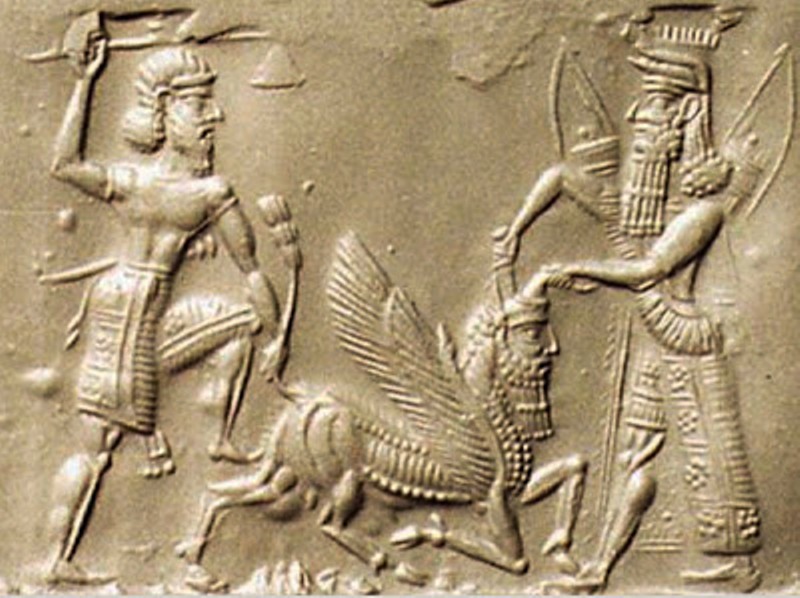
Enkidu and his other best friend, Kitty.

I like a good romance.

(Yes, we’re still talking Gilgamesh, I haven’t hit my head. Just give me a second. Haven’t we developed that kind of blogger/reader trust yet?)

In fact, I love a good romance. Give me a lady in a corset and a handsome young duke/earl/suitably wealthy gentleman/starving but really charming young artist, 300 pages and a stretch of time that my weesters are occupied elsewhere and I am all yours. I think the romance genre of fiction is underrated and, frankly, under-read by writers in many other genres.

But romance, or more precisely eros, has taken over fiction and fandom. Romantic relationships have become the primary relationship we see in our entertainment. Romantic tension is wedged into stories, often awkwardly. It’s often justified by seeking to appeal to a female demographic, as if women were incapable of liking stories without romance or that romance is the only relationship that we value. This is not only condescending, it’s exclusionary on a number of levels. And it is sad, because some of the greatest relationships in history were not romantic or familial, but friendships.

And the first great relationship we have recorded is just that. As we discussed last time, Gilgamesh has been making a royal pain of himself, and when his people pray for help, the gods respond by creating a man who will be his match. That man is Enkidu, and once the gods breathe life into him, they set him down in the wilderness.

Read More Read More

Vintage Treasures: Paradox Lost by Fredric Brown

Vintage Treasures: Paradox Lost by Fredric Brown

Paradox Lost Fredric Brown-smallIt’s strange to think that I didn’t really discover Fredric Brown until last year. Sure, before that I could probably name one or two of his most famous stories (including the Star Trek episode “Arena,” which doesn’t really count), but I didn’t truly learn to appreciate him until I brought a battered paperback with me on a flight back from Las Vegas last October. A week later I wrote about it, saying:

The Best of Fredric Brown is one of the best short story collections I’ve read in years. Brown is frequently compared to O. Henry for his gift for twist endings and the comparison is apt. Even when you’re on the alert, Brown manages to constantly surprise and delight you in a way that very few authors — in the genre or out — can pull off… I can’t remember the last time I’ve had as much fun with a single collection.

It’s good to know I can still find unexpected treasures in my own library.

Now, if you’re a Fredric Brown fan, the logical way to collect him these days is by purchasing From These Ashes from NESFA Press, which contains his complete short fiction in one gorgeous and economical volume — and is still in print.

Of course, you know how I feel about that. It takes all the fun out of it. You want to really appreciate Fredric Brown? You painstakingly track down his eight collections, like a normal person. Starting with Paradox Lost, because it has a dinosaur on the cover. Duh.

Paradox Lost (full title: Paradox Lost, and Twelve Other Great Science Fiction Stories) was published in 1974 by Berkley Medallion. It contains many of his finest stories, including the brilliant and oh-so-slightly-terrifying “Puppet Show,” “It Didn’t Happen,” “Eine Kleine Nachtmusik,” and ten others, plus a thoughtful introduction by his wife Elizabeth Brown (the only place where it appears). The book is 176 pages, priced at 95 cents; the cover is by Vincent DiFate. It is out of print. There is no digital edition, but copies in good condition start at under a buck at Amazon.

See all of our recent Vintage Treasures here.

Knight at the Movies: The Battery (2012)

Knight at the Movies: The Battery (2012)

GregBunburyTheBatteryMoviePosterAs Black Gate‘s resident oddball zombie movie reviewer (Honest! John O’Neill did it in style of Mad Men‘s Roger Sterling, he did a Jedi hand wave and anointed me thus) I have to say a little bit about the ultra-low budget 2012 movie The Battery.

The zombie movie has reached the arthouse at last. And the arthouse loved it, this micro-budget film won numerous awards.

Now don’t get me wrong, I love a traditional zombie movie as much as the next fan. I have a soft spot in my heart for 2008’s Day of the Dead, despite such howlers as the assertion that zombie Bud is safe because he was a vegetarian in life, as though that moral choice trumps thousands of years of cultural conditioning toward a similar moral choice against cannibalism.

But back to The Battery. Filmed on a budget of $6000, writer/director Jeremy Gardner put together a horror film that delivers the most entertainment per budget dollar since Blair Witch Project — though I expect The Battery, while not as original as that legendary effort, will prove more enjoyable on the re-watch.

Its strengths are the same as Romero’s original Night of the Living Dead: a limited budget means you have to spend your time on character and tension. Without money for a lot of extras in zombie makeup to be featured more than briefly, you have to make do with the sounds of zombies outside the windows, which is creepier anyway.

Read More Read More

The Public Life of Sherlock Holmes: Ellery Queen’s Misadventures of SH

The Public Life of Sherlock Holmes: Ellery Queen’s Misadventures of SH

Misadventures_CoverYou’ve probably heard the name ‘Ellery Queen,’ but you may not know that it’s actually the name for joint efforts by cousins Frederic Dannay and Manfred Lee. They were important players in the mystery field for decades, with Dannay being a notable Sherlockian.

In 1943, Dannay planned The Misadventures of Sherlock Holmes, an anthology of parodies and pastiches. Unlike today, Holmes anthologies were unheard of back then. Due in large part, as we’ll see, to the management of the Doyle Estate by Sir Arthur Conan’s sons, Adrian and Dennis.

The book, by Ellery Queen, was unveiled at a Baker Street Irregulars gathering in 1944. I gave a taste what dealing with Doyle’s two sons could be like in my post on “The Man Who Was Wanted.” There’s more of the same in this tale.

Adrian heard about the collection and went off in his usual rage, telegramming his brother Denis (also a wastrel) in Spain. Denis cabled the Estate’s law firm and instructed them to demand that Queen and the publishers, Little, Brown and Company, stop publication and withdraw all copies. They were also to be sued for damages.

To quote Denis’s cable to the lawyers: “It is obviously a flagrant example of that very sort of piracy, striking at the very roots of the literary value of the property which my father left to his family, against which we have fought together in the past…books which will completely devaluate and ruin the whole value of the Holmes property, including films, radio and stage.”

Read More Read More

Selling Short Fantasy, Science Fiction and Horror Fiction, Part I

Selling Short Fantasy, Science Fiction and Horror Fiction, Part I

Asimov's Science Fiction February 2014-smallA little while ago, I blogged about The Economics of Short Fiction and feedback was that there’s interest in a short series (no pun intended) on the selling of short fiction, which is a fascinatingly complex topic.

To be clear, this won’t be about the craft of writing. I’ve got lots of thoughts on creativity and the craft, some of which came out in an interview I gave to the excellent podcast the Creative Writer’s Tool Box.

In this first post on selling short fiction, I want to tackle three important pieces: (1) finding markets, (2) knowing the markets, and (3) knowing yourself.

So let’s assume you’re reading this post because you’ve written a short story, of say 5,000 words, and you’ve never looked at markets before. That’s where I was about eleven years ago.

Finding markets

There are a few places that compile market information on publishers of short fiction. I know some people swear by others for their multifunctionality [like www.duotrope.com or The (Submission) Grinder], but I find www.ralan.com far easier to use because independent of filters, there’s a list I can just browse. I’ve donated money to Ralan because I find this site so useful.

At Ralan, under the banner, you’ll see links to click on Pro markets, Semi-Pro markets, Pay markets, and Token markets (which I believe was once called 4-the-luv markets, which seemed more evocative to me). Pro markets pay SFWA rates, which are 6 cents a word and more. Semi-pro markets pay 3-5 cents a word, pay markets pay 1-2 cents, and token markets are anything below that. Ralan also shows you the lengths they publish and any sub-genres (ex.: sf/f/h means they take science fiction, fantasy and horror).

Read More Read More