Browsed by
Category: Blog Entry

Sax Rohmer at Towers of London

Sax Rohmer at Towers of London

51xCPS2lXQL._SY344_BO1,204,203,200_190px-FaceoffumanchuA couple weeks ago, I finally read Mr. Towers of London, the posthumously published memoirs of Harry Alan Towers, the unflappable veteran British radio/TV/film writer-producer with well over a hundred works to his credit. It wasn’t Towers’s first stab at writing his memoirs, but this final work was notable as his most personal.

Anyone who actually knows major figures in the entertainment industry is likely aware of some of the salacious stories of debauchery, sometimes even criminal activity, that are never far from the surface. Towers’s memoirs are unique for being perhaps the most honest ever committed to print. If he pulls any punches or whitewashes any parts of his adventures, he can surely be forgiven for what he does dish out about himself and others.

That said, the most disappointing part of the book for me is that he tells the reader very little about his experiences as a writer. I would have loved to have understood more about the more private side of his profession as the book places all of the emphasis on his role as a producer. Today, he is unfairly remembered as the producer of genre films and exploitation fare. While that accounted for much of his output after 1960, he was also a respected writer-producer of family drama who frequently cast some of the biggest stars in Hollywood in his radio, TV, and film productions.
Read More Read More

Firefly Friday: Serenity: Those Left Behind

Firefly Friday: Serenity: Those Left Behind

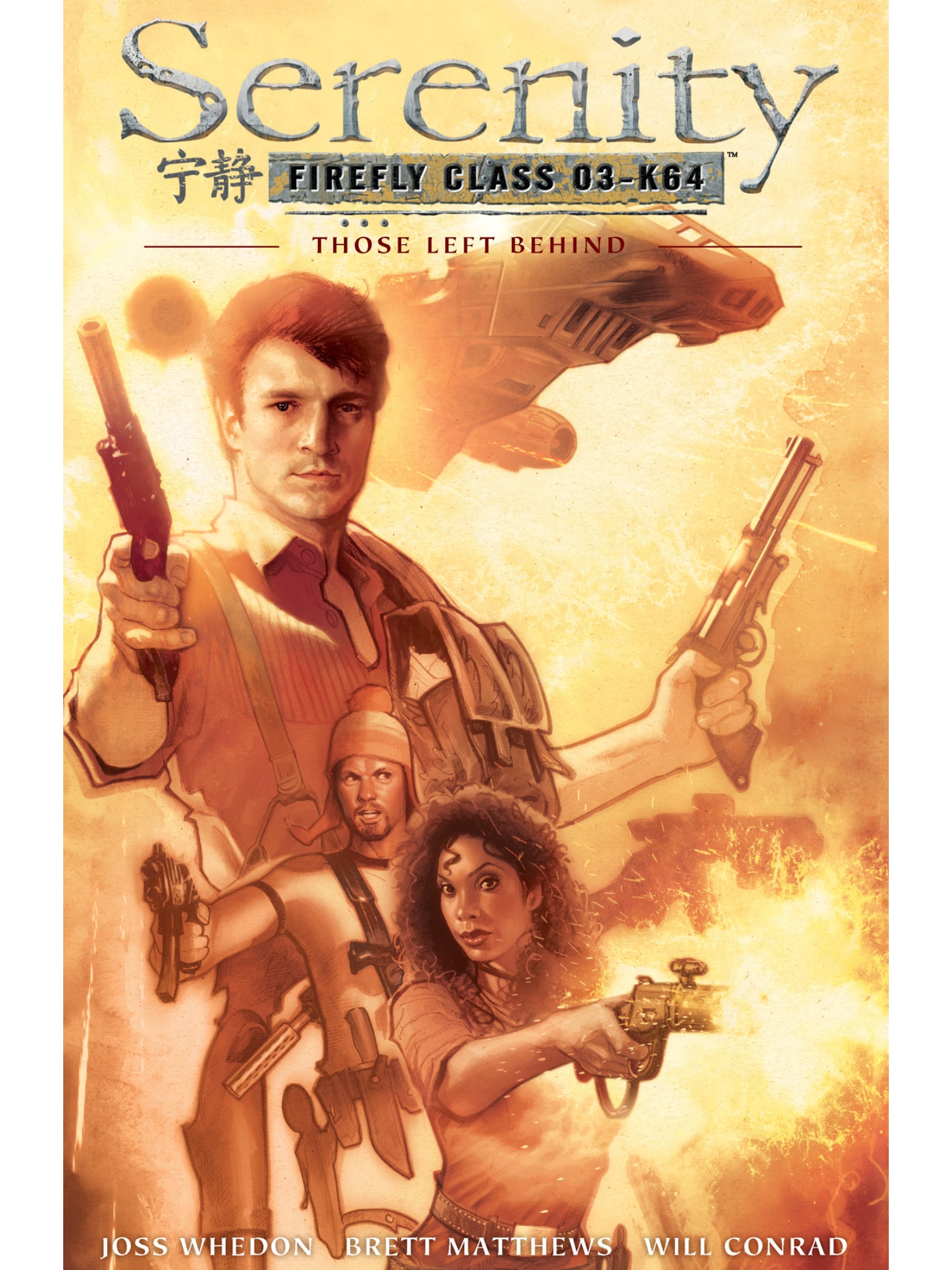
SerenityLeftBehindFan passion for more Firefly stories led to the rare (unprecedented?) move of turning a failed television series into a feature length film, in the form of 2005 film Serenity (Amazon). As an attempt to bridge the narrative gap between the end of the series and the start of the film, Joss Whedon collaborated with Dark Horse comics to produce the three-issue comic limited series Serenity: Those Left Behind (Amazon). This review is based on the original hardcover collection of the series, published in 2007. (They’ve since published a 2nd edition.)

Here are the major jumps between the end of Firefly and the beginning of Serenity, which the comic series seeks to explain:

  • Inara is no longer on the Serenity
  • Shepherd Book is no longer on the Serenity
  • Instead of the mysterious blue-handed agents in the series, the film introduces the operative as the key person hunting down River Tam

Serenity: Those Left Behind covers all three of these elements, and also brings back a villain from the television series who would have been recurring had it continued. I won’t ruin it by saying which one. As a hint, though, it’s someone who feels that they were wronged in their last interaction with Malcolm Reynolds, so that should narrow it down. This individual joins forces with the blue-handed operatives to move against the folks on Serenity. In addition to the mysterious recurring villain, there’s also a nice cameo by Mal’s contact Badger, who assigns them a job that doesn’t go exactly as intended. (Or at least not as intended by Mal and the crew.)

Read More Read More

Judges Guild Premium Editions Coming

Judges Guild Premium Editions Coming

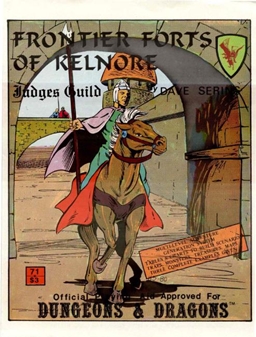
JudgesGuild_KelnoreWhen I began playing Dungeons and Dragons in the late seventies, I was a Judges Guild fan. My friend, who had more money, would buy shiny TSR modules. And I would get the cheaper-covered Judges Guild products. F’Dech Fo’s Tomb, Ravenscrag, Inferno (with a real cover), City State of the World Emperor, Wraith Overlord… I loved reading those things.

Frontier Forts of Kelnore guarded the border of my kingdom of Troya, ruled by the great warrior, Astyannax (I got more creative over the years). I even subscribed to Pegasus magazine, right up to the day it was discontinued.

Now, I liked those Judges Guild modules and supplements, but looking back, many did not age well (though a few did). Gaming has changed a lot over the years and reading them is kind of like watching an early talkie from the thirties. They’re out of place.

Having said that, they can still be interesting. I recently considered updating Glory Hole Dwarven Mine to work with Forge of Fury as a Pathfinder dwarven adventure. However, converting those old AD&D/Universal modules would take a LOT of work.

Read More Read More

Find the Conflict: Unblocking (or Actually Planning!) your NaNoWriMo Novel

Find the Conflict: Unblocking (or Actually Planning!) your NaNoWriMo Novel

Pulp-O-Mizer_Cover_Image
Let’s imagine I’m my 20-something self and this is my NaNoWriMo project

Last week, I did a kind of public service announcement about “pantsing”, the “just write” school of  writing — discovery writing — applied to your NaNoWriMo novel.

Truth is, I hate pantsing. Pantsing is why my old hard drive had a dozen first three chapters gathering bitrot. The only thing I discovered in several years of writing this way was the need to outline.

OK, there are pros who do pants. However, there are lots of other pros who swear by planning. Not just minor writers like yours truly (bows), but rising stars like my mate Hannu, who is very much a planner and an outliner (though he drafts by hand — hello, the 17th century called ).

Now, NaNoWriMo is all about literary elan; “Get the words down, doesn’t matter how bad.” And if you’re all about the word count, then it’s probably asking a bit much to get you to metaphorically sit on your hands and sketch out your story before pushing out the paragraphs. Even so, there’s a good chance that you’ll write yourself into a corner, or get stuck, run out of plot. Get blocked. So I thought you might find it useful if I shared an approach I used last year when writing novels to order — professionally, my 2013 was like NaNoWriMo does Groundhog Day.

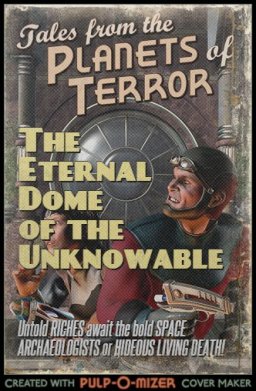
Just to keep me honest, I went over to the Thrilling Tales Derange-O-Lab, generated random pulp titles, picked one that jumped out and built a cover for it (right).

Let’s imagine I’m my 20-something self and this is my NaNoWriMo project, The Eternal Dome of the Unknowable.

Read More Read More

New Treasures: Radiant by Karina Sumner-Smith

New Treasures: Radiant by Karina Sumner-Smith

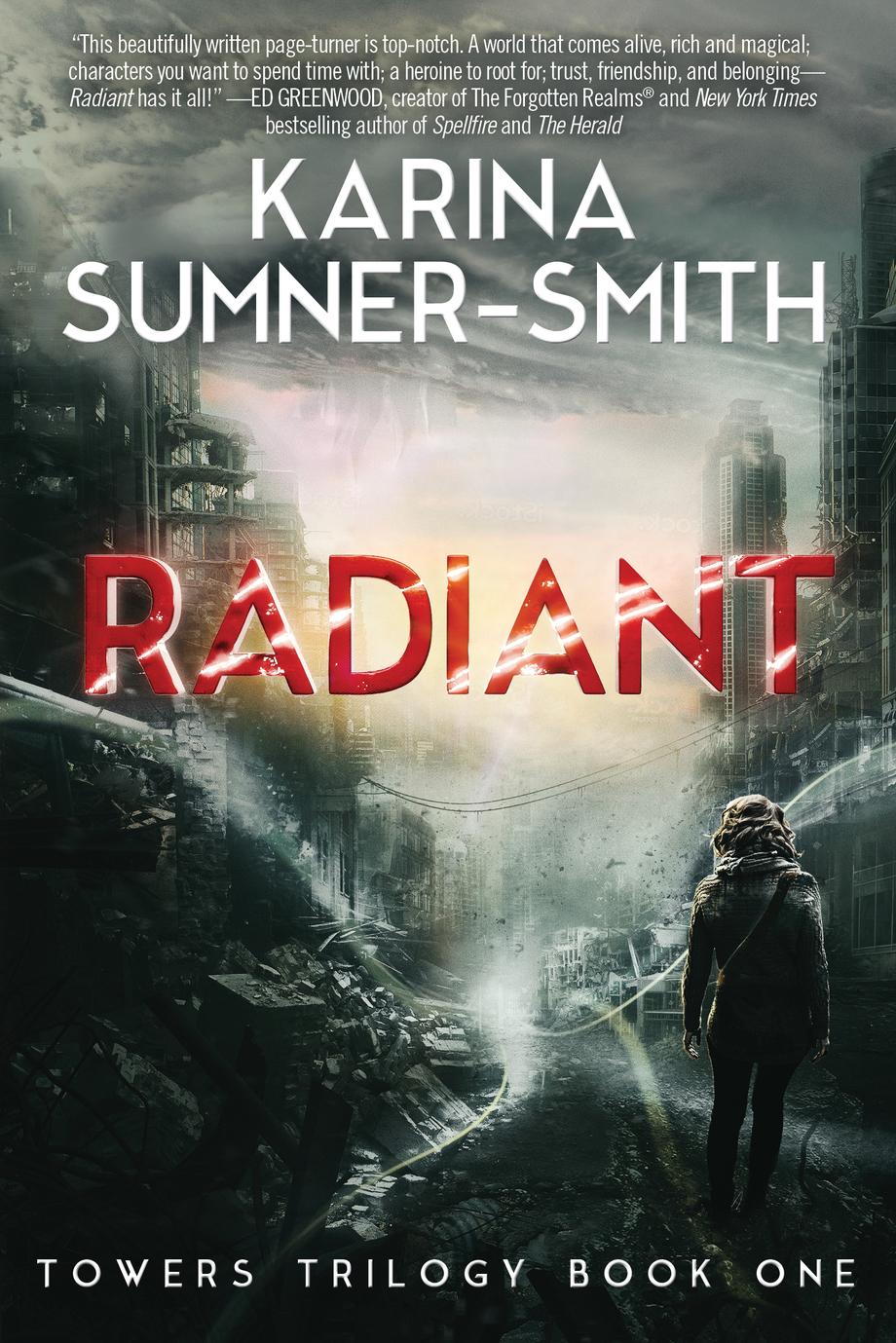
Radiant Karina Sumner-Smith-smallThe surest way to get my attention these days is with an original setting. And I was struck by the darkly imaginative setting of Karina Sumner-Smith’s debut novel Radiant immediately.

Sumner-Smith is a Canadian author of fantasy, science fiction, and young adult fiction. Her short fiction has been nominated for the Nebula award and has appeared in The Living Dead 2, The Best Horror of the Year Volume Three, and other places. Radiant is the first book of the Towers Trilogy.

Xhea has no magic. Born without the power that everyone else takes for granted, Xhea is an outcast—no way to earn a living, buy food, or change the life that fate has dealt her. Yet she has a unique talent: the ability to see ghosts and the tethers that bind them to the living world, which she uses to scratch out a bare existence in the ruins beneath the City’s floating Towers.

When a rich City man comes to her with a young woman’s ghost tethered to his chest, Xhea has no idea that this ghost will change everything. The ghost, Shai, is a Radiant, a rare person who generates so much power that the Towers use it to fuel their magic, heedless of the pain such use causes. Shai’s home Tower is desperate to get the ghost back and force her into a body — any body — so that it can regain its position, while the Tower’s rivals seek the ghost to use her magic for their own ends. Caught between a multitude of enemies and desperate to save Shai, Xhea thinks herself powerless — until a strange magic wakes within her. Magic dark and slow, like rising smoke, like seeping oil. A magic whose very touch brings death.

Radiant was published by Talos Press on October 7, 2014. It is 400 pages, priced at $15.99 in trade paperback and $9.99 for the digital version.

Nab the Trafficking in Magic, Magicking in Traffic Anthology for Just $4.35 at Amazon.com

Nab the Trafficking in Magic, Magicking in Traffic Anthology for Just $4.35 at Amazon.com

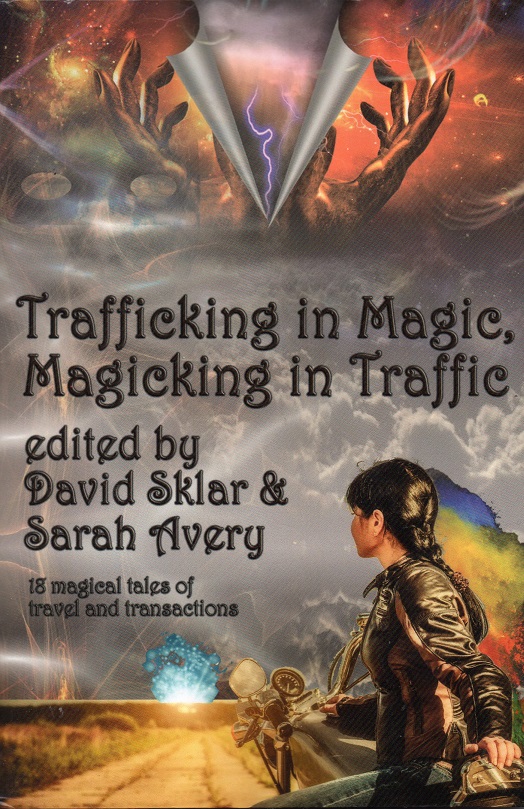
Trafficking in Magic Magicking in Traffic-smallBlack Gate author, blogger, and roving correspondent Sarah Avery reports in with some unexpected news: Amazon.com has discounted her acclaimed new anthology Trafficking in Magic, Magicking in Traffic to just $4.35, a steep 73% savings off the $15 cover price.

Sarah and her publisher are not sure how long the sale will last, however, so act fast. Of special interest to Black Gate fans, it contains a brand new story from James Enge — as well as fiction from Elizabeth Bear, Darrell Schweitzer, Pauline J. Alama, and many others. Here’s the complete description.

What do you seek at the end of this road? What have you brought to pay your way? The road is full of hazards, and the marketplace can cost more than you expect.

In Trafficking in Magic, Magicking in Traffic, editors David Sklar and Sarah Avery bring you 18 magical tales of travel and transactions, ranging from busking in a train station to walking between the worlds, from doppelgangers for hire to capturing the remnants of the dead.

Ideal to read on your vacation, commute, or flight from vengeful ghosts, this collection features classic stories by Elizabeth Bear, Daniel Braum, George R. Galuschak and Darrell Schweitzer, as well as new work by Pauline J. Alama, Megan Arkenberg, D.W. Carlson, Joyce Chng, M.C. DeMarco, E. Grace Diehl, James Enge, Manny Frishberg, Sara M. Harvey, Scott Hungerford, Deborah Grabien, Deirdre M. Murphy, Rhonda Parrish, Richard Rider, and Heather Stearns.

Trafficking in Magic, Magicking in Traffic was edited by David Sklar and Sarah Avery, and published by Fantastic Books on May 23, 2014. It is 264 pages, regularly priced at $15.99 in paperback. There is no digital edition. Order online from Amazon.com.

Game Review: Dead of Winter from Plaid Hat Games

Game Review: Dead of Winter from Plaid Hat Games

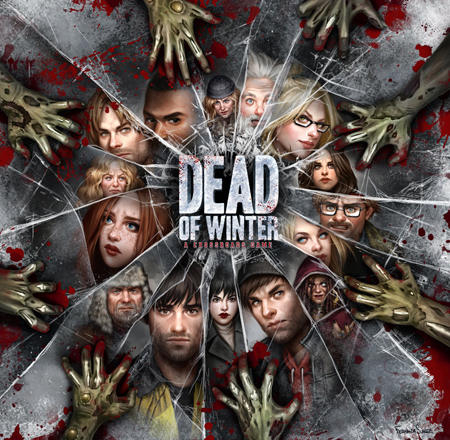
dead-of-winter-boxColor me rotting-flesh green and call me thunderstruck. I believe I’ve been playing the best board game in my thirty years of dice rolling this week: the Plaid Hat Games survival horror magnificence that is Dead of Winter.

Ron Burgundy “That’s No Lie” seal of approval. I know I often write here with tongue probing my cheek, but this time I’m undeadly serious. Maybe it was just the subject matter, or how dark the game can get as desperation builds, but I found it my most enjoyable gaming session in memory.

I’m not just trying to squeeze in another gore-dripped Zombie-related post before Halloween, either. I was perfectly willing to let my one sad little movie post for the month be my fall contribution, but honestly, this game has taken over my brain like a Venusian virus brought back to Earth and I must write about it.

Like tabletop gaming with friends? Like Zombies? If either of these conditions = TRUE, you can read through all my blah blah questionable-humor blah blah blah, or you can get off the Internet, utilize your preferred mode of transport (I don’t care about your hair, that’s why God created baseball hats), go to your Friendly Local Game Store and grab this jewel so you can read the rules and play it over the course of Halloween all the more quickly.

You’re welcome.

Read More Read More

See Westeros the Way George R.R. Martin Intended in The World of Ice & Fire

See Westeros the Way George R.R. Martin Intended in The World of Ice & Fire

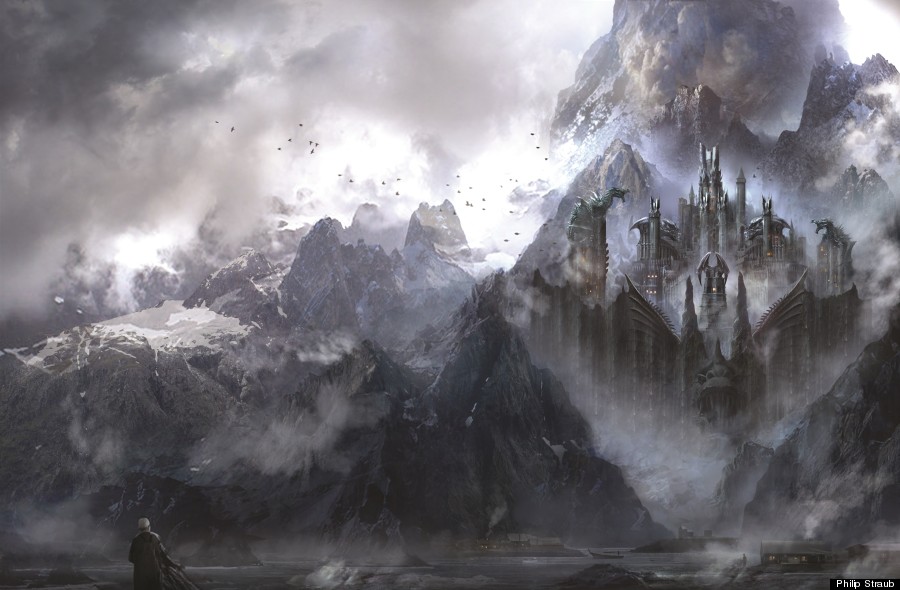
Dragonstone
Dragonstone

If you’ve been watching HBO’s Game of Thrones, then you’ve already been treated to some spectacular sights.

It seems George R.R. Martin is not content to let HBO be the final word on the visual splendor of Westeros, however. His new book The World of Ice & Fire: The Untold History of Westeros and the Game of Thrones, released this week, gives Game of Thrones fans the chance to see visions of Martin’s world that are much closer to what he intended.

In an interview at The Huffington Post, Martin explains why there are so many pictures of castles:

I wanted accurate versions of these castles. We’ve had a number of different artists draw them on covers and on the fantasy like cards and games, and some of them have been beautiful images but not necessarily accurate to what I described.

The World of Ice & Fire, co-authored with Elio M. García, Jr. and Linda Antonsson, who run the site Westeros.org, isn’t just an art book, however. It’s a comprehensive history of the Seven Kingdoms — all the battles, betrayals, and back-room deals that lead to the events of Martin’s novels. It includes full family trees for Houses Stark, Lannister, and Targaryen; detailed histories of the cultures of Westeros; and more than 170 pieces of original art and maps, many in full-color.

See five high-resolution images from the book at The Huffington Post article here. The World of Ice & Fire was published on October 28 by Bantam Books. It is 336 pages, priced at $50 in hardcover and $19.99 for the digital edition.

Art of the Genre: Owning a Time Machine

Art of the Genre: Owning a Time Machine

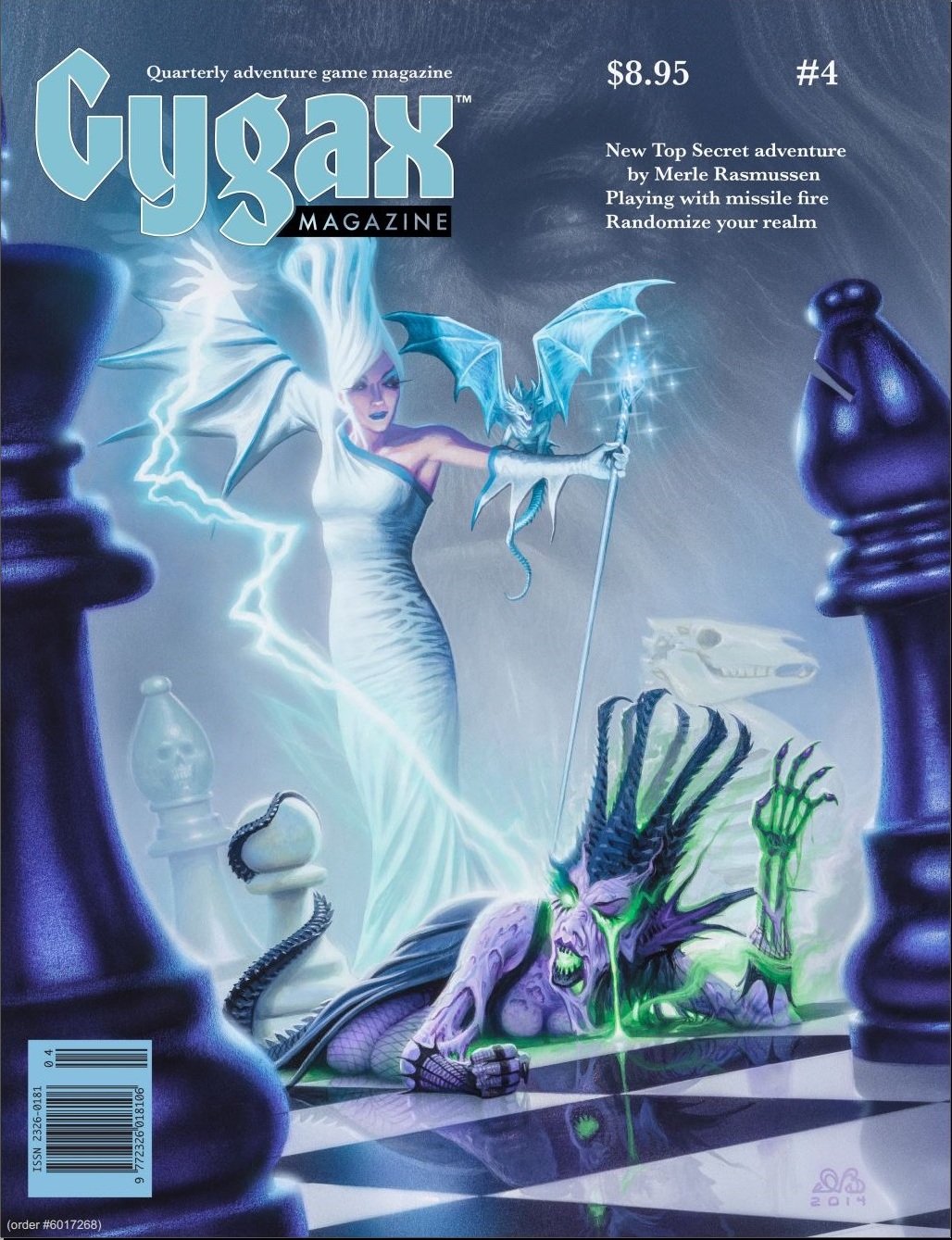
Working with artist Den Beauvais on a new Chess cover was a thrill beyond words for an old art geek like me!

It’s true, in a sense. You see, I work as the Art Director for Gygax Magazine, and as such I’m tasked with trying to recreate the artistic feel of Dragon Magazine circa 1984. So, I spend my days not only going over old art, but also trying my best to discover new talent that somehow reflects some of the best aspects of the OSR.

Certainly, there have been others that have tried this type of nostalgia-based marketing. Goodman Games comes to mind with their initial line of Dungeon Crawl Classics, and the same could be said for Rob Kuntz and his Pied Piper Press in the mid-2000s.

Still, it isn’t as easy as it sounds. You can’t simply plug in old artists and make everything perfect. Talents evolve, and in some cases erode, and working with established artists who have trademark styles sometimes limits your ability to direct them inside a product.  Egos must be taken into account, as well as their vision versus yours, and finally how a price point that satisfies everyone can be achieved.

It can be a position of highs and lows, and I’ve had some great successes as well as failures along the way, but never once did I say ‘this just isn’t worth it.’

Why?  Because I love the art.  I love the artists, and having gone so deep into their world, I understand all too well the struggles they face on a daily basis. Each time I get the opportunity to pick up a phone, call an artist, and offer them work is what gives my job meaning.

Gygax provides this incredible vehicle to do just that, and when you finally get to hold the magazine in your hands, feel it just like you did that Dragon Magazine when you were in your teens, you understand just how special it really is.

Read More Read More

On the Road to Khurdisan: Brak the Barbarian by John Jakes

On the Road to Khurdisan: Brak the Barbarian by John Jakes

oie_2702648M0L78hhBFor people of a certain age (the pushing-fifty crowd) John Jakes is probably best known for The Kent Family Chronicles, his massive series of massive books about American history and the mini-series made from the first one, The Bastard. Hearing that title said out loud on TV was a pretty shocking thing for us kids back in 1978.

It wasn’t until I was a little older that I discovered John Jakes had started his career as a real journeyman pulp writer. While working in advertising, he wrote science fiction, westerns, mystery, and horror stories for all the major genre magazines. His name appears on the contents page of Fantastic Adventures and Amazing Stories, as well as Tales of the Frightened (easily one of my favorite titles for anything ever).

While Robert E. Howard had created the basic template for swords & sorcery back in the 1930s, it wasn’t until several decades later that the genre really exploded. Fritz Leiber and Sprague de Camp labored throughout the 50s, but it’s in the early 60s that S&S really takes off. Suddenly, Lin Carter’s writing his Howard/Edgar Rice Burroughs mashups, Michael Moorcock’s inverting and mocking many of the field’s cliches while still writing exciting tales, and Andre Norton is expanding S&S’s vison beyond the too-common male thud and blunder.

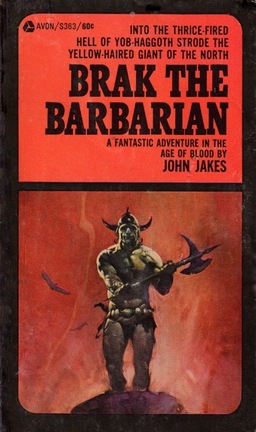
In 1963, with “Devils in the Walls” published in Fantastic, Jakes introduced his own barbarian hero, Brak. In a 1980 preface to a new editon of the first collection of stories, Brak the Barbarian (1968), he wrote:

It was in the role of dedicated Conan fan that I wrote the first Brak tale, Devils in the Walls. In spirit, anyway, the story was a Howard pastiche, and I have acknowledged the fact more than once.

Read More Read More