Browsed by
Category: Blog Entry

The Three Phases of Adam Warlock: Return from the Dead

The Three Phases of Adam Warlock: Return from the Dead

Infinity_Gauntlet_Vol_1_1_001I’ve been taking a look at Adam Warlock, one of my favorite comic characters. In previous posts, I’ve written about his early period as a failed messiah figure on Counter-Earth in the early- and mid-1970s, and then his Jim-Starlin-written tragic middle period as the cosmic champion of life, which led to his heroic death in 1977.

Today, I want to take up the thread of the Adam Warlock saga fourteen years later, when both he and the Champion of Death, Thanos, were resurrected as the core of a massive cross-over event called The Infinity Gauntlet.

This may be timely for some folk who had never read the original or reprinted Warlock runs, because Marvel movies have already teased us with a hero-sized cocoon in a Thor movie and have announced an Infinity War movie for 2018.

So, since the Infinity Gauntlet series is now 24 years old, I’m not going to issue spoiler alerts; I’ll likely just berate you for not having read this already (you can, incidentally, stop reading this post, go pick up the Infinity Gauntlet at comixology.com, and then come back when you’re done; I don’t own Marvel stock or anything, it’s just that much fun).

To remind readers where we left off, in 1977, Adam Warlock, the lonely, tragic Champion of Life, killed Thanos, the nihilistic, insane cosmic Champion of Death. Fast forward to 1991 to Infinity Gauntlet #1, and we find that quite a bit has happened. Death has been chaffing at the imbalance between Life and Death and has pulled out her greatest admirer and lover, Thanos to rectify things.

Read More Read More

Chivalry: Might is Right… Not Quite What You Think

Chivalry: Might is Right… Not Quite What You Think

Chivalry and Violence
I love writing knights because they had such a fascinatingly simple way of looking at the world.

I love writing knights because they had such a unapologetically simple way of looking at the world (first blog entry in this series here).

The knightly world view was internally consistent, but must have been infuriating to anybody with a logical turn of mind. In Swords Versus Tanks, I had fun imagining just such a conversation:

Ranulph swept his arm around the cell to indicate the corpses. “God has just shown you His will.”

“Knights!” The red-haired girl gestured at the carnage. “You think that was a trial by combat.” Her eyes narrowed. “You wear a somewhat soiled arming jacket, so it was defeat in battle which brought you to this dungeon. Was that also God’s will, Sir Ranulph?”

“I suppose that God wanted me here to save you,” said Ranulph, with a vague, familiar, feeling that he was going to regret arguing with her.

Swords Versus Tanks 1: Steel Tide (forthcoming)

In fact — if Kaeuper’s Chivalry and Violence is to be believed — real knights tended to take things further with an utterly glorious piece of reasoning:

Knight: “God granted me victory, therefore  I am more pious than the dead guy.”

Priest: “But you still need to do penance!”

Knight: “Penance, Sir Priest? Pah! Wearing armor in the field is mortification enough.”

Partly this was lazy thinking at work.

Read More Read More

When Is Fantasy Not Fantasy? Or, One Person’s Religion = Another Person’s Mythology

When Is Fantasy Not Fantasy? Or, One Person’s Religion = Another Person’s Mythology

Peters BonesI’ve always been intrigued by the appearance of the supernatural in historical fiction. When a modern writer sets a novel in the historical past, and uses elements of the supernatural, or magic, or some such item, it’s fantasy, right? Or, is it magic realism? Or is it magic realism only if the story is set in modern day South America, preferably written by a modern day South American?

Just what is magic realism, anyway? Is it more than magical thinking on the part of characters? Or a way for non-genre critics to talk about supernatural elements in books they don’t like to think contain supernatural elements?

Are Ellis Peters’ Brother Cadfael novels examples of magic realism? Or plain old fantasy, for that matter? Cadfael prays to the Welsh Saint Winifred, and she responds. Miracles happen. The authorities, in this case the Abbot of Shrewsbury, might check for fraud (was the lame boy truly lame to start with?) but no one doubts the possibility of the miraculous, and no one searches for another explanation. On the other hand, no one suggests that this is a series of crossover books. Why not?

It’s one thing for modern writers to write of historical times and include the belief systems of the people of those times. Maybe that isn’t, strictly speaking, fantasy. But what about contemporary writers, by which I mean the people writing in those times? What about that kind of “historical” fiction?

Read More Read More

Vintage Treasures: The Pocket Games of Task Force Games, Part One

Vintage Treasures: The Pocket Games of Task Force Games, Part One

Starfire Task Force Games-small Asteroid Zero-Four-small Valkenburg Castle-smaller


Three Task Force Games: Starfire (1979), Asteroid Zero-Four (1979), and Valkenburg Castle (1980)

Task Force Games, based in Amarillo, Texas, was one of the very best board game companies in the business in the 80s, especially for science fiction fans. They published the majestic Federation & Empire (and its follow-up, Federation Commander), Kings Bounty, Godsfire, Battlewagon, Armor at Kursk, Musketeers, and the RPGs Crime Fighter, Prime Directive (based on Star Trek), and the glorious Heroes of Olympus — among many, many others — before the company was sold to Might & Magic developer New World Computing in 1988, and then went out of business.

Of course, who could afford big games like that? Not me, that’s for sure. But that’s okay, because Task Force Games was also a pioneer in the microgame market, with a line of truly stellar Pocket Games, starting with Starfire in 1979. Starfire was one of the most successful microgames ever released. It sold a zillion copies, went through six different editions, and is still being sold today by Starfire Design Studio. It was so popular it eventually inspired a series of novels by David Weber and Steve White, including the New York Times bestseller The Shiva Option.

Read More Read More

Discovering Robert E. Howard: David Hardy on El Borak – The First and Last REH Hero

Discovering Robert E. Howard: David Hardy on El Borak – The First and Last REH Hero

ElBorak_EarlyToday, our ‘Discovering Robert E. Howard’ series talks about my favorite REH stories: those featuring El Borak. David Hardy wrote the introduction to the Robert E. Howard Foundation’s The Early Adventures of El Borak and he also contributed what is essentially the afterward to Del Rey’s El Borak and Other Desert Adventures.  There’s no one better suited to expound on Francis Xavier Gordon, so enough blathering from me. Let’s check out ‘The Swift.’


Francis Xavier Gordon, known from Stamboul to the China Sea as “El Borak”-the Swift-is perhaps the first of Robert E. Howard’s characters, and the last. El Borak is one of those distinctive characters that could only come from the fertile imagination of REH. He is a Texas gunslinger from El Paso, an adventurer, who has cast his lot in the deserts and mountains of Arabia and Afghanistan. There’s a little bit of John Wesley Hardin in his makeup, a bit of Lawrence of Arabia, and just a touch of Genghis Khan.

Howard described the origin of Gordon and other characters to Alvin Earl Perry: “The first character I ever created was Francis Xavier Gordon, El Borak, the hero of “The Daughter of Erlik Khan” (Top Notch), etc. I don’t remember his genesis. He came to life in my mind when I was about ten years old.”

That would put El Borak’s origins about 1915, the year Rafael Sabatini’s pirate novel The Sea Hawk appeared. The titular Sea Hawk is an Englishman who joins the corsairs of the Barbary Coast. There is also a supporting character named El Borak. Howard also noted that Bran Mak Morn, hero of “Worms of the Earth,” bore a resemblance to El Borak.

Read More Read More

The Public Life of Sherlock Holmes: What to Write About?

The Public Life of Sherlock Holmes: What to Write About?

The itsy-bitsy spider, went up the water spout...
The itsy-bitsy spider, went up the water spout…

For the past 76 Monday mornings, The Public Life of Sherlock Holmes has appeared here at Black Gate. I’ve written a couple other posts, but this column is why they keep me around. Well, that and I work for free.

Most of my posts involve (a little or a lot of) re-reading. Which means that more often than I would like, what I want to post on a particular Monday isn’t ready to go. For example, I’ve read ten books and watched one tv pilot for a post on Erle Stanley Gardner’s ‘Cool and Lam’ private eye books (fantastic stuff). And I still need to read more.

And I’ve listened to at least six dozen radio shows for posts on Yours Truly, Johnny Dollar, The Fat Man and Box 13: with more listening to go. So, for this week’s post, I thought I’d talk about some of the subjects that I have started digging into, but which I’m not ready to tackle yet:

Sherlock Holmes A to Z – A post that’s going to include at least one recommended author, movie or book title for every letter of the alphabet (this is a fun one).

Read More Read More

Dear Conservatives: Don’t Let the Door Hit You On the Way Out

Dear Conservatives: Don’t Let the Door Hit You On the Way Out

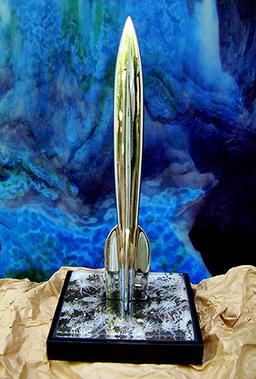
Loncon 3 Hugo statue-smallThe results of the 2015 Hugo balloting are in. The results are a clear statement to conservatives: you’re not welcome in true SF fandom as long as you bitterly cling to your ideals.

When I read io9’s liveblog of the results this morning, I was dismayed, but not the tiniest bit surprised, to see NO AWARD after NO AWARD, all to the accompaniment of raucous cheering and Charlie Jane Anders’s gloating. This is exactly what I predicted after reading the clamor here at Black Gate and elsewhere on the net, and the surging tide of people saying “Vote NO AWARD on everything! Let’s show the Puppies they can’t get away with it!”

In the editor categories, as well as some of the others, there were plenty of nominees who have won Hugo awards in the past, and are considered at the top of their field. All went down beneath the NO AWARD tidal wave.

After the readers’ packets were distributed, there were comments to the effect “Eh, all these works are crap, anyway.” John O’Neill’s post this morning here at Black Gate reiterated this view after the results were announced: “Dear Puppies: Your Taste Sucks.”

There’s also comment from editors and the like around the net about how they read the works and found them worthy not of being tossed lightly aside, but rather hurled with great force.

So which is it? Is it a vote against slate tactics, or is it a vote against the specific works nominated?

Read More Read More

The Great Serialization Experiment: Attack on Multiple Fronts!

The Great Serialization Experiment: Attack on Multiple Fronts!

As mentioned last time, serializing has its challenges and potential successes, JUST LIKE ANY WORTHWHILE BATTLE!

Plus: Strike a Pose.

Different Attack Plans:

  • POWER RANGERS MORPHING TIME: You can serialize a novel in several chunks, which can then be put together into one giant destructo-omnibus, like I did with Nigh.
  • D&D MIGHTY PARTY: You can serialize a universe in several stand-alone projects that are all linked to one another.
  • FRANKENSTEINING: You can also serialize a book one chapter at a time, with or without a subscription service or a social media platform such as Wattpad.

My first serialization was done à la Frankenstein with an existing book, Destiny’s Blood, on Wattpad. There are two other books in the series, so the hope was that readers would either get impatient and buy Destiny’s Blood before I was done posting it, or they’d at least buy the other two novels.  Linda Poitevin, author of the Grigori Legacy series, had lots of success on Wattpad. Check out her details on the subject.

Nigh was serialized differently, à la Power Rangers Morphing Time, with the whole novel published in five parts (you don’t *need* five parts to morph together, but if it worked for the Power Rangers and Voltron, you obviously can’t go wrong).

Read More Read More

Chivalry: Not Really About Opening Doors (and Still Quite a Useful Coping Strategy)

Chivalry: Not Really About Opening Doors (and Still Quite a Useful Coping Strategy)

800px-Boys_King_Arthur_-_N._C._Wyeth_-_p38
He can’t give the lady her favor and spare the other man. What’s he going to do?

So, Lancelot is fighting this knight who insulted him. A few blows in and the rude fellow is on his knees: “Mercy, Sir Lancelot!”

Sir Lancelot stays his hand. He always grants mercy when asked.

However, before he can help the other chap to his feet,  a lady rides up. “Lancelot! I beg you a favor.”

“OK…,” says Lancelot. He also always grants favors to damsels.

“Give me that knight’s head! He slew my sister.”

Lancelot frowns. Now he’s caught between two imperatives.

He can’t give the lady her favor and spare the other man.

What’s he going to do?

Read More Read More

Galaxy Science Fiction, November 1952: A Retro-Review

Galaxy Science Fiction, November 1952: A Retro-Review

Galaxy November 1952-smallThe November 1952 issue of Galaxy Science Fiction features cover art by Jack Coggins of an Earth satellite. This satellite is more like a space station than satellites I typically think of. But considering that the first artificial satellite (Sputnik 1) wasn’t launched until about five years after this issue hit newsstands, everything was still left to the imagination at this point.

Before I jump to the fiction, I want to comment on Willy Ley’s “For Your Information.” In part of the column, he discusses Mars and its vegetation. I thought that was rather odd or presumptuous for him, but at this time, scientists were observing coloration on the planet’s surface that changed seasonally. That coloration plausibly suggested vegetation, and if there’s vegetation, what other life might be there? Then Mariner 4 did a fly-by in 1965, showing reality. Additional Mariner spacecraft confirmed more of the same — that Mars was a dead planet.

I wonder how many people were crushed by this, including authors of science fiction. There might have been some who feared Martians coming to destroy us and felt relief. But I also think that the possibility of life on Mars offered a kind of hope to some — that humanity wasn’t completely alone. With the truth of Mars revealed, that hope had to extend beyond the neighboring red planet. It will be interesting to see how science fact continues to influence science fiction, not necessarily by devestating our hopes and dreams but by helping to reshape them into new possibilities. And even without life on Mars, the planet still has an allure to it — a vacant planet that beckons to be explored and perhaps settled.

“The Martian Way” by Isaac Asimov — Mario Rioz and Ted Long work together on a small ship near Mars, tracking and scavenging the abandoned shells of Earth spacecraft. These jettisoned pieces are essentially rocket stages cast off as part of the flight, and they contain metal the humans on Mars can reuse.

A rising politician on Earth named Hilder points out that Mars doesn’t reimburse Earth for the shells, and the monetary investments will take many years to return. But worse than that, Mars can never replenish the water it takes from Earth to propel its ships. As Hilder’s voice gains more attention, other politicians begin mimicking him, which leads to new policies that prevent the scavenging of shells.

Read More Read More