Browsed by
Category: BG Staff

Locus Online Reviews Black Gate 15

Locus Online Reviews Black Gate 15

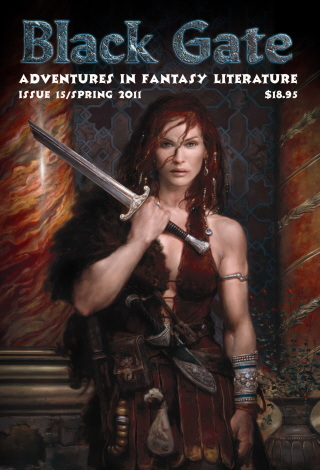
bg-15-cover2Lois Tilton at Locus Online is one of the most diligent short fiction reviewers in the industry, and she’s been a friend and frequent champion of Black Gate for years. She’s the first to check in with a complete (and I do mean complete) review of our latest issue, although as usual she’s cranky about our fondness for series fiction:

I found much to praise in the last issue, and particularly the absence of the usual series stories. Possibly just to vex me, this time the zine has at least four new series and more sequels.

She had many kind words for the issue, including this about Jonathan L. Howard’s “The Shuttered Temple”:

Kyth the Taker… has taken a commission from the priesthood of Prytha to enter the Shuttered Temple, originally built years ago by an emperor whose power was being eroded by the Prythians. No one has yet survived the attempt… What Kyth is, besides broke, is apt at recognizing a trap when she sees it.

This one features the protagonist from one of the most enjoyable tales I’ve read in this zine, and the current story shares the same qualities of cleverness and ingenuity, with a light, engaging narrative.

–RECOMMENDED

We’re fans of sequels and series, of course, because truly great characters and stories aren’t always recognized immediately. Sometimes it takes a few installments for rich, complex fantasy to really find its audience.

Case in point: it’s great to see that Lois now considers the first Kyth story, “The Beautiful Corridor” (BG 13), “one of the most enjoyable tales I’ve read in this zine.” Especially since she dismissed it with faint praise in her original review, giving a “Recommended” label to the tale that followed it instead. It’s frequently only in retrospect that rich fiction truly reveals itself, and the best way we know to keep exciting characters fresh in your mind  is to present them to you as often as we can.

And that’s why we publish sequels. I’m glad it’s working.

WISCON FRIDAY: In Which the Pre-Raphaelite Sisterhood Crashes A Zeppelin Into the State Capital

WISCON FRIDAY: In Which the Pre-Raphaelite Sisterhood Crashes A Zeppelin Into the State Capital

The Harold Lamb Comes to East Dundee

It was a partly cloudy day in East Dundee, IL.

There we were, three youngish women, frolicking in the flower garden, drinking tea and entertaining toddlers, when all of a sudden, a shadow moved over the sun.

It was Black Gate’s zeppelin, the Harold Lamb, on the descent.

“Ef!” Ms. Templeton twirled her stealth parasol in alarm. “The Gee-Dee thing’s coming down on the roof!”

“Not my roof!” Ms. Redding shouted, a baby on one stylishly jutted hip and a chaenomeles speciosa (a nasty and ubiquitous shrubbery, recently uprooted by dint of chain and pickup truck from her front garden) brandished high in her free arm.

For myself, I was convinced Ms. Redding was set to hurl the shrub (or, at the very least, the baby) at the Harold Lamb in an effort to knock it off its fatal course. Thankfully, at the last moment, the zeppelin veered, mooring itself between two surviving elms. A rope ladder unfurled. A familiar voice over the loudspeaker boomed down:

“Will the Pre-Raphaelite Sisterhood please climb aboard?”

Read More Read More

Why Do You Like to Write? The Story of Janelle

Why Do You Like to Write? The Story of Janelle

mead-notebooksWriters of the Future Volume XXVII is now available for pre-order from Amazon. That any book with my work in it is available on Amazon blows my mind.

Anyway . . . this week I started writing some more observations on my experience at the Writers of the Future Workshop, but somehow got sidetracked into the rest of what you’re going to read. So I’m delaying more WotF until next week.

“Why did you become a writer?” or “Why do you like to write?” These are variants of the same question — one that most writers, whether career authors, part-timers, or hobbyists, encounter many times. The simplest questions are the trickiest to answer, as the Tao Te Ching points out: “Straightforward words sometimes seem paradoxical.”

Here are my straightforward words to answer both these questions: I enjoy telling stories by using words in interesting ways.

Now, to confuse the issue and make it paradoxical, allow me to tell you about a girl named Janelle.

Read More Read More

Self-Publishing: What I’m Doing, and Why

Self-Publishing: What I’m Doing, and Why

The Fell Gard CodicesThere’s been a lot of talk around the blogosphere lately about self-publishing, and its merits relative to traditional publishing. I’m not going to say anything about that, as such. But it seems obvious to me that self-publishing has a value if you have a story that could not, due to the nature of its form, be published traditionally.

Which brings me to an announcement: I’m beginning a self-publishing venture of my own, The Fell Gard Codices. It’s an ongoing fantasy serial, and the first chapter goes live Wednesday, June 1. The web site’s already up, at Fellgard.com. I’ll be posting chapters every day for six days, and after that putting up three chapters a week, on Mondays, Wednesdays, and Fridays. The serial is free through the web site, though readers can donate through PayPal, if they’re so inclined; and once I have enough material, I’ll be selling collections as ebooks.

So, given how I started this post, the questions become: why am I doing this? What is it about this story that makes this approach seem like a good idea?

Read More Read More

Writers of the Future: I Got an Illustration . . . and an Interpretive Dance!

Writers of the Future: I Got an Illustration . . . and an Interpretive Dance!

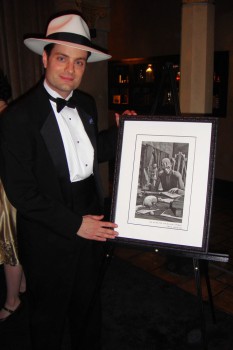
with-framed-acolyte-illustration1chelsea-as-hallett-1I have returned after a two-week hiatus from Black Gate. It was a — busy time.

To get this out of the way first: Yes, I gave a shout out to Black Gate in general, with John O’Neill, Howard Andrew Jones, and Bill Ward in particular, when I accepted my award at the Writers of the Future Ceremony on 15 May 2011 at the Hollywood Roosevelt Hotel. (Here is the video of my section of the event, starting with the dance.)

When I started to write with the aim of publication — I don’t remember the exact moment when my love of writing began to seem like a possible profession, but it occurred about fifteen years ago — I liked to imagine a time when a professional artist would make an illustration of one of my books or stories. However, I never imagined that professional acrobats and dancers would create an interpretive dance of one of my stories as well.

I received many great gifts from my time at the Writers and Illustrators of the Future Workshop in Hollywood last week. Some are the tangibles like publication in a major anthology, a gala awards ceremony, my first official book signing, and payment. Some gifts are social, like a new network with the other winners as well as with the many celebrated writers and illustrators who make up the judging panel and the workshop teachers. All of us at the workshop will carry away a lifetime’s worth of advice, on everything from story construction to the best way to avoid getting a cold while on a book-promotion tour, from people such as Tim Powers, Robert J. Sawyer, Gregory Benford, K. D. Wentworth, Eric Flint, Dr. Yoji Kondo, Kristine Kathryn Rusch, Nina Kiriki Hoffman, Kevin J. Anderson, Dave Wolverton, Rebecca Moesta, and Mike Resnick.

There’s plenty for me to say about the experience of the workshop and getting published in Writers of the Future Vol. XXVII, and I will say more in future posts. But for this post, I am going to delve into the purely emotional and personal high points: the picture, and the dance. The first I knew was coming — and it was better than I could have imagined. The second I did not expect — and no surprise could have been more sublime.

Read More Read More

Saladin Ahmed on Black Gate

Saladin Ahmed on Black Gate

saladin-ahmedOver at Pat’s Fantasy Hotlist, guest blogger Saladin Ahmed had this to say about the modern landscape for heroic fantasy:

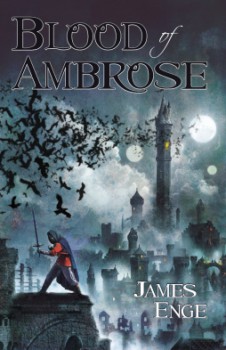
In recent years I’ve also discovered that there is a wealth of short-form heroic fantasy out there… Anthologies like the excellent Swords and Dark Magic feature some of the top names in the field (Erikson, Lynch, Abercrombie, Moorcock, Nix, Cook). And writers like Peter V. Brett have produced collections of short works set in their bestselling worlds (The Great Bazaar and Other Stories, Brayan’s Gold). But there are also some great short story ezines out there publishing the next generation of heroic fantasy writers: Heroic Fantasy Quarterly has made it their mission to bring back the pulp era with unabashedly larger-than-life adventures. Black Gate (the magazine where James Enge’s awesome Morlock Ambrosius got his start) is also working hard to revive the sense of wonder that heroes like Conan and John Carter of Mars used to evoke in readers. And Beneath Ceaseless Skies specializes in what the editor calls ‘literary adventure fantasy’ – stories that combine excellent prose and psychological depth with fantasy elements like alchemists, samurai, werewolves, and talking swords.

Thanks for the shout-out, Saladin! For our part we’re looking forward to your upcoming novel, Throne of the Crescent Moon.

Larry Tritten, 1939 – 2011

Larry Tritten, 1939 – 2011

black_gate_9-2771Black Gate lost one of its own last month with the passing of noted short story writer Larry Tritten.

Larry began his lengthy career in 1968 with the story “West is West,” in Worlds of If magazine. He appeared in dozens of magazines such as The New YorkerFantasy and Science FictionAsimov’sTwilight Zone, and many others. In 2005 his story “It’s a Wonderful Con,” featuring a man who cons Santa Claus out of $200, appeared in Black Gate 9.

As much as I enjoyed his fiction, I was even more charmed with Larry’s letters, which related fascinating details of a writing life. I got his permission to include a few of those anecdotes in a sidebar that accompanied the story, and got more mail about that than about his fiction. The sidebar read, in part:

I was in the Mammoth Book of Future Cops a while back, with a Chandler parody set in future San Francisco, and not long ago I was the lone male (heterosexual) writer in the British anthology Va-Va-Voom – Red Hot Lesbian Erotica.  Just me and 32 Lesbian writers. I try to cover all territories.  Had a piece in Minnesota Parent a while back, though I am not a parent and have never been to Minnesota (except to change planes).  Had one in Range (but am not a cattle grower).  And so on.

The count is about 1500 pieces since the sixties, so I’ve had time to get around.  I’m probably one of the few writers to have published in both Hustler and The New Yorker.  I’m often astonishing younger writers with memories of the those early days.  For example, in December 1978 I made four or five sales (one to The New Yorker for, I think, about $1250), and the money added up to close to $5,000.  I was living in an apartment where the rent was $185 per month.  Rent for two years!  Hard to believe such times ever existed.  Today my rent and bills are about ten times what they were then, and just the next month’s rent always looms like the sword of Damocles.

F&SF editor Gordon van Gelder wrote:

He was a smart, talented, and funny writer. He was also the sort of professional writer that seems to be disappearing, the kind of professional who never met a market he didn’t like and had the versatility to tailor almost any work to meet the needs of any market.

He contributed a lot of funny stuff to F&SF over the years.

Larry died in April, 2011. A more complete obituary appears in the May issue of Locus.

On NPR: Howard Andrew Jones on Pulp Fiction

On NPR: Howard Andrew Jones on Pulp Fiction

pulp-cover---planet-stories-summer-1946-lorelei-of-the-red-mists-1Black Gate Managing Editor Howard Andrew Jones had his turn in the national spotlight last week, with a feature article on National Public Radio’s website titled Rich Tales In Cheap Print: Three Pulp Fiction Finds.

Howard used his fifteen minutes of fame to shine a spotlight on neglected pulp masters:

The pulps have a well-earned reputation for purple prose, but there was gold among the dross.

Fine adventure stories from other genres were printed in pulps like Adventure, Weird Tales and Planet Stories, but unfortunately, many of these authors remain neglected or marginalized. Today’s readers might expect to find nothing but legions of square-jawed heroes, wilting damsels and tentacled monsters in the old magazines, but there were also skilled, inventive writers plying their trade, evoking thrills and chills without formulaic plotting.

Howard calls out three modern reprints of some of the very best fantasy from the pulp era, returned to print by publishers who have worked hard to preserve pulp fiction and present it to a modern audience:

  1. Lorelei Of The Red Mist, Leigh Brackett (Haffner Press)
  2. Who Fears The Devil, Manly Wade Wellman (Paizo Publishing)
  3. The Best Of Robert E. Howard Volume 2: Grim Lands, Robert E. Howard (Del Rey)

All these publishers deserve your support — and you deserve to read these stories. As Howard says in his final line, “Some of the tales are dark, many are brooding, but though they be decades old, each beguiles with a siren call to strange lands to witness heroic deeds.”

Read the complete article here.

Adventures Fantastic Salutes Bud Webster and Tom Reamy

Adventures Fantastic Salutes Bud Webster and Tom Reamy

san-diego-lightfoot1We’re receiving reports as Black Gate 15 arrives in mailboxes around the globe. We’ll update you here as we collect feedback and reviews on the issue and its contents.

One of the first to check in was Keith West at Adventures Fantastic, who has written an open letter to Bud Webster in response to Bud’s column on Tom Reamy, the acclaimed fan and short story writer who died in 1977:

Dear Bud,

I wanted to let you know how much I appreciated your profiling Tom Reamy in your inaugural installment of “Who?!” in the new issue of Black Gate. I’ve enjoyed your “Past Masters” columns for years. You have a tendency to profile most of my favorite writers from my teenage years. I assume you know which ones to pick because you have exemplary taste. I was especially pleased that you chose Tom Reamy. He is an author who is sadly neglected, and I wish someone would bring him back into print in an archival edition…

Somewhere, and I don’t recall where, I found a hardcover of San Diego Lightfoot Sue. At the time I was (and still am) an aspiring writer with a fondness for short fiction… In his Afterward, Howard Waldrop writes about the gas station the Reamys operated on the highway between Breckenridge and Woodson. As soon as I read about it, I knew exactly the gas station Howard was talking about. It sat in a curve in the road just inside the county line.

The gas station is gone now, but the house is still standing. That’s it in the photo on the right. I’d read on the Black Gate blog that you were going to write about Tom and I took the picture when I was visiting my parents in Breckenridge last Christmas.

Job well done, Keith. A nice piece of investigative reporting. Thanks for the touching tribute of your own. Hope you enjoy the rest of the issue as much as Bud’s column.

You can see Keith’s complete letter (and photos) here.

A Review of City of Bones by Martha Wells

A Review of City of Bones by Martha Wells

city-of-bonesCity of Bones by Martha Wells
Tor Books (383 pages, hardcover, June 1995)

It’s always fun to find a fantasy book that isn’t based on medieval Europe. City of Bones, by Martha Wells, is advertised as a story which draws on the Arabian Nights, and it does not have genies and magic lamps, but certainly brave thieves and dangerous deserts. It also contains a little bit of steampunk and a post-apocalyptic element.

Our hero Khat is a relic dealer, which is to say, a shady and unlicensed archeologist-for-profit. It seems that long ago, the world was wetter and cooler and more hospitable, and artifacts from that time have great value — not to mention, very occasionally, magic powers. Now, most of the world is covered by a rocky desert called the Waste. Khat is a krisman, a hardy marsupial humanoid who is well-adapted to the Waste, but reviled in most cities. Charisat, where he lives, may be one of the richest trading cities in the world, but it’s a cruel and hierarchical place.

Khat and most of the people he knows are noncitizens, and they take it for granted that they have very few rights. They aren’t even permitted to use “real” money, just tokens that serve the same purpose. Khat and his associates are very careful never to speak of buying artifacts; they barter for them. Even using the word “buying” could bring the Trade Inspectors down on them, and if the Trade Inspectors take them away, they won’t be coming back.

This tension between the powerful and the powerless is one of the driving forces of the story. When Khat is hired by a Patrician to help explore a nearby ruin, he takes it as read that he’ll probably be betrayed. It only becomes worse when he realizes that the Patrician is actually a Warder, a law enforcer who uses sanity-destroying magic. Khat becomes more and more involved in events, but he never entirely trusts any of his companions, even fellow relic dealer Sagai, his long-time partner. His paranoia is at least partly justified.

Read More Read More