Browsed by
Author: Steven H Silver

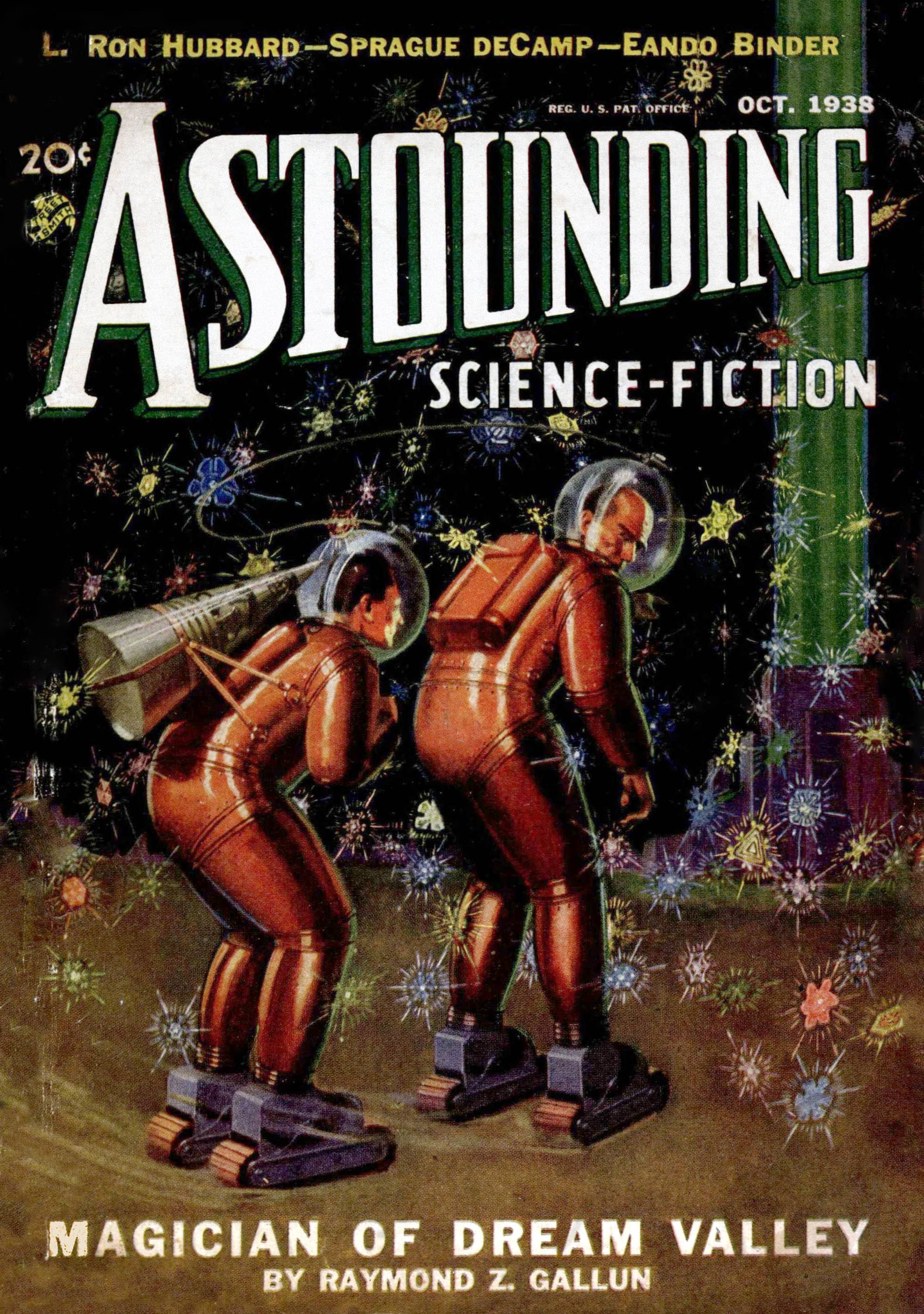
Birthday Reviews: Wyman Guin’s “Trigger Tide”

Birthday Reviews: Wyman Guin’s “Trigger Tide”

Cover by Ed Cartier
Cover by Ed Cartier

Wyman Guin was born on March 1, 1915 and died on February 19, 1989. Guin only published seven stories and one novel, The Standing Joy during his career. His most famous stories may have been “Beyond Bedlam” and “Volpla,” the latter of which was adapted for the radio show X Minus 1 in August 1957. Guin was declared the winner of the Cordwainer Smith Rediscovery Award in 2013.

Guin’s first story was “Trigger Tide.” When it was first published in Astounding in October 1950, edited by John W. Campbell Jr., it appeared under the pseudonym Norman Menasco, although Guin reverted to his own name for his second story, “Beyond Bedlam.”

The story was reprinted by Groff Conklin in Omnibus of Science Fiction and was included in his collection Living Way Out (a.k.a. Beyond Bedlam). It was again reprinted in The World Turned Upside Down, edited by Eric Flint, David Drake, and Jim Baen.

Guin’s story is about an agent on a distant planet who is trying to assassinate a fascist leader, a task assigned to earlier agents who have failed. When the story opens, he is lying, beaten, on a shelf of quartzcar near the beach and must try to get away from the shore before the tide comes in.

The setting is the most intriguing part of the story. The world is made up of archipelagos of quartzcar. The crystalline structure of the material means that any landmass above the water line is a series of shelves. In addition, the five moons orbiting the planet caused a wide variation of tides. Furthermore, the tides wreaked havoc with the piezoelectrical currents inherent in the quartz.

The impact of this strange situation is felt at the climax of the story, which doesn’t feel like a deus ex machina only because the story feels like it is a set up to exploit the strange parameters of the world.

Read More Read More

Birthday Reviews: Tim Powers’s “Through and Through”

Birthday Reviews: Tim Powers’s “Through and Through”

Cover by Phil Parks
Cover by Phil Parks

While 2018 isn’t a leap year, that doesn’t stop us from celebrating authors with that very particular birthday.

Tim Powers was born on February 29, 1952. Other authors who were born on leap day include Patricia McKillip, Howard Tayler, and Sharon Webb. Powers has frequently collaborated with James P. Blaylock, occasionally using the joint pseudonym William Ashbless, which is not only a pseudonym, but a poet both authors have referred to in their works.

Powers has won the Philip K. Dick Award for his novels The Anubis Gates and Dinner at Deviant’s Palace. His novels Last Call and Declare have won the World Fantasy Award for Best Novel and he won the Collection award for The Bible Repairman and Other Stories. Anubis Gates also won the Prix Apollo and Geffen Award, Declare earned Powers an International Horror Guild Award, and The Stress of Her Regard won a Mythopoeic Award and Ignotus Award. A translation of the story “A Soul in a Bottle” won the Xatafi-Cyberdark Award. In 2014, LASFS recognized Powers with the Forry Award.

In 2003, Subterranean Press published an anthology by Tim Powers and James P. Blaylock called The Devils in the Details, which contained a story by each author and a collaborative effort. Powers contributed “Through and Through.” The story was included in his collection Strange Itineraries and again in Down and Out in Purgatory: The Collected Stories of Tim Powers.

“Through and Through” tells the tale of a priest doing a stint in the Confessional shortly after a woman committed suicide in his church. He had received her confession, but was unable to give her absolution. A week after her funeral, she returns to receive the penance he refused her the first time.

In other hands, the priest might have suffered from a crisis of faith, however Powers priest is grounded in the secular world, while easily accepting that the woman’s ghost can be in the confession. At the same time, he is trying to balance the changes that have been introduced to the traditional priesthood and sacraments he embraces, and those the Church is currently promoting.

Read More Read More

Birthday Reviews: February Index

Birthday Reviews: February Index

Galactic-Empires-Dozois New Dimensions 2 Asimovs-Science-Fiction-April-May-2007-small

January index

At the one sixth mark in our journey through the year, here’s a look back at the birthday reviews that appeared at Black Gate in February.

February 1, Yevgeny Zamyatin: “The Cave
February 2, Selina Rosen: “Food Quart
February 3, Alex Bledsoe: “Shall We Gather
February 4, Neal Asher: “Owner Space
February 5, Joseph H. Delaney: “Survival Course
February 6, Eric Flint: “Portraits
February 7, Karen Joy Fowler: “Always
February 8, Mary Robinette Kowal: “Just Right

Read More Read More

Birthday Reviews: Stephen Goldin’s “The Last Ghost”

Birthday Reviews: Stephen Goldin’s “The Last Ghost”

Protostars-small Protostars-back-small

Cover by Gene Szafran

Stephen Goldin was born on February 28, 1947. Prior to becoming a science fiction author, Goldin earned a degree in astronomy and worked as a civilian space scientist for the US Navy.

Beginning in 1976, Goldin wrote the Family d’Alembert novels, based on a novella by E.E. “Doc” Smith. He followed that series up with the Parsina Saga and wrote the two volume Rehumanization of Jade Darcy series in collaboration with his second wife, Mary Mason.

He co-edited the anthology Protostars with David Gerrold and edited the anthology The Alien Condition solo. Goldin also collaborated with his first wife, Kathleen Sky, on both fiction and non-fiction. He received a Nebula nomination for his short story “The Last Ghost” in 1972.

“The Last Ghost” originally appeared in the 1971 anthology Protostars, edited by David Gerrold and Stephen Goldin. Lloyd Biggle, Jr. reprinted it in Nebula Award Stories Seven. Goldin included it in two of his collections, The Last Ghost and Other Stories and Ghosts, Girls, & Other Phantasms. It has been translated into French twice and German twice.

Goldin looks at a distant future in which immorality of a sort has been achieved by downloading people’s consciousness into machines. His two characters, which he arbitrarily designates as male and female, have both been downloaded into a computer for several thousand years.

Read More Read More

Birthday Reviews: Michael A. Burstein’s “Reality Check”

Birthday Reviews: Michael A. Burstein’s “Reality Check”

Cover by Kim Poor
Cover by Kim Poor

Michael A. Burstein was born on February 27, 1970. Burstein is an Orthodox Jew and many of his stories are informed by this background, from the main character of “Reality Check” to the entire story “Kaddish for the Last Survivor.”

Much of his short fiction is gathered in the collection I Remember the Future: The Award-Nominated Stories of Michael A. Burstein. His debut story “TeleAbsence” won the Analog Readers Poll and the Science Fiction Chronicle Readers Poll. His later novella “Sanctuary,” also won the Anlab poll. Burstein won the John W. Campbell Award for Best New Writer in 1997.

“Reality Check” was first published in Analog’s November 1999 issue, purchased by Stanley Schmidt. It was reprinted in Burstein’s collection I Remember the Future and was nominated for the Nebula Award for Best Novella and shortlisted for the Theodore Sturgeon Award.

Michael Burstein’s four linked stories, “Broken Symmetry,” “Absent Friends,” “Reality Check,” and “Empty Spaces,” deal with parallel universes linked together through a Superconducting Supercollider. Although “Reality Check” is the third in the sequence and refers to the subject of “Absent Friends,” it requires no knowledge of the previous story to enjoy it (although the four appear sequentially in I Remember the Future).

David Strock is a theoretical physicist specializing in low energy research. When one of his papers gains the attention of a government facility in Texas, he is invited to see the classified work they are doing. Despite his better judgment, and the desires of his wife, he visits them and decides to take a temporary appointment to work on the secret project, offering him the chance to collaborate with another universe. Strock tries to balance his research and time in Texas with his home life in Boston, although the strife in Boston seems to be worse than Burstein shows.

When Strock meets a woman who reveals that he has a near doppelganger on the other side, his interest is further piqued in the project, although he tries to point out to her that he is not the person she has heard about from the other universe. In the end, Burstein successfully ties together disparate scenes of Strock’s home-life, his lunches at MIT with a graduate student, his doppelganger, and the research he was conducting.

Read More Read More

Birthday Reviews: Theodore Sturgeon’s “The Girl Had Guts”

Birthday Reviews: Theodore Sturgeon’s “The Girl Had Guts”

Venture Science Fiction January 1957-small Venture Science Fiction January 1957-back-small

Cover by Ed Emshwiller

Theodore Sturgeon was born on February 26, 1918 (Happy Centennial Theodore!) and died on May 8, 1985. Sturgeon won the Hugo and Nebula Awards for his story “Slow Sculpture,” possibly the only time a story has won the Novelette Nebula and the Short Story Hugo.

His novel More Than Human received the International Fantasy Award. A translation of “And Now the News…” received a Seiun Award while “The World Well Lost” received a Gaylactic Spectrum Hall of Fame Award. Sturgeon himself received the Forry Award from LASFS in 1971 and a Life Achievement World Fantasy Award shortly after his death. In 2000 he was inducted into the Science Fiction Hall of Fame. He’s remembered today mostly for his short stories, including “Killdozer,” “A Saucer of Loneliness,” and “If All Men Were Brothers, Would You Let One Marry Your Sister,” but he also wrote the novels More Than Human, Venus Plus X, and The Dreaming Jewels. Kurt Vonnegut’s recurring character Kilgore Trout is believed to have been named for him.

Sturgeon wrote the classic Star Trek episode “Amok Time,” which introduced the Vulcan salute and the phrase “Live long and prosper.” His short fiction has been collected into a thirteen volume set by North Atlantic Press. The Theodore Sturgeon Memorial Award, presented annually for short stories by the Gunn Center at the University of Kansas, is named in his honor.

Read More Read More

Birthday Reviews: A.M. Dellamonica’s “A Key to the Illuminated Heretic”

Birthday Reviews: A.M. Dellamonica’s “A Key to the Illuminated Heretic”

Cover by Jeff Easley

A.M. (Alyxandra Margaret) Dellamonica was born on February 25, 1968. She began publishing short fiction in 1994 and published her first novel, Indigo Springs, the first novel in a duology, in 2009.

From 2014-2016, she published the Hidden Sea trilogy, beginning with Child of a Hidden Sea and continuing with A Daughter of No Nation and The Nature of a Pirate. With Steve Berman, Dellamonica edited Heiress of Russ 2016: The Year’s Best Lesbian Speculative Fiction.

Dellamonica won the Sunburst Award for Indigo Springs and the Aurora Award for A Daughter of No Nation. She has one other Aurora nomination and has also received nominations for the Lambda Award for novel and the Gaylactic Spectrum Award for short fiction.

“A Key to the Illuminated Heretic” was original published in Alternate Generals III, edited by Harry Turtledove in 2005. It was nominated for the Sidewise Award for Alternate History. Dellamonica later published the story in an e-chapbook.

A.M. Dellamonica creates a world in which Joan of Arc is not burned at the stake on May 30, 1431, instead surviving to continue to be a thorn in the side of not only King Henry VI on England and King Charles VI of France, but also of Pope Eugene IV, continuing her battle not only for the secular realm of France, but also in support of her own heretical sect of Christianity, the Listeners, who follow Joan and believe in her visions.

While much of the story describes her military escapes in France, the focus is really on her relationship with a young artist, Dulice Aulon, and the paintings she created of important moments in Joan’s life. Descriptions of these paintings are found throughout, as if written for an exhibit catalog, and the paintings described help illuminate the action that immediately follows.

Dellamonica notes that Joan was illiterate, which serves to heighten the importance of Aulon’s paintings. They are the way Joan’s story is spread to the masses, gaining Joan adherents who are willing to fight for Joan’s visions and vision for France and support her, particularly the city of Orleans, which Joan had rescued from siege prior to Dellamonica’s point of divergence.

Read More Read More

Birthday Reviews: August Derleth’s “The Return of Hastur”

Birthday Reviews: August Derleth’s “The Return of Hastur”

Weird Tales March 1939-small Weird Tales March 1939-back-small

Cover by Virgil Finlay

August Derleth was born on February 24, 1909 and died on July 4, 1971. It was Derleth who coined the term “Cthulhu Mythos” for H.P. Lovecraft’s stories, although Derleth had earlier suggested the “Hastur Mythology,” which Lovecraft rejected.

In 1939, Derleth and Donald Wandrei founded Arkham House, a small press dedicated to preserving the writings of H.P. Lovecraft, and eventually those who were influenced by Lovecraft.

Although best known as a proponent of Lovecraft and for his own stories which expand on Lovecraft’s work, Derleth also wrote children’s books and biographies aimed at kids and detective fiction, most notable the Solar Pons series. He felt his Sac Prairie saga, which was based on Sauk City, Wisconsin, where he lived, was his most important work.

“The Return of Hastur” was purchased by Farnsworth Wright and appeared in the March 1939 issue of Weird Tales, which also included a story by Lovecraft. Derleth reprinted the story in his collection Someone in the Dark in 1941 and again in The Mask of Cthulhu in 1958. Lin Carter selected the story for The Spawn of Cthulhu and it was eventually included in Robert M. Price’s The Hastur Cycle. It was included in the Barnes and Noble collection of Derleth stories The Cthulhu Mythos and in In Lovecraft’s Shadows: The Cthulhu Mythos Stories of August Derleth, issued by Arkham House in 1998. The story has been translated into French, Italian, and German. Lovecraft is known to have read and commented on an early version.

Read More Read More

Birthday Reviews: W.E.B. Du Bois’s “Jesus Christ in Texas”

Birthday Reviews: W.E.B. Du Bois’s “Jesus Christ in Texas”

darkwater1 darkwater darkwater2

W.E.B. (William Edward Burghardt) Du Bois was born on February 23, 1868 and died on August 27, 1963. He was the first black man to earn a doctorate from Harvard University and taught history, sociology, and economics.

Du Bois helped found the National Association for the Advancement of Colored People in 1909. Most of W.E.B. Du Bois’s writings were sociological in nature, focusing on the plight of African-Americans. Throughout his career, he fought for equal rights for blacks and against lynchings and Jim Crow laws.

“Jesus Christ In Texas” was original published in Du Bois’s collection Darkwater: Voices from the Veil in 1920. It has been reprinted numerous times since.

Two of Du Bois’s stories have elements of the fantastic in them, including “Jesus in Texas.” As told in the title, this story is about a visitation of Jesus to Texas. During his brief time, he sees black prisoners used on a chain gang, the whites who are benefiting from their labor, and a prisoner who has escaped.

Read More Read More

Birthday Reviews: Joanna Russ’s “Nobody’s Home”

Birthday Reviews: Joanna Russ’s “Nobody’s Home”

New Dimensions 2-small New Dimensions 2-back-small

Cover by Ron Walotsky

Joanna Russ was born on February 22, 1937 and died on April 29, 2011. From her first publications, she became a voice for feminist science fiction in a world which was dominated, but not exclusively, by men.

As important as her science fiction, if not moreso, is her monograph How to Suppress Women’s Writing. Among her notable science fiction are the stories that make of the Alyx cycle, including Picnic on Paradise, and the novels And Chaos Died and The Female Man.

She won the Nebula Award for her short story “When It Changed” and a Hugo for the novella “Souls.” In 1996, she received two retrospective James Tiptree, Jr. Awards for “When It Changed” and for The Female Man. The Female Man was inducted into the Gaylactic Spectrum Hall of Fame. Russ received a Pilgrim Award for Lifetime Achievement for her contributions to science fiction and fantasy scholarship from the SFRA in 1988 and was inducted into the Science Fiction Hall of Fame in 2013. In 2015, Russ received the Solstice Award from the SFWA.

“Nobody’s Home” was originally printed in New Dimensions II, edited by Robert Silverberg in 1972. It was picked up the next year by Terry Carr for The Best Science Fiction of the Year #2. Pamela Sargent included it in Women of Wonder. Silverberg has reprinted it in several of his anthologies over the years, including Alpha 9, The Best of New Dimensions, Great Tales of Science Fiction, and The Arbor House Treasury of Science Fiction. Russ included it in her collection The Zanzibar Cat in 1983. David G. Hartwell reprinted it in The World Treasury of Science Fiction and Gardner Dozois reprinted it in Modern Classics of Science Fiction and Supermen. “Nobody’s Home” was translated into Spanish in 1977 and into Dutch in 1980.

Read More Read More