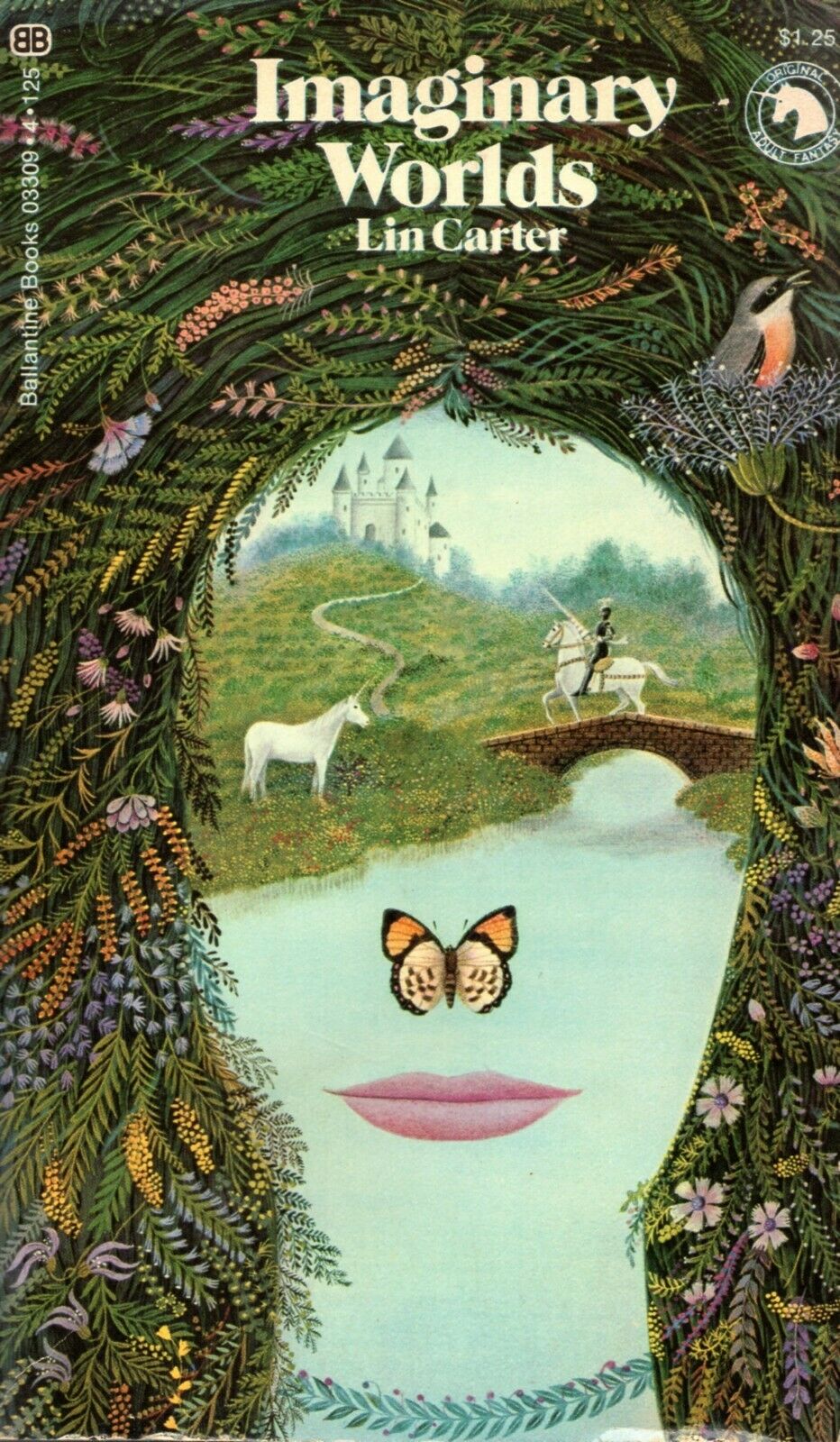
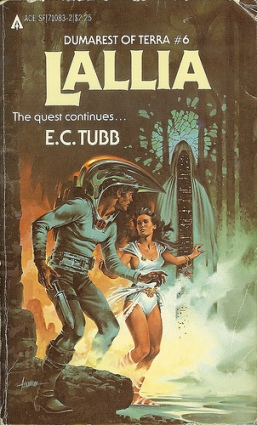
Imaginary Worlds (Ballantine Books, June 1973). Cover by Gervasio Gallardo
I’m the age Proust was when he died, and Lin Carter books are my Madeleine cake.
The covers transport me to the sunny afternoon garage sales of my teens. Picking up one — they’re tiny compared to today’s paperbacks — and riffling the yellowing pages, and I’m thirteen years old, on a hill-walking holiday in Wales, rummaging in a small town charity shop while the rain rattles the dirty glass window. And later, playing Dungeons and Dragons (AD&D was my edition!) in a stuffy teenage bedroom in a Victorian house where the hundred-year-old window slammed down and nearly took off the DM’s leg as he was smoking a roll-up while perched on the ledge…
And like the D&D games of my mid teens, Lin Carter’s books never quite lived up to the potential of the promised exoticism. In our case, we were teenagers with limited life experience. We did very well, as far as it went, and our DMs were patient and I argued too much. Lin Carter, several times married, a Korean war veteran — the Vietnam sequence that kicks off the Callisto books reads very authentically — cosmopolitan New Yorker, experienced editor, has less excuse.
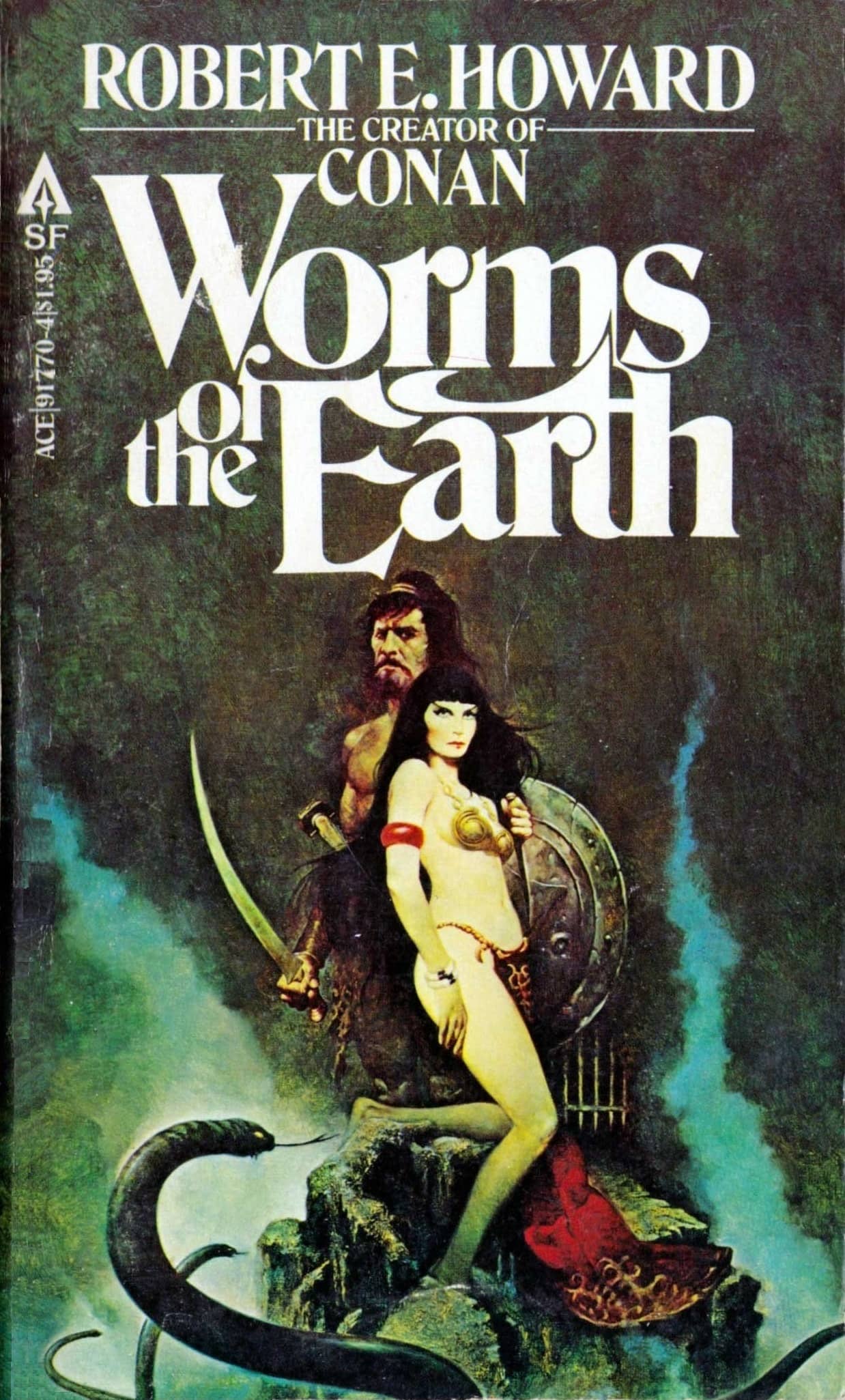
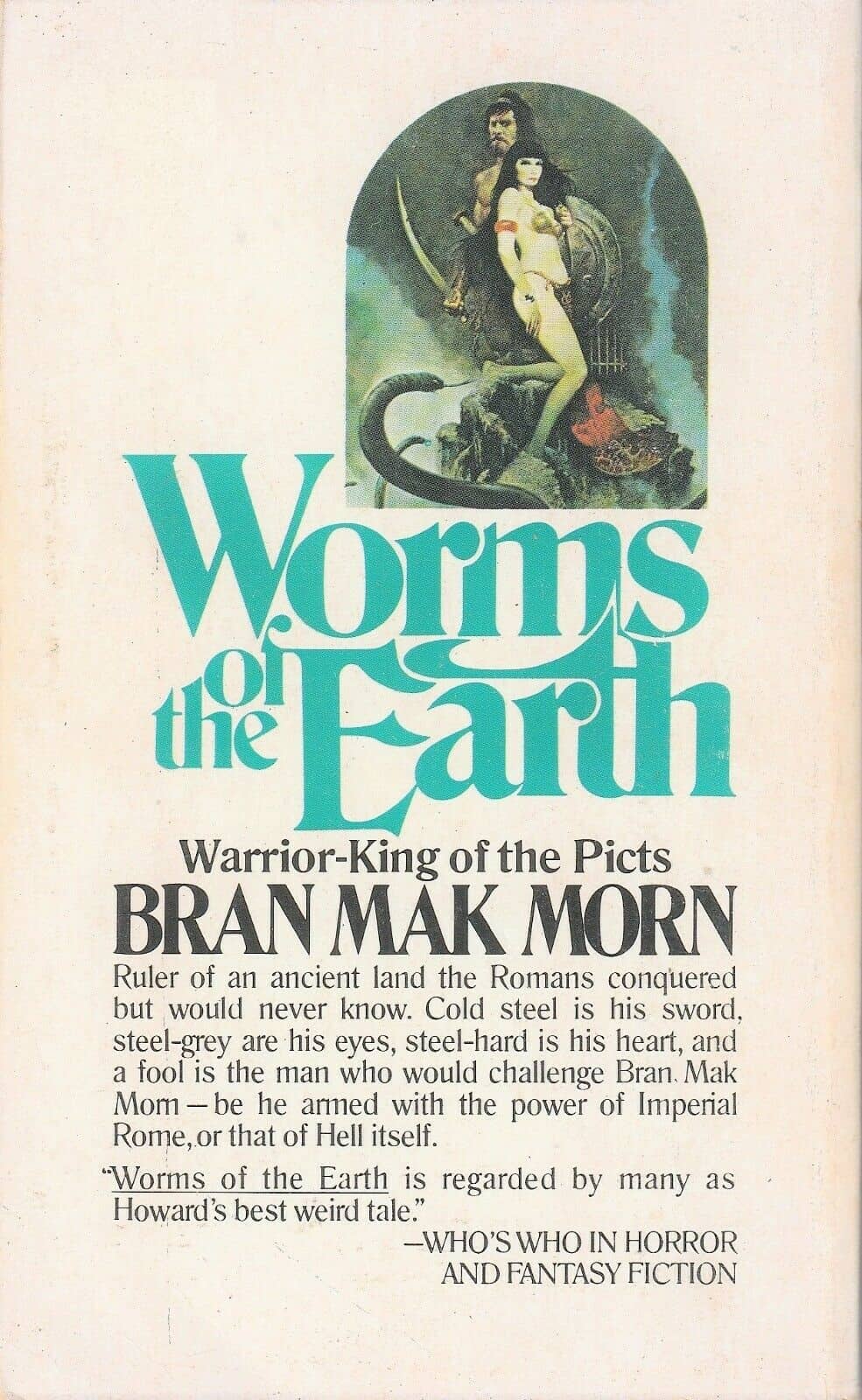
Worms of the Earth by Robert E. Howard (Ace Books, 1979). Cover by Sanjulian
“Worms of the Earth” was published in Weird Tales in November of 1932, and was thus described in the table of contents as “a grim shuddery tale of the days when Roman legions ruled in Britain–a powerful story of a gruesome horror from the bowels of the earth.” It features Bran Mak Morn, the King of the Picts, one of Howard’s barbarian characters. A quasi-Faustian tale, the story dramatizes Bran Mak Morn’s greatest transgression, a dark pact the king makes with diabolic force to avenge his dying and brutalized race: the Picts.
Many consider “Worms of the Earth” one of Howard’s masterpieces, truly haunting and enigmatic, its impact lingering long after a reading, like a stagnant tobacco smell or a leathery flapping of shadowy wings. The story is also notable for its inclusion of allusions to H.P. Lovecraft’s mythos, specifically the ancient Mesopotamian god “Dagon” and the sunken city of “R’lyeh,” home to dreaming Cthulhu. Undoubtedly, the story’s themes of racial degeneracy and the violent power of geologic time are steeped in Howard’s legendary 1930s correspondence with Lovecraft.
“Written by authors who mostly died before we were born”
What is wrong with us?
A gazillion SF&F books get published every month, and here we are reading books written by people who mostly died before we were born. And this is Science Fiction we’re talking about! Surely that’s the genre that riffs off the present to paint a plausible future, or at least an illuminating one? Why are we still reading the old stuff?
Is it because we’re wedded to some idea of “canon”? Probably not.
Sure, it’s interesting to visit the roots of a genre, but most of us want to be also entertained in our scarce leisure time. It’s why people who like theatre come back to Shakespeare for pleasure, but mostly approach Jonson and Marlow out of intellectual interest, and why I still dip into Malory’s pulpy Le Morte De Arthur, but not the ploddy Vulgate Cycleby some Medieval French guy(s?) I forget.
Similarly, aspiring authors are well-advised to see how their predecessors managed the… choreography of certain kinds of story: there’s no point in reinventing the wheel when past generations have left so many tried and tested examples just lying around. However, that presupposes that those wheels were proven in action, that they carried along stories that were entertaining.
And, yes, given how wide the field is, we’re more likely to find common ground talking about CL Moore than China Mieville: the best place to catch your mates is outside the pub, not in its murky depths. Even so, we want to be able to rant about books we loved and why… books that we found entertaining.
And there’s that word again: entertaining.
What does the old stuff have that the new doesn’t? After all, modern SF comes in meaty tomes of 100K words, generally has plausible extrapolation, and often takes us out of our comfort zone. How can 30K of often lightly characterized and emotionally distant narrative with not much contemporary significance compete with that?
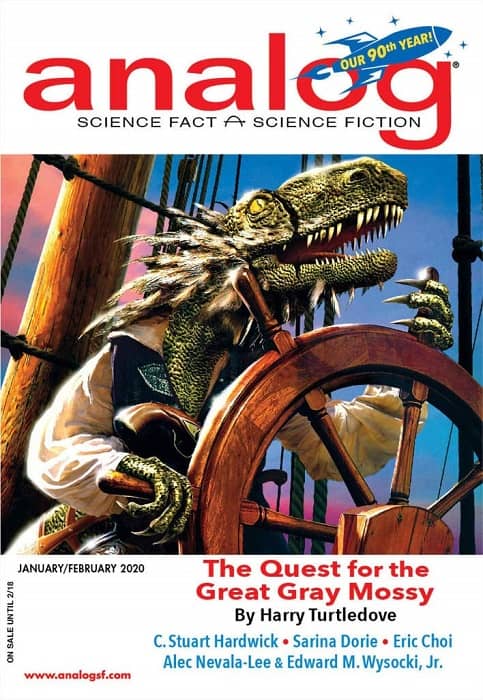
Back in the Before Times, I strolled, maskless and blissful, into Barnes and Noble and bought the Analog Science Fiction, January/February 2020 issue. It is a super-sized double issue with a reprint of a classic story from the 90s. I’ve read it in bits and pieces over the months and one tale stuck out at me — the cover story: “The Quest for the Great Gray Mossy” by Harry Turtledove.
Turtledove mines the classics with an enviable lack of shame in this Moby Dick pastiche. Is it even a pastiche? It is more of an abridged version, but with dinosaurs. Imagine if you had a test due on Moby Dick, but by some outlandish set of coincidences you lacked internet access and couldn’t even get your hands on an old copy of the Cliff Notes — hitting this story the night before would ensure you’d manage the test fine.
Honestly, while there wasn’t anything wrong with the story, it didn’t bring anything new to it, either. I mean, outside of the fact that they are dinosaurs.
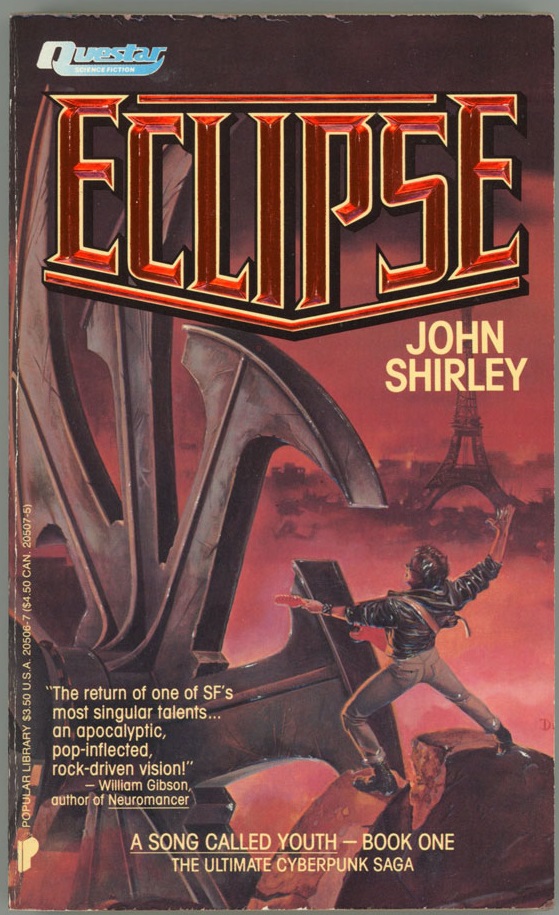
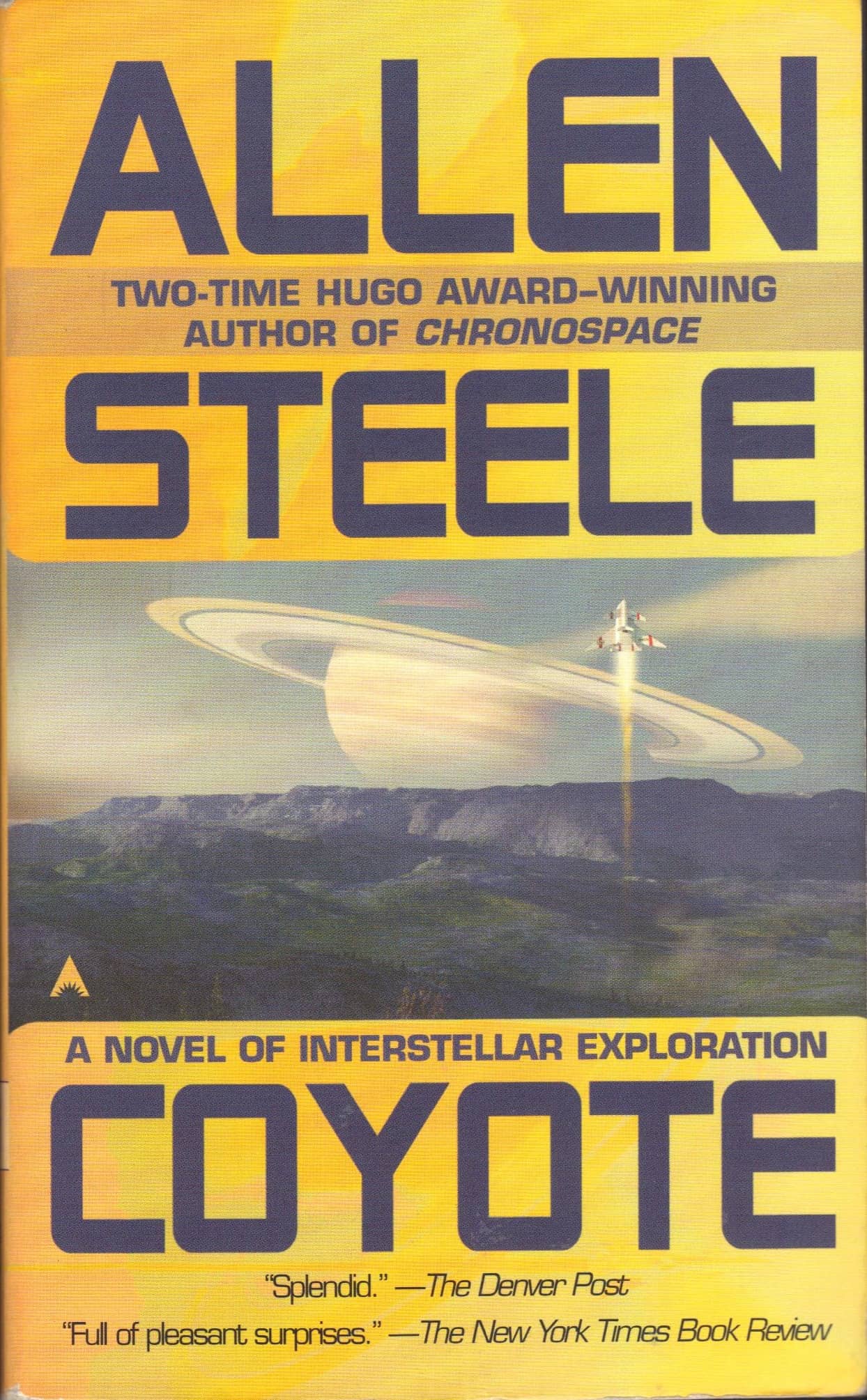
Eclipse by John Shirey (Questar/Popular Library, 1987), Alternate Presidents edited by Mike Resnick (Tor, 1992), Coyote by Allen Steele (Ace, 2002). Covers by Joe DeVito, Barclay Shaw and Ron Miller
“It’s rigged,” said Republican presidential candidate Donald Trump four years ago. What was? Everything. The system, the primaries, the TV debates, the media. And probably even the election itself.
His view, of course, was and remains that it’s all rigged against a hard-working, self-made billionaire who started out with two empty hands (and a small loan of $14 million from daddy – and this was more than 45 years ago, so consider inflation). But if you look at another aspect, that of general expectations, you might find a different kind of rigging.
So far, no woman has been president of the United States. Consequently, no historical or contemporary realistic fiction has portrayed a female President. But since science fiction is reality-based speculation, and since women make up a little over half of humanity, it would seem reasonable to expect at least some writers to write about possible futures, or alternate pasts and presents, where women inhabit the White House.
But in fact, such speculations have been few and far between. Kristin Lillvis (in “Take Me to Your Lady Leader,” in New Ohio Review #20, 2016) suggests that the first example of an imagined woman president may be found in C. L. Moore’s “Greater Than Gods,” in Astounding, July 1939. Moore’s story is basically about gender stereotypes: her protagonist, Bill Corey, considers which of two women to marry and visits the two possible alternate futures that would result from this decision. One of them is a patriarchal, technologically advanced but militaristic society of blind obedience to strong leaders; the other a matriarchal society with a succession of female presidents (though the first elected no earlier than around 2300), peaceful and comforting but also static and stagnant. “Women as a sex are not scientists, not inventors, not mechanics or engineers or architects,” the story says. And Moore lets her hero marry a third woman, who will add balance and reason to his own limitless ambition, and so give rise to a more diverse future.
“You’re the second guy I’ve met within hours who seems to think a gat in the hand means a world by the tail.” – Phillip Marlowe in Raymond Chandler’s The Big Sleep
(Gat — Prohibition Era term for a gun. Shortened version of Gatling Gun)
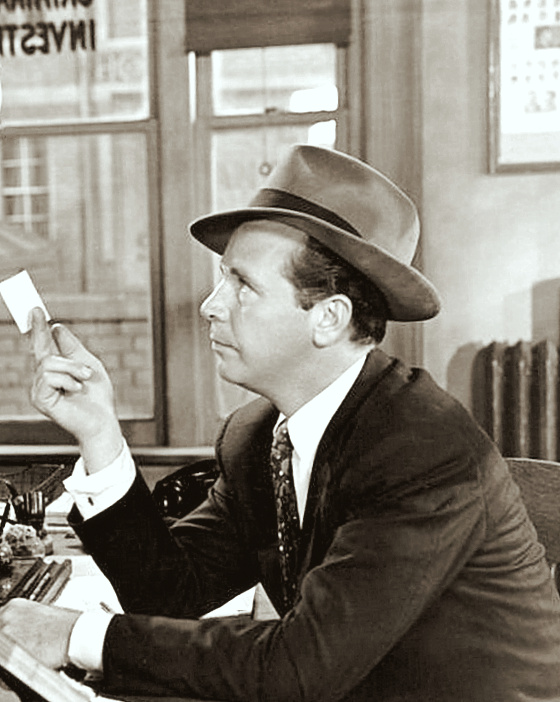
Dick Powell was Johnny Dollar? Well, no, not exactly. Yours Truly, Johnny Dollar, was a very successful radio show, which ran for over 800 episodes, covering thirteen years. It easily outlasted many competing programs, such as The Adventures of Sam Spade, and The (New) Adventures of Philip Marlowe. Dollar was “the insurance investigator with the action-packed expense account,” though he started out as more of a typical private eye. Which can also be said of Erle Stanley Gardner’s lawyer, Perry Mason.
In December of 1948, Dick Powell auditioned for the new show, recording the episode Milford Brooks III. With movies such as 1944’s Murder My Sweet, and 1947’s Johnny O’Clock, the popular song-and-dance man had carved out a niche as an unlikely hardboiled star. He’s actually my favorite movie Marlowe, and I wrote about Johnny O’Clock here at Black Gate. Here’s the episode, for your listening pleasure.
He had also spent the previous two years as Richard Rogue in the rather unusual PI radio show, Rogue’s Gallery. Like many shows of the time, Rogue’s Gallery had a lack of stability in network, time slot and even renewal, and Powell left after 1947, replaced by Barry Sullivan. This left him available to try out for Johnny Dollar. The original title was Yours Truly, Lloyd London, but was presumably changed to avoid trouble with the well-known insurance company.
However, it appears that Powell decided to pass on the part to pursue a different radio opportunity; Richard Diamond, Private Eye(another of my favorites). So, actor Charles Russell was given the part. This essay is going to talk mostly about Powell’s audition, but will go beyond that focus.
In this earliest incarnation, Powell plays a somewhat light-hearted version of Dollar, though he’s still more of a typical private eye than a distinctive insurance investigator. His witty patter is consistent throughout, and he even hums ‘Slow Boat to China;’ a tip of the fedora to his Hollywood musical background. In fact, Powell comes across as pretty similar to his next part, Richard Diamond.
Early on, a young man he’s dealing with bites him, which later lets Dollar make a cryptic comment that “Let’s just say, he put the bite on me.” That comes just after saying, “That kid’s liquor sure can hold him.” Very much like Diamond, Powell’s Dollar is quick with a quip. Which is fine. But it’s more prevalent here than it would be with other actors in the role.
“You’re the second guy I’ve met within hours who seems to think a gat in the hand means a world by the tail.” – Phillip Marlowe in Raymond Chandler’s The Big Sleep
(Gat — Prohibition Era term for a gun. Shortened version of Gatling Gun)
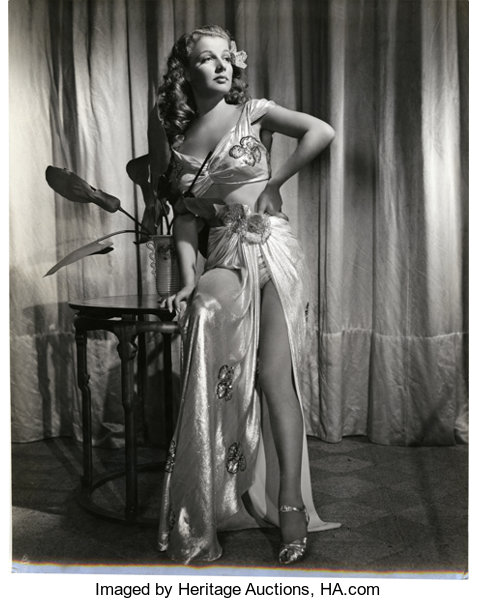
Coming off of Edward G. Robinson as the May Star of the Month on TCM, June is Ann Sheridan Month. The ‘Oomph Girl’ appeared in several hardboiled/noir/crime movies, so we’ll tell you some movies to look for.
Every Tuesday, there is a batch of Sheridan movies, and things kicked off June 1st, with eight flicks, including two Bogart movies: Black Legion, and The Great O’Malley. But the past is prologue.
Now, all of these films can be streamed live on Watch TCM if you get Turner Classic via your cable company. But even if you don’t, most of them can be viewed for at least one week after airing on WatchTCM. Some, like Casablanca, don’t get put up. I assume it’s to help sell mover DVDs. But most do. So, if you miss a movie, you can watch it via the app, or the website.
Having laid all of that out, let’s take a look at some of the June films, all EST:
June 2 (look for on Watch TCM)
8:00 PM – Black Legion
A 1937 ‘social cause’ movie. It’s based on the real-life Black Legion, which was a splinter group of the Ku Klux Klan. Humphrey Bogart is a factory worker with seniority who gets passed over by a smarter, harder-working foreigner. And ends up joining the hate group. It was a strong performance by Bogart, who was just being forced by Warners to crank out B-movies (this was four years before High Sierra). Sheridan is fourth-billed and is really only the third main female. The speech from the judge at the end is as heavy-handed propaganda as you’ll run across in a Bogart film. Worth a watch.
9:30 PM – Dodge City
This is a big budget western, starring the swashbuckling Errol Flynn. Michael Curtiz (Casablanca) directed, with a great musical score by Max Steiner. One of my favorite comic supporting actors, Frank McHugh, is here, as Sheridan plays female second banana to Olivia de Haviland. This movie features a heck of a bar room brawl, and the cast is solid. There was an unrelated follow-up with Flynn, Virginia City. Which included Bogart as a Mexican raider with a cheesy mustache.
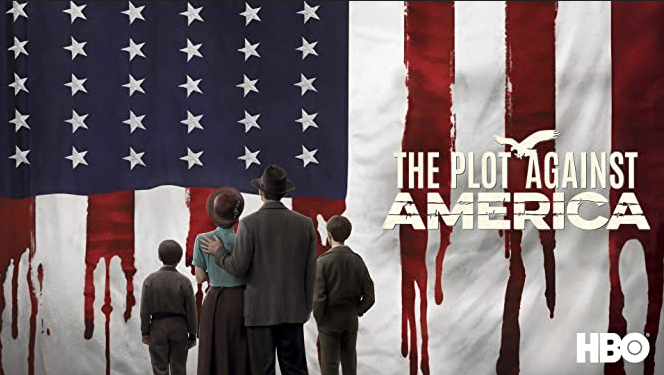
The story so far: in this tale of an alternate America, based on a pseudo-memoir written by Philip Roth, anti-Semite Charles Lindbergh was elected president in 1940, keeping the USA out of the war in its darkest hours and inaugurating a scary time for American Jews, especially 9-year-old Philip Levin (Azhy Robertson).
Feelings about the Lindbergh administration vary through America’s Jewish community. For some, like Rabbi Bengelsdorf (John Tuturro) and his new bride Evelyn (Winona Ryder), it’s an opportunity for social climbing and collaboration. To some, like young Sandy Levin (Caleb Malis), Lindbergh is a hero and any concerns to the contrary come from ignorant frightened “ghetto Jews” — like his parents. For some, like Philip’s overbearing Uncle Monty (David Krumholz), business is good; the nation is at peace; there are worse things than President Lindbergh.
Others (young Philip’s parents, played by Morgan Spector and Zoe Kazan, and his cousin Alvin, played by Anthony Boyle) are intent on resisting the tide of anti-Semitism rising in America and the rest of the world. But, tragically, they can’t agree on what should be done and end up fighting with each other as much or more than with the real enemy.
These days, in intersection with my Conan gaming (I enjoy both Monolith’s board game and Modiphius’s roleplaying game), I have been reading a lot of two things: weird fiction from the turn of last century into, maybe, the 1940s; and sword & sorcery — anything that, on its cover, features a muscled male wielding medieval weaponry — predominantly from the ‘70s or ‘80s. (This latter does the double duty of encouraging me to work out.)
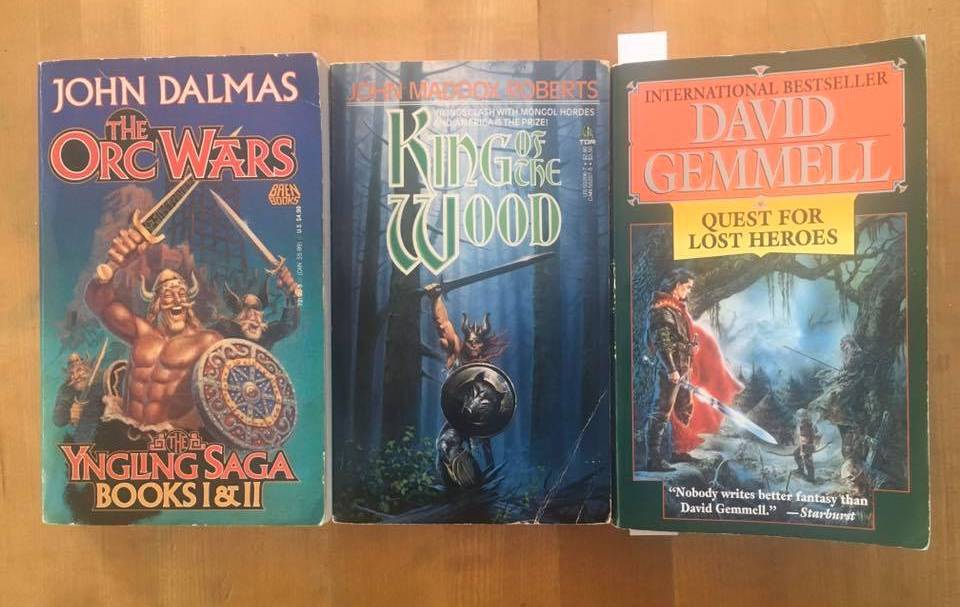
As is to be expected, these works offer various levels of quality. Early-last-century weird fiction is in a class of its own, and, though writers of that era freely borrowed tropes, themes and elements from each other (they very much appear to have been in conversation, literally or otherwise), the form of the weird tale is not as calcified as that of sword & sorcery appears to be by the ‘80s. Even within this latter’s straitjacket, however, I have encountered some standouts, including John Dalmas’s The Orc Wars (beginning with The Yngling, 1971), Gordon Dickson’s and Roland Green’s Jamie the Red (an unofficial Thieves’ World novel, 1984), and John Maddox Robert’s The King of the Wood (1983). Why I like these is for the reasons that one would like any work of fiction, of course, but with one addition: they present a sense of verisimilitude. I should add here, for anyone who might not be privy to how sword & sorcery is supposed to be subdivided from its parent genre of fantasy, that sword & sorcery is supposed to be more “realistic.” The world presented in such tales is premodern. Life is hard. The cultures do not have our present technology (nor magic — magic, in this subgenre, if not “low,” is rare and mysterious and terrifying and usually very, very “wrong”) with which to ease the drudgery of existence. In other words, the characters in such stories live in the way that folks in the Middle Ages lived, possibly in the way that many of our grandparents or great-grandparents lived, if they were homesteading somewhere.
This is why I no longer write sword & sorcery. I am a city boy. I am modern. I have no idea what “real life” is like. And yet I somehow have enough of one to know — intuitively or otherwise — when a writer knows even less than I do. To catalog the many errors of some of our most famous current fantasy writers is outside of the scope of these observations, but I’ll point to the occasion that spurred me finally to write on this topic here.
In Part I of this 3-part series, we looked at how the concept of the Virtual Idol first emerged in anime during the 1980s, featuring some of the more popular storylines and prominent idols to make an appearance in this genre, a phenomenon which could be seen as the precursor to an eventual reality where technology would let them enter our lives more directly. This is the reality that unfolds before us now!
As we enter the digital age, the possibilities open up considerably. Idols can go beyond just appearing in a futuristic context — and actually manifest as creations on our own computers!! The giant leap forward comes with the arrival of a line of software products called Vocaloids. Created by Crypton Future Media, and using technology developed by musical equipment giant Yamaha, a Vocaloid is a type of speech synthesis program which converts words and melodies designated by the user into an electronic singing voice.
There are some parameters for tweaking the sound, but for the most part each version of the program is based on one specific voice, and is tied to a related character avatar representing the singer. The first two major entries in the series featured a female singer named Meiko, along with her male counterpart Kaito. They remained somewhat obscure for most people though, at least in the beginning. It was the next entry, the first in the newer ‘Vocaloid2’ line, who was to become the star that would launch a massive cultural revolution in Japanese music — the virtual idol known as Hatsune Miku!!