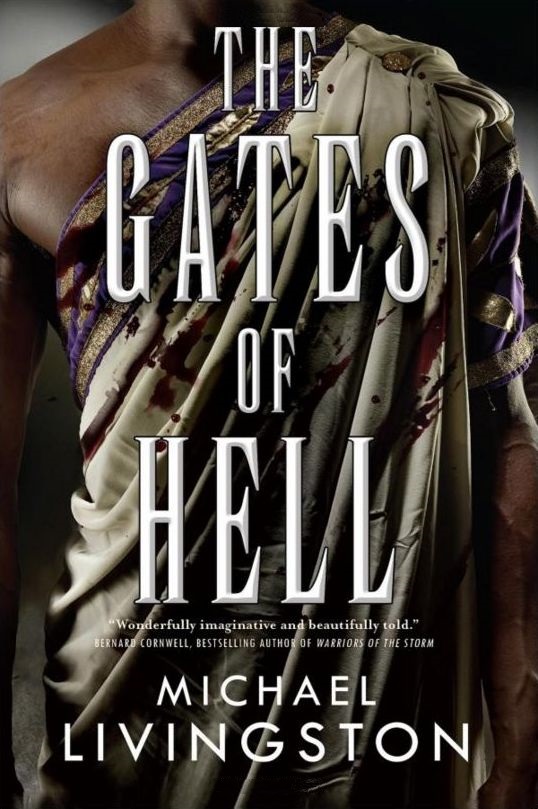
New Treasures: The Gates of Hell by Michael Livingston
 Michael Livingston’s stories for Black Gate made him a favorite among our readers, so I was looking forward to seeing how the wider world would react to him with the publication of his first novel, The Shards of Heaven, a historical fantasy that reveals the hidden magic behind the history we know. I was not disappointed. Library Journal called it “Top-noth,” and bestselling writer Bernard Cornwell called it “A brilliant debut.” And Sam Reader at the B&N SF Blog gave it this rave review:
The Shards of Heaven is breathtaking in scope. With the first volume of a planned series intertwining Roman history and myth with Judeo-Christian mythology, Michael Livingston has created something truly epic… He uses real events and characters as the backbone for a truly inventive epic fantasy like novel, a massive undertaking that launches a tremendously ambitious series.
The Gates of Hell is second volume in the series; it’s available in hardcover from Tor on Tuesday.
Alexandria has fallen, and with it the great kingdom of Egypt. Cleopatra is dead. Her children are paraded through the streets in chains wrought of their mother’s golden treasures, and within a year all but one of them will be dead. Only her young daughter, Cleopatra Selene, survives to continue her quest for vengeance against Rome and its emperor, Augustus Caesar.
To show his strength, Augustus Caesar will go to war against the Cantabrians in northern Spain, and it isn’t long before he calls on Juba of Numidia, his adopted half-brother and the man whom Selene has been made to marry — but whom she has grown to love. The young couple journey to the Cantabrian frontier, where they learn that Caesar wants Juba so he can use the Trident of Poseidon to destroy his enemies. Perfidy and treachery abound. Juba’s love of Selene will cost him dearly in the epic fight, and the choices made may change the very fabric of the known world.
Michael Livingston’s most recent blog post for us was his 2015 article on the challenges of writing longer fiction.
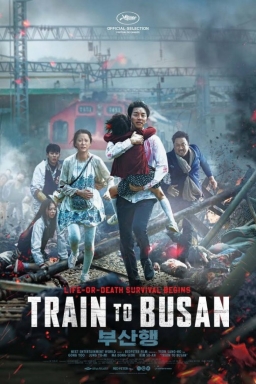 On the morning of Sunday, August 1, I was in no particular hurry to get to the Hall Theatre. I planned to see the Korean zombie movie Train to Busan, but knowing it had already played the large room of the Hall once I didn’t anticipate I’d have difficulty finding a seat. I intended after that to go across the street to the De Sève Theatre, where I’d watch Operation: Avalanche, a found-footage fiction about filmmakers who’d faked the moon landing in 1969. Then I’d go have a bite to eat and come back for two more movies. It sounded like a nice well-spaced day, but when I got to the Hall ten minutes before Train to Busan was scheduled to start I found I’d radically underestimated the film’s popularity. As the doors opened to let the ticket-holders in, the line stretched around the corner, up to the next street, and then around the corner there. Luckily enough, I was able to find a good seat in the back of the Hall, where I watched the auditorium fill up with an enthusiastic crowd.
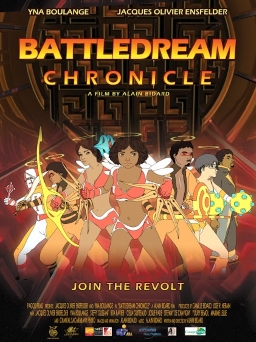 Saturday, July 30, I had hopes of seeing four shows at Fantasia. In the event, I saw three — and ended up with an interesting chat after the last one. First came an animated teen dystopia from Martinique, Battledream Chronicle, in which a young woman fights to free her homeland from digital colonialism. After that came a collection of short films, the International Science Fiction Short Film Showcase 2016 (one of the shorts being an adaptation of Ken Liu’s short story “
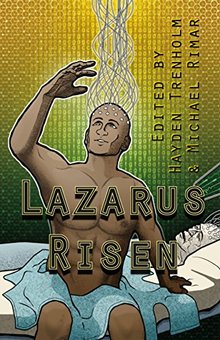 I know I’ve mentioned before that I’m a big fan of the original anthology, and I’d like to take the opportunity to draw your attention to two new ones that have crossed my table in the last month or so.