Browsed by
Category: Reviews

You got your Zombies in my Pride and Prejudice!

You got your Zombies in my Pride and Prejudice!

ppzombiesPride and Prejudice and Zombies
By Jane Austen and Seth Grahame-Smith (Quirk Classics, 2009)

I love the genre of “re-contextualizing,” taking a work of art, regardless of its qualities, and slamming it into a new setting to see what happens. This can come from a Warholian perspective, or it can be done with the humorous ocean of pop-culture parody in Mystery Science Theater 3000 (which I have no hesitation in naming my favorite television show ever). Re-contextualization can be as simple as re-writing the captions for The Family Circus and printing Garfield cartoons with Garfield’s thought-balloons removed to create a surreal world. It can also create a new work of art, such as taking Nikolai Rimsky-Korsakov’s aria “The Song of the Indian Guest” from the opera Sadko and making it a jazz classic like “Song of India,” perhaps one of the greatest dance-pieces ever charted.

Although re-contextualizing often implies satire or parody, it can simply involve experiment. “What would such-and-such feel like if it were altered in a certain way? I think it would go something like this. . . .”

And that’s where the new volume Pride and Prejudice and Zombies comes in. Author Seth Grahame-Smith, who wrote The Big Book of Porn, a look into the oddest entertainment industry, and How to Survive a Horror Movie, takes the text of Jane Austen’s 1813 comedy of manners and tweaks it to include a zombie plague overrunning the English countryside at the same time that busybody Mrs. Bennet maneuvers to get her daughters married to eligible bachelors.

Read More Read More

Short Fiction Review #16: We’ll Always Have Paris by Ray Bradbury

Short Fiction Review #16: We’ll Always Have Paris by Ray Bradbury

We'll Always HAve Paris

In his for the most part disdainful observations of science fiction as a cultural phenomenon, The Dreams Our Stuff is Made Of, Thomas Disch characterizes Ray Bradbury, among other notable genre authors of the post- WW II generation, as being in “affluent decline” by the 1980s, suffering from “the literary equivalent of repetition compulsion” (122). He also rues that SF is a young man’s game, not because it is physically exhausting, but because the marketplace focuses on a largely juvenile audience in terms of intellectual temperament, if not actual age. Established authors such as Bradbury who remain successful within the genre do so because they have a “permanent mind-set that is ‘forever-young'” (213). I don’t think this is meant as a compliment.

I can only wonder what Disch may have thought of Bradbury’s 2007 Pulitzer Prize special citation. But, I have to admit he has a point.

Quick, name any Bradbury fiction written after the 1960s that had remotely any affect on you similar to The Martian Chronicles (1950), The Illustrated Man (1951), Fahrenheit 451 (1953), Dandelion Wine (1957), A Medicine for Melancholy (1959) or Something Wicked This Way Comes (1962)?  And if you weren’t a baby boomer reading any of these works at the so-called golden age of wonder, i.e. 12, and most likely male and most likely a bit of a nerd, during an era roughly contemporaneous to their publication, give or take a decade, you probably have no idea what the point of the question is.

As an aforementioned male baby boomer nerd whose reading of The Martian Chronicles in the fifth grade weaned me off of Hardy Boys books (for further details about this awakening, see this), Ray Bradbury is why you’re reading this (go ahead, blame him). Bradbury was my literary hero, though, for me, these days he’s something of a faded hero. The problem is that I’ve grown up, while Bradbury seems stuck in perpetual small town adolescence, a side trip to Europe or Mars or Los Angeles notwithstanding. For some readers, sometimes you can’t go home again.

Read More Read More

Monsters vs Aliens

Monsters vs Aliens

Monsters vs Aliens: An IMAX 3D Experience (2009)
Directed by Conrad Vernon and Rob Letterman. Featuring the voices of Reese Witherspoon, Seth Rogen, Hugh Laurie, Will Arnett, Rainn Wilson, Kiefer Sutherland, Paul Rudd, Stephen Colbert.

Monsters vs Aliens disappointed me. “Disappointed” isn’t a term I normally use regarding a DreamWorks CGI-animated film. Or any CGI-animated film that doesn’t start with the Pixar logo. I’ve come to expect that computer-animated fare from anyone aside from Pixar means overused celebrity voice-acting and tiresome, unrelenting pop-culture references placed over the needs of story and character. So why would I feel disappointed when Monsters vs Aliens ended up in the same DreamWorks ballpark of the mediocre?

Because the trailers looked good. Because it was going to play theaters in IMAX 3D (not actual IMAX, but a blow-up for the larger format). Because it was an homage to one of my favorite genres, the 1950s science-fiction ‘B’-movie. Because it has giant monsters and robots.

For all its possibility, Monsters vs Aliens still ends up a stale non-Pixar ‘yuk-yuk’ festival. The filmmakers could have striven for something higher. They could have gone for Coraline—or even Monster House. Instead, they ended up with a movie somewhat superior to Shrek 2, Shrek 3, Kung Fu Panda, Madagascar, and Shark Tale. That’s a victory, of sorts. And the 3D in the IMAX enlargement is, at the very least, breathtaking.

Read More Read More

Pastiches ‘R’ Us: Conan and the Treasure of Python

Pastiches ‘R’ Us: Conan and the Treasure of Python

Conan and the Treasure of Python

By John Maddox Roberts (Tor, 1992)

My first post on Black Gate’s blog was a review of a Conan pastiche. I would feel untrue to myself if I didn’t return to this rich vein of material from time to time. This go-round, I’m paying a visit to one of the most interesting of the Tor novels from the most consistently successful of its stable of authors, John Maddox Roberts. Even if you’re not a fan of Conan novels that don’t come from the pen of Robert E. Howard, Conan and the Treasure of the Python has something to offer you: a take on one of the classic adventure novels of all time.

The editors should have renamed this book Conan and the Treasure of King Solomon’s Mines. This isn’t a case of borrowing or inspiration the way that, for example, Forbidden Planet borrows from The Tempest, or The Warriors draws inspiration from Xenophon’s Anabasis. No, this novel is literally King Solomon’s Mines: John Maddox Roberts copies the exact plot of the classic H. Rider Haggard 1885 adventure novel and recasts it as a Conan story, with the legendary barbarian starring in the Allan Quatermain role. The story similarities are striking, pervasive, and go far beyond coincidence or subconscious borrowing. The overall structure of both books is beat-for-beat identical.

Read More Read More

Short FictionReview #15: The New Weird edited by Ann & Jeff Vandermeer

Short FictionReview #15: The New Weird edited by Ann & Jeff Vandermeer

It might seem weird that people once got worked up about this stuff (and, maybe they still do and I’m just not paying that much attention anymore), but about five years or so ago (that’s 35  in dog years and  paleolithic ancient history in Internet reckoning), people were getting worked up about “The New Weird,” whether it was a bona fide genre subcategory and/or movement, who its practitioners were, and who the hell cared.   At least it was better than arguing about whether cyberpunk was dead and whether slipstream was literary science fiction, or literary fiction that stole from science fiction.

Now, along come the Vandermeers —  both of whom have dogs in this hunt, Ann as editor of the presumably now defunct Silver Web magazine and currently at the helm of Weird Tales and Jeff as the author of City of Saints and Madmen, among other works, associated with The New Weird milieu and, if recollection serves, one of those who at the time thought the whole discussion about  the classification kind of pointless — with  The New Weird anthology. Theirs is an interesting approach.  This is more than a compendium of stories that tend to share a theme; rather, it is a kind of snapshot of a fixed era (with one exception) of excitement  — possibly mixed with some confusion —  of authors breaking ground from traditional fantasy and horror and mixing it up in very intriguing, though sometimes incomprehensible ways, whose time, the editors seem to suggest, has past.  “New Weird is dead.  Long Live the Next Weird.”

Read More Read More

Dungeons and Dragons Fourth Edition Review

Dungeons and Dragons Fourth Edition Review

dungeons-and-dragons-players-handbookFourth Edition Dungeons and Dragons has been with us for about a year now; long enough for the gaming community to get a pretty good taste of it. I’ve been hearing various reports from gamer friends about the system, and opinions of it have fallen across a roughly tripartite spectrum, from favorable to neutral to negative. Among these views, though, there is agreement that this isn’t the same old Dungeons and Dragons. Fans of Fourth Edition sometimes call it a “transformation,” or point out, “This time around they didn’t have any sacred cows. They were ready to change anything.” Critics have generally agreed that “It might be a game some people like, but it’s no longer D&D.”

Read More Read More

Who Watches the Watchmen? I Watches!

Who Watches the Watchmen? I Watches!

Watchmen (2009)
Directed by Zack Snyder. Starring Patrick Wilson, Jackie Earle Haley, Billy Crudup, Malin Akerman, Matthew Goode, Jeffrey Dean Morgan, Carla Gugino.

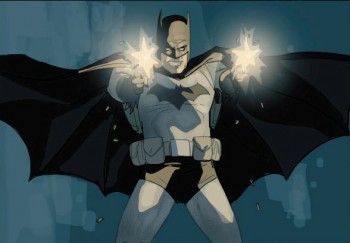
In the 1980s, two graphic novels (ah, I remember when I first heard that term in junior high) changed forever the perception of serial art as a form of literature: The Dark Knight Returns by Frank Miller, and Watchmen by writer Alan Moore and artist Dave Gibbons.

Appropriately enough, less than a year after a film called The Dark Knight (not based on the graphic novel, but showing its influence) helped shift viewer’s perceptions of what sort of movie a comic book hero can appear in, a long-awaited adaptation of Watchmen also hit the screen. We have entered a new era in the comics-to-film genre, and this double-punch will raise the bar for all future movie versions of graphic novels and superhero tales.

A significant difference between The Dark Knight and Watchmen, however, is their relation to the source material. The Dark Knight draws off a character with an enormous history and multiple interpretations, and it uses this variety to create an original story. With Watchmen, the movie has a singular source which fans hold with the same reverence as other people—depending on their orientation—hold the Torah, the New Testament, the Bhagavad-Gita, the Qur’an, Hamlet, The Lord of the Rings, or Atlas Shrugged. (If your name is Rorschach and you wear a constantly shifting inkblot mask, I guarantee it’s Atlas Shrugged.) A Batman film can do many different interpretations, while Watchmen has to adhere to one… with variations for the new medium.

Read More Read More

Short Fiction Review #14: Interzone #220/February 2009

Short Fiction Review #14: Interzone #220/February 2009

Back in June, Interzone published an edition dedicated to “Mundane SF,” which essentially means the story’s future speculative setting must be based on plausible science. So, no FTL, which virtually eliminates space opera, or telepaths or pointy eared aliens who speak English and act more or less like human beings except that they have pointy ears even though they live on planets light years away from Earth.  I guess. It all sounds to me like Hard SF in a girdle, and I don’t quite get it. You could, for example, group fiction that takes place only in New York City, or must involve farm implements, or that is first person narration by a transsexual. I mean, it might be interesting to read a collection of stories that take place in New York City, if only to say, “Oh, I recognize that restaurant where the characters are eating, I go there all the time,” but, beyond that, I’m not really sure how the categorization serves to help the reader to appreciate the author’s technique or critical perspective. Geoff Ryman’s introduction seems to say that one purpose of mundanity is to provide hope (and, indeed, his own contribution, “Talk is Cheap,” seeks to show how hope springs eternal in even direst circumstances). But, I’m not so sure why that should be the case. After all, On the Beach takes the mundane approach to the possibility of nuclear holocaust that is plausible, but certainly not hopeful.

I was thinking about this in reading the latest Interzone, which, with one exception, could be a mundane issue.  Not only in the sense of plausible scientific extrapolation, but also in the sense of, well, being mundane in trodding  familiar ground.  Not that this is necessarily a bad thing; the better stories here manage to unearth some disturbing ideas that are certainly relevant to our mundane existences.

Read More Read More

Tarzan Swing-By: Tarzan and “The Foreign Legion”

Tarzan Swing-By: Tarzan and “The Foreign Legion”

Tarzan and Foreign Legion 1st edI would like to step forward at this moment to address the audience before the curtain rises on our feature book review presentation so that I may make a personal observation about Edgar Rice Burroughs. Specifically, I would like to explain why I’ve written so many posts about his work in the last few weeks.

Burroughs needs no excuse for discussion in a magazine dedicated to heroic fantasy and planetary romance. Adventure literature as we know it springs from the influence of Burroughs in the early twentieth century. Although pulp magazines existed before Burroughs published Under the Moons of Mars (later titled A Princess of Mars) and Tarzan of the Apes, this double-punch in 1912 changed the style of this publishing medium for the remainder of its lifetime, and the influence continued into the paperback revolution and on into our era. Burroughs looms as one of the Titans of genre literature. But the true question is: Why am I re-reading so much of his work right now, in concentrated doses that I usually reserve for no author?

One answer is that I enjoy writing about Burroughs almost as much as I enjoy reading him. For an author who supposedly crafted straightforward entertainment, Edgar Rice Burroughs’s novels contain a remarkable breadth of ideas for debate and consideration. But a deeper reason for such current copious reading of Burroughs is that his work always gives me a unique uplift. In times of uncertainty and concern, I find that no author can temporarily re-energize me than ERB. Even a violent and embittered book, such as the one I’m about to discuss, provides an energy boost like a literary vodka with Red Bull. Burroughs knows how to make life seem wild, colorful, and far removed from the petty concerns of the everyday. It isn’t strictly “escapism,” a word I dislike, but a form of romantic empowerment. Burroughs’s daydreams on paper enhance our yearning for that which is beyond what we have to struggle with in day-to-day life.

End of psychological exegesis. The curtain now rises on today’s Tuesday Topic: one of Burroughs’s most unusual books, one that few people have read because — let’s face facts — how many but the most dedicated fans manage to reach Book #22 in any long-running series?

Read More Read More

The Land That Time Forgot: The Movie

The Land That Time Forgot: The Movie

Land That Time Forgot PosterThe Land That Time Forgot (1975)
Directed by Kevin Connor. Starring Doug McClure, John McEnery, Susan Penhaligon, Keith Baron, Anthony Ainley, Bobby Parr.

In A.D. (Anno Dinosauriae) 1975, the old era of low-budget fantasy and science-fiction filmmaking neared its close — although nobody knew it. In 1977, an under-marketed flick called Star Wars forever changed the way studios approached genre movies, elevating them to A-budget, blockbuster, mega-studio super-entertainment with emphasis on attaining photo-realistic effects.

Progress? In a way. But when I look at a movie like 1975’s The Land That Time Forgot, a British adaptation from Amicus Productions (famed for their horror anthologies) of the first third of Edgar Rice Burroughs’s classic “Lost World” novel, I feel a tug of regret that such handmade, analog epics, crafted on tight budgets with intense imagination and invention, have largely suffered extinction. There’s a beautiful innocence to The Land That Time Forgot that makes it an ideal approach to Burroughs’s style. If its effects aren’t “realistic,” they certainly are thrilling and wonders to behold. We shall never see such marvels again.

It’s easy for the general public and the old-guard movie critics who still lumber around major magazines and paperback video guides to dismiss this “rubber dinosaurs and cavemen” film as campy, but The Land That Time Forgot plays it straight — it isn’t camp unless you choose to approach it that way. That’s acceptable, of course; the film belongs to the viewer. But taken as a serious adventure-fantasy, The Land That Time Forgot provides remarkable entertainment, far better than a campy romp. And it’s smart.

Read More Read More