A Remembrance of Steve Tompkins
A little over a year ago, my friend John C. Hocking called me to let me know that Steve Tompkins passed away. I was on a family mini-vacation at the time, and, oddly enough, I am again on a family mini-vacation shortly after the anniversary of his death.
 I wanted to point all of you to the fine series of articles over on The Cimmerian in remembrance of Steve, but I also wanted to offer a word of explanation. Neither John nor myself could claim to be close friends with Steve, though we were occasional correspondents. I had the pleasure to meet him in person once, and we sometimes traded information and opinions, for we shared many of the same fiction preferences, but I did not know him that well.
So why, then, was Hocking so upset that he called me to let me know, and why was the passing of this acquaintance so moving that I think about him from time to time even when it’s not the anniversary of his death? Why are so many people still talking about a man that many of you may never have heard of?
It’s because Steve was a phenomenal scholar of fantasy and heroic fiction/sword-and-sorcery and probably the most well-read person I’ve ever met — and he was also, simply, a really nice guy.
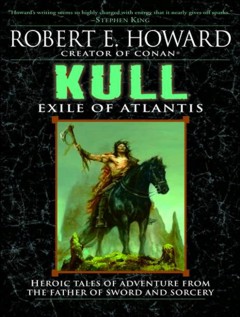
You have only to visit his archived essays at The Cimmerian to see that talent, or his good natured spirit. You also can flip through the essays he drafted in many other places, not the least of which are some of the Del Rey Robert E. Howard volumes, including Kull – Exile of Atlantis. He was a genius.
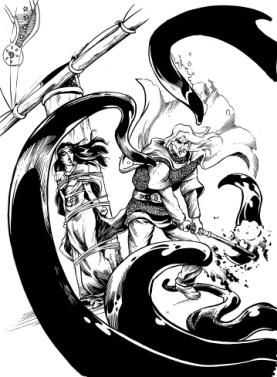 The Sorcerer’s Guild announced this week that John C. Hocking’s “The Face in the Sea” (from Black Gate 13) has been nominated for the Harper’s Pen Award (formerly the Ham-Sized Fist Award).
 There’s nothing like being faced with your own weirdness.
 Most pulp writers of the 1930s were itching to break into the hardcover book market. Since reprints of pulp stories in book form were rare at the time, these writers did not expect that their work for the newsstands would survive past an issue’s sell-date. They felt comfortable re-working and expanding on them to create novels. Raymond Chandler famously called his process of novelizing his already published work as “cannibalizing.” He welded together different short stories, often keeping large sections of text intact with only slight alterations. Other authors took ideas that they liked, or else felt they could do more justice to in the novel format, and enlarged them into books without text carry-over. Robert E. Howard used “The Scarlet Citadel” as a guide for The Hour of the Dragon. And Cornell Woolrich turned many of his short stories into novels. “Face Work” became The Black Angel. “Call Me Patrice” became I Married a Dead Man. “The Street of Jungle Death” became Black Alibi. And “Speak to Me of Death” became Woolrich’s most depressing novel (which is really saying something), Night Has a Thousand Eyes.
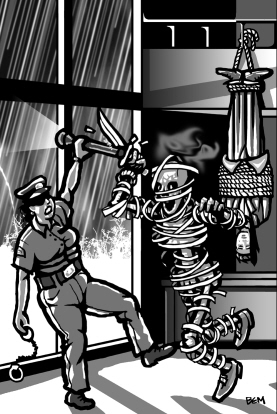 The sarcophagus was empty, the mummy was on the loose, and Corporate expected her to deal with it. Seemed like a lot to ask, especially for minimum wage.
 I freely cop to having the sort of geeky sense of humor that is immediately triggered by someone coming up with the perfect movie quote for any given situation. For that matter, the level of hilarity is proportionately magnified by the obscurity of the quote, how quickly I was able to identify it, and any subtle, “insider” references the quote might invoke.