The episode opens with a young man (Robert), dressed all in black and wearing too much product in his hair, romances a girl (Kristen) in a bar. He is enigmatic and tentative, recoiling at the sight of blood from a papercut. “We can’t be together,” he says. “You think you know me, but you don’t. I’ve done bad things. You should run. Now.”
“I can make my own decisions,” Krsten replies. “I’m 17.”
No, they haven’t called in Stephanie Meyer to guest write this week’s episode of Supernatural. Instead, they’re taking a turn at dark parody, pulling the cliches from the Twilight saga into their more nitty-gritty vampire mythos. In Supernatural, vampires are flat-out monsters, not dark romantic leads.
The McGill book fair is the largest English-language used book sale in Montreal. It’s been held for decades, every October, on the second Wednesday and Thursday after Thanksgiving (which in Canada is on the second Monday in October). Every year an eclectic mix of thousands of books are sold, helping to raise money for scholarships.
I’ve been coming to the sale for about a dozen years. I’ve found novels by Lord Dunsany, a biography of C.S. Lewis, a book about Hypatia of Alexandria, a Dennis Wheatley omnibus, Fighting Fantasy Gamebooks, Paul Park’s Celestis, a volume combining Bede’s Ecclesiastical History with The Anglo Saxon Chronicle, collections of poetry by John Clare and Francois Villon and Elizabeth Barrett Browning and Robert Southey and Don Marquis, a graphic novel by Posy Simmonds — and all of these (along with books by Neal Stephenson, Tad Williams, and T.H. White) in just one year, 2008, when I bought a total of 65 books for $161.
A great painting by Joe Jusko featuring a convergence of Barsoom's most memorable elements. That's John Carter and Dejah Thoris in the midst of all the savage beasties. The setting is one of Mars' ancient ruined cities, home to the savage green Tharks.
It’s a sublimely gorgeous rainy day here in Napa. I’m listening to the ancient, pattering rhythm of the rainsong and thinking about Mars.
No, not the red dustball of our modern age, where tiny robots scour the dunes for microscopic life. I’m thinking of BARSOOM, the title the red planet bore a long, long time ago.
I’m thinking of ancient cities crumbling across dead sea-bottoms, tusked green warriors standing ten feet tall, snake-haired plant-men, four-armed white apes, ten-legged lions, flashing swords, and blasting radium pistols. I’m thinking of Edgar Rice Burroughs and his most original creation John Carter of Mars.
In 1912, Edgar Rice Burroughs published A Princess of Mars, his first novel. John Carter, his rugged hero, was a Civil War veteran who stumbled into a mystical cave and was transported through space and time to an ancient version of Mars (Barsoom) where various races of Martians (some obviously descended from Native American stock, some wholly alien in design) battled constantly for survival among the remains of a fallen civilization.
Here was swordplay, swashbuckling, and adventure in the grandest style. From 1912 to 1964, Burroughs wrote a total of 11 novels set on Barsoom (most of which featured John Carter).
These books, not to mention the author’s Tarzan, Venus,Pellucidar, Westerns, and various other works, make ERB one of pulp fiction’s towering giants.
Warriors, edited by George RR Martin & Gardner Dozois
Tor Books (736 pages. $27.99. March 16th, 2010)
Warriors is a unique anthology. With its smorgasbord of genres, there is a tale and a Warrior for any reader. Well, there is a tale for every reader. Similar to Swords & Dark Magic, the other 2010 mega-sized mega-star-studded co-edited anthology, Warriors’ cover — title and text — misleads the reader as to the nature of its contents.
The cover — which at my very first glance I mistook as a pencil rather than a bared blade of steel — gives the impression of being a ‘how-to’ text on writing about Warriors. This struck a chord with me, for it bears a remarkable resemblance to a looming RBE publication. Turns out, this is not the nature of the anthology. This is a collection of…what, exactly? Experimental works? Writing exercises? Explorations of what being a Warrior is? Perhaps. Yet the back cover cites Homer, Achilles, Gilgamesh, Crane, and Jones, and does not in fact mesh well with an experimental/instructional image, or the actual contents.
Unlike S&DM though, I was unable to read Warriors straight through. No, this anthology took me several months to read, months of setting it down to fill my sparse personal reading time with something more entertaining, more exciting, then reluctantly returning to and finally bulling through it due more to Black Gate’s looming deadline than any other reason. Fortunately for me, five of the final seven tales were winners. In these (and a few earlier) delightful tales, I also happily discovered a few authors new to me.
Unfortunately, almost half the tales contained in Warriors are not of ‘Warriors’ as such titling and portrayal would have one believe. ‘Fighters’ most certainly: every tale delivers a fight. ‘Survivors’ more accurately: every fight delivers a survivor… But Warriors? I think not.
I should start by introducing myself: my name is Harry Connolly and I’m a Del Rey author. My second novel came out on the last day of August and I’m pretty proud of it. I’m also proud that my first fiction sale was to Black Gate: “The Whoremaster of Pald” headed the table of contents of the second issue (and can be read for free on this website). Happily, there have been a couple of other sales here, too. I also spoke about the details of my first novel sale last Saturday, and my interview with Howard Andrew Jones appeared here Monday.
Anyway, per John’s request, I’d like to describe the method I used to find my agent. I’m a cheap bastard, so I didn’t spend any money but the search did take a while. I’ll also detail the mistakes I made, which may be instructive for others.
First, I don’t need to say I spent a long time revising my query letter, right? You guys all know that the letter has to be specific, intriguing and on-point, I’m sure. So let’s skip the part where I recommend you revise it several times and ask smart friends for feedback.
But where to send it? Being cheap, I went to the internet. Specifically, I went to agentquery.com and used their “Full Search” to compile a long list of agents that represent fantasy, science fiction, and horror. Thank you, copy and paste.
SF3, the Society for the Furtherance & Study of Science Fiction and Fantasy, the parent organization of Wiscon, has withdrawn Elizabeth Moon’s Guest of Honor Invitation for WisCon 35.
This follows several weeks of intense controversy after Moon made some surprising (and to me, frankly dumb) comments about Muslims on her blog on Sept. 11:
I do not dispute that there are moderate, even liberal, Muslims, that many Muslims have all the virtues of civilized persons and are admirable in all those ways… But Muslims fail to recognize how much forbearance they’ve had…. I feel that I personally (and many others) lean over backwards to put up with these things, to let Muslims believe stuff that unfits them for citizenship, on the grounds of their personal freedom. It would be helpful to have them understand what they’re demanding of me and others – how much more they’re asking than giving.
As you’ve probably guessed, both events have generated the kind of blog outrage that glues you to your screen and makes you twenty minutes late for the marketing meeting. (Highlights at the World SF Blog and Wiscon News blog, among many others).
Black Gate attended its first WisCon this year and I was extremely impressed with the convention, although I think the “World’s Leading Feminist SF Convention” tag is a little misleading. WisCon seems to have evolved into something much broader, and still crucially important: a friendly and informed gathering not just for feminists, but for women, POC (people of color), and LGBT (lesbian, gay, bisexual, and transgender) fans and their friends to discuss science fiction and — more importantly, I think — amplify their voice sufficiently to make the rest of us aware of just how diverse and rich the field truly is.
After just one trip to WisCon I’m hardly an expert, but even I was keenly aware that a key part of that formula is “friendly and informed.” Folks on all sides of this debate are welcomed at WisCon — indeed, welcoming all sides of a debate is something the convention is exceptionally good at — but having their Guest of Honor make so many guests feel uncomfortable must have been very awkward for the convention organizers. This had to be a tough and extremely painful decision, but ultimately I think they made the right one.
Last week I was in Seattle and Portland, where I made pilgrimages to venues possible interest to readers here. One was Powell’s Books, which claims to be the largest independent bookstore of both used and new books in the nation. It’s an amazing place, with floors of books in a range of almost every conceivable category that would put any Barnes and Noble “superbookstore” to shame even in its heyday. Needless to say, the science fiction and fantasy aisle alone is something you could easily browse for an hour or two.
Though I could easily have gone nuts in stuffing a shopping basket, I managed to restrict my purchases to a single used copy of Inherent Vice by Thomas Pynchon (I resisted the urge to also get the mammoth Against the Day because, well, as much as I’m interested, I don’t have the time to commit to 1104 pages of one-stop reading; the audio version comprises 42 CDs for 54 hours of listening) and a gift vegan cookbook for my daughter. One thing that helped keep my book jones in check was that Powell’s isn’t inexpensive. As much as I’d like to contribute to the physical presence of the bookstore, even one that I’m not likely to visit frequently, the fact is that other than maybe some featured bestsellers, I could get just about anything new or used less expensively at that other big bookstore you may have heard of that exists only virtually. And when you buy a lot of books like I do (and probably you do), many of which spend extended periods on the “to read” shelf, keeping cost of acquisition down becomes an important buying decision.
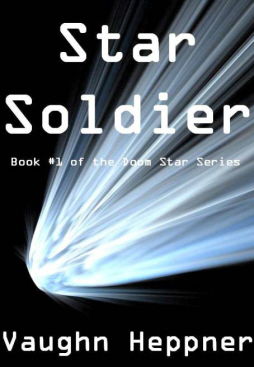
Last month we reported that Black Gate author Vaughn Heppner had cracked the bestseller list at Amazon with Star Soldier, Book #1 of the Doom Star Series.
Star Soldier and its sequels, Bio-Weapon and Battle Pod, now occupy the top three spots at Amazon’s bestseller list for Series Science Fiction in Kindle ebooks, — outselling Dune, Foundation, and many others.
In the general Science Fiction Bestsellers list for Kindle editions, Star Soldier remains solidly at #2, where it’s been for nearly two months.
We’re very proud to offer you an exclusive preview of the first 5,000 words of Star Soldier, an action-packed space opera of the invasion of Earth in 2350, Doom Star pirates, and genetically designed super soldiers caught in a brutal war of extinction.
Read Part One of this article here. Click on images for larger versions.
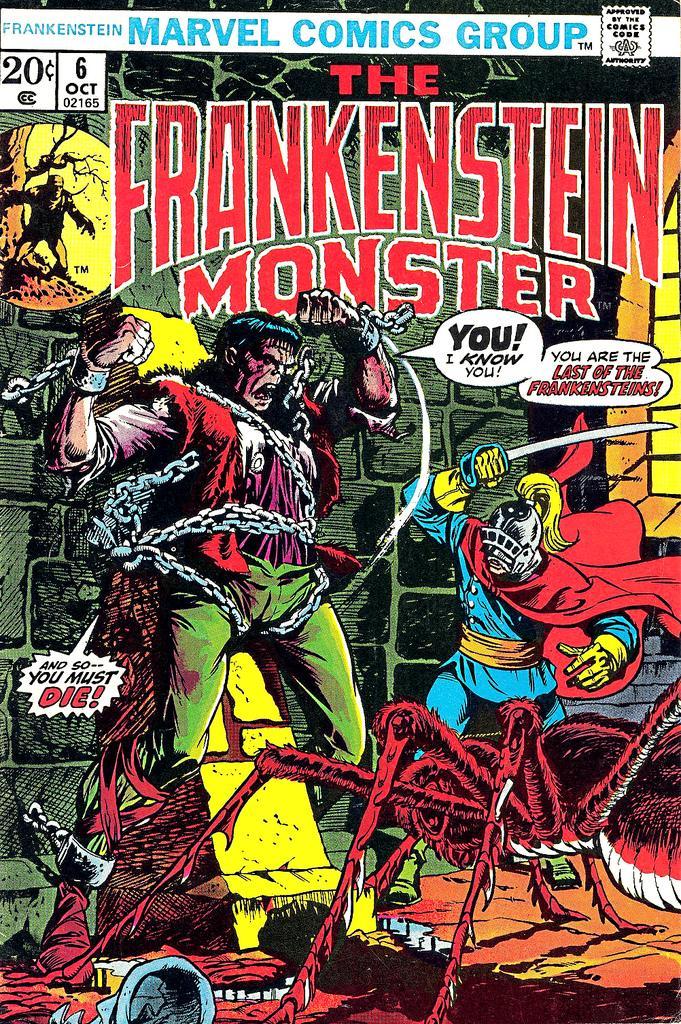
The 19th Century adventures of Mary Shelley’s famous monster following Gary Friedrich and Mike Ploog’s adaptation of the classic novel continued in Issue 5 of Marvel’s The Monster of Frankenstein with another standalone filler story. This time out it is a more serviceable horror yarn that sees the Monster bravely rescuing a beautiful girl from being burned at the stake. She claims that her town is under the spell of a demon dressed in black that only she could resist. The Monster confronts and subdues her abusive father in his quest to end her persecution.
Along the way, there are hints that the girl is not as virtuous as she initially appeared. The Monster learns at the climax that the girl is actually a werewolf. The demon in black is revealed to be the village priest. The story is a familiar yarn having been utilized in numerous other comics and short stories for several prior decades. Gary Friedrich’s script puts the tested story to good use, but this is one of Mike Ploog’s less-inspired issues as artist.
Ploog’s swan song with the series was Issue 6. The title was modified slightly to The Frankenstein Monster starting with this issue. Ploog’s artwork here is simply stunning recalling at times Barry Windsor-Smith’s run on Marvel’s Conan the Barbarian. His Frankenstein Monster also strongly resembles Herb Trimpe’s interpretation of The Incredible Hulk and yet, there is much that is undeniably Ploog’s own brilliant style throughout. This final issue for the artist is his best for the series and does much to underline what made his artwork so beloved by comics fans.
Claire: How do we do this, O’Neill? I’m still new at this website editing.
John: Just type everything I say, Cooney. First, we wanna hype Magill and Sam.
Claire: Easy!
John: Wow, you type fast. This can’t be too long. We’ve got to get right to it.
Claire: Okay. So, dear Black Gate readers, look at this cool thing my friends Magill Foote and Sam Rahn did. It’s so 21st Century. And it makes Black Gate look so cool. Not that it needed any help. And now we just post it? Beneath the cut?
John: No, no, no. It’s gotta be right here! Do it now!
 The episode opens with a young man (Robert), dressed all in black and wearing too much product in his hair, romances a girl (Kristen) in a bar. He is enigmatic and tentative, recoiling at the sight of blood from a papercut. “We can’t be together,” he says. “You think you know me, but you don’t. I’ve done bad things. You should run. Now.”
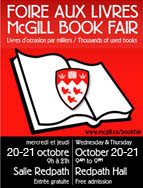 The McGill book fair is the largest English-language used book sale in Montreal. It’s been held for decades, every October, on the second Wednesday and Thursday after Thanksgiving (which in Canada is on the second Monday in October). Every year an eclectic mix of thousands of books are sold, helping to raise money for scholarships.
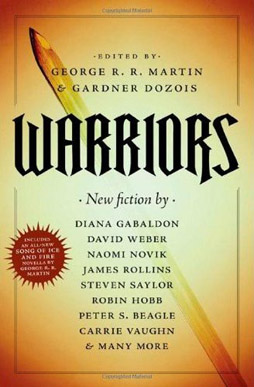 Warriors, edited by George RR Martin & Gardner Dozois

 Last week I was in Seattle and Portland, where I made pilgrimages to venues possible interest to readers here. One was Powell’s Books, which claims to be the largest independent bookstore of both used and new books in the nation. It’s an amazing place, with floors of books in a range of almost every conceivable category that would put any Barnes and Noble “superbookstore” to shame even in its heyday. Needless to say, the science fiction and fantasy aisle alone is something you could easily browse for an hour or two.