Steampunk Spotlight: Scott Westerfeld’s Leviathan Trilogy
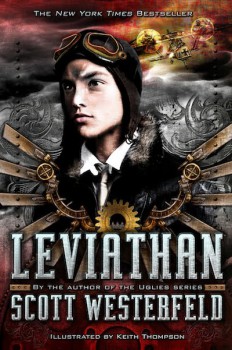
Leviathan (Amazon, B&N)
Scott Westerfeld
Simon Pulse (440 pp, $9.99, Oct. 2009)
Behemoth (Amazon, B&N)
Scott Westerfeld
Simon Pulse (5112 pp, $9.99, Oct. 2010)
Goliath (Amazon, B&N)
Scott Westerfeld
Simon Pulse (543 pp, $19.99, Sept. 2011)
Reviewed by Andrew Zimmerman Jones
Scott Westerfeld’s Leviathan trilogy is an epic about an alternate-history version of World War I … and a great example of how steampunk can really work well when it’s firing on all cylinders (both literally and figuratively). In this, the military conflict isn’t just political, but also centers around an ideological difference about technology. The British and Russians have embraced Charles Darwin’s biological insights to breed massive war beasts, while the German alliance put their faith in mechanical (frequently multi-legged) battle machines.
In addition to the global conflict, the major tension in the story centers around two young characters – one from each side of the battle – who are living with their own secrets in the midst of the war. One is a girl disguised as a boy so that she can serve in the British military upon the living zeppelin Leviathan. The other is a prince (and secret heir to the Austrian Empire) on the run from his own people.
On top of all of that, there’s also a romance … even though one of the participants doesn’t realize it for quite some time.
 I’ve been in unwilling low-content mode for the past couple of weeks (question: what’s worse than getting the flu at Christmas? Answer: getting the flu along with a sinus infection). That’s meant I’ve had some time to read, which is good for a number of reasons. As it happens, though, one of the things I picked up to read left me wondering something I’ve wondered several times before: why do certain books pull me along, and compel me to read them, even when I think they’re not particularly good?
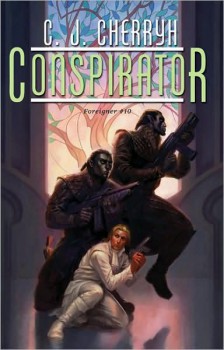 Conspirator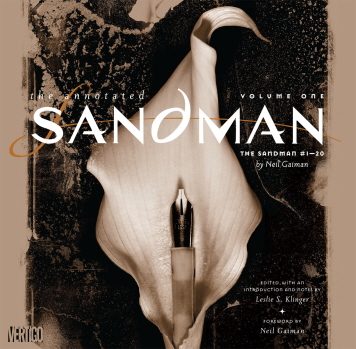
 This month’s Apex Magazine features new fiction from Cat Rambo (“So Glad We Had This Time Together”) and Sarah Dalton (“Sweetheart Showdown”), as well as a reprint of “The Prowl” by Gregory Frost, who is also the featured interview. Stephan Segal provides the cover art and John Hines discusses “Writing About Rape.”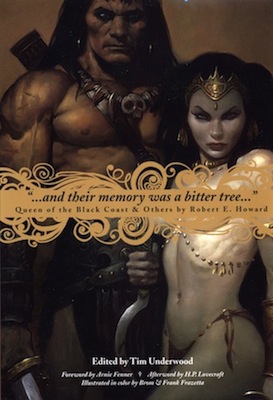

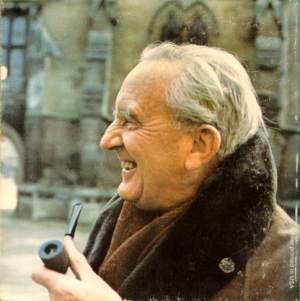 The 1961 nominations for the Nobel prize in literature apparently included The Lord of the Rings,