A Few Words About The Order of the Stick
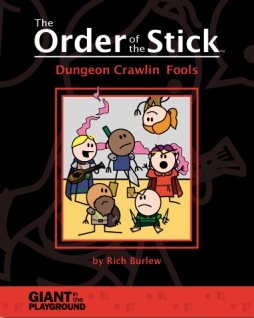 Dying is easy, the old saw has it, but comedy … that’s hard. Only — what happens if we’re talking about a world in which miracles happen to order, and people come back to life whenever a priest wants? Dying suddenly isn’t quite so easy. But comedy, real comedy … that’s still pretty hard.
Fantasy’s no more or less risible than almost anything else in life, and you can find comedic fantasy good, bad, and indifferent. I want to talk about one particular example. Lately, I’ve been rereading a lot of Rich Burlew’s webcomic, The Order of the Stick. It’s a successful, funny fantasy; impressive, since it looks like it should have no business succeeding as well as it does. It’s not just a fantasy comedy, it’s a gaming fantasy comedy. Clearly, the strip’s appeal is going to be somewhat limited.
The main characters are adventurers in a fantasy world that operates according to the rules of Dungeons & Dragons (version 3.5); inevitably a good part of the comedy comes from the characters consciously manipulating the rules of the game, and commenting on its conventions and mechanics. But there’s more to it. The strip isn’t just about the game, nor is it just a showcase for Burlew’s killer sense of humour. The comic’s run for over eight hundred installments up to this point, plus extra stories in various print collections; it’s developed a coherent story, and surprisingly sympathetic characters. It’s gone from a gag strip to a fantasy epic — a nice trick, given that the story’s told with stick figures.
 Prospero in Hell
 Of potential interest to readers of this space is my
 Whenever discussions of fantasy fiction arise, the question of “which came first?” inevitably follows. Newbies mistakenly think that J.R.R. Tolkien started the genre, overlooking authors like William Morris and E.R. Eddison who had already begun a rich tradition of secondary world fantasy. The same arguments swirl over the many sub-genres of fantasy, too. For example, most believe that Robert E. Howard is the proper father of swords and sorcery, beginning with his 1929 short story “The Shadow Kingdom.” But others have pled the case for Lord Dunsany’s “The Fortress Unvanquishable, Save for Sacnoth” (1908), and so on.
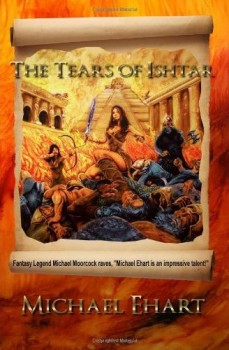 The Tears of Ishtar