Joyce Carol Oates’ Gothic Quintet, Part III: Mysteries of Winterthurn
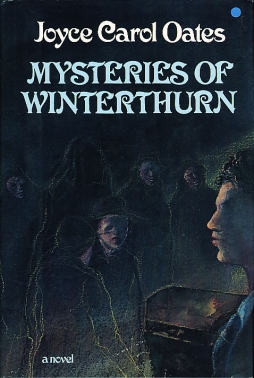 For the past couple of weeks, I’ve been looking at Joyce Carol Oates’s Gothic Quintet, in advance of the publication of the fifth book in the sequence next March. I started off with 1980’s Bellefleur, which I thought was brilliant. Last week I looked at 1982’s A Bloodsmoor Romance, which I found interesting, but not up to the first book’s level, perhaps due to my unfamiliarity with the romance genre. This week, I’ll be looking at Mysteries of Winterthurn, from 1984, which impressed me quite a bit.
Winterthurn plays with the mystery novel as Bellefleur did the Gothic and Bloodsmoor did the romance. Like those books, it both celebrates and subverts its form, and presents a parable whose themes include America, gender, and God. Unlike those books, it also creates a fully-realised community, the city of Winterthurn, against which background its hero investigates three separate cases. I think it succeeds both as a story and as a work of well-wrought prose. It deftly manipulates symbol and theme, while in its pacing and manipulation of suspense, it might well be called genre-savvy; though not necessarily savvy in the genre one would expect.
The book follows detective Xavier Kilgarvan in three separate cases over about two dozen years. In the first case, “The Virgin in the Rose-Bower; Or, The Tragedy of Glen Mawr Manor,” a teenaged Xavier investigates a murder at Glen Mawr Manor, the dwelling of his uncle, Judge Erasmus Kilgarvan, and Erasmus’s three daughters — for one of whom, Perdita, Xavier has conceived a strong attraction. As killings and macabre events continue, Xavier finds himself facing apparently supernatural forces. In the second case, “Devil’s Half-Acre; Or, The Mystery of the ‘Cruel Suitor’,” Xavier returns to Winterthurn in his late twenties, at the height of his fame, to unravel the events around the deaths of five women in a ruined landscape near the city. He draws closer to Perdita, even as his suspicions are drawn to the aristocratic Valentine Westergaard. Finally, “The Bloodstained Bridal Gown; Or, Xavier Kilgarvan’s Last Case” sees Xavier, nearing forty, dealing with a triple murder in Winterthurn — and, again, his love for Perdita.