My home is pretty cool. There are teetering piles of unread books everywhere, ready to topple like late August sunflowers. And if I only had time to review a few, it might be even cooler.
Fortunately, I’m not the only one who lives here. Occasionally, the other inhabitants find something that catches their eye, and when I see that happen I grab a notepad and try and coerce some comments out of them. It’s not the perfect family dynamic, but at least it’s something we do together.
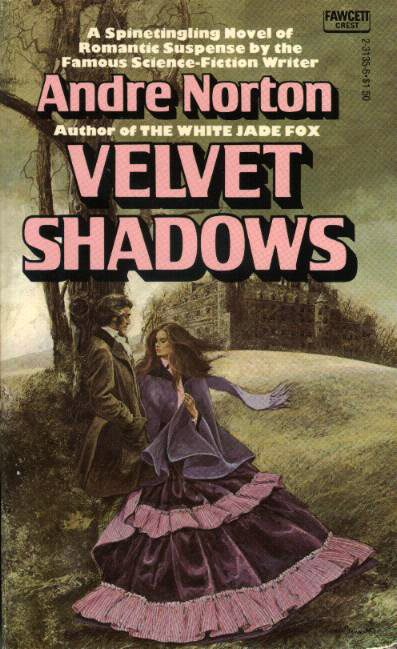
I don’t get to choose what my family reads, obviously, so these reviews-by-proxy tend to be an odd lot (the last one was The House of Dead Maids, which I discovered my daughter enjoying a while back). Last weekend, I noticed my wife had casually picked up a copy of Andre Norton’s Velvet Shadows. I debated for a second before grabbing my notepad. Andre Norton, vintage paperback, gothic romance… Well, close enough to Black Gate territory for our purposes.
What follows is a raw transcript of our conversation, which she agreed to have published here only after I promised not to use her real name on the Internet. Not everyone has a taste for fame, I guess.
John O’Neill: Well, how was it?
Unidentified Reviewer #1: It was terrible.
JO: Okay that’s a little more, uh… concise than our usual reviews. What else you can tell us?
Eugie Foster portrays a god of vengeance in “Trixie and the Pandas of Dread,” Lettie Prell writes about “The Performance Artist” and Tansy Rayner Roberts provides something of a romance in “The Patrician.”
Sarah Kuhn’s column explores the phenomenon of well-known genre figureheads making ill-conceived statements about women genre participants and fans, Maggie Slater interviews Eugie Foster, and editor Lynne M. Thomas’s regular “Blood on the Vellum” column rounds out the 44th edition of this e-magazine.
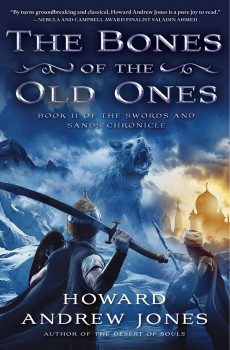
The editors and staff of Black Gate are very proud to note that the Barnes & Noble Book Club’s annual list of The Best Fantasy Releases is thick with Black Gate authors, including Howard Andrew Jones, John R. Fultz, Myke Cole, and Mark Lawrence. Here’s reviewer Paul Goat Allen:
2012 was a surprisingly strong year for fantasy… In fact, several debut novels made my year’s best fantasy list: John R. Fultz’s Seven Princes, Throne of the Crescent Moon by Saladin Ahmed, Myke Cole’s Control Point, and Scourge of the Betrayer by Jeff Salyards.
Mark Lawrence’s sequel to his debut novel Prince of Thorns was absolutely breathtaking; John R. Fultz’s debut was flawless epic fantasy… The sheer diversity of fantasy releases this year was impressive. From the epic fantasy sagas of Fultz, Weeks, and Lawrence to the glorious sword-and-sorcery adventure of Howard Andrew Jones and Saladin Ahmed to the military-powered fantasy of Myke Cole and Joe Abercrombie, the releases of 2012 were as diverse as the realms in which they were set.
While we’re pleased to see Mr’s Jones, Fultz, Cole, and Lawrence get some well-deserved recognition, I can’t say we’re too surprised. Black Gate readers were treated to early work from all four authors — and we recently published generous excerpts from both Prince of Thorns and The Bones of the Old Ones.
And you can read an advance excerpt from the sure-fire candidate for next year’s list, John R. Fultz’s exciting Seven Kings, the sequel to Seven Princes, on sale January 15, 2013.
Howard Andrew Jones is the Managing Editor of Black Gate magazine; his Dabir & Asim stories, “Sight of Vengeance” and “Whispers from the Stone,” appeared in Black Gate 10 and 12. John R. Fultz has published four stories in our pages; his epic sword & sorcery tale, “When the Glimmer Faire Came to the City of the Lonely Eye,” will be published this Sunday as part of our Black GateOnline Fiction line.
Myke Cole’s “Naktong Flow” appeared in Black Gate 13 and Mark Lawrence’s “Bulletproof” will be published as part of our Black GateOnline Fiction line late this Winter.
Paul Goat Allen’s complete list of The Best Fantasy Releases of 2012 is available here.
About a month and a half ago on this blog, I solicited submissions of self-published novels for review. I know firsthand how difficult it is to sell fiction on your own, so I wanted to give some attention to books that are often underappreciated, both by the industry and by readers. I received more than a few submissions–not so many that I was completely swamped, thankfully, but enough that I had to sort through the entries and decide on the one that I thought was most promising. That one was Tiger Lily by K. Bird Lincoln.
I selected this novel because the sample chapter was well-written and the premise was unique and intriguing. However, I was going out of my comfort zone in choosing it. Tiger Lily could be best described as a fantasy historical romance taking place in feudal Japan. I’ll readily admit that that is not my normal reading material. Since I am not as familiar with this subgenre, it’s quite possible that common and accepted tropes of it struck me the wrong way, and that I completely missed things that would bother the normal audience. So in this review, I’ll just point out what worked for me and what didn’t, and those with more familiarity with the subgenre can take what I say with a grain of salt.
The title, Tiger Lily, refers to the main character, Lily-of-the-Valley, who was born in the year of the Tiger, which she blames or credits for every stubborn and rebellious decision she makes. She’s unmarriageable, she’s a failure as a dutiful daughter, and worst of all, she keeps the old ways of Jindo, rather than the new Buddhist religion embraced by the Emperor. The author admits that she sharpened the conflict between Buddhism and Jindo in the novel, as compared to the historical competition between the two faiths in Japan. Though it may be more fantasy than history, this conflict is effective as the driving force in the novel. It’s the main motivation for Lily to keep her connection to the spirits, or kami, hidden, and is the ultimate reason behind the war she finds herself embroiled in, between the Buddhist Emperor and the Jindo-following rebels.
At the beginning of the novel, Lily doesn’t consider herself a follower of Jindo so much as of her vanished mother, who was a true practitioner. She merely enjoys walking alone in the forest, singing the forbidden songs that her mother taught her. Until one day she runs into the local lord’s son, Prince Ashikaga, injured in the forest, and she must protect him from the fox spirit rebels. Her songs are what allow the prince to fight and defeat the rebels in the early skirmishes. Soon she’s swept up in the war against the Jindo rebels, where the prince sees her as the key to success, and maybe as something more. But as they become closer, she learns that the prince has his own secrets. I won’t reveal that here, but if you know that he has a secret (which the book description tells you straight out), it’s fairly obvious what it is.
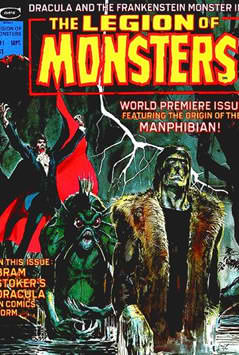
Dracula Lives was Marvel’s companion black and white companion title to the award-winning Tomb of Dracula monthly comic. As a magazine, Dracula Lives was exempt from the strictures of the Comic Code Authority, allowing for more violence and adult themes than would have been possible in the comic at the time. The Legion of Monsters #1 in 1975 and Marvel Preview #12 in 1977 collected three orphan tales – two originally slated for Dracula Lives and the other for Vampire Tales as both titles had ceased publication by this point.
Chapter Seven of Roy Thomas and Dick Giordano’s masterful adaptation of Bram Stoker’s classic was salvaged from Dracula Lives to appear in the debut issue of The Legion of Monsters. The story advances to the point where Professor Van Helsing is brought in by Dr. Seward in an ill-fated effort to save Lucy Westenra’s life. This would be the last installment to see print until the two legendary comics creators reunited decades later to finish the project for Marvel as previously covered in detail in our earlier article on comic adaptations of the Stoker novel.
“Profits are Plunging” was a Steve Gerber solo tale of Lilith, Daughter of Dracula that made its way from Vampire Tales to Marvel Preview. Frank Springer’s artwork is strictly run of the mill, but Gerber’s solid story offers an effective criticism of 1960s idealism giving way to 1970s corporate greed. Martin Gold, the series’ resident Greenwich Village hippie, accepts a PR job to help provide for his pregnant girlfriend, Angel O’Hara. Of course, the conservative capitalists at the chemical company whose compound Martin is supposed to successfully sell to the youth of America are well aware their product will harm both the environment and animal life and are willing to off Martin when he decides to play whistle-blower. This gives Lilith an opportunity to take over her host form of Angel O’Hara to save Martin and take vengeance on the men whose corrupting greed outweighs their respect for life.
Doug Moench’s lost Dracula Lives tale, “Picture of Andrea” is an effective variation on the film noir classic Laura, aided and abetted by the gorgeous artwork of Sonny Trinidad. His depiction of the Lord of Vampires is the equal of Gene Colan. It is appropriate that a story so concerned with the beauty of the human form be graced with an artist capable of illustrating it to perfection.
From Shakespeare to American Werewolf in London, audiences have always appreciated a little graveyard humor. And for those of us who thoroughly enjoy having the snot scared out of us in the theater, there’s almost nothing more sublime than the added adrenaline rush of not being able to decide whether to shriek with horror or laughter.
Therefore it was with double satisfaction that last week I got a look at the opening scene for a new flick called Warm Bodies; once because it furthers my prediction that zombies are the new vampires (following the polyester bell-bottoms that were the Twilight franchise, something had to give…) and twice because the clip was well, just so darn amusing.
Coming to theaters on February 1, just around the time when all of us in cold-weather states can relate to a zombie trapped in an airport terminal, Warm Bodies takes us into the mind of “R” the film’s protagonist zombie played by Nicholas Hoult (late of X-Men First Class and Clash of the Titans) as he tries to make sense of his current situation and potentially save mankind. The cast is rounded out by Dave Franco as “Perry” (James’ younger bro), Teresa Palmer as “Julie” and John Malkovich as “General Grigio.”
The fact that it has John Malkovich alone would be enough to get me to Warm Bodies on opening night.
So is it a horror movie? An action film? A romantic comedy?
Apparently it’s a little of everything including Shakespeare. According to IMDB:
The film is based loosely on Romeo and Juliet. “R” = “Romeo”; “Julia” = “Juliet; “Perry” = “Paris”; “M/Marcus” = “Mercutio”; “Nora” = Juliet’s “Nurse” (the character of Nora is also a nurse).
See for yourself… (embedded trailer after the jump).
Louis West at Tangent Online reviews Aaron Bradford Starr’s latest tale, published here on Sunday, December 30:
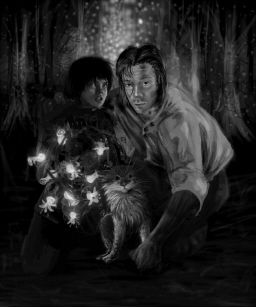
Aaron Bradford Starr’s “The Tea-Maker’s Task” is an entertaining, tongue-in-cheek fantasy about Gallery Hunters Gloren and his cat companion, Yr Neh. Their adventures take them from the rancid food of Burrow Deep Lane in the city of Ravanon to the workshop of a Tea-Making master then through the forests of Candelon, wherein lurks the Walker of the Woods, until they finally reach the ruined city of Vandelon. All the while, Gloren and the cat engage in constant, silent banter, much like two brothers or war buddies… I wanted more.
Gallery Hunters Gloren Avericci and Yr Neh were last seen seeking a legendary treasure in a sunken tower in “The Daughter’s Dowry,” published here on October 14.
You can read Louis’s complete review at Tangent Online, and “The Tea-Maker’s Task,” a complete 9,000-word short story of heroic fantasy, free here.
The complete catalog of Black Gate Online Fiction, including stories by Mark Rigney, C.S.E. Cooney, Donald S. Crankshaw, Judith Berman, Howard Andrew Jones, Dave Gross, Sean McLachlan, Harry Connolly, and Jason E. Thummel, is here.
Call for Backers, Fearful Symmetries, Edited by Ellen Datlow in Conjunction with ChiZine on Kickstarter: An Audio Mini-Interview
This is a very brief interview – I’ll be doing a longer one with Ellen in the next few months. I wanted to catch up with her, though, about her Kickstarter campaign for Fearful Symmetries, an unthemed horror anthology she will edit, published by Chizine. As of right now, the campaign is underway and not yet fully funded. I thought it worth calling people’s attention to it because:
1) Ellen edits amazing anthologies, mixing work by seasoned pros and promising newcomers (and no, she’s never bought anything from me, and likely won’t for this anthology either. She only takes the very best).
2) This campaign was one Ellen purposely undertook the hard way. She could have partnered with a publisher and raised only the amount of money needed for author’s advances, but decided this was a poor precedent to set.
When we finally reached “The Tale of Beren and Luthien,” my Intro to Myth students forgave me for dragging them through the drier, more mythographic early stretches of The Silmarillion. (“It’s as bad as the begats!” the most biblically literate one in the class said of “The Valaquenta,” and then she had to explain the begats to her classmates.) There was a lot to forgive, including a pop quiz on the names of the Valar.
But then: True love! Shapeshifting! Sauron defeated in sorcerous song battle! Fate, doom, oaths upheld at ultimate cost! “The Tale of Beren and Luthien” is cinematic, iconic, perfect for Hollywood at its best and worst. My disgruntled undergrads adored it.
They’re not the only ones who’ve ever wished it could be a movie.
Shake Google, and at least one fan film falls out, along with intermittent fan forum discussions of ideal directors, casting, and adaptation decisions. I gather the Tolkien estate is unlikely to authorize films of stories that made their first published appearances after Tolkien’s death. Fair enough. If I were looking back from the afterlife of my imagining and saw my rough drafts, cobbled together by my long-suffering literary executor, adapted by strangers into Hollywood films, I too might… no, actually, I wouldn’t object at all. Now that I think of it, I’d feel immensely honored by the effort, amused by its inevitable shortcomings, and relieved that my family might finally see some benefit from my years of toiling in proverbial obscurity. But hey, that’s just me. If Tolkien’s son thinks the professor would be displeased, he’s in a better position to know than any of the rest of us.
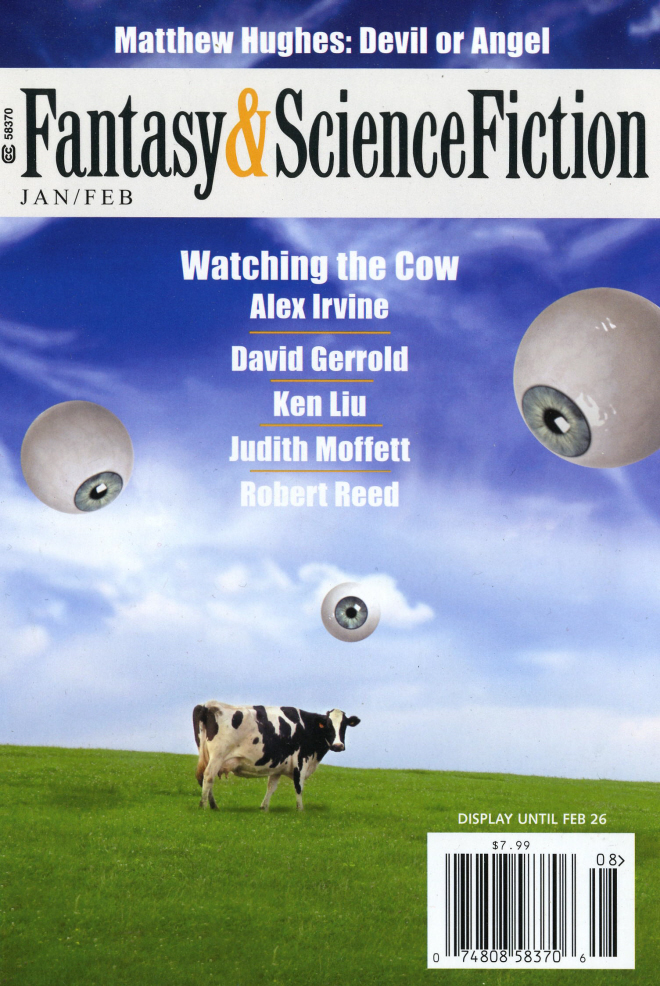
The new issue of Fantasy & Science Fiction goes on sale today. Not often you see cows (or floating eyeballs, for that matter) on the cover. Louis West reviews the issue at Tangent Online; here’s what he says about the cover story:
This issue of F&SF contains a diverse and (mostly) entertaining selection of SF, horror, and fantasy stories. Many of the authors have a long history of producing award-winning work. For the most part, that excellence is displayed throughout this issue.
“Watching the Cow,” by Alex Irvine, is masterfully told. Once started, I couldn’t stop. I had to know how it would end, and the end was nicely unexpected….
Ariel, the genius of the family, has accidently blinded two million teens who had been playing a game using VR goggles. And two of the kids were her brothers. But it wasn’t a physical blindness. All the parts still worked. The brain simply had stopped processing the visual data. The kids didn’t seem bothered at all, although the parents freaked and conspiracy theories thrived.
Ariel was determined to fix the problem, and her angry brother believed her. Instead of sight, all the kids could now mentally network with each other… This story is told from Ariel’s brother’s POV. It follows his emotional roller-coaster ride as he deals with what’s happening to his kids, their lack of reaction, keeping the secret that his sister had caused the problem and wondering when the FBI will finally catch up to him and Ariel. A pleasure to read.
 My home is pretty cool. There are teetering piles of unread books everywhere, ready to topple like late August sunflowers. And if I only had time to review a few, it might be even cooler.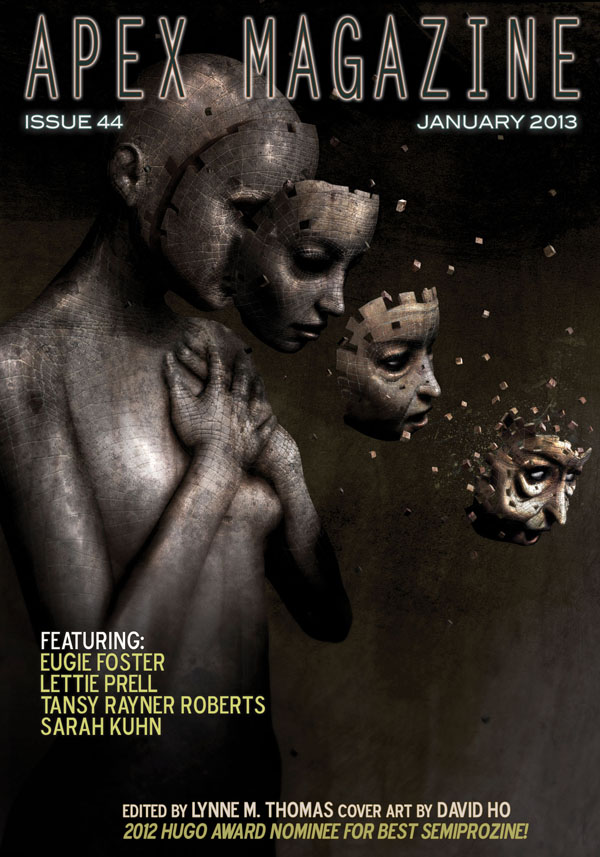
 The editors and staff of Black Gate are very proud to note that the Barnes & Noble Book Club’s annual list of The Best Fantasy Releases is thick with Black Gate authors, including Howard Andrew Jones, John R. Fultz, Myke Cole, and Mark Lawrence. Here’s reviewer Paul Goat Allen:

 This is a very brief interview – I’ll be doing a longer one with Ellen in the next few months. I wanted to catch up with her, though, about her
  When we finally reached “The Tale of Beren and Luthien,” my