Fritz Leiber is one of the grand names of f&sf, winner of six Hugo Awards, three Nebula Awards, and two World Fantasy Awards. He is a member of the SF Hall of Fame, a SFWA Grandmaster, and a lifetime achievement recipient from the World Fantasy, Bram Stoker, and Forry Awards. You wouldn’t think any novel of his from the epicenter of his career could be obscure, neglected, or forgotten. And yet, there’s the case of The Silver Eggheads.
As a novelet, “The Silver Eggheads” graced the cover of the January 1959 F&SF, normally as prestigious a slot available at the time. Yet the story has never been anthologized nor ever included in one of his three dozen collections. Possibly that’s because Leiber expanded it to novel length, published as an original paperback by Ballantine in 1962. (Yes, that is a Richard Powers cover, one of the few representational ones he did.) Ballantine reprinted it twice, but no other American publisher has touched it. This novel has been out of print in English for almost 40 years. A few foreign editions slipped in, for multilinguists and obsessive collectors.
Richard Lupoff was born on February 21, 1935. He edited the fanzine Xero, which included articles from Avram Davidson, L. Sprague de Camp, and Roger Ebert. In 1963, Lupoff and his wife, Pat, received a Hugo Award for Best Amateur Magazine for their work. In 2005, a hardcover The Best of Xero would be nominated for a Hugo for Best Related Work.
He published his first novel One Million Centuries, in 1967 and is perhaps best known for Circumpolar! and Circumsolar! Lupoff is not averse to using pseudonyms such as Ova Hamlet or Addison E. Steele. He collaborated on the graphic novel The Adventures of Professor Thintwhistle and His Incredible Aether Flyer with Steve Stiles. Lupoff edited three volumes of short stories he felt should have won the Hugo Award (What If? Volumes 1-3).
“Black Mist” was originally published in the April 1995 issue of Omni Online. Orson Scott Card reprinted it in Black Mist and Other Japanese Futures and Lupoff included it in his collection Claremont Tales. The story was also reprinted in Robert Reginald’s To the Stars—And Beyond: The Second Borgo Press Book of Science Fiction Stories.
Many stories set in the far future of space exploration select a human culture and have them expand into space, as L. Sprague de Camp did with his Viagens Interplanetary series. Often these space-faring cultures have little to do with the original terrestrial country beyond nomenclature. In “Black Mist” Lupoff has postulated a future in which Japan has taken over planetary exploration after the United States and Russia’s programs have collapsed.
The Japanese are attempting to terraform Mars and part of that effort takes place from a small outpost on Phobos. Not only do Japanese ideas of honor and caste play a big role in the story, but other aspects of Japanese society are interwoven and provide an integral part of the plot. “Black Mist” opens with a lowly kitchen worker, Jiricho Toshikawa, discovering the murdered body of a scientists on Phobos. When the body disappears, the head of operations on Mars sends his friend Hajimi Ino to investigate the disappearance.
For the last few years the major streaming players — Netflix, HBO, Amazon, Hulu, and others — have spent untold millions searching for the next Game of Thrones. A tale of dark magics, black-hearted evil, kings and princes, palace intrigue, war, treachery, and sex. I could have saved them a lot of time if they’d just asked me. I would have recommended they film John M. Ford’s The Dragon Waiting.
The Dragon Waiting: A Masque of History was published in 1983. It’s a sprawling alternate history that combines Richard III, Edward IV, the Princes in the Tower, the Medicis, and vampires. Edward IV sits on the throne of England, but his kingdom is threatened by an expansionist Byzantine Empire. The Vampire Duke Sforza is massing a dark army against Florence, and Byzantium is on the march. High in the Alps four people come together: the exiled heir to the Byzantine throne, a beautiful physician forced to flee Florence, a Welsh wizard, and a German vampire. Together they wage a secret campaign against the entire Byzantine Empire, to secure the English throne for Richard, Duke of Gloucester, the future Richard III.
As I wrote last time, this excursion through the bookshelves of my younger days was inspired by the recent death of Ursula K. Le Guin. I haven’t read much Le Guin outside the Earthsea books; most of her work hasn’t appealed to me. But the Earthsea books, especially the initial trilogy — A Wizard of Earthsea (1968), The Tombs of Atuan (1970), and The Farthest Shore (1972) — did and, I was glad to find out, still do.
In my article, “Why I’m Here: Part Two,” I described the Elric books as being like samizdat passed around between my friends and me. With so few books actually out there, we fellow fantasy fans read anything we could find, and in turn got it all into everyone else’s hands and read everything they passed along to us. After The Lord of the Rings, I’m sure there were no books as read, and read as often, as Le Guin’s three slender volumes.
There are several whys. The easiest is they are way cool, at least the first and the third. The second is more of a Gothic, and lacks the dragon-battling and dark magic of the others, like this:
Richard Matheson was born on February 20, 1926 and died on 2016. His first published story was “Born of Man and Woman,” which was nominated for a Retro-Hugo.
He received the World Fantasy Award for his novel Bid Time Return, which was turned into the film Somewhere in Time, starring Christopher Reeve and Jane Seymour. He also won the World Fantasy Award for his collection Richard Matheson: Collected Stories, which also received the Bram Stoker Award. Matheson has received lifetime achievement awards from both World Fantasy and Bram Stoker and was declared a living legend by the International Horror Guild.
The World Horror Society named him a Grand Master in 1993 and he was inducted into the Science Fiction Hall of Fame in 2010. His novel I Am Legend has been filmed numerous times under different names as has The Incredible Shrinking Man. In addition to his career as a novelist and short story writer, Matheson has written screenplays for a variety of television episodes.
“Third from the Sun” was purchased by H.L. Gold and published in the October 1950 issue of Galaxy Science Fiction. Gold reprinted it in Galaxy Reader of Science Fiction and Matheson has included it in multiple collections of his work. It was reprinted in the children’s anthology Beyond Belief and in The Twilight Zone: The Original Stories. It was adapted by Rod Serling for the first season of The Twilight Zone, starring Fritz Weaver and Denise Alexander. The story has been translated into French (twice), German, and Italian.
Matheson followed his stunning debut story, “Born of Man and Woman” with a more pedestrian outing in “Third from the Sun,” a story with a twist that is ruined by its title. Matheson tells the story of a man and woman who are clearly planning on stealing a spaceship and fleeing the earth with their children and neighbors ahead of a cataclysm. Their ability to do so it made possible by the man’s position within the space program.
While Storm Seed is the final volume in the iconic Sacred Band series to appear in a brand-new, Author’s Cut edition, it isn’t the last book in the series. The story takes place after the Sacred Band has been disbanded, after the events in Beyond Wizardwall and The City at the Edge of Time. Storm Seed follows on the heels of Tempus Unbound, and precedes the epic story of The Sacred Band.
Once again Team Morris delivers another outstanding novel in their classic “Chronicles of the Sacred Band,” as I always refer to them. Crisp prose, engaging characters, and a well-crafted plot carry this one right to the very end. This is Heroic Fantasy on a grand and epic scale, inspired by ancient mythology merged with a “lost” history of the world. All the tropes of the genre are here: wizards, witches, magic, ghosts, gods, dragons, and so much more. But these ingredients are used with a weight of reality to them, and in a manner I can only describe as “uniquely Morris.” Storm Seed is a story about love and loyalty, family and comradeship. And for all the elements of the fantastic, this novel is grounded in the veracity of its characters, and in the human drama and dynamics of their relationships. Almost everyone has a quest of their own to undertake, and the story unfolds at a brisk pace as the various events take one twist and turn after another until all the characters and plot-lines come together.
It seems like a reunion as so many characters from previous novels return to share the stage. Team Morris does a splendid job of giving the members of their cast equal time; almost everyone has a storyline of their own. Tempus the Black and Niko, his right-side companion, are here. Also present and accounted for: the goddess Jihan, the powerful Froth Daughter; Randal the allergy-prone wizard; Roxane the witch you really don’t want to get involved with; Cime the wizard slayer who is a real force to be reckoned with; Kama, Tempus’ daughter and warrior. The Sacred Banders Strat, Crit, and Gayle are also here, as well as Enlil the Storm God, Abarsis the Slaughter Priest, and even Strat’s Ghost Horse.
When Jim Baen left Ace to found Baen Books in 1983, he implemented a publishing strategy that served him well for decades: buying up the back catalog of popular authors and re-issuing them in visually similar covers that could be identified at a glance on crowded bookstore shelves. It was a strategy he learned while working under Tom Doherty at Ace Books from 1977-1980 (and refined under Doherty at Tor Book from 1980 – 1983).
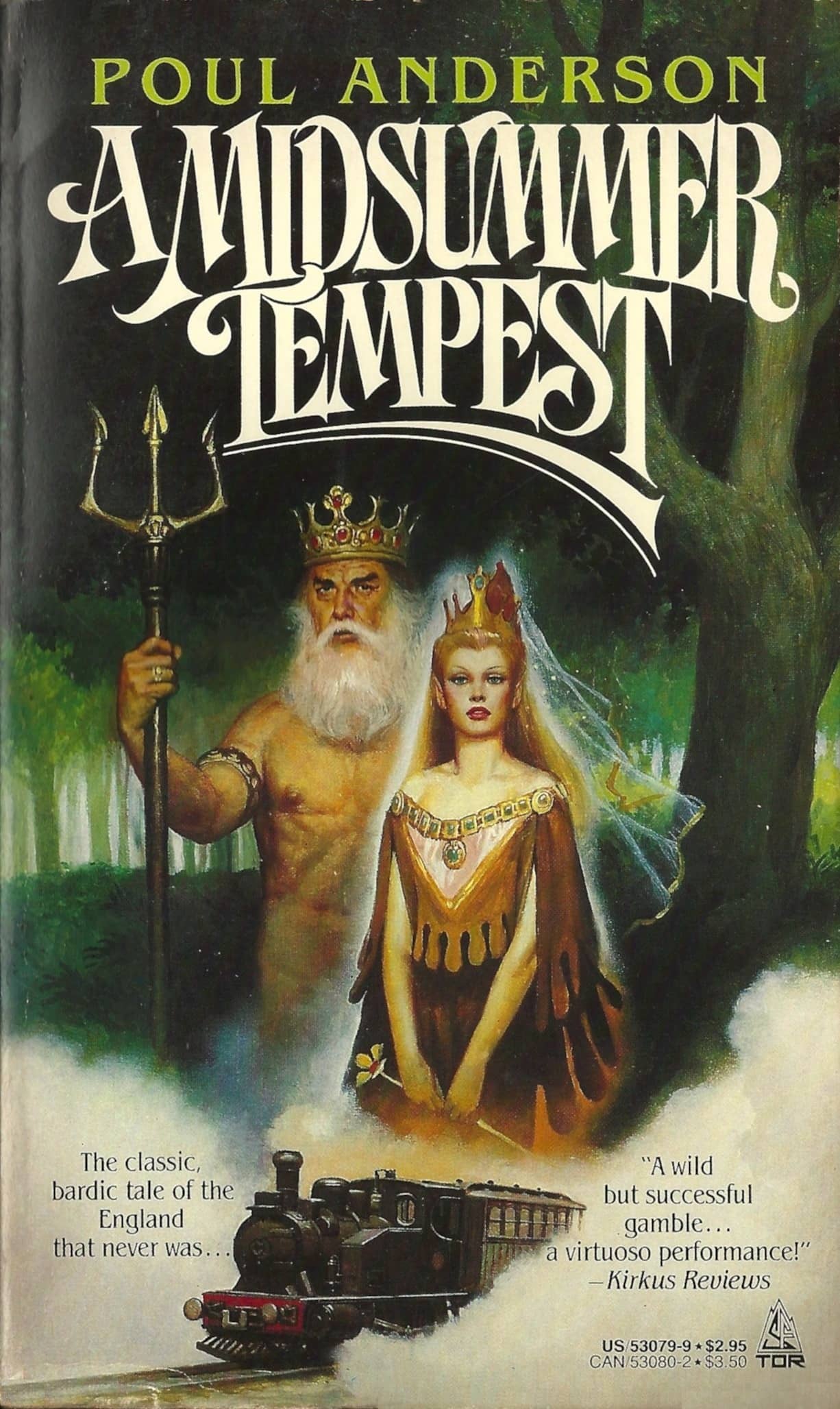
While at Ace, Baen’s genius was to marry popular authors that had substantial back catalogs — like Andre Norton, Gordon R. Dickson, and Keith Laumer — with brilliant new cover artists. For me the exemplar of this strategy was Poul Anderson’s late 70s Ace editions, given new life by the striking world of a rising new artist named Michael Whelan.
When Richard Powers single-handedly remade science fiction art in the late 60s, it wasn’t long before bookshelves were overrun with abstract art. SF paperbacks, once criticized for pulp-era sameness and tired spaceship motifs, now suffered from a very different but no less stifling form of sameness. Plenty of writers were victims of the “Powers revolution” in SF art in the 1960s, but I think Poul Anderson was more victimized than most. His colorful tales of science fiction adventure on far planets were sold to the public under abstract covers that told them nothing about what they were getting.
Andre Norton was born on February 17, 1912 and died on March 17, 2005. She began publishing with “People of the Crater,” using the pseudonym Andrew North (reprinted in 2003 in my anthology Magical Beginnings).
Over the years, she published numerous short stories and novels, including the various stories of the Witch World cycle. She also published the first Dungeons and Dragons tie-in novel, Quag Keep, set in Gary Gygax’s World of Greyhawk. In addition to her own novels, she collaborated with a variety of authors including Rosemary Edghill, Jean Rabe, Mercedes Lackey, Lyn McConchie, Susan Shwartz, Julian May, Marion Zimmer Bradley, P.M. Griffin, Sherwood Smith, Dorothy Madlee, Sasha Miller, and more.
From 1999 through early 2004, Norton organized the High Hallack Library, a research library and authors retreat in Tennessee. The library, along with her collaborations, were only a few of the ways Norton helped shape new generations of authors. Many authors claimed Norton as an influence on their own styles, even if they didn’t work directly with her. She edited the Catfantasticanthologies with Martin H. Greenberg and the Magic in Ithkar series with Robert Adams. Other anthology series allowed authors to write in her Witch World series.
Norton was named the first female SFWA Grand Master in 1984. She received the Phoenix Award in 1975, the Skylark Award in 1983, the Big Heart Award in 1988, and the Forry Award in 1989. In 1994, she was inducted into the First Fandom Hall of Fame and was the first woman inducted into the Science Fiction Hall of Fame in 1997. In 1998, the World Fantasy Convention gave her a Lifetime Achievement Award (11 years earlier, they gave her a Special Convention Award). When SFWA created a Young Adult Award in 2005, it was named in honor of Norton. She received the only Coveted Balrog Award for Lifetime Achievement in 1979 and was named a Gandalf Grand Master of Fantasy in 1977.
“The Gifts of Asti” was originally published under Norton’s Andrew North pseudonym in the July 1948 issue of Fantasy Book, edited by Garret Ford. The next year, it was reprinted in Griffin Booklet One and was included by Sam Moskowitz in The Time Curve in 1968. Norton used it in The Many Worlds of Andre Norton (a.k.a.The Book of Andre Norton). It was the title story in Roger Elwood’s The Gifts of Asti and Other Stories of Science Fiction and editor Jane Mobley used it in the anthology Phantasmagoria: Tales of Fantasy and the Supernatural. Spastic Press opened Anthology of Sci-Fi: The Pulp Writers: Volume I with the story and it was also reprinted in Tales from High Halleck: The Collected Short Stories of Andre Norton, Volume I in 2014.
Jack Dann was born on February 15, 1945. His novels include The Man Who Melted, The Memory Cathedral, and The Silent, among many others. Dann has edited several anthologies, often in conjunction with Gardner Dozois, Janeen Webb, or George Zebrowski. He edited the Jewish science fiction anthology Wandering Stars in 1974 and followed it up with More Wandering Stars.
Dann won the Nebula Award for Best Novella for his 1995 story “Da Vinci Rising” and has won the World Fantasy Award for Best Anthology twice, for Dreaming Down Under, edited with Janeen Webb, and Dreaming in the Dark. His anthology Ghosts by Gaslight, edited with Nick Gevers, won the Shirley Jackson Award and the Aurealis Award. He also won the Aurealis Award for his short story “Niagara Falling,” written with Webb, and his novel The Memory Cathedral. “Niagara Falling” also earned him his first Ditmar Award, which was followed up with anthology awards for Dreaming Down Under, Dreaming Again, and Dreaming in the Dark and a short fiction award for “The Diamond Pit.” In 2004, he received the Peter McNamara Award for a professional working in the Australian SF field.
“Rings Around the Moon” was originally published in Polyphony 3, edited by Deborah Layne and Jay Lake. It was later reprinted in Dann’s collection Promised Land: Stories of Another America. “Rings Around the Moon” is part of Dann’s “The Rebel” cycle, which includes several stories as well as the 2004 novel The Rebel: An Imagined Life of James Dean. The story was nominated for the Darrell Award for best Mid-South science fiction, fantasy, or horror.
Mostly told from the viewpoint of a young Elvis Presley, “Rings Around the Moon” opens in Memphis on the evening of September 30, 1955, around the time his career was starting to take off. Unfortunately for Elvis, his burgeoning touring career, and the rumors of his sexual escapades, are putting a strain on his relationship with Lizzie, his girlfriend. As the two are trying to figure out what their relationship is, Gladys Presley informs them that the actor Elvis is always talking about, James Dean, has been injured in a car accident.
Elvis decides he needs to visit Dean and asks Lizzie to go with him. The set up allows Dann to explore the blessings and curses of fame through a fictitious meeting between two of the most legendary individuals of the burgeoning 1950s youth culture. James Dean lying in his hospital bed recovering, and the young Elvis having his first taste of stardom listening to what Dean has to say.
Russian science fiction writers Boris and Arkady Strugatsky are the authors of a pair of acknowledged classics, Hard to Be a God (which Zeta Moore reviewed for us here) and Roadside Picnic (1977). Their books were introduced to a broad audience in the US in the 1970s by Donald Wollheim at DAW Books. Over a dozen of their novels have been translated into English, including The Ugly Swans (1972), The Final Circle of Paradise (1976), Monday Begins on Saturday (1977), Prisoners of Power (1977), and The Time Wanderers (1987).
When I recently discovered there was a Strugatsky paperback I didn’t have, The Snail on the Slope, it was bittersweet. On the one hand, it’s always a delight to find a new object of interest. On the other hand, copies on eBay started at $30, and on Abe Books anywhere from $40 and up. (I suppose I can’t be too cranky. The vast majority of genre paperbacks from the 70s and 80s have declined in value over the past 40 years; it’s good to see the vintage paperback market has at least a few hot spots.)
But what’s the deal with the skyrocketing prices for a pair of relatively obscure Soviet-era science fiction writers? Fifteen years ago you could have had virtually any of their paperbacks for a song.