Browsed by
Category: Vintage Treasures

Anne McCaffrey, April 1, 1926 – November 21, 2011

Anne McCaffrey, April 1, 1926 – November 21, 2011

weyr-searchAnne McCaffrey, one of the most loved SF and fantasy writers of the 20th Century, died yesterday at her home in Ireland.

McCaffrey is probably best known for her Dragonriders of Pern novels, which began with the novella “Weyr Search” in Analog in October, 1967.

“Weyr Search” won the Hugo Award for Best Novella; its sequel “Dragonrider” (published in two parts in Analog in December 1967 and January 1968) was awarded the Nebula.  The two stories were collected as the first Pern novel Dragonflight, first published by Ballantine Books in July, 1968.

That was followed by an incredible 22 novels and two collections of short stories (some co-written with her son Todd), including The White Dragon (1978), the first hardcover SF novel to become a New York Times bestseller.

McCaffrey was a very prolific writer, with more than 100 books to her credit. Her first novel was Restoree (1967), and she had a real talent for series — including the Crystal Singer series, Freedom, Doona, Dinosaur PlanetBrain & Brawn Ship, Acorna, and many others. [I know — crazy, right? The only comparable modern author I can think of who has nearly this many popular series  is L. E. Modesitt.]

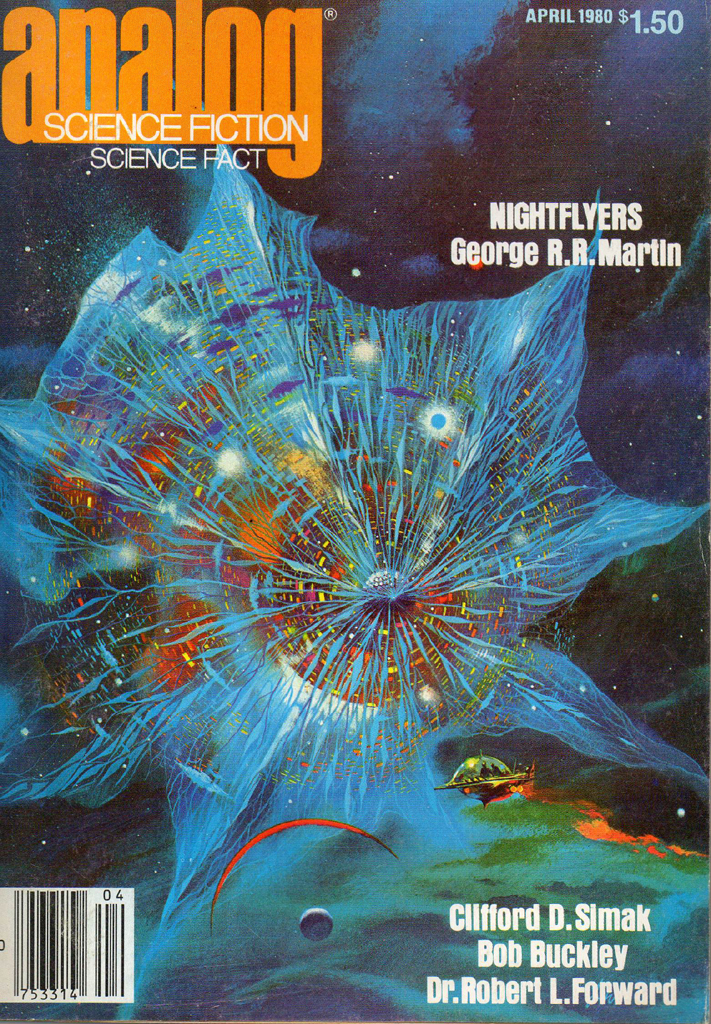
I recently bought a collection of vintage Analog magazines, and came across the one above, with the “Weyr Search” cover by John Schoenherr. It reminded me that those were the days when genre magazines could catapult you to the very peak of the profession, something far more rare today. McCaffrey had published only a handful of stories and her first novel (barely) when “Weyr Search” appeared… within a year she had won both the Hugo and Nebula, and published the first novel of a series that would make her a bestselling writer.

In addition to stellar sales, Anne McCaffrey was highly honored by fans and her fellow writers. She won the Robert A. Heinlein Award in 2007, became a SFWA Grand Master in 2005, and was inducted into the SF Hall of Fame in 2006.

The Nightmare Men: “The Judge”

The Nightmare Men: “The Judge”

fearful-rock-other-precarious-locales-selected-stories-manly-wade-wellman-hardcover-cover-artA man of great height and greater girth, Judge Keith Hilary Pursuivant, after retiring from the bench, devoted his golden years to investigating the occult in the works of North Carolina author, Manly Wade Wellman. Pursuivant, with his broad bulbous nose and protruding, warm eyes, was one of a half-dozen occult investigators created by Wellman over the course of his career, though the Judge has the distinction of being the first, and, in many ways, the most important of the lot.

Pursuivant made his first appearance in Weird Tales in 1938, in the story, “The Hairy Ones Shall Dance”, wherein the Judge faced off against a werewolf. He appeared in Weird Tales three more times from 1938 to 1941, in “The Black Drama”, “The Dreadful Rabbits”, and “The Half-Haunted”, respectively facing off with a vampiric Lord Byron, demon-rabbits and ghosts. All of these stories have been anthologized on a number of occasions, and have all been collected in the 2001 Nightshade Books collection Fearful Rock and Other Precarious Locales.

Besides the aforementioned four tales, Pursuivant appeared as a supporting character in a number of Wellman’s other stories, including his Silver John novel, The Hanging Stones, where he aids John the Balladeer, another of Wellman’s occult investigators, in combating a tribe of inbred, druidic werewolves. And, even if he doesn’t appear, Pursuivant is likely mentioned…indeed, the Judge looms over Wellman’s other occult investigators like a guardian angel, wielding knowledge, wit and wisdom in support of humanity’s more active defenders.

Read More Read More

The Nightmare Men: “The Ghost-Seer”

The Nightmare Men: “The Ghost-Seer”

9781840225396Aylmer Vance, agent of the enigmatic Ghost Circle, made his first appearance on the nightmare stage in 1914. The creation of husband-and-wife writing team Alice and Claude Askew, Vance appeared in eight consecutive issues of The Weekly Tale-Teller between July and August. The stories-“The Invader”, “The Stranger”, “Lady Green-Sleeves”, “The Fire Unquenchable”, “The Vampire”, “The Boy of Blackstock”, “The Indissoluble Bond” and “The Fear”-ranged from grotesque to gentle, and are, by and large, of a slower pace than those featuring Vance’s contemporaries, such as Carnacki. Only one of the stories has been regularly anthologized (“The Vampire”), with the rest languishing in obscurity until the release of recent collections by Ash-Tree Press and Wordsworth Editions respectively.

Like John Silence, Vance inhabits an England of soft spiritual influence, where elementals, ancient memories and ghostly manifestations cling to the unseen corners and visit just long enough to inject the mundane with a booster shot of the strange. Unlike Carnacki’s Outer Monstrosities and Malign Visitors, the apparitions that Vance faces are utterly human in their aspect, if not their motivation. Death is no barrier to the desires of the flesh or the dreams of the determined, and it is when these elements intrude on the hard-won peace of the Edwardian mind that the Ghost-Seer must intervene.

Read More Read More

The Seven Greyhawk Classics of the Ancient World

The Seven Greyhawk Classics of the Ancient World

against-the-giants1I’ve been pretty hard on Greyhawk novels. They’ve been the butt of more than a few jokes — both mine and others — from those of us who enjoy reviewing and talking about the fantasy genre.

I’m generally pretty forgiving, especially with novels of adventure fantasy. What can I tell you — I’m a fan.  But when books can’t be bothered to clamber over the very low bar of my expectations, I’m as capable of a harsh review as anyone.

The novels of Gary Gygax — and in particular his Greyhawk books — routinely limboed under that bar with room to spar, and I’ve said as much in print several times over the years.

Now, I’m second to none in my admiration of Gygax. I consider the man one of the great creative minds of the 20th Century, full stop.

I believe his work with D&D and Advanced D&D — especially the original hardback rules, and the incredibly inventive adventure modules that accompanied them, such as Descent into the Depths of the Earth and The Temple of Elemental Evil — was directly responsible for the mainstream acceptance of fantasy, as manifested in modern role playing obsessions like World of Warcraft and Warhammer.

But his novels?  Poo poo.

tomb-of-horrorsHowever, Gygax wasn’t the only one to pen Greyhawk novels.

Some of them — especially the so-called Greyhawk Classics published in honor of TSR’s 25th anniversary — are remembed quite fondly.

Written by Paul Kidd, Ru Emerson, Keith Francis Strohm, and Thomas M. Reid, and based on some of TSR’s most famous adventure modules, including Against the Giants, Tomb of Horrors, and Keep on the Borderlands, the seven Greyhawk Classic novels formed a nostalgic return to some of the most fondly-remembered adventure settings in gaming.

They were published in mass market paperback by TSR (later Wizards of the Coast) between July 1999 and February 2002, beginning with Against the Giants and ending with Tomb of Horrors.

Here’s the other thing you need to know about the Greyhawk Classic novels: you can’t have them.

They’re among the most collectible D&D novels ever published, and that’s saying something.

Read More Read More

Little Lulu Volume 25: The Burglar-Proof Clubhouse and Other Stories

Little Lulu Volume 25: The Burglar-Proof Clubhouse and Other Stories

little-luluDuring my heyday as a young comic collector — from maybe 1973-1977 — I primarily chased Marvel titles, with the occasional DC offering like Legion of Super-Heroes, and a smattering of Charlton comics such as Blue Beetle. Like most ten-year-old collectors I scorned kid’s comics, of course.

At least in public. Behind closed doors, I loved virtually all comics, and read whatever I could get my hands on: Archie, Uncle Scrooge, Casper the Friendly Ghost, and even Little Lulu, which featured the comparatively tame adventures of Lulu Moppet and her neighborhood friends as they hunt for wild turkeys in the local woods, solve the mystery of a missing tea cup, and go to school.

I only recently discovered that Dark Horse Comics has reprinted over a decade’s worth of Little Lulu in 29 volumes (!!), many of them in full color. A pretty staggering feat of cultural scholarship, sure, but I have to admit my initial reaction was “Who the hell wants to read that much Little Lulu?”

Me, as it turns out.

Just as I did roughly 40 years ago, I slipped a copy of Little Lulu into a stack of larger comics when I thought no one was looking.  Back then it would go between Amazing Spider-man and Grimm’s Ghost Stories, just before I marched up to the drug store counter with my stack of quarters.  Last week, I quietly added it to my Amazon cart between Hellboy, Volume 1 and Marvel’s collected Son of Hulk, when my kids were in the other room. Listen — no matter how old you are, the scorn of children is a terrible thing.

As soon as that package arrived, it wasn’t Hellboy or Son of Hulk I opened first. It wasn’t even Star Wars: Knights Of The Old Republic, Volume 7, and that baby had storm troopers on the cover. No. It was Little Lulu.

Read More Read More

The Nightmare Men: “The Ghost-Finder”

The Nightmare Men: “The Ghost-Finder”

Carnacki!William Hope Hodgson’s Carnacki outlived his creator with a tenacity that Hodgson, a bantam rooster of a man, would have appreciated. Thomas Carnacki, resident of 472 Cheyne Walk, London, first appeared in a series of five stories (“Gateway of the Monster”, “The House Among the Laurels”, “The Whistling Room”, “The Horse of the Invisible”, and “The Searcher of the End House”) in The Idler Magazine in the January through April, as well as June, issues of 1910. But despite Hodgson’s death in World War I, Carnacki carried on in a further four stories (“The Thing Invisible”, “The Hog”, “The Haunted Jarvee” and “The Find”) retrieved from Hodgson’s papers by his wife. All nine stories are available in a variety of printed, electronic and audio forms.

But that wasn’t the end. Carnacki’s career was further chronicled by other writers, including A. F. Kidd, Andrew Cartmel, Barbara Hambly, Alberto Lopez Aroca, Kim Newman, Willie Meikle and Alan Moore. He battled evil alongside the Second Doctor and Sherlock Holmes, as well as Mina Murray’s League. He appeared on television, played ably by Donald Pleasance. He’s even inspired a concept album! But in each of his incarnations, Carnacki combined ancient sorceries and Edwardian science to face the squealing, swine-faced threats of the Outer Void.

Read More Read More

The Nightmare Men: “Physician Extraordinary”

The Nightmare Men: “Physician Extraordinary”

john-silence

‘Rich by accident and a doctor by choice, John Silence took only those cases which interested him.’

The above is from “A Psychical Invasion” (1908), the first of Algernon Blackwood’s stories to feature Dr. John Silence, the ‘psychic doctor’.  Blackwood chronicled six of Silence’s cases, though only five appear in the initial collection, John Silence (containing “A Psychical Invasion”, “Ancient Sorceries”, “The Nemesis of Fire”, “Secret Worship”, and “The Camp of the Dog”; “A Victim of Higher Space”, the sixth story, was included in later collections) released in 1908 (then re-issued in 1942). Even if you can’t get your hands on one of the many reprint collections (or on the 1942 re-issue as I was lucky enough to do), you can rest easy…Blackwood’s work is in the public domain and is freely available from a variety of electronic sources.

The stories themselves are in the inimitable Blackwood style, seen at its most effective in “The Wendigo” and “The Willows”, and display the author’s interest in the occult. The horrors that Silence faces are nebulous things, at once more vast than the horizon and smaller than the inside of a cupboard. They range from nightmare assaults out of deep time to unrequited yearnings gone impossibly savage, originating in both human action as well as from events far outside of human understanding. Time and space are suggestions at best, and as in the works of Hodgson and Lovecraft, reality itself comes under assault from outside entities which seek to impose themselves on their victims.

Enter John Silence, MD.

Read More Read More

The Nightmare Men: “A Doctor, Darkly”

The Nightmare Men: “A Doctor, Darkly”

800px-carmillaIt’s always best to begin at the start, to quote no one in particular. We’ll start with the introductions: my name is Josh Reynolds and I wanted to be a detective when I grew up…no, not just a detective.

I wanted to be an occult detective. I wanted to be Donald Pleasance hunting down the Horse of the Invisible, or Peter Cushing making a cross out of candlesticks and shoving them right all up in Christopher Lee’s fang-y mug. I wanted to be Carl Kolchak, Thomas Carnacki and Dr. Strange. I wanted to bust up eldritch cults, Draculas and devil-worshipping biker gangs.

Unfortunately, my wife won’t let me. So, instead, I scratch the monster-hunting, ghost-busting itch by writing…well, stuff like this. ‘This’, of course, being ‘The Nightmare Men’ (of which this is the first installment, natch), a series of semi-regular essays on the subject of occult detectives; one part introduction, one part analysis, all awesome, all the time. Basically, if you’ve ever wanted a primer on occult detectives, the Nightmare Men is for you. And we begin with the granddaddy of them all…

Sheridan Le Fanu’s Dr. Martin Hesselius.

Read More Read More

On NPR: Howard Andrew Jones on Pulp Fiction

On NPR: Howard Andrew Jones on Pulp Fiction

pulp-cover---planet-stories-summer-1946-lorelei-of-the-red-mists-1Black Gate Managing Editor Howard Andrew Jones had his turn in the national spotlight last week, with a feature article on National Public Radio’s website titled Rich Tales In Cheap Print: Three Pulp Fiction Finds.

Howard used his fifteen minutes of fame to shine a spotlight on neglected pulp masters:

The pulps have a well-earned reputation for purple prose, but there was gold among the dross.

Fine adventure stories from other genres were printed in pulps like Adventure, Weird Tales and Planet Stories, but unfortunately, many of these authors remain neglected or marginalized. Today’s readers might expect to find nothing but legions of square-jawed heroes, wilting damsels and tentacled monsters in the old magazines, but there were also skilled, inventive writers plying their trade, evoking thrills and chills without formulaic plotting.

Howard calls out three modern reprints of some of the very best fantasy from the pulp era, returned to print by publishers who have worked hard to preserve pulp fiction and present it to a modern audience:

  1. Lorelei Of The Red Mist, Leigh Brackett (Haffner Press)
  2. Who Fears The Devil, Manly Wade Wellman (Paizo Publishing)
  3. The Best Of Robert E. Howard Volume 2: Grim Lands, Robert E. Howard (Del Rey)

All these publishers deserve your support — and you deserve to read these stories. As Howard says in his final line, “Some of the tales are dark, many are brooding, but though they be decades old, each beguiles with a siren call to strange lands to witness heroic deeds.”

Read the complete article here.

Joanna Russ: February 22, 1937 – April 29, 2011

Joanna Russ: February 22, 1937 – April 29, 2011

female-man1Joanna Russ, acclaimed feminist writer and one of the most respected science fiction authors of the 20th Century, passed away yesterday at the age of 74.

Russ’s first SF story, “Nor Custom Stale,” appeared in F&SF in 1959. Numerous notable short stories followed, including Nebula Award winner “When It Changed” (1972), and Hugo Award winner “Souls” (1982). Altogether her fiction has been nominated for a total of nine Nebula and three Hugo Awards. Her short stories were collected in four volumes:  The Adventures of Alyx (1983), The Zanzibar Cat (1983), Extra(ordinary) People (1984), and The Hidden Side of the Moon (1988).

Her first novel Picnic on Paradise, the tale of a pleasure cruise that crash lands on a vacation planet with only enough food for a picnic, was nominated for a Nebula in 1968. It was collected with four additional stories featuring the resourceful protagonist Alyx as The Adventures of Alyx (1983).

Her other novels include Nebula Award finalist And Chaos Died (1970), The Female Man (1975),  We Who Are About To… (1977), and The Two of Them (1978).

The Female Man, one of the most acclaimed SF novels of the decade, follows four women across four parallel worlds, all struggling against the restrictive role of the female sex, and what it truly means to be a woman. The character who bears Russ’s first name, “Joanna”  refers to herself early in the novel as the “female man” because she is convinced she must surrender her identity as a woman to be respected.

Read More Read More