Browsed by
Category: Vintage Treasures

Vintage Bits: In Search of the Lost Black Crypt

Vintage Bits: In Search of the Lost Black Crypt

black-crypt-smallSome 20 years ago, shortly after I graduated from the University of Illinois, I bought my first home computer. It was an Amiga 2000, essentially the same as the entry-level Amiga 500 but with a hard drive. The hobby computing industry — which is now dead — was booming in the early 90s, and there were thousands of fun things the dedicated hobbyist could do with a decent home computer. Video editing, BASIC programming, ray trace imaging, indexing Chicken Cacciatore recipes… and if you were cutting edge enough to buy a modem, you could even log into BITNET and post on those electronic bulletin boards everyone was talking about. Crazy.

All of that was very interesting. But I shelled out my $1,500 bucks for one reason, and one reason only: to play games. And that’s exactly what I did.

I played the role playing games I’d been aching to try out in my last year of grad school, while feverishly finishing my Ph.D. thesis: Pool of Radiance, Bard’s Tale, Dragon Wars, many others. I played late into the night, before dragging my weary butt into work at Amoco Oil the next morning. It was an exhausting and emotionally draining lifestyle but, let’s face it, those dungeons weren’t going to clean themselves out. Countless terrified townspeople in tiny electronic villages were counting on me, and I wasn’t going to let them down.

About a year after I bought my Amiga, in March 1992, Electronic Arts published one of the most acclaimed role playing games ever made for that platform: Black Crypt, the first release from Raven Software, future makers of the popular Hexen, Soldier of Fortune, Quake 4, and Call of Duty: Modern Warware 3. Inspired by the legendary game Dungeon Master, another famous Amiga title, Black Crypt was nothing less than a vast trap-filled dungeon crammed with monsters, secret passages, hidden switches, and magical loot. The graphics were gorgeous, and the wonderful sound effects — the distant clanking of trapdoors, odd footsteps, and telltale sounds of the teleporters — immersed players like never before, and made you want to play with the sound cranked up and the lights turned down low.

I played the first few levels and was mesmerized. Then, in November 1992, I got married and moved to Belgium, leaving my beloved Amiga behind. I thought about the game many times in the intervening years, as I returned to the States, got a job at a tiny software company, worked on Internet Explorer 1.0, and was at ground zero of the Internet revolution that transformed the entire country. Some time during those turbulent years, my Amiga was moved to the basement, where it quietly sits today, collecting dust.

In the last few weeks, I’ve been on a quest to find and complete Black Crypt. It’s a quest filled with exactly the kind of twists and turns you’d expect for a man determined to find a long-lost crypt, spoken of only in half-forgotten legend. While critics raved, Black Crypt was released when the Amiga was already in decline, and was never successful enough to be ported to any other platform. It vanished quickly, both from store shelves and collective memory. As I search for the right magical tools that will allow me to open the crypt, I’m well aware that it’s not going to be easy.

But that’s okay. After twenty years, one of the things I’ve learned is that true joy isn’t always in the destination. It’s in the journey.

Our most recent Vintage Bits articles were Sword of Aragon, Lordlings of Yore, and Battletech: The Crescent Hawk’s Inception.

Vintage Treasures: Al Williamson Adventures

Vintage Treasures: Al Williamson Adventures

al-williamson-adventures-smallAl Williamson is one of my all-time favorite comic artists. His meticulously-detailed alien landscapes, boundless imagination and kinetic style combined to make him the perfect artist for SF adventure comics.

He started working for E.C. Comics in 1952, illustrating stories by Harlan Ellison, Ray Bradbury, and others, in titles including Valor, Weird Science, Weird Fantasy, and Incredible Science Fiction. I remember him chiefly for his later work, especially his famed Star Wars comic adaptations, and his 80’s art in Alien Worlds and Marvel’s Epic Illustrated. He passed away in 2010 (see the BG obit here).

Fortunately, you don’t have to hunt through expensive old comics to see his very best work. Over the years, a number of excellent retrospectives have appeared, including The Art of Al Williamson (1983), Al Williamson: Hidden Lands (2004), The Al Williamson Reader (2008), Al Williamson’s Flash Gordon (2009), and Al Williamson Archives (2010). One of my favorites is Al Williamson Adventures, a beautifully-produced collection of seven stories spanning his entire career, written by some of the best writers in the business:

“Along the Scenic Route” — Harlan Ellison
“Cliff Hanger” — Bruce Jones
“Relic” — Archie Goodwin
“The Few and the Far” — Bruce Jones
“One Last Job” — Mark Schultz
“Out of Phase” — Archie Goodwin
“Tracker” — Mark Wheatley

Al Williamson Adventures was published by Insight Studios Group in September, 2003. It is 96 pages in oversize hardcover, with an 8-page color section.

New Treasures: The Hand of Fu Manchu, by Sax Rohmer

New Treasures: The Hand of Fu Manchu, by Sax Rohmer

the-hand-of-fu-manchu-smallWilliam Patrick Maynard, Black Gate‘s resident Sax Rohmer expert, wrote an excellent 9-part series on The Hand of Fu Manchu, starting last November. It piqued my curiosity towards Rohmer, and The Hand of Fu Manchu in particular, and I vowed I would spend some quality time with both.

You’ll note it’s now October. Maybe I don’t always do it quickly, but I do keep my promises. This one was made even easier by the arrival of the gorgeous reprint edition of Rohmer’s third Fu-Manchu novel from Titan Books.

London, 1913. The era of Sherlock Holmes, Dracula, and the Invisible Man. A time of shadows, secret societies, and dens filled with opium addicts. Into this world comes the most fantastic emissary of evil society has ever known… Fu-Manchu.

A sealed box and murder most foul call Nayland Smith and Dr Petrie back from distant Egypt to the fog-enshrouded streets of London. There they discover that Dr. Fu-Manchu is an agent of a vast and deadly organization — one which will stop at nothing to achieve its ruthless goals.

The Hand of Fu Manchu was originally published in 1917 (the UK title was The Si-Fan Mysteries). There have been numerous paperback reprints over the last century, but few of this level of quality. These Titan editions are handsome and very affordable, in oversize trade paperback format; this one includes an afterword by Leslie S. Klinger, an abbreviated version of his essay from The Mystery of Fu-Manchu.

The Hand of Fu Manchu was published by Titan Books in May 2012. It is 266 pages, and priced at $9.95 for the print version and $7.99 for the digital edition. Read more at the Titan Books website.

Adventure on Film: The Thief of Baghdad

Adventure on Film: The Thief of Baghdad

the-thief-of-baghdad-smallOn a recent Friday night, I sat down with my wife to watch The Thief of Baghdad (the definitive Korda/Powell version, from 1940). Thirty minutes later, my wife was fast asleep. When she woke up, she said, knowing I planned to mention the film to Black Gate’s readership, “What are you going to write about this?” Her notable lack of enthusiasm could, of course, be due to any number of factors, but only three reasonable alternatives present themselves: A) my wife is entirely lacking in taste; B) my wife has been replaced by a cantankerous alien entirely lacking in taste; C) this particular movie might well cause many a discerning viewer to harbor similar sentiments.

Let’s be clear: The Thief of Baghdad is one of the most universally acclaimed fantasy films ever made. Even my old (well-loved) copy of The Movie Guide gushes. “Perhaps the most splendid fantasy film ever made,” writes James Monaco and his various contributors, ending the review with “Film fantasy just doesn’t get much better than this.” Halliwell’s is equally enthusiastic, and they don’t like anything. Time Out raves. Coppola and Lucas cite it as a significant influence.

The story is crackerjack from start to finish. (Spoilers here: if you don’t want the plot, skip to the next paragraph.) Ahmed, the king deposed by Jaffar, his own Grand Vizier, falls in love with a princess whom no man can see, and of course vows to see her repeatedly. Ahmed is aided by Abu the thief, but of course Jaffar has designs on the very same princess. When Jaffar kidnaps her, Ahmed and Abu follow, but Jaffar conjures up a storm that separates our two heroes. In order to find Ahmed again, Abu must gain the reluctant help of a fifty-foot genie (the exceptional Rex Ingram), then steal the Eye of the World from a temple guarded by, among other things, a giant spider and giant octopi. Finally, with Ahmed captured and about to be beheaded, Abu swoops in on a flying carpet to save the day.

Given all this, how on earth did my wife (or some random alien) pass out?

The Thief of Baghdad has not aged gracefully. It’s essential viewing, yes, but only for buffs of either fantasy films or Old Guard Hollywood. The inconsistent special effects are the least of its problems; worse by far is what one might call presentational acting, but is in fact mostly just plain bad. Even Sabu, the Indian star who first made it big with Elephant Boy, is revealed to be a truly wooden performer. Conrad Veidt, as the cruel-as-an-adder Jaffar, comes off as a well-oiled villain, but he’s horribly miscast; he’s German through and through.

Read More Read More

Vintage Treasures: Solomon Kane: The Hills of the Dead, by Robert E. Howard

Vintage Treasures: Solomon Kane: The Hills of the Dead, by Robert E. Howard

solomon-kane-the-hills-of-the-deadWith all the recent discussion around these parts about Conan and Robert E. Howard, I figured the best use of my time this week would be to sit back and enjoy some genuine Robert E. Howard.

With output as vast as Howard’s, the biggest challenge was choosing what to read. One of my favorite Howard pieces is “Skulls in the Stars,” a genuinely creepy tale in which Solomon Kane investigates a moonlit moor trail haunted by a vindictive spirit, so I decided on Solomon Kane: The Hills of the Dead. It was the second Kane paperback published by Bantam Books (the first was Solomon Kane: Skulls in the Stars, in December, 1978). The striking cover is part of a fold-out poster by Bob Larkin.

In a world ruled by piracy, stalked by vampires, peopled by cities of the inhuman, he stood tall amid the terrors of the Dark Continent. Kane, a man of savage and unconquerable courage, strode deep into the jungles, forever slashing his diamond-edged rapier as evil guided the creatures of the night toward him. Wicked whispers of death touched him. Haunted horrors of the world beyond life reached for him. But Kane never halted his march, for he would never rest until the final, epic duel between light and dark was waged… and won.

Disappointingly, I discovered the contents are not pure Howard — in fact, two of the five stories within were completed by Ramsey Campbell, who also provides the introduction.

Introduction: The Mystery of Solomon Kane, by Ramsey Campbell
“The Hills of the Dead”
“Hawk of Basti” (completed by Ramsey Campbell)
“The Return of Sir Richard Grenville” (poem)
“Wings in the Night”
“The Footfalls Within”
“The Children of Asshur” (completed by Ramsey Campbell)
“Solomon Kane’s Homecoming” (poem)

Still, these’s lots here to enjoy. I’m especially pleased to see the poetry, and Campbell’s introduction, which as far as I know is unique to this volume.

Solomon Kane: The Hills of the Dead was published in paperback by Bantam Books in March, 1979. It is 141 pages, with a cover price of $1.95.

Cover Your Naked Books, Please

Cover Your Naked Books, Please

shiversOn Tuesday, I mentioned a few of the vintage anthologies I bought from the collection of Martin Harry Greenberg at the Windy City Pulp & Paper Show. I’ve been enjoying them quite a bit, and I certainly couldn’t argue with the price.

However, most of them were coverless. Maybe Greenberg used those beautiful old dust jackets to wrap Christmas presents, I dunno. Anyway, they look a little odd that way on my shelves.

But we live in the era of the Internet, when you can find anything you want from the comfort of your couch, so I figured I could find a cover for the 1949 Merlin Press edition of From Off This World, maybe. As enjoyable as that book is, it would look a lot better with that Virgil Finlay wraparound cover. I’m not asking much — just a brand new dust jacket for an obscure 60-year old hardcover from a forgotten publisher. Give it up, Internet.

And you know what? I found one.

Facsimile Dust Jackets LLC sells over 7,700 high-quality reproductions of dust jackets for rare and collectable books. Mark Terry, the mad genius behind the company, tells us it is the sole funding for his “Dust Jacket Archive Project.” He’s traveled all over North America, Europe, the United Kingdom, Australia, New Zealand, Bahamas and Jamaica, scanning collections and accumulating over 50,000 jackets. Nice work if you can get it.

Just browsing through his online catalog is fascinating. His SciFi/Fantasy/Supernatural category includes over 800 vintage covers from Gnome Press, Arkham House, Doubleday, and many other publishers. I immediately fell in love with the cover to Shivers, a 1932 British anthology in the Creeps series, from Philip Allan & Co. Just look at the skinny stick dude menacing that plucky young English lass. You know something untoward is in the wind, and no mistake.

The facsimiles are a little pricey (averaging around $22), but I’ve seen much worse in the collector’s market. I’m tempted to buy a handful, to dress up my coverless books and even replace some of the more tattered dust jackets in my collection. And I think I’ll buy a facsimile dust jacket for Shivers, too. I don’t have a copy of Shivers, but I’m willing to grab a random hardcover, throw away the jacket, and put this one on it. Because, damn.

Facsimile Dust Jackets LLC operates out of San Francisco. Their website is here.

Vintage Treasures: World of Wonder, edited by Fletcher Pratt

Vintage Treasures: World of Wonder, edited by Fletcher Pratt

world-of-wonder2I’m gradually making my way, with considerable delight, through the vintage science fiction and fantasy anthologies I bought for a few bucks from the collection of Martin H. Greenberg.

I’ve already covered From Off This World (1949) and The Giant Anthology of Science Fiction (1954), both edited by Leo Margulies and Oscar J. Friend. This week, I’ve been fondling Fletcher Pratt’s 1951 World of Wonder, subtitled An Introduction to Imaginative Literature.

Pratt, author of The Well of the Unicorn and The Blue Star, was already a noted fantasy author in his own right by 1951. The science fiction anthology was still a relatively new beast, but the handful that had been published at that point had been generally well received.

Nonetheless, Pratt felt it necessary to grouse about lack of respect in his lengthy introduction:

Now let us not kid ourselves. The stories in this book are fiction, they are literature, whatever definition one chooses to give to those often-disputed terms. A good many people tend to look down on science fiction and fantasy (there is no word that really covers both exactly) because the bulk of it has appeared in magazines with garish covers. They forget that the color of the skin is no guarantee of the flavor of the apple.

Like many books in Greenberg’s collection — especially the vintage anthologies — this one had notes scrawled in the margins, the most prominent being “Fantastic — use. Conflict resolution?” beside H. Beam Piper’s “Operation RSVP.” Greenberg reprinted “Operation RSVP” in Amazing Science Fiction Anthology: The Wild Years 1946-1955 (which I discussed back in June.)

Read More Read More

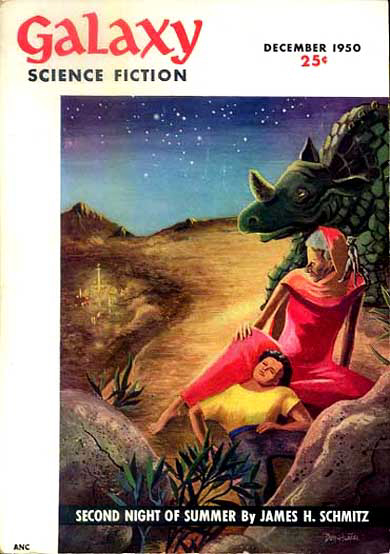
Galaxy Science Fiction, October 1950: A Retro-Review

Galaxy Science Fiction, October 1950: A Retro-Review

galaxy-october-1950-smallContinuing in my discovery of Galaxy magazine, I began reading the first issue, dated October 1950. I knew what I’d never see in Galaxy, and but what fiction would I discover within?

“Time Quarry” by Clifford D. Simak is the first of a three-part serial. I don’t see this done often with modern magazines, but it seems like back in the Fifties, novel serializations were part of the norm. I wonder how the rights and payment worked out for that, but I digress.

In Part 1, Asher Sutton returns to Earth after disappearing for twenty years on a space exploration mission to 61 Cygni. Little is known of the planet he landed on; no other ship can get near it due to unexplained anomalies. Since his return, Sutton has drawn attention, both from those who want information and those who want him dead.

“Third From the Sun” by Richard Matheson – A family plans to escape from a world on the brink of war. All they need to do is to take a spaceship for themselves and leave everyone but their closest neighbors behind.

Third From the Sun became the title of Matheson’s first paperback short story collection, published by Bantam Books in 1955.

“The Stars are the Styx” by Theodore Sturgeon – Mankind has the tools for creating vast inter-galactic travel, but it will take 6,000 years to set up the framework. Volunteers are sent (usually as married pairs) out to distant points within the galaxy, and when all are in place, they will create a connected network for instant transportation to each location.

Each person’s choice to go out or return to Earth is made at Curbstone, an Earth satellite run by a man sometimes referred to as Charon. Of the latest arrivals, Charon takes interest in Judson, a young man who seems certain to become Outbounder, provided he doesn’t get too distracted by those who are still undecided.

Read More Read More

Vintage Treasures: Hong on the Range by William F. Wu

Vintage Treasures: Hong on the Range by William F. Wu

hong-on-the-range4I admit this one doesn’t seem very vintage to me, but perhaps that’s just because I’m getting a little vintage myself.

William F. Wu’s fourth novel, Hong on the Range, was published 23 years ago. It was originally published in hardcover and has never had a paperback release.

And that’s too bad, since it’s the kind of off-the-wall science fantasy that I think would really appeal to a modern audience. Set in a post-apocalyptic American West where cities have decayed and the surviving towns cling to the railway, where most people have cyborg enhancements, meat is harvested from cows without harming them, and a young man named Louie — a “control-natural” forbidden by law from enhancing himself, and who is shunned and misunderstood by others — heads West to find his fortune.

The Old West Was Never This Wild! In a New West filled with cyber-enhanced cowboys and mechanized singing steers, Louie Hong must make his way through hostile territory filled with cattle rustlers and bank robbers, and a passel of cyborg bounty hunters who think he’s both! A story about coming of age in a strange and dangerous land where a young man’s most faithful friend may just turn out to be a computerized steer named Chuck.

While it’s the only novel in the sequence, Hong on the Range is part of a series of stories written by Wu that began in 1985 with “Wild Garlic.” Most of them were published in Pulphouse magazine; the last one, “In the Temple of Forgotten Spirits,” in 1993.

Hong on the Range was published by Walker & Co in 1989. It is 286 pages in hardcover. It has never had a paperback release, but it was re-released in a digital edition for $2.99 last October.

Hawkmoon Gets Some Respect With Tor Reprints

Hawkmoon Gets Some Respect With Tor Reprints

the-sword-of-the-dawn-smallIt’s good to see Michael Moorcock back in print in attractive accessible editions again. Thirty years ago the man ruled the paperback shelves with numerous titles in print, including half a dozen Elric novels, the Chronicles of Corum, the Jerry Cornelius books… and of course, Hawkmoon.

Moorcock is still in print, of course — but chiefly in expensive omnibus editions these days. You can’t ride your bike down to the corner store, spot a slender Moorcock paperback on the rack with a glorious Michael Whelan cover, shell out 95 cents, and cram that baby into your back pocket like you used to. (And if you can, listen to an old man and take that Hershey’s bar out of your pocket first. Trust me, you’ll thank me later.)

Anyway, my point is, those fat hardcover editions are great for cranky old collectors like me. But they don’t do much to introduce the man whom Michael Chabon called “The greatest writer of post-Tolkien British fantasy” to a new generation. Michael Moorcock deserves to be celebrated with permanent editions of his work, sure. But he should also be available in cheap paperbacks that teenagers can fold in half while they’re reading, mesmerized, on the back of the bus.

The era of the cheap paperback is over. But Tor did the next best thing two years ago, releasing all four Hawkmoon novels — The Jewel in the Skull, The Mad God’s Amulet, The Sword of the Dawn, and The Runestaff — in slender trade paperbacks with gorgeous new covers by Vance Kovacs. Now that all four have been remaindered (selling at Amazon for between $5.60 and $6.00 each, while supplies last), I took the opportunity to buy a complete set.

Collectively known as The History of the Runestaff, the novels follow the adventures of Dorian Hawkmoon — an aspect of Moorcock’s Eternal Champion — on a post-holocaust Earth as he travels a world of antique cities, scientific sorcery, and crystalline machines and is inexorably pulled into a war against the ruthless armies of Granbretan. Here’s the description for the first novel, The Jewel in the Skull:

Dorian Hawkmoon, the last Duke of Koln, swore to destroy the Dark Empire of Granbretan. But after his defeat and capture at the hands of the vast forces of the Empire. Hawkmoon becomes a puppet co-opted by his arch nemesis to infiltrate the last stronghold of rebellion against Granbretan, the small but powerful city of Kamarang. He’s been implanted with a black jewel, through whose power the Dark Empire can control his every decision. But in the city of Kamarang, Hawkmoon discovers the power inside him to overcome any control, and his vengeance against the Dark Empire is filled with an unrelenting fury.

The Hawkmoon novels were originally written between 1967 and 1969; the Tor reprints were published between January and December of 2010. Roughly 200 – 220 pages each, their original cover price was $14 – $15; they are currently much less. Move quickly if you want copies; they are selling fast.